

Table of Contents
To understand what is a Golden Retriever, look to a medium-to-large sporting dog breed originating from 19th-century Scotland, renowned for its dense water-repellent golden coat, friendly temperament, high intelligence, and gentle mouth originally bred to retrieve waterfowl. Standing 21.5 to 24 inches tall and weighing 55 to 75 pounds, Golden Retrievers are among the world's most popular family companions, service dogs, and therapy animals.
- Classified in the AKC Sporting Group and The Kennel Club Gundog Group, developed by Lord Tweedmouth at Guisachan, Scotland.
- Recognizable by a lush double coat in shades of gold, requiring regular brushing to manage moderate-to-heavy seasonal shedding.
- Known for an eager-to-please, affectionate personality, exceptional compatibility with children, and high sociability.
- Requires at least 2 hours of daily physical exercise and mental enrichment to thrive.
- Golden puppies undergo an active, mouthy developmental phase before settling into their calm adult disposition as they mature.
The Golden Retriever stands among the most celebrated canine companions in modern history, combining exceptional intelligence with an affectionate, trustworthy nature. Whether working alongside search-and-rescue teams, serving as guide dogs for individuals with disabilities, or playing in suburban backyards, this Scottish sporting breed has earned international devotion through its versatile working ability and gentle family loyalty.
What Is a Golden: Breed Identity and Origins
A Golden Retriever (often simply called a Golden) is a purebred gundog developed in the Scottish Highlands during the late 19th century. The breed was created to retrieve shot upland game birds and waterfowl on both land and water without damaging the quarry.
The foundation of the breed began with Sir Dudley Marjoribanks (later known as Lord Tweedmouth) at his Guisachan estate in Inverness-shire, Scotland. During the Victorian era, hunting wildfowl became increasingly popular among the British gentry, but existing retrievers struggled with the rugged Scottish terrain and icy lochs. According to The Kennel Club breed standard, Lord Tweedmouth crossed a yellow wavy-coated retriever named Nous with a Tweed Water Spaniel named Belle in 1868. Subsequent breeding incorporated Irish Setters, Bloodhounds, and additional water spaniels to refine scenting ability, physical stamina, and a gentle temperament.
Readers curious about the geographical roots and estate records can explore the detailed history of where Golden Retrievers are from to see how Scottish working lineages developed. While Scottish gundogs were selected for physical endurance across rugged highlands, examining what French Bulldogs were bred for demonstrates an entirely different urban companion trajectory during the same Victorian industrial era.
The Kennel Club in the United Kingdom officially recognized the Golden Retriever as a distinct breed in 1913, followed by the American Kennel Club in 1925.
| Breed Trait | Official Breed Standard Specification |
|---|---|
| Origin | Scottish Highlands, United Kingdom (1868) |
| Breed Group | Sporting Group (AKC) / Gundog Group (The Kennel Club) |
| Adult Male Height | 23 to 24 inches (58 to 61 cm) |
| Adult Female Height | 21.5 to 22.5 inches (55 to 57 cm) |
| Adult Male Weight | 65 to 75 pounds (29 to 34 kg) |
| Adult Female Weight | 55 to 65 pounds (25 to 29 kg) |
| Coat Type | Dense, water-repellent double coat with feathering |
| Coat Colors | Light Golden, Golden, Dark Golden |
| Average Lifespan | 10 to 12 years |
What Golden Retriever Traits Define the Breed Standard?
Official breed standards describe the Golden Retriever as a symmetrical, powerful, and active dog with a sound, balanced movement. The head features a broad skull, a well-defined stop, dark brown or hazel eyes set widely apart, and medium-sized ears that drop close to the cheeks. The muzzle is straight and strong, meeting in a perfect scissors bite where the upper incisors closely overlap the lower teeth.
According to the American Kennel Club, male Golden Retrievers measure 23 to 24 inches at the withers and weigh between 65 and 75 pounds, while females measure 21.5 to 22.5 inches and weigh between 55 and 65 pounds. Understanding what breed classification a Golden Retriever belongs to helps clarify why their skeletal frame is built for endurance, running, and swimming rather than short sprinting bursts.
The Golden Retriever’s athletic, balanced silhouette with a broad muzzle and moderate stop contrasts sharply with compact brachycephalic profiles, such as what a Pug dog looks like with its deeply wrinkled forehead and shortened facial bones.
The double coat consists of an outer coat of resilient, water-repellent guard hairs that lie flat or wavy against the body, supported by a dense undercoat providing insulation in cold water. Moderate feathering covers the back of the front legs, underbody, chest, thighs, and the underside of the tail. Standard coat shades range across light golden, golden, and dark golden hues. Extreme pale white or mahogany red coats fall outside conformation show ring standards, though mahogany tones frequently appear in working lines such as field Golden Retrievers bred specifically for field trials and hunting drive.
What Is the Golden Retriever Temperament and Personality?
The Golden Retriever temperament is defined by a friendly, reliable, and eager-to-please nature. Goldens are naturally gregarious dogs that form deep social bonds with their human handlers, displaying high biddability and enthusiasm for cooperative tasks.
In canine intelligence assessments, the Golden Retriever ranks as the fourth smartest dog breed, demonstrating the ability to learn new commands in fewer than five repetitions and obeying known commands on the first cue at least 95 percent of the time. This cognitive capacity pairs with their instinctual “soft mouth,” a trait bred into gundogs so they could carry shot game without leaving tooth marks. Consequently, many Goldens show an endearing habit of greeting family members with a favorite toy, shoe, or tennis ball held gently in their jaws.
Unlike toy companions classified primarily for quiet lap companionship, such as what type of dog a Pug is, a Golden Retriever possesses an innate working drive that requires daily cognitive tasks. This active retrieving drive stands apart from ancient royal lapdogs, where reviewing what Pugs were bred for in imperial Chinese courts highlights centuries of selection focused purely on human lap warming rather than physical fieldwork.
Because they lack suspiciousness or territorial aggression, Golden Retrievers excel in service and therapy roles. They serve worldwide as guide dogs for the blind, medical alert dogs for diabetic patients, mobility assistance partners, and search-and-rescue trackers. The Golden Retriever’s intense social orientation means isolation can lead to distress. Without regular human interaction and daily mental jobs, prolonged boredom may manifest as chewing furniture, digging, or persistent barking.
What About Golden Retrievers and Family Life?
Golden Retrievers are widely regarded as quintessential family dogs because they integrate effortlessly into multi-generational households. Their tolerant disposition makes them forgiving of household noise, visitor traffic, and the busy routines of active homes.
While they make excellent watchdogs that bark to alert owners when someone approaches the front door, they make poor property protection guard dogs. A Golden Retriever is far more likely to welcome an intruder with a wagging tail and a dropped toy than to mount an aggressive defense.
In multi-pet homes, Goldens typically establish peaceful relationships with other dogs and can live harmoniously with large indoor felines, such as what a Maine Coon cat is sharing family living spaces, provided proper introductions occur.
Are Golden Retrievers Good With Children and Other Pets?
Golden Retrievers exhibit remarkable patience and playful affection around children. Their sturdy build allows them to participate safely in outdoor games like fetch, soccer, and swimming without being easily injured during rough-and-tumble play.
Early puppy socialization during key developmental windows is essential to build positive associations with novel sights, sounds, children of various ages, and docile companion animals like what a Ragdoll cat is when integrating cats into the household. Parents should also teach young children basic boundaries, ensuring they do not disturb a sleeping dog or grab ears and tails during play sessions.
Do Golden Retrievers Shed and How Much Grooming Is Required?
Golden Retrievers are moderate-to-heavy shedders throughout the entire year and experience heavy seasonal shedding (commonly known as “blowing coat”) twice annually during the spring and autumn months. Managing this coat requires a dedicated weekly grooming routine.
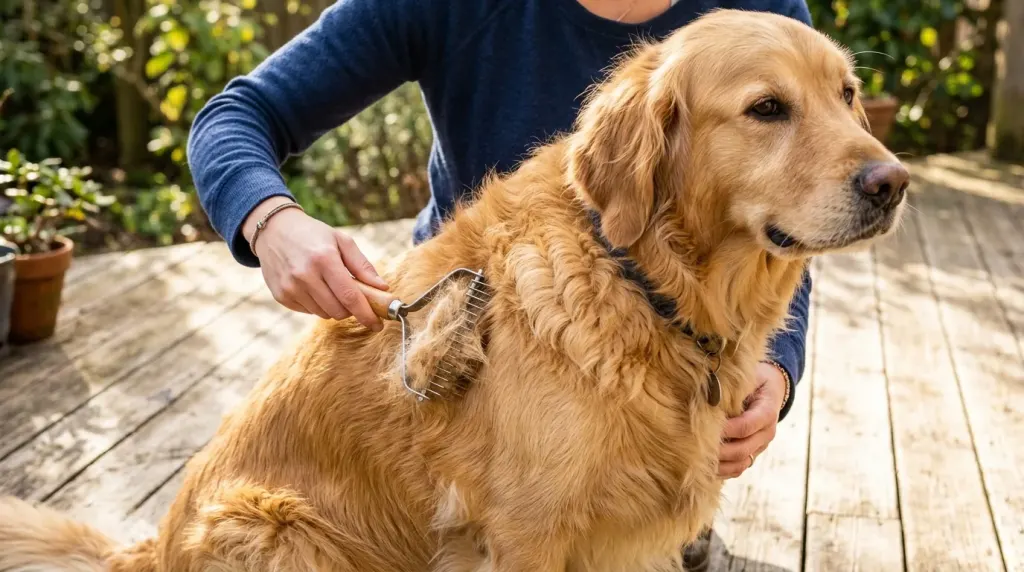
The double coat functions as a protective shield against weather extremes. The undercoat traps warm air during winter and insulates against ambient heat in summer, while the oily outer coat sheds water, dirt, and burrs.
| Grooming Task | Frequency | Recommended Tool | Primary Purpose |
|---|---|---|---|
| Undercoat Raking | 2 to 3 times weekly | Undercoat Rake | Removes dead undercoat and prevents matting |
| Surface Brushing | 3 to 4 times weekly | Slicker / Pin Brush | Smooths outer coat and distributes natural oils |
| Bathing | Every 4 to 6 weeks | Dog-Formulated Shampoo | Cleans dirt without stripping protective skin oils |
| Ear Cleaning | Weekly & after swimming | Veterinary Ear Cleaner | Cleans moisture from folded ear canals to prevent otitis |
| Nail Trimming | Every 3 to 4 weeks | Guillotine Clippers / Grinder | Prevents splayed toes and postural strain |
| Dental Care | Daily or 3 times weekly | Enzymatic Dog Toothpaste | Prevents plaque buildup and periodontal disease |
Pairing cooperative brushing sessions with healthy, low-calorie rewards, such as offering sliced apples or blueberries outlined in guides on safe fruit choices for dogs, creates positive associations with regular coat care. Pet owners managing mixed-species households often balance canine grooming routines with feline coat maintenance, such as understanding what a Mink Ragdoll cat is with its distinct plush, silky fur texture.
Because the breed has drop ears that fold over the ear canal, moisture and humidity easily get trapped inside. Regular cleaning with a veterinarian-approved ear wash after every swimming session prevents bacterial and yeast infections.
Note: Never shave a Golden Retriever’s double coat during hot summer months. Shaving strips the dog of natural sun protection, increases the risk of heat stroke, and may permanently damage follicle regrowth.
Exercise, Training, and Energy Needs
The Golden Retriever is an athletic sporting breed requiring substantial daily physical exertion and mental engagement to maintain cardiovascular health, joint mobility, and emotional balance.
According to PDSA canine health guidelines, adult Golden Retrievers require at least 2 hours of daily physical exercise. A brief 15-minute walk around the block is insufficient for this energetic retriever. An ideal exercise routine combines brisk leashed walking, off-leash running in secure areas, interactive retrieval games, and swimming sessions. Incorporating structured activities into routine dog care and wellness ensures that the dog’s innate working instincts are channeled constructively.
Maintaining optimal caloric intake and portion control is vital for high-energy retrievers to fuel intense activity without causing excess weight gain, contrasting with lower-calorie dietary plans seen in what Pugs eat to prevent obesity in sedentary toy breeds.
Mental enrichment is equally critical. Puzzle feeders, scent tracking games, agility training, and ongoing obedience drills prevent the cognitive boredom that frequently triggers destructive behavior.
Does Golden Retriever Energy Level Fit Apartment Living?
A Golden Retriever can adapt to apartment living, but only if the owner is fully committed to providing the requisite 2 hours of rigorous outdoor exercise each day regardless of weather conditions.
Without a private fenced yard for spontaneous exercise, apartment owners must schedule multiple long walks, park trips, and interactive play sessions daily. When daily physical outlets are neglected in confined apartment spaces, energetic dogs may display hyperactivity or restlessness, reflecting why dogs pace and struggle to settle down when physical energy remains unspent.
Raising a Golden Puppy: Early Growth and Training
Raising a Golden Retriever puppy is a rewarding yet demanding process that sets the foundation for lifelong temperament and physical soundness. Prospective owners should prepare for an active, highly oral puppy stage that lasts through early adolescence.

During the first several months, Golden puppies explore their environment primarily through their mouths. This teething phase requires consistent redirection to safe chew toys, rubber bones, and frozen teething rings, paired with early bite inhibition training to teach the puppy how to control its jaw pressure.
| Puppy Age Range | Developmental Focus | Exercise Guideline | Key Milestone |
|---|---|---|---|
| 8 to 12 Weeks | Crate training, housebreaking, bite inhibition | 10 to 15 minutes of gentle backyard play | Introduction to basic cues (Sit, Come) |
| 3 to 6 Months | Leash manners, public socialization | 15 to 30 minutes of low-impact walking | Teething management and puppy obedience class |
| 6 to 12 Months | Adolescent boundary testing, recall reliability | 30 to 45 minutes of walking and swimming | Growth plate development; avoid high-impact jumping |
| 12 to 24 Months | Advanced obedience, endurance building | 60 to 90 minutes of structured daily activity | Transition to adult coat and physical maturity |
Establishing a secure sleeping area through crate training accelerates housebreaking and prevents destructive chewing, using principles similar to selecting the right crate size for small dogs to ensure the animal can comfortably stand, turn, and lie down.
During positive reinforcement training sessions, handlers should observe subtle canine body language, including understanding why dogs pull their ears back to differentiate between appeasement, relaxation, and stress.
To protect developing musculoskeletal structures, owners should keep structured leashed walks brief and gentle, increasing duration gradually as the puppy grows until growth plates fully close in young adulthood. Avoiding repetitive jumping on hard surfaces, agility hurdles, or long jogging runs protects against developmental joint dysplasia.
When Do Golden Retrievers Mature and Calm Down?
While Golden Retrievers achieve their adult physical stature well before emotional maturity, behavioral development develops more gradually. Many Goldens maintain an enthusiastic, puppy-like demeanor well into early adulthood before settling into their calm, dependable adult disposition.
During the adolescent phase, young dogs often test household boundaries and experience temporary surges in boundless energy. Consistent positive reinforcement training, clear daily routines, and adequate physical exercise help owners navigate this transitional period until the dog matures.
Is a Golden Retriever Right for You? (Distinct Breed Evaluation)
Choosing a Golden Retriever requires an honest assessment of your daily lifestyle, living environment, and available time for grooming and exercise.
| Ideal Household Match | Challenging Household Match |
|---|---|
| Active individuals, runners, hikers, and outdoor lovers | Sedentary households with limited time for outdoor recreation |
| Families seeking a patient, social playmate for children | Owners away from home for 10 or more hours daily |
| Owners willing to brush a double coat several times weekly | People seeking a low-maintenance, non-shedding, or hypoallergenic pet |
| Homes committed to positive reinforcement obedience training | Households seeking a fierce, protective guard dog |
| Households with a secure, fenced yard for daily fetch | Pristine housekeepers intolerant of stray dog fur on furniture |
When comparing sporting companions, comparing a Golden with a Labrador Retriever breed profile shows that while both share friendly temperaments and retrieving heritage, Goldens have longer coats requiring more frequent brushing, whereas Labradors feature shorter, denser coats with a slightly more exuberant play style.
Prospective pet owners who prefer a low-energy indoor companion requiring minimal daily exercise may find that researching what a French Bulldog is offers a more suitable match for apartment or sedentary lifestyles. Furthermore, while large sporting retrievers require joint precautions against hip dysplasia, chondrodystrophic companion breeds face different spinal vulnerabilities, such as intervertebral disc disease (IVDD) in dogs that necessitate specialized lifestyle modifications.
Frequently Asked Questions About Golden Retrievers
How long do Golden Retrievers live?
A Golden Retriever generally lives around a decade or longer when provided with high-quality nutrition, regular exercise, weight management, and attentive preventive veterinary care throughout life.
Are Golden Retrievers easy to train?
Yes, Golden Retrievers rank among the easiest dog breeds to train due to their high working intelligence, natural biddability, and intense desire to please their human handlers during positive reinforcement training.
What is the difference between a Golden Retriever and a Labrador Retriever?
While both are sporting gundogs originating from British working lines, Golden Retrievers possess a longer double coat with feathering on the legs and tail, whereas Labrador Retrievers have a short, dense coat and a broader, heavier otter tail.
How much does a Golden Retriever cost?
A purebred Golden Retriever puppy from a reputable, health-testing breeder typically costs between $1,500 and $3,000, with ongoing annual expenses for quality dog food, routine veterinary exams, grooming supplies, and preventatives averaging $1,200 to $2,000.



Leave a Reply