

Table of Contents
When asking what breed is a Golden Retriever, it is classified as a medium-to-large purebred gundog in the Sporting Group by the American Kennel Club (AKC) and the Gundog Group by international kennel registries. Developed in 19th-century Scotland by Lord Tweedmouth to retrieve waterfowl on land and in water, the breed is defined by a dense, water-repellent double coat, an athletic build, exceptional intelligence, and a gentle, biddable temperament.
- Classified as a sporting gundog originally bred by crossbreeding a yellow retriever with the now-extinct Tweed Water Spaniel in 1868.
- Characterized by a dense, water-repellent double coat producing golden shades ranging from pale cream to rich amber.
- Diverges into three regional standards (British, American, and Canadian) and two primary functional lineages (Field Golden vs. Show Golden).
- Requires consistent physical activity (60 to 120 minutes daily), structured mental enrichment, and proactive screening for joint dysplasia and cardiac conditions.
Understanding what breed a Golden Retriever is begins with recognizing its dual legacy as a capable sporting dog and a devoted family companion. While companion dogs such as what type of dog is a pug were created specifically for indoor lap companionship, the Golden Retriever was engineered for rugged outdoor athletic performance. Known formally as the Golden Retriever, this breed combines physical strength, keen scenting ability, and a soft mouth designed to carry game gently without causing damage.
What Breed is a Golden Retriever? Classification and Breed Profile
Taxonomically, the Golden Retriever is a purebred member of the domestic dog species (Canis lupus familiaris), categorized formally by major kennel clubs into working sporting groups. The American Kennel Club officially admitted the breed to its studbook in November 1925 under the Sporting Group, whereas the Kennel Club in the United Kingdom places it within the Gundog Group. Unlike non-sporting companion breeds such as what is a French Bulldog, sporting retrievers are bred to work alongside human handlers in open fields, marshes, and dense brush.

Physical Conformation and Breed Standard
A purebred Golden Retriever exhibits a balanced, symmetrical, and powerful physique. The head features a broad skull with a well-defined stop, straight muzzle, dark nose, and kind, intelligent eyes that convey alertness and warmth. The ears are moderate in length, set roughly level with or slightly above the eyes, and hang close to the cheeks.
The official physical dimensions established by standard registry guidelines include:
- Height at Withers (Males): 23 to 24 inches (58 to 61 cm).
- Height at Withers (Females): 21.5 to 22.5 inches (55 to 57 cm).
- Weight (Males): 65 to 75 pounds (29.5 to 34 kg).
- Weight (Females): 55 to 65 pounds (25 to 29.5 kg).
- Coat Texture: Dense, resilient, water-repellent outer coat over a protective insulating undercoat, featuring moderate feathering on the neck, thighs, undercarriage, and tail.
| Breed Metric | Male Standard | Female Standard | Functional Purpose |
|---|---|---|---|
| Height at Withers | 23 to 24 inches | 21.5 to 22.5 inches | Provides stride length and clearance over wetland terrain |
| Body Weight | 65 to 75 pounds | 55 to 65 pounds | Maintains muscle mass for carrying heavy waterfowl |
| Coat Structure | Double coat with water-shedding guard hairs | Double coat with water-shedding guard hairs | Insulates core body temperature in freezing water |
| Bite & Jaws | Scissor bite with broad muzzle | Scissor bite with broad muzzle | Enables soft-mouthed carrying without crushing game |
Temperament and Behavioral Drive
A defining trait of the Golden Retriever is its biddable, trustworthy, and eager-to-please temperament. Bred to take directional hand and whistle signals from handlers across vast distances, they possess high trainability and strong working drive. The Golden Retriever’s working drive and daily care needs call for regular mental engagement, retrieving games, and structured task work. In a domestic setting, this translates into a social, friendly demeanor with negligible natural aggression, making them popular choices for therapy work, search and rescue, and assistance tasks.
Breed History: From Guisachan Estate to Global Recognition
The origin of the Golden Retriever was obscured for decades by romantic folklore. A popular myth in the early 20th century suggested that the breed descended from a troupe of Russian circus sheepdogs purchased in Brighton by an English nobleman. Detailed historical scholarship and the preservation of original kennel studbooks have thoroughly debunked this story, revealing a Scottish breeding program based on deliberate functional selection.
Dudley Marjoribanks and the Guisachan Breeding Program
The true history of the breed began between 1835 and 1890 at the Guisachan estate in Glen Affric near Inverness-shire, Scotland. Dudley Marjoribanks, later titled the first Baron Tweedmouth, sought to develop the ultimate retriever capable of navigating thick Scottish heather, upland terrain, and icy rivers. During the mid-Victorian era, hunting shotguns had improved significantly, allowing hunters to bring down game birds at greater distances across challenging waterways where older pointer and setter breeds struggled to retrieve fallen birds.
In 1865, Marjoribanks acquired a unique yellow, wavy-coated retriever named “Nous” from a cobbler in Brighton. Nous was the sole yellow puppy in an otherwise black litter bred by Lord Chichester. In 1868, Marjoribanks mated Nous to “Belle”, a Tweed Water Spaniel. The Tweed Water Spaniel, now extinct, was a liver-colored, curly-coated working water dog known for exceptional stamina, intelligence, and swimming agility along the River Tweed border region.
Lord Tweedmouth’s handwritten kennel records provide an unbroken lineage for the Golden Retriever. The initial pairing of Nous and Belle in 1868 produced four yellow female puppies named Crocus, Primrose, Cowslip, and Ada. These foundational puppies formed the genetic bedrock of the entire Golden Retriever breed.
Integration of Secondary Breeds
To refine hunting drive, scenting capacity, bone density, and coat resilience, Marjoribanks selectively introduced specific breeds into subsequent generations:
- Red Setter (Irish Setter): Introduced to enhance speed, scenting range, and intense hunting drive.
- Sandy Bloodhound: Infused to provide superior tracking ability through heavy brush and add substantive bone structure.
- St. John’s Water Dog of Newfoundland: Added to instill remarkable swimming endurance, water resistance, and an instinctive retrieving drive.
- Black Wavy-Coated and Flat-Coated Retrievers: Crossed periodically to maintain athletic body proportions and coat texture.
The development of the Golden Retriever relied on crossing distinct sporting breeds to optimize scenting ability, swimming power, and retrieving drive. By retaining only yellow and golden offspring that demonstrated superior retrieving aptitude, Tweedmouth established a consistent lineage. The Kennel Club (UK) officially recognized the variety as “Retriever (Golden and Yellow)” in 1911, before finalizing the name as “Retriever (Golden)” in 1920.
Coat Color Genetics and Physical Characteristics in Golden Retrievers
The Golden Retriever’s coat is its most defining physical asset, functioning as protective armor against inclement weather, cold water, and abrasive vegetation. The coloration is governed by a precise genetic mechanism that dictates pigment synthesis at the cellular level.
The Recessive Red (e/e) Genetic Mechanism
Canine coat colors are driven primarily by two pigment types produced by melanocytes: eumelanin (black or brown pigment) and phaeomelanin (red, yellow, or cream pigment). According to canine coat color research from the UC Davis Veterinary Genetics Laboratory, coat color in the Golden Retriever is fixed by the recessive red genotype, designated as e/e at the Extension (E) locus (MC1R gene).
When a dog inherits two copies of the recessive e allele, the melanocyte-stimulating hormone receptor is disabled in the hair follicle cells. This cellular switch prevents the hair follicles from producing black eumelanin, forcing them to produce only phaeomelanin. As a consequence:
- Every purebred Golden Retriever is genetically incapable of producing black hair shafts on its body.
- The intensity of the coat (ranging from light cream to deep red-gold) is regulated by independent polygenic intensity genes that control the concentration of phaeomelanin within the hair shaft.
- Dark golden, rich golden, and light golden shades are natural variations of the same underlying genetic mechanism.
Pigmentation of Skin, Eyes, and Mucous Membranes
Although the e/e genotype blocks eumelanin in the hair coat, it does not prevent eumelanin production in the skin and mucous membranes. The B locus (TYRP1 gene) remains homozygous dominant (B/B) in standard Golden Retrievers, directing the production of rich black pigment on the nose leather, eye rims, lips, and foot pads.
Evaluating facial pigmentation and head contours is an important part of canine breed identification, similar to assessing what a French Bulldog looks like through its flat skull and distinctive facial folds. Unlike smooth-coated companion breeds where owners evaluate what a pug dog looks like with its short single or double coat, the Golden Retriever carries a heavy, weather-resistant double coat with protective guard hairs and an insulating undercoat. In Golden Retrievers, a common seasonal phenomenon known as “snow nose” (or winter nose) occurs when the enzyme tyrosinase, which synthesizes melanin, breaks down in cold temperatures. This causes the central portion of a black nose to fade temporarily to pink or light brown during winter months before darkening again in summer.
| Genetic Locus | Gene & Allele Status | Biological Function | Phenotypic Expression in Golden Retrievers |
|---|---|---|---|
| Extension (E) Locus | MC1R fixed at e/e | Blocks follicular eumelanin synthesis | Produces golden, amber, or cream coat shades exclusively |
| Intensity Modifiers | Polygenic complexes | Modulates phaeomelanin saturation | Dictates range from pale cream to deep copper gold |
| Brown (B) Locus | TYRP1 fixed at B/B | Controls black melanin synthesis in skin | Preserves black pigment on nose, eye rims, lips, and pads |
Comparing Golden Retriever Varieties: British vs. American vs. Canadian
While all Golden Retrievers belong to a single unified breed, geographic isolation and differing kennel club standards have created three distinct regional varieties. Breeders adhering to The Royal Kennel Club in the United Kingdom, the American Kennel Club in the United States, or the Canadian Kennel Club in Canada emphasize slightly different conformational traits.
These geographic adaptations reflect how regional kennel clubs prioritize specific conformational qualities, just as learning what French Bulldogs were bred for explains how working toy bulldogs transformed into urban companion standards. Managing the nutritional balance of a heavy-boned gundog is critical for joint longevity, just as learning what French Bulldogs can eat helps owners prevent obesity and digestive strain in compact breeds.
British (English) Golden Retriever
The British type, frequently referred to in commercial circles as the English Cream Golden Retriever, conforms to the UK and Federation Cynologique Internationale (FCI) standards. Key traits include:
- Skull and Muzzle: A broader, more chisel-shaped skull with a deeper stop and slightly wider muzzle.
- Eyes: Dark, round eyes positioned on a level horizontal plane.
- Build: Shorter legs, heavier bone density, and a deep, well-sprung rib cage resulting in a stockier, level-backed silhouette.
- Coat Color: Accepts very pale shades, including cream and light platinum gold, alongside classic gold.
American Golden Retriever
The American type adheres to the AKC breed standard, prioritizing a fluid, athletic stride with a refined outline:
- Skull and Muzzle: Slightly narrower head with a more subtle stop and cleaner taper toward the nose.
- Eyes: Slanted, triangular or slightly almond-shaped dark eyes with dark rims.
- Build: Taller and more slender than the British line, featuring a moderate slope from the withers to the croup.
- Coat Color: Warm, rich golden shades ranging from light gold to deep lustrous gold. The AKC standard considers pale cream or excessively dark red coats to be undesirable in show conformation.
Canadian Golden Retriever
The Canadian variety reflects a blend of early British imports and American working lines:
- Build: Taller, leggy proportions with an athletic, muscular frame that stands slightly taller at the withers than the American average.
- Coat Texture: Typically thinner and less dense than British show lines, with lighter feathering designed for practical field retrieval.
- Coat Color: Medium golden tones, rarely exhibiting the pale cream of British lines or the rich dark hues of American field lines.
| Attribute | British (English) Type | American Type | Canadian Type |
|---|---|---|---|
| Primary Standard | The Royal Kennel Club / FCI | American Kennel Club (AKC) | Canadian Kennel Club (CKC) |
| Head Shape | Broad, blocky with deep stop | Moderate width, clean chisel | Lean, moderate broad skull |
| Eye Shape & Set | Round, set level | Almond to triangular, slightly slanted | Dark, medium round set |
| Body Frame | Heavy bone, deep chest, level back | Athletic, moderate bone, slight slope | Tall, rangy, muscular build |
| Accepted Colors | Cream, light gold, rich gold | Light gold, classic gold, dark gold | Golden shades, medium gold |
Field Golden vs. Show Golden: Working Lines Compared to Conformation Lines
Beyond geographic differences, the most profound division within the Golden Retriever breed is between working field lines (Field Golden) and conformation show lines (Show Golden). This functional split mirrors the working-versus-companion divergence seen in other sporting breeds such as the Labrador Retriever.
Conformation and Physical Differences
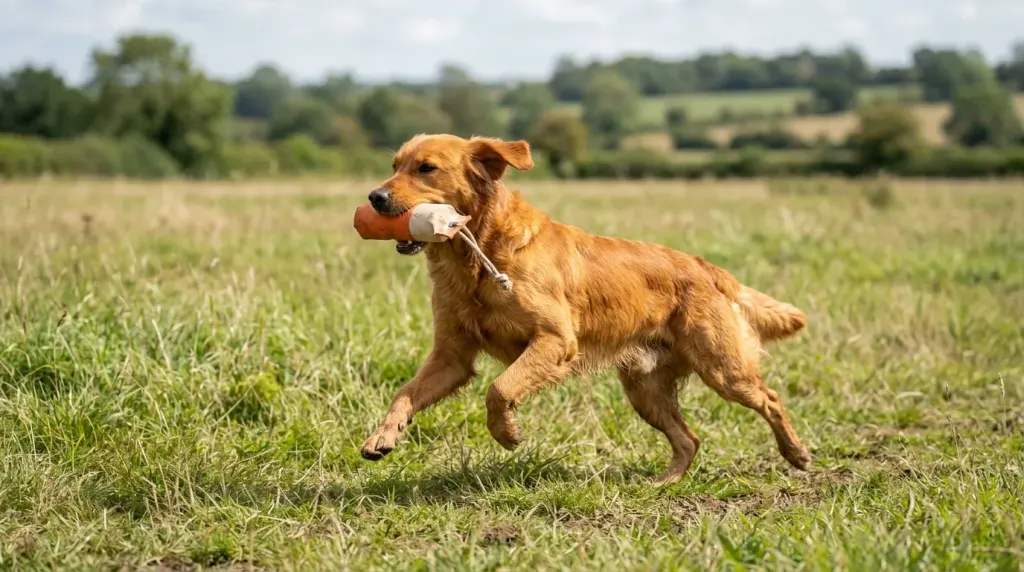
Field-bred Golden Retrievers are bred specifically for field trials, hunting tests, and actual waterfowl retrieval. Consequently, physical selection favors speed, agility, and stamina over cosmetic symmetry:
- Structure: Field Goldens are noticeably lighter, leaner, and more compact, often weighing 50 to 65 pounds. They possess longer legs, narrower chests, and a streamlined skull.
- Coat: Their coat is shorter, coarser, and possesses minimal decorative feathering on the legs and tail to prevent burs and debris from tangling during field work. Coat colors lean toward dark gold, amber, and deep copper-red.
- Show Goldens: In contrast, show-line Goldens feature heavier bone structures, broad heads, pronounced chest development, and long, luxurious coats with extensive feathering in shades of pale to medium gold.
Energy Levels and Daily Management
The difference in drive between these two lines influences their suitability for different households:
- Field Goldens: Possess an intense prey drive, boundless stamina, and a relentless desire to work. They require 90 to 120 minutes of vigorous daily exercise coupled with structured mental tasks like agility, scent work, or advanced obedience. Without adequate physical and mental outlets, they can develop destructive chewing or hyperactivity.
- Show Goldens: While still active sporting dogs requiring 60 to 90 minutes of daily activity, show-line Goldens typically display a calmer, more laid-back demeanor indoors, making them easier to manage for average companion homes.
The divergence between Field and Show Golden Retrievers demonstrates how selective breeding can alter energy profiles and physical traits within the same genetic registry. Prospective owners should assess their own daily activity levels before choosing between a high-drive working line and a moderate-drive show line.
When setting up living spaces and crate training for sporting retrievers, sizing requirements differ substantially from smaller breeds. While selecting what size crate for a French Bulldog typically involves compact 24-inch or 30-inch enclosures, an adult Golden Retriever requires a spacious 42-inch or 48-inch crate to accommodate its standing height and body length. Under-exercised field retrievers often display restlessness and pacing, differing from canine medical concerns like what causes a pug to keep moving and not lay down where discomfort or pain causes continuous movement.
According to exercise guidelines from the PDSA, adult Golden Retrievers require a minimum of two hours of daily exercise, including active running, retrieving games, and swimming opportunities, to maintain cardiovascular health and prevent behavioral stress.
Health Profile and Recommended Screenings for Golden Retrievers
The Golden Retriever is generally a sturdy, athletic breed with an average lifespan of 10 to 12 years. However, high historical popularity and intensive selective breeding have concentrated several hereditary health vulnerabilities that responsible owners and breeders must monitor.
Cancer Prevalence and Common Neoplastic Conditions
Cancer represents a significant health concern across the purebred Golden Retriever population, with high rates of neoplastic disease documented in veterinary medicine. Among these conditions, hemangiosarcoma (a malignant cancer of vascular endothelial cells) is a particularly serious diagnosis. According to veterinary oncology research from the Cornell University College of Veterinary Medicine Riney Canine Health Center, hemangiosarcoma develops rapidly and silently, most commonly targeting the spleen, heart (right atrium), and liver. Other common neoplastic diseases affecting the breed include lymphoma, mast cell tumors, and osteosarcoma.
Orthopedic and Joint Conditions
Because Golden Retrievers are active, medium-to-large sporting dogs, their rapid skeletal growth puts stress on weight-bearing joints:
- Hip Dysplasia: Malformation of the coxofemoral ball-and-socket joint, leading to cartilage wear, joint laxity, and painful osteoarthritis.
- Elbow Dysplasia: Developmental abnormalities in the elbow joint complex, including fragmented coronoid process (FCP) and ununited anconeal process (UAP).
While dwarf and compact breeds face vertebral vulnerabilities such as what is IVDD in French Bulldogs, Golden Retrievers primarily require radiographic joint evaluations for hip and elbow dysplasia through the Orthopedic Foundation for Animals (OFA) or the PennHIP method prior to breeding.
Ophthalmic and Cardiac Screenings
- Subvalvular Aortic Stenosis (SAS): A congenital heart defect characterized by a fibrous ring below the aortic valve that obstructs blood flow from the left ventricle into the aorta. Breeding stock must be screened via cardiac auscultation and echocardiogram by a board-certified veterinary cardiologist.
- Progressive Retinal Atrophy (PRA): Inherited degenerative diseases of the retinal photoreceptor cells (including prcd-PRA, PRA1, and PRA2 mutations) that lead to gradual blindness. Annual eye exams by a board-certified veterinary ophthalmologist and commercial DNA testing panels are standard protocols.
Note: Prospective puppy buyers should always request documented proof of official parent health clearances, including OFA or PennHIP hip scores, OFA elbow clearance, veterinary cardiologist clearance, and annual CAER ophthalmologist evaluations.
Frequently Asked Questions About Golden Retrievers
Is a Golden Retriever a purebred dog?
Yes, the Golden Retriever is a recognized purebred dog breed officially registered with major international kennel clubs, including the American Kennel Club (AKC) since 1925 and The Royal Kennel Club (UK) since 1913. Every purebred Golden traces its lineage back to documented studbooks originating at the Guisachan estate in Scotland.
Are there different types of Golden Retrievers?
Yes, the breed encompasses three distinct geographic conformation styles (British, American, and Canadian) and two primary working lines (Field Golden and Show Golden). While all share the same breed registry, they differ in bone density, head shape, coat color intensity, and athletic energy drive.
Can a purebred Golden Retriever have a black coat?
No, a purebred Golden Retriever cannot have a black coat. Genetically, the breed carries recessive red pigmentation traits that prevent hair follicles from producing black pigment in the coat, restricting the coat exclusively to golden, amber, or cream shades. Any dog resembling a Golden Retriever with a solid black coat is typically a Flat-Coated Retriever, a black Labrador mix, or another crossbreed.
What is the difference between a Field Golden and a Show Golden?
Field Goldens are bred for hunting trials and athletic performance, featuring a leaner body, shorter red-to-amber coat, and high working drive. Show Goldens are bred to conform to breed ring aesthetic standards, featuring heavier bone structures, broader blocky heads, luxurious golden-to-cream coats, and calmer temperaments.


Leave a Reply