

Table of Contents
What were French Bulldogs bred for? Originally, French Bulldogs were bred in the mid-19th century as small companion pets and lap warmers for English textile artisans, specifically lace workers in Nottingham. During the Industrial Revolution, displaced lacemakers migrated to northern France, bringing these toy bulldogs with them. In and around Paris, breeders crossed them with local terrier breeds, refining a compact companion dog with upright bat ears and a calm temperament designed specifically for indoor living.
- The breed originated from miniature English Toy Bulldogs created in the early 1800s after bull-baiting was outlawed in Britain in 1835.
- Nottingham lace workers kept toy bulldogs on their laps for warmth in drafty workshops and occasionally to deter small pests.
- English artisans moving to Normandy and Paris in the 1850s and 1860s brought these dogs, where French breeders refined the Bouledogue Francais.
- American fanciers in the late 1890s preserved the signature upright bat ear standard over the English rose ear.
- French Bulldogs were never bred for fighting or hunting; their selective breeding focused exclusively on human companionship and quiet house manners.
Origins and early context of the breed
To understand the historical purpose of the French Bulldog, one must look at the transformation of British working dogs during the early Victorian period. Before the Cruelty to Animals Act of 1835 outlawed bull-baiting across the United Kingdom, traditional bulldogs were athletic, heavy-set dogs bred for blood sports. Once bull-baiting ceased, canine enthusiasts began redirecting bulldog breeding toward companionship, creating smaller, lighter varieties often referred to as miniature or toy bulldogs.
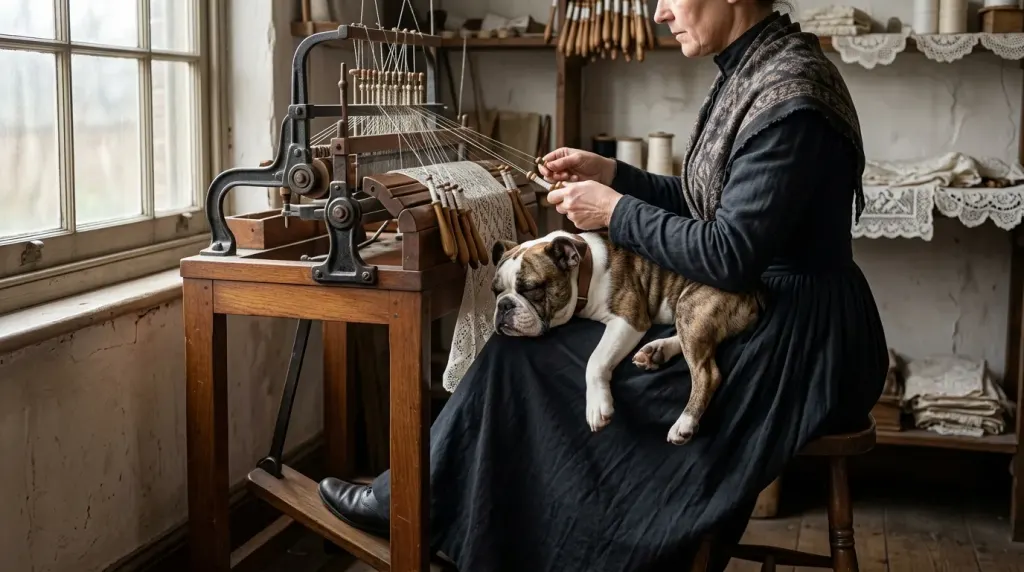
By the 1850s, these compact bulldogs, typically weighing between 12 and 25 pounds, gained strong popularity in the English Midlands, particularly in Nottingham. Artisans working in the lace-making trade favored these small dogs because their gentle disposition and manageable size fit inside cramped worker cottages. When exploring what defines a French Bulldog as a distinct breed, historians point directly to these English toy bulldogs as the foundational stock of the modern breed.
Key Development Milestones
- 1835: Bull-baiting banned in Britain; bulldog breeders shift focus to domestic companions.
- 1850s: Nottingham lace artisans adopt miniature Toy Bulldogs as lap pets and shop mascots.
- 1860s: Industrial mechanization forces lace workers to relocate across the Channel to Normandy.
- 1880: The first breed club, Societe du Bouledogue Francais, forms in Paris.
- 1897: The French Bull Dog Club of America organizes, establishing the erect bat ear standard.
The breed’s purpose in the 19th century
In 19th-century lace shops, workers sat for long hours at manual foot-treadle machines in drafty rooms. Lace artisans kept small bulldogs on their laps while working, using the dogs as living hot-water bottles to keep warm during cold weather. The dogs also provided quiet companionship during repetitive workdays and occasionally caught small rodents that wandered around workshop floors.
According to historical records documented by the American Kennel Club (AKC), these dogs were valued because they lacked the sharp barking habits and high prey drives of hunting terriers. Their primary duty was simple, quiet presence alongside their working-class owners.
Influence of cross-breeding and industry on traits
As industrial machines replaced hand-loom lace making in England during the 1850s and 1860s, hundreds of lace workers lost their trade. Many relocated to Normandy in northern France, where demand for handmade lace remained strong. The workers carried their miniature bulldogs with them across the English Channel.
In France, these dogs became an immediate sensation. French breeders selectively crossed the imported English toy bulldogs with local ratting terriers and other small companion dogs around Paris. This crossbreeding reduced overall body size, rounded the skull, shortened the muzzle, and produced the upright ear shape that would later become famous.
Geographic origin debates and nomenclature
The question of whether French Bulldogs come from England or France has sparked debate among canine historians for over a century. The initial genetic stock originated in England from downsized bulldogs, yet the deliberate selection that established the breed’s signature look, temperament, and standard took place in France.
By the 1870s, Parisian dog enthusiasts called these animals Bouledogue Francais. The breed quickly crossed social boundaries, becoming popular with cafe owners, market butchers, artists in Montmartre, and wealthy aristocrats. When the dogs were later exported to England and the United States, the French name remained to distinguish them from standard English Bulldogs.
Transition to a modern companion breed
By the late 19th century, the French Bulldog had transitioned from a working artisan’s lap warmer to a favored companion of high society on both sides of the Atlantic. Wealthy American travelers visiting Paris during the Belle Epoque admired the compact dogs sitting in Parisian street cafes and began importing them to North America.
American breeders quickly recognized that the breed needed a standardized look. At early specialty shows, English judges frequently favored rose-shaped ears that folded backward like standard English Bulldog ears. American fanciers strongly preferred upright, rounded bat ears. In 1897, American enthusiasts founded the French Bull Dog Club of America (FBDCA), establishing a breed standard that made erect bat ears mandatory.
The shift toward modern urban living further cemented the French Bulldog’s role as an indoor pet. Their compact frame, low barking tendency, and minimal exercise requirements matched apartment living. Modern owners exploring the reasons behind French Bulldog popularity find that the breed’s social, human-oriented nature stems directly from two centuries of selection focused exclusively on companionship. Their relaxed energy profile also explains how much French Bulldogs sleep during normal routines, typically resting between 12 and 14 hours per day.
Traits tied to breeding purpose
Every defining physical and behavioral characteristic of the French Bulldog directly reflects its history as an indoor companion. Because breeders never selected these dogs for chasing prey, running long distances, or guarding property, the breed evolved into an adaptable house pet with specific physical traits.

| Trait | Historical Breeding Reason | Modern Care Consideration |
|---|---|---|
| Compact, Heavy-Boned Body | Bred to sit comfortably on laps without taking up cottage space | Weight must be managed to prevent excess joint strain |
| Brachycephalic (Flat) Face | Aesthetic companion selection for expressive, human-like expressions | Vulnerable to overheating and breathing constraints in warm weather |
| Erect Bat Ears | Standardized by late-19th-century breeders for alert expression | Open ear canals require routine cleaning to avoid moisture buildup |
| Low-Barking Temperament | Needed for quiet workshops and dense apartment buildings | Relies on body language and vocal grunts rather than watch-dog barking |
| Low Endurance Profile | Built for indoor rest rather than athletic outdoor labor | Requires moderate daily walks rather than strenuous endurance running |
These physical adaptations influence how owners manage everyday activities. For example, because of their heavy front-body mass and short airways, questions about whether French Bulldogs can run show that short trotting sessions are healthy, but prolonged sprinting can lead to respiratory distress. Similarly, their dense muscle mass and compact frame explain water safety and why French Bulldogs cannot swim without a fitted life vest. The French Bulldog represents a clear example of functional selection shifting from utility to emotional companionship. When Victorian breeders removed working drive and aggression, they created an exceptionally docile companion, but concentrated anatomical compromises like brachycephaly that modern owners must manage carefully.
Debates and sources on origin
Official canine organizations maintain detailed archives on how the French Bulldog developed across different countries. While British kennel historians originally categorized early imports simply as small variations of the native bulldog, French and American clubs treated them as a distinct breed.
Official Breed Club Perspectives
- British Kennel Club: Formally recognized the French Bulldog in 1905, acknowledging its separate classification from the British Bulldog.
- Societe Centrale Canine (France): Standardized the Bouledogue Francais in the late 19th century, crediting Parisian breeders for stabilizing breed type.
- French Bull Dog Club of America: Established in 1897 as the world’s first club dedicated solely to the breed, codifying the upright ear requirement.
Historians studying selective practices when breeding French Bulldogs emphasize that early pedigrees were kept informally by Parisian artisans before formal studbooks opened in the 1880s. This informal record-keeping explains why slight variations in historical accounts exist regarding the exact percentage of terrier or pug blood introduced during the Parisian period.
Note: Prospective dog owners should note that historical breed standards prioritized physical appearance before modern veterinary genetics existed. Always evaluate reputable breeders who conduct health screenings for airway, cardiac, and spine function.
Summary timeline
The development of the French Bulldog spans nearly two centuries of international history:
- 1835: The United Kingdom passes the Cruelty to Animals Act, ending bull-baiting and encouraging the breeding of smaller domestic bulldogs.
- 1850-1860: Nottingham lace makers breed lightweight Toy Bulldogs to serve as lap companions in textile workshops.
- 1865: English lace workers emigrate to Normandy, introducing their small bulldogs to northern France.
- 1870-1885: Parisian breeders cross toy bulldogs with local ratters, establishing the Bouledogue Francais with distinct bat ears.
- 1896-1897: American fanciers organize the French Bull Dog Club of America and draft the first official standard requiring upright bat ears.
- 1898: The American Kennel Club formally recognizes the French Bulldog.
- 1905: The British Kennel Club grants the French Bulldog independent breed status.
Common misconceptions
Several persistent myths surround the history and original purpose of French Bulldogs:
- Myth 1: French Bulldogs were bred as fighting dogs. Fact: The ancestral bulldog was once used in blood sports, but the toy bulldog line leading to the French Bulldog was developed decades after bull-baiting was banned. Breeders deliberately bred out aggression to create peaceful companion animals.
- Myth 2: French Bulldogs are purely French in genetic origin. Fact: The foundational stock came from English Toy Bulldogs exported from Nottingham and Bristol. France provided the selective crossbreeding, ear refinement, and cultural adoption that stabilized the modern breed.
- Myth 3: Their flat face was created for catching rats. Fact: Short muzzles were selected purely as an aesthetic companion trait to give the dogs an expressive, round head. Their ratting ability in 19th-century shops was incidental rather than a primary anatomical goal.
Understanding this companion heritage helps owners apply appropriate methods used to train a French Bulldog, using positive reinforcement rather than forceful handling. It also highlights the importance of monitoring spinal health vulnerabilities like IVDD in French Bulldogs to maintain long-term physical mobility.
Frequently asked questions about what French Bulldogs were bred for
What were French Bulldogs originally bred for?
French Bulldogs were originally bred in the mid-1800s as miniature companion pets and lap warmers for English lace workers in Nottingham. When those workers relocated to France, local breeders refined the dogs into dedicated indoor companions.
Why are French Bulldogs called French Bulldogs?
The breed is named the French Bulldog because Parisian artisans and breeders developed, standardized, and popularized the dog in the late 19th century, distinguishing it from the traditional English Bulldog.
Where did they originate?
The breed originated from English Toy Bulldogs in central England that were subsequently exported to Normandy and refined through selective breeding in Paris, France.
How long have French Bulldogs been around?
French Bulldogs have existed as a recognizable type since the 1860s and as an officially recognized kennel club breed since the late 1890s, giving them roughly 160 years of documented history.


Leave a Reply