
Table of Contents
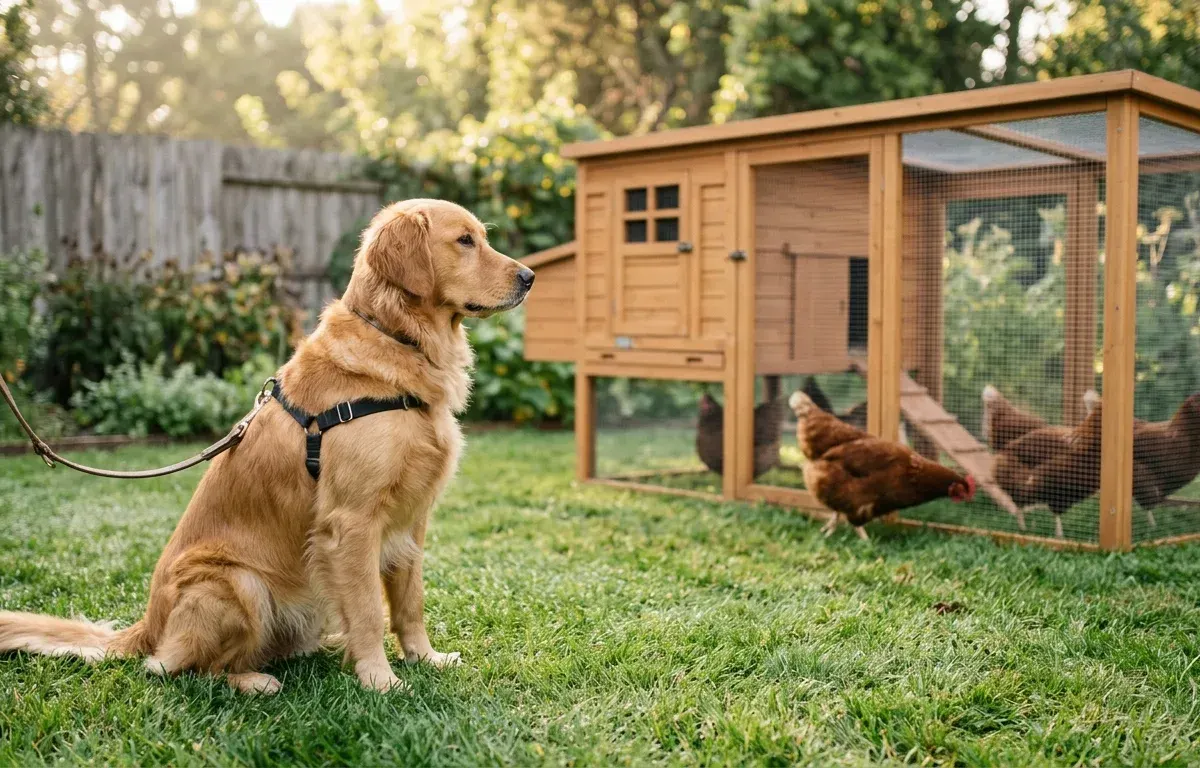
Golden Retrievers do not inherently view chickens as companion animals; instead, their gundog breeding often sparks an intense curiosity or chase instinct when birds flutter. While Golden Retrievers can learn to coexist peacefully with backyard flocks through consistent desensitization and obedience training, they should never be left unsupervised around free-ranging chickens without proven impulse control and secure physical fencing.
- Gundog background: Bred historically to retrieve waterfowl, Golden Retrievers naturally fixate on bird movements, sounds, and scents.
- Supervision is essential: Even friendly, non-aggressive Golden Retrievers can fatally injure a chicken during overexcited play or retrieving attempts.
- Structured training: Teaching rock-solid "leave it" and "recall" cues while keeping the dog on a leash near the coop forms the backbone of successful integration.
- Coop security: Hardware cloth fencing and secure latches prevent accidental boundary breaches and protect the flock.
- Dietary clarification: Cooked, unseasoned chicken meat is a healthy protein for dogs, but live chickens must strictly be established as off-limits.
Bringing backyard chickens home to a property with a resident dog requires an honest look at canine genetics and natural behavior. While the gentle nature of a Golden Retriever makes them wonderful family companions, their heritage as waterfowl hunting dogs means poultry can trigger an immediate urge to track, chase, and mouth moving birds. Understanding the difference between general social friendliness and hunting instincts is the first step toward building a safe, harmonious environment for both your dog and your flock.
Do Golden Retrievers Naturally Like Chickens? Temperament vs. Instinct
Golden Retrievers are famous for their sociable, eager-to-please temperament, but they do not automatically view chickens as friends or fellow pets. In canine psychology, friendliness toward humans and other dogs does not cancel out the predatory reflexes hardwired into hunting breeds. When evaluating what is a golden retriever, owners must recognize that a dog can be exceptionally sweet with family members while still viewing a flapping bird as an exciting object to chase.
The primary issue stems from sensory stimulation. Chickens move unpredictably, make high-pitched vocalizations, and flap their wings rapidly when startled. These specific auditory and visual cues trigger arousal in the canine central nervous system. A dog that displays calm affection on the living room rug may suddenly shift into high-drive tracking mode when standing next to a chicken run.
To understand how do golden retrievers act around small livestock, it helps to contrast typical household social behavior with their instinctual hunting responses.
| Behavioral Aspect | Companion Dog Temperament | Gundog Prey Reaction Around Poultry |
|---|---|---|
| Primary Motivation | Social connection, play, and handler praise | Visual tracking, stalking, and retrieving objects |
| Response to Movement | Approaching with loose body posture and tail wags | Tensing, freezing, and fixating on flapping wings |
| Vocalization Cue | Whining for attention or playful barking | High-arousal whining or silent, focused staring |
| Bite Inhibition | Gentle play mouthing with human hands | Grabbing or pinning moving prey instinctively |
| Recovery Threshold | Easy redirection with toys or basic verbal cues | Difficult redirection once predatory arousal peaks |
While individual Golden Retrievers raised around poultry from early puppyhood can become indifferent to birds, natural tolerance is never guaranteed. Assuming your retriever will automatically “be nice” to backyard birds without active training often leads to tragic accidents.
Understanding the Gundog Instinct: Prey Drive vs. “Soft Mouth”
To understand why Golden Retrievers react so strongly to chickens, you must look at their working history. The breed was originally developed in 19th-century Scotland by crossing yellow retrievers with Tweed Water Spaniels, Bloodhounds, and Irish Setters. According to the American Kennel Club breed standard, these dogs were created specifically to mark the fall of shot waterfowl and retrieve them undamaged over rough Scottish terrain and icy waters.
Because of what were golden retrievers bred for, their predatory motor pattern differs slightly from that of true vermin-hunting terriers or flock-guarding breeds. In wild canines, the full predatory sequence consists of five distinct stages: Orient, Stalk, Chase, Grab-Bite, and Kill-Bite. Selective breeding in retriever lines emphasized the search, chase, and gentle grab stages while muting the final kill bite.
This modified behavioral sequence explains why Golden Retrievers are celebrated for having a “soft mouth”, which is the ability to hold game birds gently without tearing flesh or puncturing skin. However, many pet owners misunderstand this trait. A soft mouth does not make a dog safe around live backyard chickens.
| Predatory Stage | Natural Canine Sequence | Modified Golden Retriever Pattern | Risk Level to Backyard Chickens |
|---|---|---|---|
| 1. Orient | Detect movement and turn head | Immediate sharp visual fixation on flock | Low (manageable with redirection) |
| 2. Stalk | Lower body and creep closer | Slow approach or stiff posturing near fence | Moderate (arousal building rapidly) |
| 3. Chase | Sprint after fleeing target | Rapid pursuit triggered by flapping wings | High (panic causes flock collisions) |
| 4. Grab-Bite | Seize target with jaws | Mouths bird gently or pins to ground | Critical (fatal trauma or suffocation) |
| 5. Kill-Bite | Hard bite and violent shaking | Often absent; dog attempts retrieval | Critical (severe internal organ damage) |
Chickens have fragile skeletal structures, thin skin, and delicate respiratory systems. When an excited 65-pound retriever picks up a flapping hen, even a gentle grip can cause crushed ribs, punctured air sacs, severe internal hemorrhaging, and lethal shock. Furthermore, the sheer terror of being chased and caught can trigger fatal cardiac arrest in poultry. Recognizing that are golden retrievers working dogs at heart helps owners respect these predatory instincts rather than dismissing them as malicious aggression.
Step-by-Step Guide: How to Train Your Golden Retriever to Ignore Chickens
Conditioning a Golden Retriever to coexist peacefully with backyard poultry is an exercise in desensitization, impulse control, and handler focus. The goal is not to force the dog to become friends with the chickens, but to teach the dog that the birds are boring and completely off-limits.
Phase 1: Distance Desensitization and Engagement
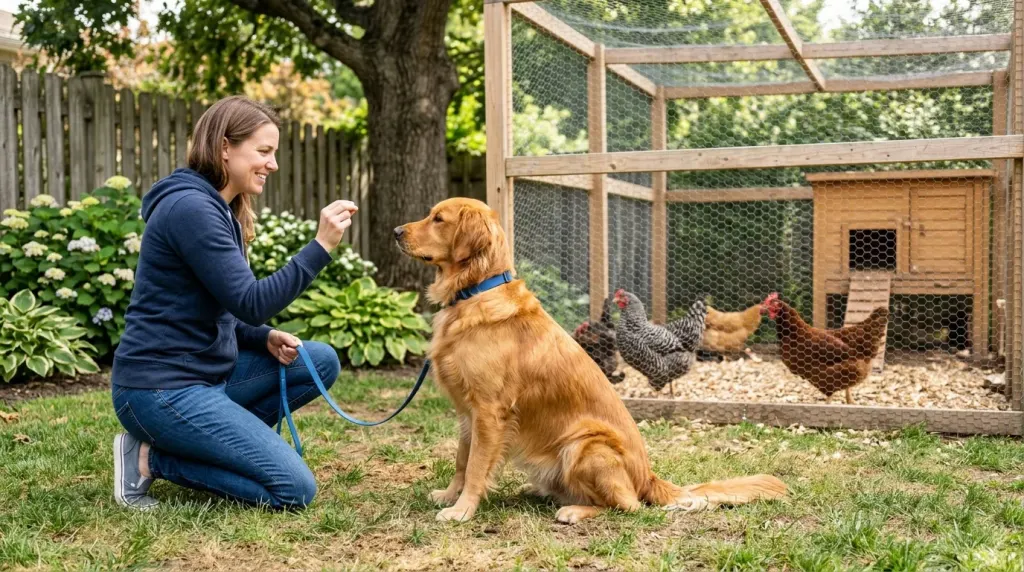
- Fit your Golden Retriever with a secure, flat collar or front-clip harness and a standard 6-foot non-retractable leash.
- Position yourself at a starting distance of 30 to 40 feet away from the secure chicken coop and run.
- Allow your dog to notice the chickens. The moment your dog looks at the coop and then turns their head back toward you, immediately mark the behavior with a verbal click or “yes” and deliver a high-value treat (such as small pieces of roast beef or real cheese).
- Repeat this “look at that” exercise for 5 to 10 minutes per session. If your dog whines, pulls, or refuses treats, you are too close to the birds; increase the distance until the dog can focus and take food calmly.
Phase 2: Fence-Line Conditioning and Impulse Control
- Once your dog reliably checks in with you at 30 feet, gradually decrease the distance by 5 feet every two to three days.
- Walk your dog on a leash parallel to the chicken run at a distance of 10 to 15 feet.
- Ask for basic obedience cues such as “sit”, “down”, and “watch me” while the chickens are active and moving inside their run.
- Reward calm, relaxed posture. If the chickens flap or make loud noises, immediately reward your dog for keeping all four paws on the ground and looking at you rather than lunging toward the wire.
Phase 3: Mastering the Emergency “Leave It” Cue
- Practice a rapid “leave it” command using high-value treats tossed onto the ground during indoor training sessions first.
- Advance to the backyard near the chicken enclosure on leash. When a chicken flaps its wings or runs across the run, issue the “leave it” cue in a clear, upbeat voice.
- As soon as your dog turns away from the coop, step backward, praise enthusiastically, and jackpot reward with three to four treats in a row.
- Never yank harshly on the leash or yell, as physical punishment elevates canine stress and can redirect frustration toward the chickens or handler.
Phase 4: Long-Line Supervised Exposure
- Attach a 20-foot to 30-foot biothane long line to your dog’s harness in the open yard while the chickens remain safely locked inside their secure predator-proof run.
- Allow your dog to explore the yard freely, practice regular recall cues (“come”), and reward every voluntary choice to ignore the chicken coop.
- Progress to supervised free-ranging sessions only after several months of consistent, zero-reaction behavior on the long line, keeping the birds secured in an enclosure whenever the dog is outside.
Training a retriever to ignore chickens is significantly easier when started during early puppyhood (8-16 weeks), but adult dogs with established chase histories require strict long-term management alongside counter-conditioning.
Recognizing High Prey Drive and Warning Body Language Around Poultry
Canine body language provides clear advance notice before a predatory chase occurs. An aroused Golden Retriever undergoes physiological shifts that indicate rising arousal. If an owner misses these early cues, the dog will reach a point of sensory fixation where verbal commands are completely tuned out.
| Calm and Safe Body Language | High Prey Drive / Warning Signs |
|---|---|
| Soft, blinking eyes and relaxed facial muscles | Hard, unblinking stare locked onto individual birds |
| Loose, sweeping tail wag at spine level | High, stiff, rapid tail vibration or rigid flag tail |
| Open mouth with relaxed tongue hanging | Tightly closed mouth, lip licking, or stress panting |
| Sniffing the grass and ignoring bird sounds | Stiff, forward-leaning posture with raised hackles |
| Responsive to name and soft verbal prompts | Complete auditory shutdown and whining with tension |
| Turning body away to sit or lie down comfortably | Trembling body, drooling, or sudden lunging against leash |
If you observe your dog displaying any of the warning signs in the table above, act immediately before the chase reflex engages. Step directly into your dog’s line of sight to break eye contact, take hold of the leash, and calmly walk the dog in the opposite direction until their body loosens and responsiveness returns.
Original Breed Assessment: Field-Bred vs. Show-Line Goldens Around Livestock
Not all Golden Retrievers possess the same intensity of hunting drive. Over decades of selective breeding, the breed has diverged into two distinct lineages: field-bred (working) lines and show-bred (conformation) lines. Understanding which lineage your dog belongs to helps set realistic expectations for livestock management.
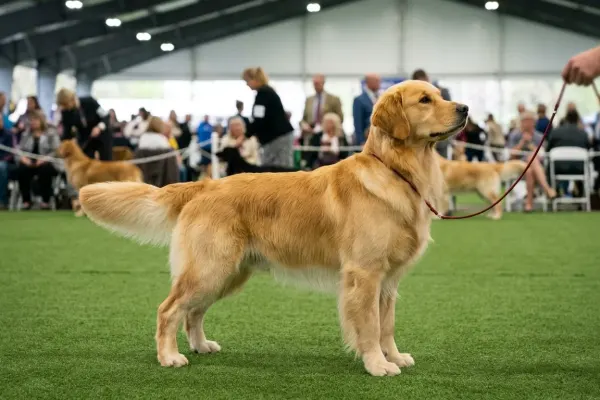
When researching what is a field golden retriever, you will find they are bred specifically for hunting trials, stamina, high drive, and intense bird focus. They tend to have lighter, leaner frames, darker golden or red coats, and a relentless desire to work. In contrast, standard show-line dogs from the broader golden retriever dog breed are typically heavier-boned with thicker, lighter coats and a lower baseline arousal threshold.
| Breed Line | Energy and Drive Level | Bird Fascination | Training Difficulty Around Poultry | Ideal Management Strategy |
|---|---|---|---|---|
| Field-Bred Golden | High to very high working drive | Intense focus on airborne and ground movement | High; requires rigorous daily mental work | Long-term physical separation and active retrieve outlets |
| Show-Line Golden | Moderate, steady energy | Moderate curiosity; easier to distract | Moderate; responds quickly to basic obedience | Structured desensitization and perimeter boundary rules |
Field-line retrievers require substantial daily mental enrichment, structured retrieve games (such as fetching canvas training dummies or balls), and agility work to satisfy their working instincts. Without productive outlets for their natural drive, field-bred dogs are much more prone to fixating on backyard poultry as a substitute job.
Coop Security and Management Rules: Setting Fail-Safe Boundaries
While behavioral training is essential, environmental management remains the only 100% reliable method to protect backyard chickens. Even a thoroughly trained dog can experience an instinctual relapse if a panicked hen escapes or a strange predator startles the flock.
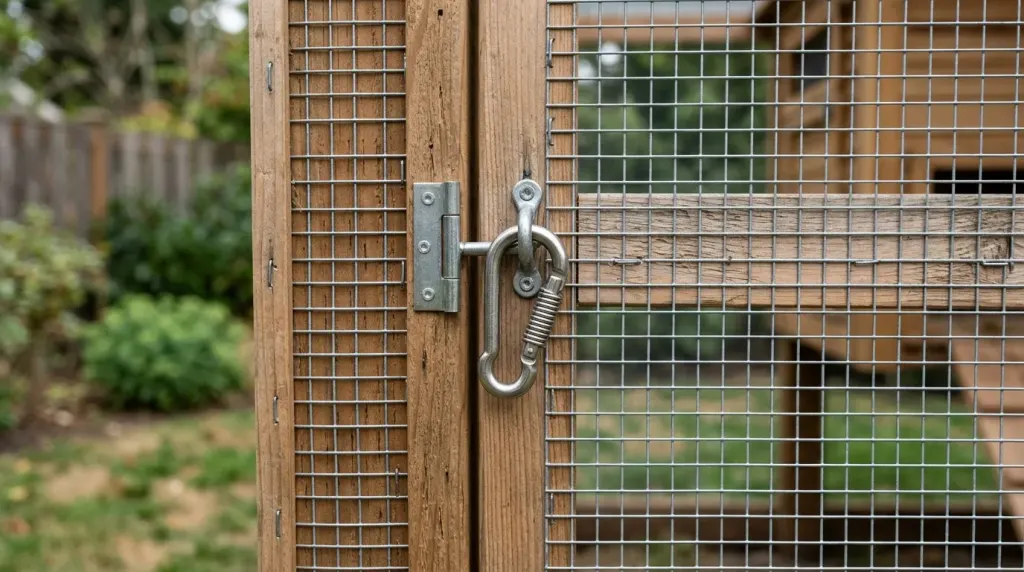
Relying on standard chicken wire is a common and dangerous mistake. Hexagonal chicken wire is designed to keep chickens inside an area, but it provides almost no structural resistance against a determined, 70-pound dog. A retriever can easily push through, tear, or dig under standard chicken wire within minutes.
Key predator-proofing specifications for your coop and run include:
- 1/2-inch galvanized hardware cloth: Wrap the entire run in 16-gauge or 19-gauge welded hardware cloth, secured to wooden framing using heavy-duty wood screws with wide fender washers rather than basic staples.
- Buried anti-dig wire aprons: Extend hardware cloth 12 to 18 inches horizontally outward along the ground from the base of the run and bury it beneath the turf to stop digging behaviors.
- Two-step locking hardware: Install sliding barrel bolts secured with spring-loaded carabiners or padlocks on all coop doors and nesting box lids. Dogs can easily bump open simple gravity latches with their snouts.
- Perimeter boundary fences: Maintain a dedicated 5-foot or 6-foot backyard perimeter fence separating the main dog exercise area from the chicken enclosure.
It is also important to clarify the protective capabilities of the breed. When owners ask will a golden retriever protect you or your flock from predators, the answer is no. Golden Retrievers are hunting retrievers, not Livestock Guardian Dogs (LGDs) such as Great Pyrenees or Anatolian Shepherds. They do not possess the territorial guarding instincts required to defend a flock against raccoons, coyotes, or foxes, and placing them in a guardian role puts both the dog and the chickens at risk.
Frequently Asked Questions About Golden Retrievers and Chickens
Can Golden Retrievers be trusted alone with free-ranging chickens?
No, Golden Retrievers should never be left unsupervised with free-ranging chickens. Even a dog with years of gentle behavior can suddenly react to an unexpected flurry of feathers, a sudden distress call, or a bird attempting to fly. The instinctual chase reflex can trigger in a fraction of a second, leading to fatal injuries before an owner can intervene.
Can a Golden Retriever puppy grow up to be gentle with chickens?
Yes, raising a Golden Retriever puppy alongside backyard chickens through controlled, positive introductions can help the dog view poultry as mundane background fixtures rather than exciting prey. However, owners must maintain close supervision during the adolescent phase (6 to 18 months), when surging hormones and exploratory drives frequently cause temporary training regressions.
How do I stop my Golden Retriever from chasing chickens?
Immediately secure your dog on a leash and increase the physical distance from the flock until your dog can refocus on you. Practice the “leave it” cue daily using high-value rewards, redirect your dog’s retrieving energy onto safe toys and balls, and ensure the chickens remain in a secure, predator-proof enclosure whenever the dog is in the yard.
Will a Golden Retriever protect chickens from predators?
No, Golden Retrievers lack the guardian instincts of dedicated livestock guardian breeds. Instead of patrolling boundaries and deterring nocturnal predators like foxes or raccoons, an unsupervised Golden Retriever is more likely to investigate, chase, or accidentally injure the chickens themselves.
Can Golden Retrievers eat cooked or raw chicken meat?
Plain, cooked chicken meat without bones, skin, onions, garlic, or heavy seasonings is a healthy source of lean protein for Golden Retrievers, provided the dog does not have a poultry allergy. Never feed cooked chicken bones under any circumstances, as they splinter easily and cause serious choking hazards, esophageal tears, or intestinal punctures.

Leave a Reply