

Table of Contents
A field Golden Retriever is a working bloodline of the purebred Golden Retriever selectively bred for hunting, field trials, and athletic performance rather than the conformation show ring. Field Goldens are leaner, lighter, and more agile than show-bred dogs, featuring a shorter, water-resistant double coat (often in darker gold or red shades) and an intense, high-energy drive that requires substantial daily exercise and mental engagement.
- Field Golden Retrievers are purebred Golden Retrievers bred specifically for hunting, retrieving, and field trial performance.
- Physically, field lines are leaner (55 to 70 pounds), more agile, and have shorter coats with minimal feathering compared to heavier show lines.
- Coat colors often lean toward darker gold and deep red tones, designed for practicality in water and dense brush.
- They possess an exceptionally high working drive and require at least 60 to 90 minutes of vigorous daily exercise and mental training.
- Field and show Goldens belong to the same official breed standard recognized by major kennel clubs, differing only in selective bloodline focus.
The Golden Retriever is celebrated worldwide as one of the most versatile and friendly canine companions, but the breed actually encompasses two distinct lineages: show lines (conformation) and field lines (working). While both varieties belong to the exact same breed and share the hallmark gentle disposition of the Golden Retriever, their physical builds, daily energy levels, and lifestyle requirements differ considerably.
Understanding what makes a field Golden Retriever unique helps prospective owners decide whether this high-drive hunting partner or an easygoing companion dog fits their daily routine best.
Defining the Field Golden Retriever: Origins and Working Purpose
A field Golden Retriever (often called a field-bred or working Golden Retriever) is a bloodline bred specifically to excel at hunting, retrieving waterfowl, and competing in formal retriever field trials alongside its closest working counterpart, the Labrador Retriever. While show-line Goldens are bred to match the strict visual aesthetic of the show ring, field lines are selected based on functional performance, scenting ability, stamina, and cooperative biddability.
The foundational roots of the breed trace back to 1868 at the Guisachan estate in the Scottish Highlands. Sir Dudley Marjoribanks (later known as Lord Tweedmouth) set out to develop the ultimate gundog capable of retrieving downed game from both rugged upland terrain and icy lochs. He crossed a yellow wavy-coated retriever named Nous with a Tweed Water Spaniel named Belle, subsequently incorporating Red Setter and Bloodhound lines to refine scenting prowess and temperament.
Official standards documented by The Kennel Club breed standard classify the Golden Retriever as a gundog built for endurance and working utility. Unlike toy breeds developed for indoor lap companionship, the Golden Retriever was engineered from its inception to work closely with humans outdoors in demanding conditions. Field Golden breeders continue Lord Tweedmouth’s original vision by prioritizing speed, drive, and natural retrieving instinct above decorative coat volume.
Physical Characteristics: How Field Goldens Differ from Show Lines
Although field Goldens must meet the structural breed criteria established by kennel registries, their physical conformation reflects athletic utility rather than show-ring glamour.
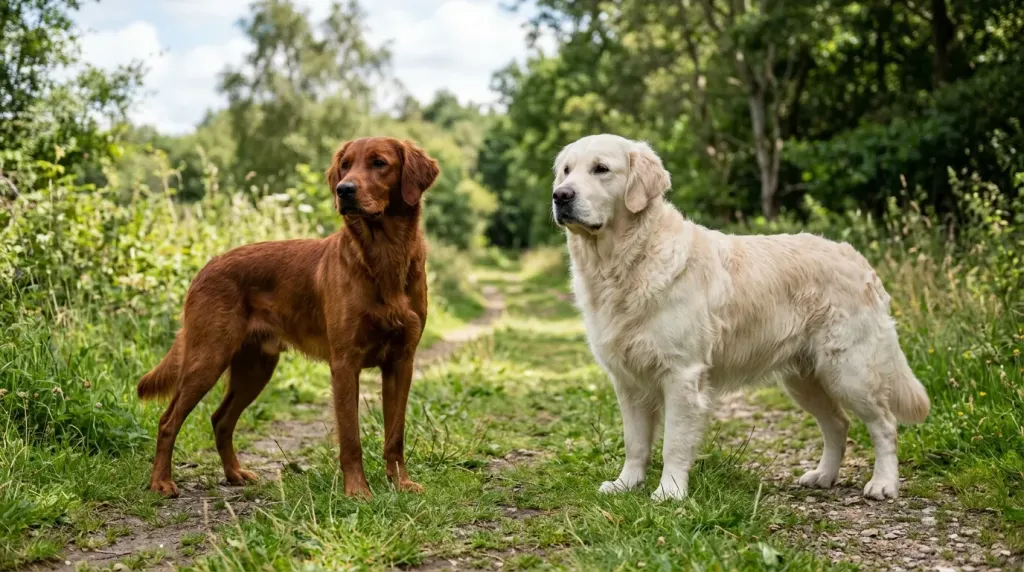
Build and Body Structure
Field-bred Goldens have a sleeker, more streamlined silhouette with lighter bone density and a tucked abdomen. They typically carry less body fat and possess longer legs relative to their torso length, giving them enhanced speed and agility over uneven ground. According to the American Kennel Club breed standard, male Golden Retrievers stand 23 to 24 inches at the shoulder and weigh 65 to 75 pounds, while females measure 21.5 to 22.5 inches and weigh 55 to 65 pounds. Field lines frequently register at the lighter end of these official weight brackets (or slightly under, between 50 and 65 pounds), whereas show lines frequently trend toward the heavier upper limit or beyond.
Compared with the compact, heavy-set conformation of typical companion breeds, a field Golden’s athletic frame is built for sustained cardiovascular output, swimming against river currents, and clearing field obstacles.
Coat Texture, Length, and Color
The coat of a field Golden Retriever is designed for rugged fieldwork. It consists of a dense, water-repellent undercoat topped by a short to medium-length flat outer coat. Unlike show Goldens, field lines carry significantly less fringe feathering around their legs, underbelly, and tail. This shorter coat prevents burs, stickers, and muddy debris from tangling in the fur during outdoor excursions.
Coloration also tends to differ between lines:
- Field lines: Often exhibit rich gold, dark amber, or deep reddish-mahogany coats.
- Show lines: Commonly display lighter shades of gold, ranging from light cream (popular in English show lines) to lustrous golden hues.
Comprehensive Comparison: Field Golden vs. Show Golden Retriever
The table below outlines the core functional and physical differences between field-bred and show-bred Golden Retrievers.
| Attribute | Field Golden Retriever (Working Line) | Show Golden Retriever (Conformation Line) |
|---|---|---|
| Primary Breeding Goal | Hunting, field trials, athletic performance | Conformation dog shows, companion standards |
| Average Adult Weight | Males: 60 to 70 lbs; Females: 50 to 60 lbs | Males: 65 to 75+ lbs; Females: 55 to 65 lbs |
| Body Build | Lean, athletic, lighter bone structure, wedge head | Stocky, heavy-boned, broad skull, deep chest |
| Coat Characteristics | Shorter, dense, water-resistant, minimal feathering | Long, flowing, dense wavy coat with heavy feathering |
| Dominant Coat Colors | Rich gold, dark gold, deep mahogany red | Cream, light gold, lustrous warm gold |
| Energy and Drive Level | Very high working drive, intense focus, athletic | Moderate energy, calm, easygoing household pace |
| Daily Exercise Need | 60 to 90+ minutes of vigorous physical/mental work | 45 to 60 minutes of moderate daily walking/play |
| Grooming Maintenance | Low to moderate (weekly brushing, burr removal) | High (frequent brushing, de-matting, trimming) |
Field Golden Retrievers are not a separate breed under official kennel club registries. They represent a functional lineage bred for athletic endurance, speed, and retrieving drive, whereas show lines are selected for physical conformity to bench standards and a calmer household presence.
Temperament, Working Drive, and Training Needs
The temperament of a field Golden Retriever is defined by high biddability, exceptional intelligence, and an intense working drive. While they share the hallmark friendly nature of the wider Golden Retriever breed, their energy profile is markedly different from standard family pets.

High Drive and Problem-Solving Instincts
Field Goldens possess what hunters and dog sport enthusiasts call “birdiness” and high prey drive for retrieving objects. When given a task, whether retrieving bumpers in water or navigating agility courses, they demonstrate laser focus and high motivation. They thrive on positive reinforcement training and learn complex multi-step commands far faster than average companion breeds.
Where placid companion breeds are content with leisurely indoor lounging, a field Golden without a dedicated mental job can develop boredom-related habits such as digging, excessive barking, or chewing.
The “Off-Switch” and Household Living
A well-bred field Golden should have a reliable off-switch, meaning they can work with full intensity in the field and settle quietly inside the home once their exercise needs are met. Developing this off-switch requires early crate training, impulse control exercises, and consistent mental stimulation alongside physical activity.
Daily Care: Exercise, Nutrition, and Crate Sizing
Integrating a field Golden Retriever into a family home requires an active lifestyle and an environment that accommodates their physical needs.
Exercise and Sports Outlets
A simple stroll around the neighborhood is rarely enough for a field Golden. Ideal exercise routines include:
- Long-distance retrieving: Using canvas bumpers or ball launchers across open fields or bodies of water.
- Canine sports: Agility trials, dock diving, tracking, scent work, and flyball.
- Outdoor recreation: Trail running, hiking, and open-water swimming.
Owners should also provide structured indoor rest spaces. An adult field Golden needs a 36-inch to 42-inch wire or heavy-duty crate that allows them to stand, turn around, and stretch out comfortably after vigorous outdoor sessions.
High-Performance Nutrition
Due to their elevated metabolic rate and continuous muscular exertion, field Goldens require an energy-dense diet rich in animal protein (typically 26% to 30%) and healthy fats (16% to 20%). Working dogs burning calories in the field may consume 20% to 40% more food than sedentary household dogs.
During field training sessions, handlers often incorporate low-calorie fruit rewards such as blueberries and seedless apple slices alongside standard rations.
Health Profile, Screening, and Lifespan
Field Golden Retrievers are generally robust and athletic, often exhibiting fewer orthopedic issues related to excessive body weight than show lines. However, they remain susceptible to the inherited health conditions common across the broader Golden Retriever gene pool.
Key health considerations include:
- Hip and Elbow Dysplasia: Malformation of the ball-and-socket joints, screened via Orthopedic Foundation for Animals (OFA) or PennHIP evaluations.
- Cardiovascular Disease: Particularly subvalvular aortic stenosis (SAS), which requires veterinary cardiac auscultation and echocardiogram screening.
- Eye Disorders: Progressive retinal atrophy (PRA), pigmentary uveitis, and juvenile cataracts.
- Cancer: Hemangiosarcoma and lymphoma represent significant health challenges across all Golden Retriever lines.
The primary orthopedic concerns for high-impact sporting retrievers center on hip dysplasia, elbow dysplasia, and cruciate ligament tears resulting from rigorous running and jumping across uneven terrain.
Post-exercise monitoring is vital for working retrievers. Physical discomfort or joint pain in canines often manifests as pacing and inability to settle, alerting owners to muscle fatigue, burs, or joint strain before serious lameness develops.
Note: Prospective puppy buyers should always ask breeders for certified health clearances from the OFA (or equivalent national registry) for hips, elbows, eyes, and cardiac health before purchasing a field-bred puppy.
Frequently Asked Questions About Field Golden Retrievers
Is a field Golden Retriever a distinct dog breed?
No. Field Golden Retrievers are purebred Golden Retrievers registered under the exact same breed standard as show Goldens. The distinction is purely based on bloodline specialization and breeding focus (hunting and performance vs conformation showing).
Do field Golden Retrievers make good family pets?
Yes, field Goldens make affectionate, loyal, and social family pets, provided the household is active. They thrive with families who hike, run, camp, or participate in canine sports. Homes with sedentary routines may find their high energy level challenging to manage.
Do field Golden Retrievers shed as much as show Goldens?
Field Golden Retrievers shed year-round and blow their undercoat seasonally in the spring and fall, similar to show lines. However, because their coat is shorter with substantially less feathering, grooming is faster, and the sheer volume of visible hair is often easier to manage with weekly brushing.
Are red Golden Retrievers always field-bred?
While most red or dark mahogany Golden Retrievers come from field lines where rich coat colors were historically favored, color alone is not a guarantee of lineage. Pedigree research showing working titles (such as Master Hunter, Field Champion, or Junior Hunter) is the only reliable confirmation of field-bred ancestry.



Leave a Reply