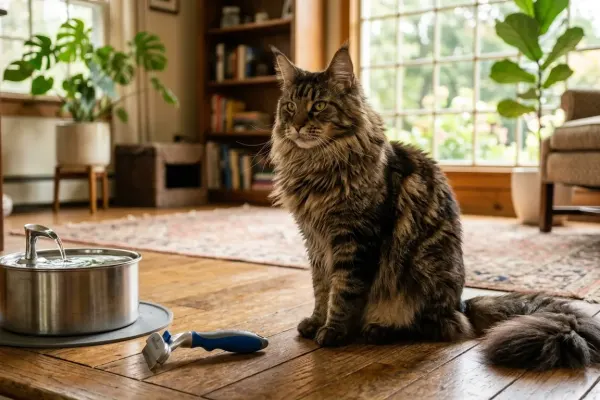
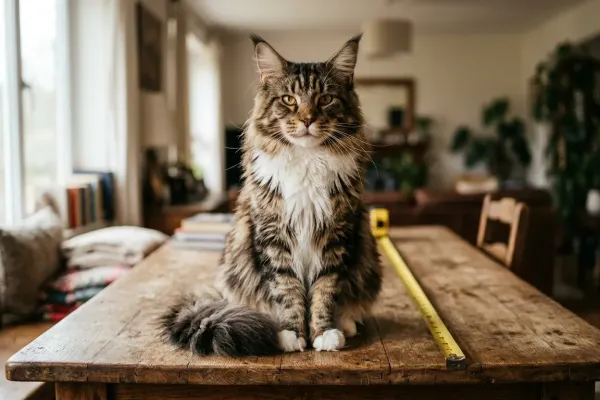
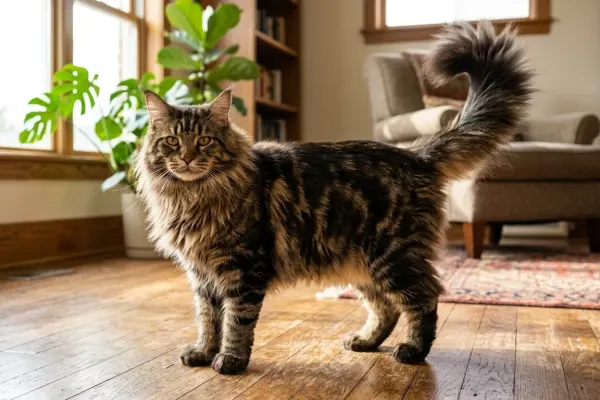
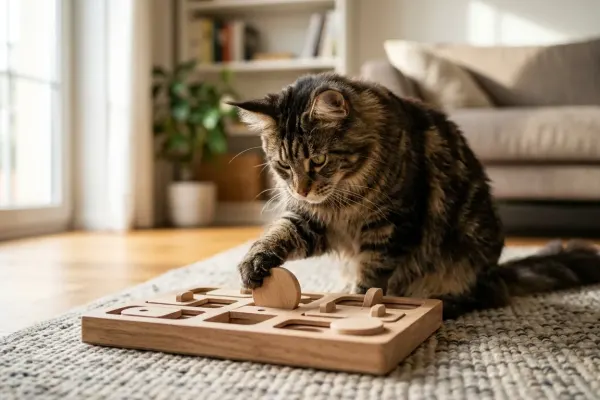
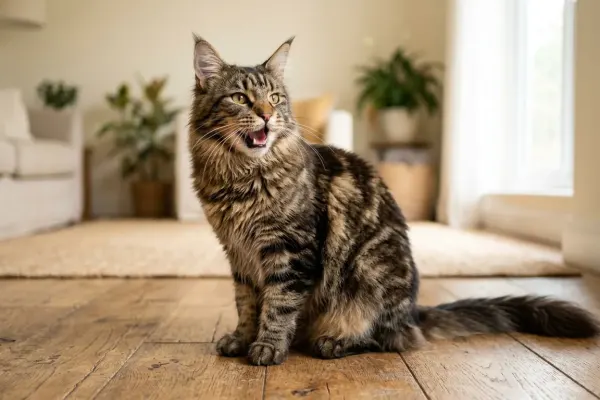
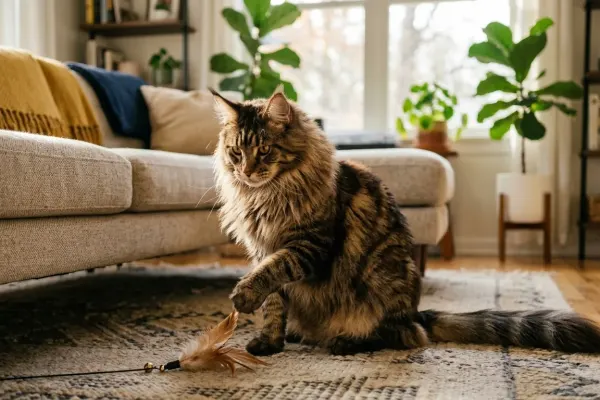
In terms of daily care, are Maine Coons high maintenance? Overall, they are moderately demanding cats that require 2 to 3 weekly brushing sessions, 20 to 30 minutes of daily interactive play, and oversized cat furniture due to their 10-25 lb frame, though their calm temperament makes daily handling straightforward. While they do not demand professional grooming if brushed consistently at home, their dense double coat, large appetite, and social nature require noticeably more daily care than an average domestic shorthair.
September 29, 2026
By ShowDogsWest Editor
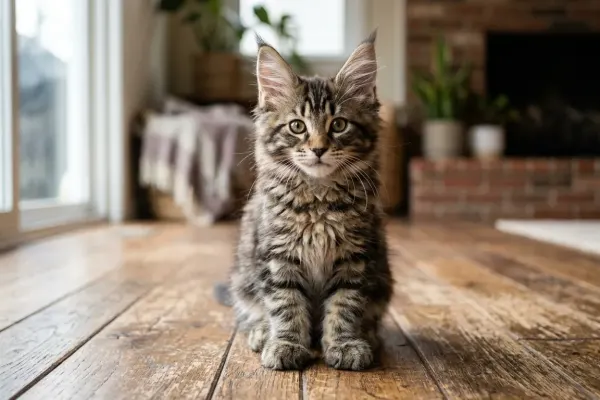
A Maine Coon kitten is the purebred juvenile offspring of North America's native longhaired Maine Coon cat breed, known for its sturdy rectangular bone structure, large tufted ears with lynx-like tips, square muzzle, and dog-like, social personality. While standard domestic cats finish growing within 12 months, Maine Coon kittens develop along an extended growth curve that spans 3 to 5 years before reaching their full adult weight of 15 to 25 pounds for males and 10 to 15 pounds for females.
September 28, 2026
By ShowDogsWest Editor
When determining what a Maine Coon is mixed with, the genetic reality is that a Maine Coon mix is a domestic cat with one purebred Maine Coon parent and one non-pedigreed domestic cat (such as a Domestic Longhair or Shorthair) or another cat breed. Major feline registries like the Cat Fanciers' Association (CFA) and The International Cat Association (TICA) do not recognize crossbreeding, so there are no official designer hybrids. Most mixed cats result from accidental matings or non-pedigreed domestic lineages, inheriting a blend of traits like lynx-tipped ears, a sturdy rectangular body, a bushy plumed tail, and a gentle, dog-like temperament.
September 27, 2026
By ShowDogsWest Editor
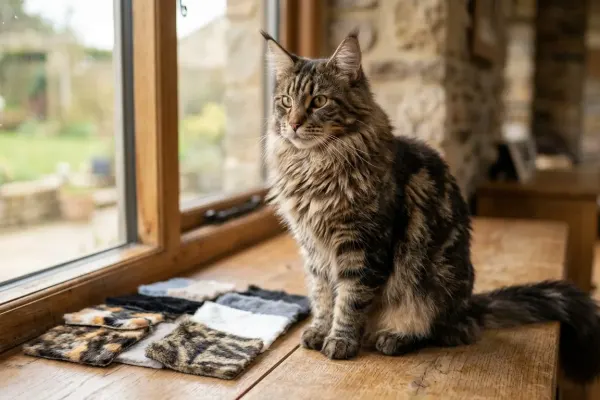
Maine Coon cats come in over 75 recognized color and pattern combinations, spanning solid coats (black, white, blue, red, and cream), classic and mackerel tabbies, smokes, shaded silvers, calicos, and tortoiseshells. When prospective owners ask what color are maine coon cats, official registries like the Cat Fanciers' Association (CFA) and The International Cat Association (TICA) accept virtually all natural feline coat varieties, excluding only those that indicate hybridization, such as chocolate, lilac, cinnamon, fawn, and colorpoint patterns.
September 26, 2026
By ShowDogsWest Editor
In answering what is the biggest Maine Coon cat on record, official documentation recognizes Stewie (Mymains Stewart Gilligan), who measured 123 cm (48.5 inches) from the tip of his nose to the tip of his tail. Typical healthy adult males measure 38 to 40 inches in total length and weigh 15 to 25 pounds, while slow skeletal maturation extends development up to 5 years.
September 25, 2026
By ShowDogsWest Editor
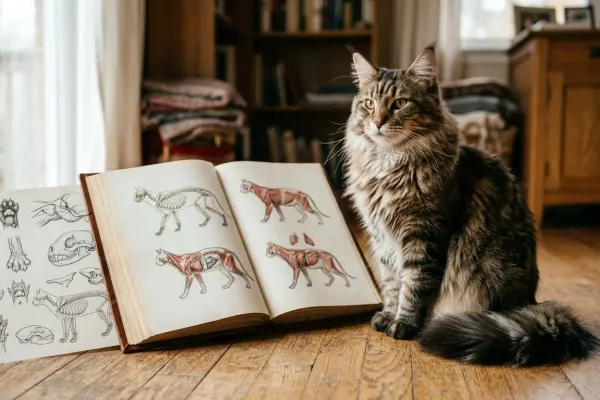
A Maine Coon is a massive, rugged cat characterized by a rectangular muscular body, a visibly square muzzle, high-set pointed ears with lynx tips, and an exceptionally bushy plumed tail that reaches its shoulders. When identifying what does a maine coon look like, key visual hallmarks include a multi-layered shaggy double coat with a lion-like frontal ruff, broad chest, heavy bone structure, and oversized round paws with dense fur tufts between the toes. Adult males typically weigh 15 to 25 pounds, while females weigh 10 to 15 pounds, taking three to five full years to reach complete physical maturity.
September 24, 2026
By ShowDogsWest Editor
So, are Maine Coons smart? Yes, Maine Coons rank among the most intelligent domestic cat breeds, characterized by sharp spatial problem-solving skills, strong social attunement, and high trainability. Often referred to as the dogs of the cat world, they readily learn household routines, interactive tricks, fetch, and harness walking through positive reinforcement.
September 22, 2026
By ShowDogsWest Editor
Yes, Maine Coons are known for being vocal, communicative cats, but they rarely produce loud, demanding meows. Instead, they use a soft, melodic vocabulary of high-pitched chirps, trills, and gentle squeaks to greet their owners, express excitement, and initiate conversational dialogue. Their talkative nature reflects their highly social temperament and close attachment to human families.
September 20, 2026
By ShowDogsWest Editor
In understanding what is the personality of Maine Coon cats, the breed stands out for an affectionate, easygoing, and sociable nature that earned them the title of gentle giants. They are highly intelligent, people-oriented, and playful without being clingy. Maine Coons converse with soft chirps and trills, adapt easily to homes with children and dogs, and often display dog-like habits such as playing fetch and investigating water.
September 19, 2026
By ShowDogsWest Editor

 ShowDogsWest Editor