
Table of Contents
The Maine Coon cat breed is a large, rugged domestic feline native to New England, recognized for its dog-like devotion, water-repellent double coat, tufted snowshoe paws, and slow, multi-year physical maturation. Adult males average 15 to 25 pounds, while females weigh 10 to 15 pounds. Responsible ownership requires regular undercoat combing, joint-protective nutrition, and proactive screening for hereditary heart conditions.
- Adult males weigh 15 to 25 pounds and take several years of steady growth to complete full skeletal and muscular development.
- The water-resistant semi-longhair double coat requires weekly combing with a steel greyhound comb to prevent mats.
- Feline Hypertrophic Cardiomyopathy (HCM) risk involves the MYBPC3 A31P mutation, making annual echocardiograms essential.
- Highly social and dog-like, Maine Coons communicate primarily through gentle chirps and trills rather than persistent meows.
The Maine Coon holds a storied place as North America’s native longhaired working cat, pairing formidable physical stature with an affectionate, steady disposition. Originating from the rugged maritime and agricultural landscapes of New England, these cats evolved thick insulated coats, tufted snowshoe paws, and heavy muscular frames to endure harsh northern winters. Today, the Maine Coon cat breed stands among the most popular companion felines globally, requiring prospective guardians to understand their conformation standards, extended developmental timeline, and veterinary screening needs.
Origin, Heritage, and Pedigree Recognition
The Maine Coon developed through natural environmental selection in 19th-century New England, where domestic short-haired felines mated with long-haired cats introduced by European sailors and Scandinavian traders. Survival in northern winters favored cats with heavy water-resistant coats, substantial bone density, and acute hunting instincts. Farmsteads and trading ships valued these felines as essential working mousers capable of protecting winter grain supplies and cargo holds. Understanding what a Maine Coon cat is begins with recognizing that every physical trait, from their broad snowshoe paws to their muscular torso, evolved as a practical survival adaptation.
Pedigreed documentation confirms that the breed achieved early prominence in American cat fancy, winning top honors when a brown tabby female named Cosey earned Best in Show at Madison Square Garden in 1895. Although the introduction of exotic longhaired breeds led to a temporary decline in the early 20th century, dedicated breeders established the Central Maine Cat Club in the 1950s to preserve foundation lineages. According to official historical records from the CFA Maine Coon breed history, the Cat Fanciers’ Association granted the breed full championship status in 1976. The State of Maine formally declared the Maine Coon its official state cat in 1985. While some prospective owners wonder whether Maine Coon cats are rare today, established preservation catteries and international registries now position the breed among the most widely registered felines in North America and Europe.
Debunking Ancestry Myths: Raccoon Hybrids and Marie Antoinette
Popular folklore frequently claims that the Maine Coon originated from hybridization between domestic cats (Felis catus) and wild raccoons (Procyon lotor). Cross-species breeding between felines and raccoons is biologically impossible because domestic cats belong to the suborder Feliformia while raccoons belong to the suborder Caniformia, separated by complete reproductive isolation. The myth persisted solely due to the breed’s bushy ringed tail, dense brown tabby markings, and unusual affinity for water.
Another persistent legend suggests that the breed descended from six Turkish Angora cats sent to Maine by Queen Marie Antoinette during the French Revolution aboard Captain Samuel Clough’s ship. While longhaired European cats certainly arrived via Atlantic shipping routes, historical records lack verification for royal feline ancestry. Modern feline genetics confirms that the Maine Coon represents a pure domestic lineage shaped by European maritime stock and New England natural selection.
Physical Standards, Adult Dimensions, and Growth Timeline
Official conformation standards established by feline registries describe the Maine Coon as a large, well-muscled cat with a substantial rectangular body frame. The chest is broad, the torso is long, and the legs are medium in length with heavy bone structure and strong musculature. The head standard forms a modified wedge with high cheekbones, large tall ears set high and wide, and a distinctly square muzzle with a firm, perpendicular chin.
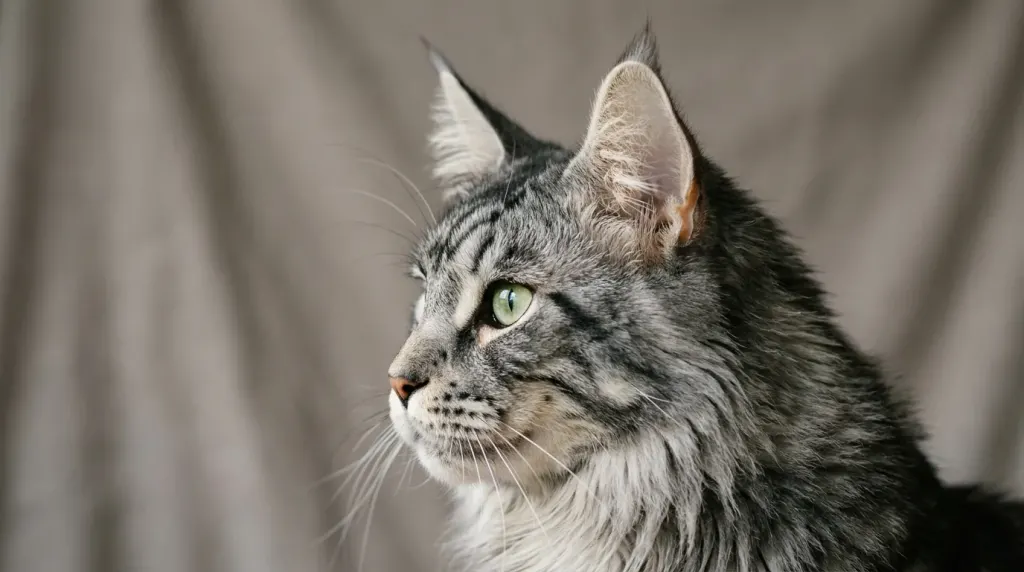
Adult male Maine Coons typically weigh between 15 and 25 pounds (6.8 to 11.3 kg), while adult females range from 10 to 15 pounds (4.5 to 6.8 kg). In terms of total length, standard adults measure 30 to 40 inches (76 to 101 cm) from the tip of the nose to the end of the tail, with a standing height between 10 and 16 inches (25 to 40 cm). According to conformation guidelines detailed in the TICA Maine Coon breed standard, judges evaluate the breed for rugged balance, bone substance, and rectangular proportions rather than extreme body length alone. Prospective guardians researching how big Maine Coon cats get must balance skeletal size against body condition scoring to maintain a healthy Maine Coon cat weight that does not overload developing joints.
Metric Specification Table: Male vs. Female Standards
| Conformation Metric | Adult Male Standard | Adult Female Standard |
|---|---|---|
| Average Body Weight | 15 to 25 lbs (6.8 to 11.3 kg) | 10 to 15 lbs (4.5 to 6.8 kg) |
| Standing Shoulder Height | 10 to 16 inches (25 to 40 cm) | 10 to 14 inches (25 to 35 cm) |
| Total Nose-to-Tail Length | 36 to 40 inches (91 to 101 cm) | 30 to 36 inches (76 to 91 cm) |
| Skeletal Growth Window | 3 to 5 years | 3 to 4 years |
| Coat Structure | Heavy, all-weather double coat | Heavy, all-weather double coat |
| Muzzle Conformation | Visibly square box, firm chin | Visibly square box, firm chin |
How does the Maine Coon’s slow maturation timeline affect early development?
Unlike standard domestic felines that achieve full skeletal and muscular maturity by 12 months of age, Maine Coons follow an extended 3-to-5-year developmental timeline. Skeletal growth plates remain open longer, allowing long bones in the limbs and spine to lengthen before muscle mass fills out the broad chest and flanks.
A two-year-old Maine Coon remains physically adolescent. During this prolonged juvenile phase, owners must manage nutrition carefully to support steady bone mineralization and lean muscle accretion. Overfeeding high-calorie diets to accelerate growth creates excess fatty weight that places premature biomechanical strain on developing coxofemoral (hip) and stifle (knee) joints.
Coat Genetics, Colors, and Shorthair Misconceptions
The Maine Coon coat is a heavy, semi-long double coat designed for all-weather thermal insulation. The fur is shorter over the shoulders and nape, lengthening gradually along the back, flanks, and belly. A frontal ruff frames the chest, while dense, shaggy britches cover the hind legs. The texture is silky with a slight body, falling smoothly over a soft, insulating undercoat that resists water absorption.
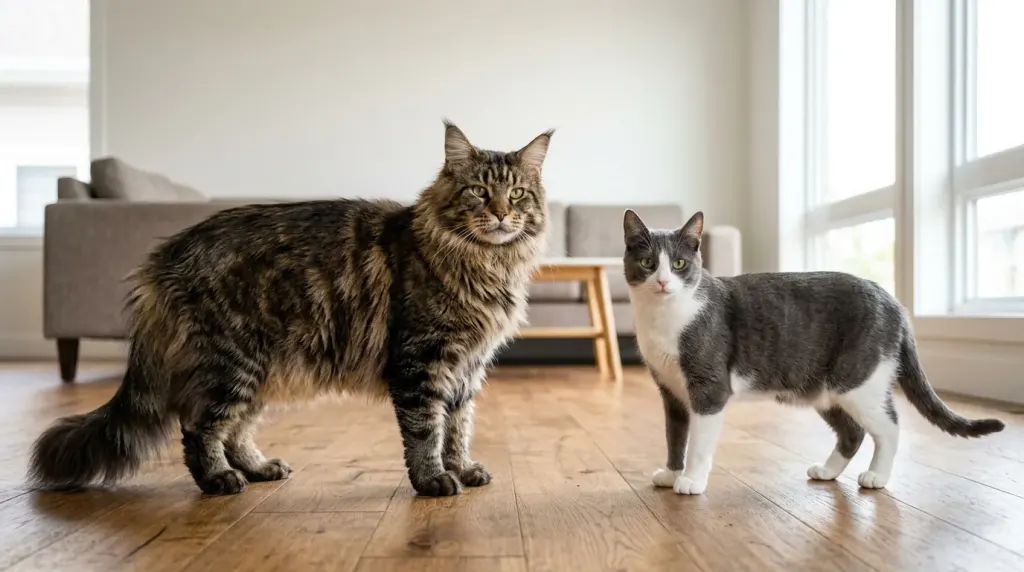
Registry standards recognize over 75 color and pattern combinations, including classic and mackerel tabbies, solid colors (black, white, red, blue, cream), silver and smoke varieties, tortoiseshell, and bi-colors. However, purebred standards strictly prohibit pointed patterns (characteristic of Siamese or Himalayan cats), chocolate, lavender/lilac, cinnamon, and fawn, as these colors indicate foreign outcrossing. When examining coat genetics, owners exploring whether short hair Maine Coon cats exist learn that purebred registries exclusively permit semi-long double coats; short-haired felines exhibiting large frames are domestic mixed-breed cats rather than pedigreed Maine Coons. Managing their dense undercoat requires understanding complete coat shedding and maintenance across seasonal shedding cycles.
What physical features distinguish a Maine Coon from Norwegian Forest Cats and Siberians?
The Maine Coon, Norwegian Forest Cat (Wegie), and Siberian cat represent the three premier natural forest cat breeds, but each exhibits clear conformational differences:
- Head Profile and Muzzle: The Maine Coon features a square muzzle with a gentle profile dip and prominent cheekbones. The Norwegian Forest Cat possesses an equilateral triangular head with a completely straight nasal profile and no stop. The Siberian exhibits a modified wedge with soft, rounded contours.
- Eye Shape: Maine Coons have large, slightly oval eyes set with an oblique aperture. Norwegian Forest Cats have almond-shaped, obliquely set eyes. Siberians possess nearly round, expressive eyes set slightly wider apart.
- Body Structure: Maine Coons are distinctly rectangular and long-bodied. Norwegian Forest Cats possess high hind legs with a muscular, tubular torso. Siberians have a barrel-shaped, compact body with a slightly arched back.
- Ear Furnishings: Maine Coons have tall, large ears with heavy interior furnishings and pronounced lynx tips at the apex. Norwegian Forest Cat ears follow the outer triangular line of the face.
Polydactyl Genetics and Cold-Climate Anatomical Adaptations
Polydactyly is a genetic variation characterized by the presence of extra digits on one or more paws. Historically, up to 40% of native Maine Coons in the 19th century were polydactyl. These wide, multi-toed paws functioned as natural snowshoes in deep Maine winter drifts and provided enhanced grip on pitching wooden ship decks during coastal storms.
Genetically, feline polydactyly is inherited as an autosomal dominant trait through the Pd gene variant, primarily causing preaxial polydactyly where additional digits develop on the medial (thumb) side of the paw. While the standard CFA show ring restricts championship eligibility to cats with standard five front and four rear toes, The International Cat Association (TICA) recognizes the Maine Coon Polydactyl as an official championship breed category. Reviewing how many toes Maine Coon cats have reveals that polydactyl individuals can possess up to six or seven digits per paw, requiring regular claw trimming to prevent interior dewclaws from curling inward into adjacent footpads.
Temperament, Social Dynamics, and Vocalization
Maine Coons are celebrated for their gentle, balanced, and highly sociable disposition, frequently earning the nickname “the dogs of the cat world.” They demonstrate strong attachment to human family members, companionably following owners throughout the home to observe daily routines without displaying overly demanding or clingy behavior. Their playful nature persists well into mature adulthood, with many individuals readily retrieving tossed toys, playing with puzzle feeders, and investigating novelty items with calm curiosity.
The breed’s size and confident temperament make them exceptionally steady in multi-pet environments. Prospective owners evaluating how Maine Coon cats get along with dogs find that their sturdy build and unflappable personality prevent them from fleeing or panicking in the presence of canine housemates. As noted in veterinary behavioral profiles from VCA Animal Hospitals Maine Coon profile, Maine Coons rarely exhibit unprovoked defensive aggression. When addressing whether Maine Coon cats show aggression, feline behaviorists emphasize that sudden irritability almost always stems from underlying orthopedic discomfort, dental pain, or territorial insecurity rather than an innate breed trait.
Why do Maine Coons chirp and trill instead of meow?
Rather than producing loud, repetitive meows, Maine Coons communicate through an extensive vocabulary of soft chirps, trills, and gentle purrs. In feline ethology, trilling is a closed-mouth rolling vocalization that mother cats use to greet and direct kittens.
Maine Coons maintain this juvenile vocalization pattern into adult life, using modulated trills to express pleasant excitement, acknowledge familiar humans upon entering a room, and invite social play. Their gentle vocal intensity contrasts markedly with their formidable physical size.
Breed Comparison: Maine Coon vs. Ragdoll
While Maine Coons and Ragdolls both rank among the largest pedigreed domestic companion cats, their developmental origins, coat structures, and activity patterns exhibit clear distinctions. Maine Coons evolved as outdoor working farm cats, whereas Ragdolls were developed in 1960s California specifically for placid indoor companionship.
Prospective pet parents comparing how big Ragdoll cats get with Maine Coon dimensions find that while adult male Ragdolls reach 15 to 20 pounds, the Maine Coon exhibits a longer, more angular rectangular frame and heavier bone structure. Behavioral dynamics also differ: observing Ragdoll cat behavioral traits reveals a low-energy, floor-loving lap cat that frequently relaxes completely when held, whereas the Maine Coon is an interactive problem-solver and active vertical climber.
Comparative Matrix: Maine Coon vs. Ragdoll
| Breed Characteristic | Maine Coon | Ragdoll |
|---|---|---|
| Historical Origin | Natural working cat (Maine, USA) | Selected foundation breed (California, USA) |
| Body Conformation | Long, rugged rectangular frame with heavy bone | Heavy-set, broad torso with medium-heavy bone |
| Coat Structure | Heavy semi-long double coat with dense undercoat | Plush, silky semi-long coat with minimal undercoat |
| Permissible Eye Colors | Green, gold, copper, odd-eye (blue in white coats) | Obligate blue eyes across all color patterns |
| Muzzle Structure | Square box with perpendicular chin | Modified broad wedge with rounded contours |
| Typical Activity Level | Moderate to high (playful hunter and climber) | Low to moderate (relaxed floor companion) |
| Vocalization Style | Melodic chirps, trills, and soft chirrups | Soft, quiet meows and gentle purring |
Hereditary Health Considerations and Preventive Veterinary Care
The Maine Coon is a naturally hardy breed with an average lifespan of 12 to 15 years. However, purebred lineages carry genetic predispositions to specific hereditary disorders, including Hypertrophic Cardiomyopathy (HCM), feline hip dysplasia, and Spinal Muscular Atrophy (SMA). Proactive veterinary management and structured breeder screening minimize the clinical impact of these conditions.
Evaluating longevity factors outlined in guides on how long Maine Coon cats live emphasizes that maintaining a lean body condition score directly preserves joint health and cardiovascular efficiency. When comparing feline health profiles with the average Ragdoll lifespan, both large breeds benefit significantly from early echocardiographic screening and weight management.
- Hypertrophic Cardiomyopathy (HCM): HCM causes progressive thickening (hypertrophy) of the left ventricular myocardium, impairing diastolic filling. According to research from the UC Davis Veterinary Genetics Laboratory HCM test data, the A31P missense mutation in the MYBPC3 gene is inherited in an autosomal dominant manner with incomplete penetrance. Cats carrying two copies (homozygous) face elevated risk of severe juvenile or early adult cardiac remodeling.
- Feline Hip Dysplasia: Due to their large skeletal frame, Maine Coons have a higher incidence of coxofemoral subluxation (loose hip joints) than smaller breeds. Radiographic screening of breeding stock and maintaining lean juvenile weight reduce the risk of secondary degenerative osteoarthritis.
- Spinal Muscular Atrophy (SMA): An autosomal recessive neuromuscular condition caused by a deletion in feline chromosome A1, leading to progressive loss of lower motor neurons in the spinal cord. Affected kittens show hind-limb instability around 3 to 4 months of age but generally live normal, painless indoor lifespans.
- Dental Gingivitis and Stomatitis: Large-jawed cats can develop juvenile gingival inflammation. Daily veterinary enzymatic tooth brushing and routine dental scalings prevent advanced periodontal disease.
Note: Genetic DNA screening identifies specific known mutations such as MYBPC3 A31P, but structural cardiac evaluations via echocardiograms remain the clinical standard for identifying wall thickening in breeding and companion cats.
Why is DNA testing alone insufficient for screening Hypertrophic Cardiomyopathy (HCM)?
A negative DNA test confirms that a cat does not carry the specific MYBPC3 A31P mutation. However, a clear DNA result does not guarantee that the cat will never develop feline heart disease.
HCM is genetically heterogeneous, meaning cardiac hypertrophy can develop from other undiscovered gene mutations, secondary hypertension, or environmental factors. Veterinary cardiologists establish that annual or biennial Doppler echocardiograms remain indispensable for directly measuring ventricular wall thickness and left atrial dimensions throughout a cat’s adult life.
Daily Care, Coat Maintenance, and Nutritional Needs
Maintaining a Maine Coon’s long-term health requires a structured daily husbandry routine focused on coat care, hydration, and environmental enrichment. The semi-longhair double coat benefits from 2 to 3 brushing sessions per week using a wide-toothed stainless steel greyhound comb to detangle the soft undercoat, followed by a soft slicker brush to remove loose guard hairs. Pay special attention to high-friction areas prone to matting, such as the armpits, inguinal groin, collar ruff, and rear britches.
Nutritional management must accommodate the breed’s substantial muscle mass without promoting obesity. Felines are obligate carnivores requiring high levels of bioavailable animal protein, moderate fats, and minimal carbohydrates. Incorporating wet canned food daily supplies essential dietary moisture that protects renal function and reduces the risk of feline lower urinary tract disease (FLUTD). Supplementation with marine-derived omega-3 fatty acids (EPA and DHA) supports coat gloss and cushions weight-bearing joints. Managing caloric density during the prolonged developmental window preserves joint integrity by preventing excessive juvenile weight gain that places premature stress on developing hip and stifle structures.
Environmental setups must reflect the breed’s size. Standard commercial cat furniture is often too small or light; Maine Coons require heavy-base cat trees with perches at least 20 inches wide, extra-tall sisal scratching posts (≥36 inches tall) allowing full vertical extension, and oversized litter boxes (≥22 inches long) that allow unhindered turning.
Ethical Sourcing, Breeder Vetting, and Ownership Costs
Acquiring a healthy Maine Coon kitten requires rigorous vetting of preservation breeders or purebred rescue organizations. Prospective owners consulting where to buy a Maine Coon cat should prioritize catteries that operate with transparency, demonstrate registry affiliation with CFA or TICA, and provide documented health clearances.
A pedigreed Maine Coon kitten from an ethical breeder typically costs between $1,500 and $3,500. Lower prices advertised online (under $800) frequently signal commercial backyard breeding operations or fraudulent deposit scams. Essential documentation to demand from a prospective breeder includes:
- Official CFA or TICA cattery registration certificates and individual kitten pedigree transfer forms.
- Official board-certified veterinary cardiologist echocardiogram screening certificates for both parent cats demonstrating recent, routine cardiac evaluations.
- UC Davis VGL (or equivalent accredited laboratory) DNA clearance certificates confirming parental status for the MYBPC3 A31P HCM mutation, SMA, and PKDef.
- Comprehensive veterinary records showing age-appropriate core vaccinations (FVRCP), microchip registration, and internal parasite deworming.
- A comprehensive written sales contract with genetic health replacement coverage and a policy retaining kittens with their mother through full maternal weaning and initial socialization.
Frequently Asked Questions About the Maine Coon Cat Breed
How big do Maine Coon cats get?
Adult male Maine Coons typically reach 15 to 25 pounds (6.8 to 11.3 kg), while adult females average 10 to 15 pounds (4.5 to 6.8 kg). They measure 30 to 40 inches from the tip of the nose to the end of the tail and stand 10 to 16 inches tall at the shoulder.
Do Maine Coon cats shed a lot?
Maine Coons shed moderately year-round and experience heavier seasonal coat blows in the spring and autumn. Regular weekly combing with a stainless steel comb removes dead undercoat and significantly reduces hair shedding around the home.
Are Maine Coon cats aggressive?
Maine Coons are renowned for their gentle, docile, and tolerant temperament. True behavioral aggression is exceptionally rare in the breed and typically indicates untreated medical pain, fear, or territorial stress rather than genetic aggression.
What is the average lifespan of a Maine Coon cat?
Maine Coons are robust domestic cats that typically enjoy a full lifespan into their early-to-mid teens when supported by balanced nutrition, indoor safety, and regular preventive veterinary care. Individual longevity depends on underlying genetics, maintaining a lean body condition score, and routine cardiovascular screening.
Why do Maine Coons chirp instead of meow?
Maine Coons communicate primarily through soft chirps and trills, which are natural maternal contact vocalizations. They use these melodic sounds to greet family members, express pleasant excitement, and maintain social contact.
Leave a Reply