
Table of Contents
A standard Maine Coon cat has exactly 18 toes (five on each front paw and four on each hind paw), but determining how many toes do Maine Coon cats have overall depends on whether they carry the polydactyl gene, which produces 19 to 28 digits. Most polydactyl Maine Coons display between 20 and 24 toes across their four paws.
- Standard Maine Coons possess exactly 18 toes (5 on each front paw, 4 on each hind paw).
- Polydactyl Maine Coons naturally develop between 19 and 28 toes due to an autosomal dominant gene mutation.
- The verified world record for the highest number of toes on a cat is 29 digits, held by a Maine Coon named Erebus.
- Extra digits develop as thumb-like mitten paws (preaxial) or broad patty paws without causing orthopedic pain.
- CFA championship show rings require standard 18-toe feet, whereas TICA recognizes polydactyl Maine Coons for championship titles.
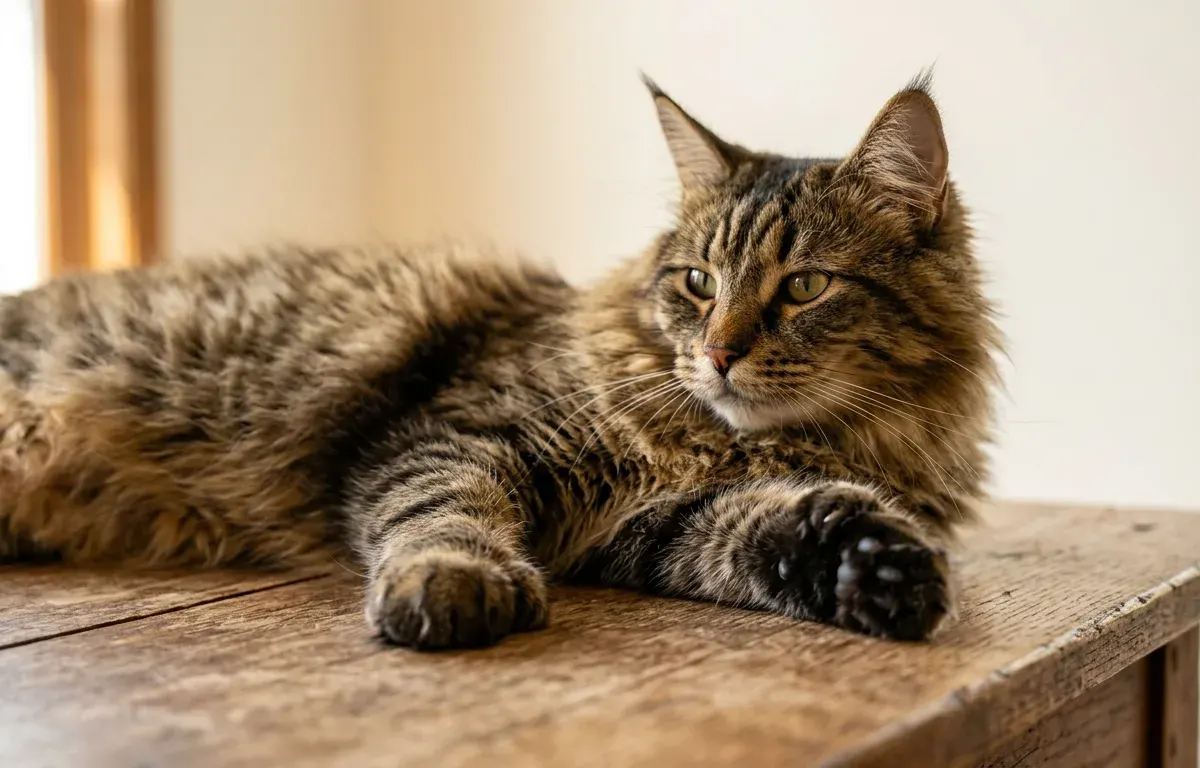
Counting the toes on a Maine Coon reveals fascinating insights into feline anatomy, evolutionary history, and genetic inheritance. While most companion felines walk on 18 standard digits, the Maine Coon’s deep New England heritage has preserved a notable population of multi-toed cats. Understanding whether your cat has standard or polydactyl paws helps ensure proper grooming, claw care, and breed standard awareness.
Standard Maine Coon Toe Count and Anatomy
Under normal biological standards, a typical Maine Coon cat has exactly 18 toes across its four feet. The front paws each feature five distinct digits, consisting of four ground-bearing walking toes and one medial dewclaw positioned slightly higher on the inner wrist. The hind paws each feature four ground-bearing walking digits. This 5-5-4-4 anatomical configuration represents the standard digit distribution shared by the majority of domestic cat breeds.
The feline dewclaw functions much like an inner stabilizing digit, helping cats grip prey, scale rough surfaces, and maintain balance during rapid direction changes. When evaluating adult frame density alongside how big do Maine Coon cats get, the breed’s heavy bone structure and dense interdigital fur tufts make its feet appear substantial, even on cats possessing the standard 18-toe layout. Similar heavy-boned proportions appear when examining how big do Ragdoll cats get, where broad paw bases support substantial adult frames without extra digits.
In standard championship show rings, judges inspect each foot to confirm this exact anatomical count. According to the official Cat Fanciers’ Association (CFA) Maine Coon breed standard, competition Maine Coons must possess five toes in front and four toes behind, with any deviation in digit count resulting in disqualification from standard classes.
Typical Digit Distribution Across Paws
The table below contrasts standard feline digit distribution against the typical ranges observed in polydactyl Maine Coon populations:
| Paw Location | Standard Maine Coon Count | Polydactyl Maine Coon Range | Anatomical Structure |
|---|---|---|---|
| Front Left Paw | 5 digits | 5 to 7 digits | 4 walking toes plus 1 standard dewclaw (or 2 to 3 extra thumb digits) |
| Front Right Paw | 5 digits | 5 to 7 digits | 4 walking toes plus 1 standard dewclaw (or 2 to 3 extra thumb digits) |
| Rear Left Paw | 4 digits | 4 to 7 digits | 4 walking toes (or 1 to 3 extra digits; extra rear digits occur almost exclusively alongside front polydactyly) |
| Rear Right Paw | 4 digits | 4 to 7 digits | 4 walking toes (or 1 to 3 extra digits; extra rear digits occur almost exclusively alongside front polydactyly) |
| Total Digit Count | Exactly 18 toes | 19 to 28 toes | Baseline 18 toes vs. wide mitten or snowshoe configurations |
How Many Toes Does a Maine Coon Have (Extreme Ranges and Records)?
While 18 is the standard baseline for non-polydactyl cats, how many toes a Maine Coon cat can have as an individual varies widely across the breed. Felines carrying the polydactyly gene express extra digits in different numerical combinations. Most polydactyl Maine Coons have one or two additional toes on each front foot, bringing their total count to 20, 22, or 24 toes.
On rare occasions, individual cats express supernumerary digits on all four feet. The official Guinness World Record for the most toes on a cat stands at 29 digits, documented on a Maine Coon named Erebus in May 2026. This achievement surpassed the previous long-standing record of 28 toes held by felines named Jake and Toby (each possessing seven fully articulated digits on every paw). While 28 or 29 toes represents an extreme phenotypic expression, finding six or seven toes on the front paws of a polydactyl Maine Coon is relatively common among dedicated heritage lines.
Do Maine Coon Cats Have Extra Toes? Phenotypes and Prevalence
Not all Maine Coon cats have extra toes, but the breed has a stronger historical and genetic association with polydactyly than almost any other recognized pedigree feline. Many modern pet owners discover that their cat has standard five-toed front paws, while others adopt kittens displaying oversized, thumb-like front feet.
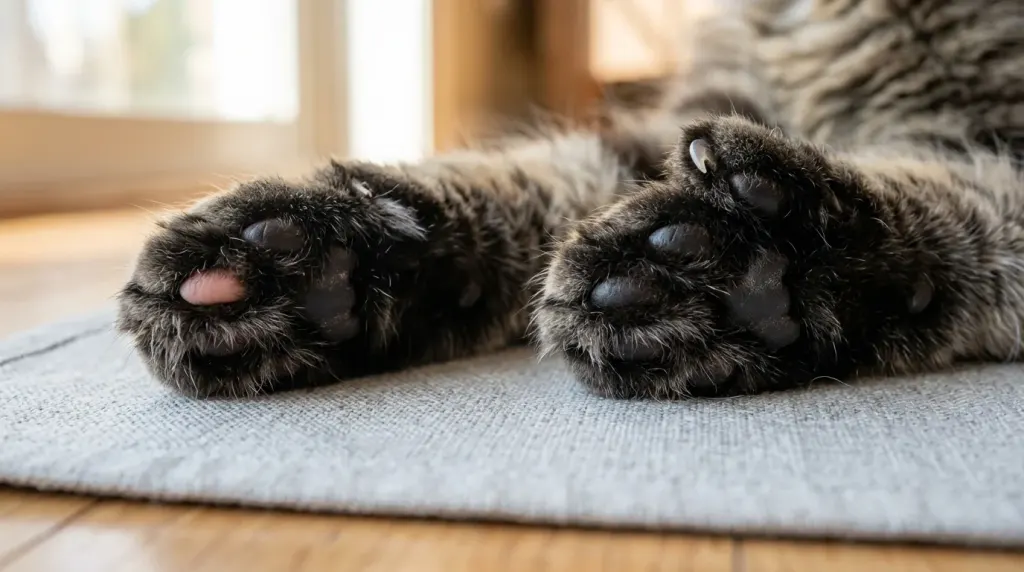
Polydactyl paws in Maine Coons generally present in two primary anatomical forms:
- Preaxial Polydactyly (“Mitten Paws” or “Thumb Cats”): This is the most common form in the breed. Extra digits develop on the medial side (the inside edge) of the front paws, producing an enlarged thumb-like structure. These supplemental digits often possess remarkable dexterity, allowing cats to grasp toys, manipulate objects, and steady themselves on narrow ledges.
- Patty Paws or Snowshoe Paws: In this configuration, supernumerary digits form alongside the regular walking toes rather than creating an isolated thumb. The paw expands outward like a wide paddle, significantly increasing the overall surface area of the foot pad.
Importantly, supernumerary digits in Maine Coons are complete anatomical structures. They contain their own phalangeal bones, joints, vascular supplies, tendons, and retractable claws, rather than forming non-functional skin tags. This robust structural framework provides a broad support base that distributes body pressure efficiently, which becomes particularly beneficial when assessing how much does a Maine Coon cat weigh across adult development.
Are All Maine Coons Polydactyl?
No, the majority of modern registered Maine Coons are not polydactyl. Historical records and breed preservation registries indicate that approximately 40 percent of the original, native Maine cat population in the 19th century carried extra digits. In the rugged New England climate, natural selection favored cats with broad, multi-toed feet because oversized paws distributed body weight across deep snow drifts and provided superior traction on icy surfaces.
However, when major feline associations established formal conformation standards in the mid-20th century, show rules penalized extra digits. As a result, commercial show breeders selected against polydactyly for several decades, reducing its prevalence in mainstream show lines. Today, polydactyl Maine Coons represent a distinct, highly treasured variety maintained by specialized heritage catteries.
Understanding how genetic traits interact in the breed, similar to coat and color genetics discussed in are there short hair Maine Coon cats, shows how selective breeding shapes physical traits across generations.
Why Do Maine Coon Cats Have Extra Toes? Genetics and Evolutionary History
Extra toes in Maine Coons develop through an inherited genetic mechanism rather than spontaneous developmental accidents. Feline polydactyly is inherited primarily as an autosomal dominant trait with variable expressivity and incomplete penetrance. In most cases, a kitten develops extra digits after inheriting a single copy of the mutated allele from a polydactyl parent. However, because the trait exhibits incomplete penetrance, some cats carry the dominant mutation without physically developing extra toes, remaining standard 18-toed non-penetrant carriers that can still transmit the gene to their offspring.
According to veterinary genetics research published in the Journal of Feline Medicine and Surgery, feline polydactyly in North American Maine Coon bloodlines is linked to point mutations in the Zone of Polarizing Activity Regulatory Sequence (ZRS), a long-range enhancer controlling the Sonic Hedgehog (SHH) gene. During normal embryonic development, the Zone of Polarizing Activity (ZPA) produces SHH exclusively along the posterior margin of the limb bud to direct digit patterning. Point mutations in the ZRS disrupt this restriction, triggering ectopic expression of SHH at the anterior (medial) margin of the developing limb bud, which stimulates the growth of additional digital rays and phalanges.
Because the gene displays variable expressivity alongside incomplete penetrance, physical expression varies significantly across related cats. Siblings from the same litter inheriting the identical mutation can develop different digit numbers (such as six toes on each front paw for one kitten and seven on the front with five on the back for another), while non-penetrant siblings retain a standard 18-toe layout despite carrying the allele.
Historically, this trait provided a tangible survival advantage. Early Maine Coons worked as barn cats and maritime mousers on sailing ships along the New England coast. Their broad, multi-toed feet acted like natural snowshoes across harsh winter drifts and gave them superior climbing grip on pitching ship decks during rough Atlantic crossings. This rugged working heritage supported remarkable physical stamina, which explains why prospective owners researching how long do Maine Coon cats live discover that the breed retains strong natural constitution. Similar health resilience and lifespan patterns appear across other pedigree cats, where genetic health screenings parallel the life expectancy factors seen in how long do Ragdoll cats live.
Feline Registry Standards: CFA vs. TICA Show Rules
Official feline registries hold differing policies regarding polydactyl Maine Coons in competitive show rings:
- Cat Fanciers’ Association (CFA): Enforces a strict 5-front, 4-back digit requirement for championship classes. Polydactyl Maine Coons can be registered and used in breeding programs to preserve genetic diversity, but they cannot compete for championship titles.
- The International Cat Association (TICA): Formally recognizes the Maine Coon Polydactyl (MCP) as a distinct championship breed group (since May 1, 2015). Cats with up to 7 toes per foot can compete directly for titles, provided the digits are straight, functional, and ground-bearing.
- Fédération Internationale Féline (FIFe) & Governing Council of the Cat Fancy (GCCF): Strictly enforce standard 18-digit conformation for European championship show classes, viewing polydactyly as a non-competitive heritage trait.
Strict anatomical scrutiny in feline exhibition rings parallels the rigorous standard evaluations conducted at premier canine conformation events. Just as historic triumphs prompt pet enthusiasts to ask did a Pug win the dog show following Westminster ring victories, feline judges assess whether structural variations meet precise breed guidelines. In both cat and dog fancy rings, judges verify physical proportions against established breed limits, similar to how conformation standards regulate weight and bone density when measuring how big do French Bulldogs get.
Polydactyly Health Considerations and Paw Care
Preaxial polydactyly in Maine Coons is a benign, non-syndromic physical variation. Clinical veterinary evaluations confirm that extra digits develop without skeletal malformations, joint instability, or early-onset arthritis. Polydactyl cats run, jump, and climb with the same agility and strength as standard felines, experiencing healthy lifespans comparable to the active longevity profiles seen in companion pets like how long do French Bulldogs live.
Benign Polydactyly vs. Radial Hypoplasia (Structural Limb Defect)
It is crucial to distinguish harmless preaxial polydactyly from congenital skeletal conditions such as radial hypoplasia (sometimes referred to as twisty cat syndrome).
True feline polydactyly involves duplicate digits attached to normal carpal or tarsal bones, with completely straight, healthy radius and ulna foreleg bones. In contrast, radial hypoplasia is a debilitating condition where the radius bone is underdeveloped or missing entirely, causing severely twisted forelegs and joint disability. Maine Coons with standard polydactyly have straight, robust legs and normal bone architecture. Polydactyly in Maine Coons is an isolated, benign anatomical trait that does not compromise orthopedic stability or cause early-onset arthritis.
Note: If an overgrown accessory claw pierces the digital pad tissue, consult a veterinarian for sterile extraction and antiseptic treatment rather than pulling the embedded claw at home.
Step-by-Step Grooming and Nail Care for Extra Toes
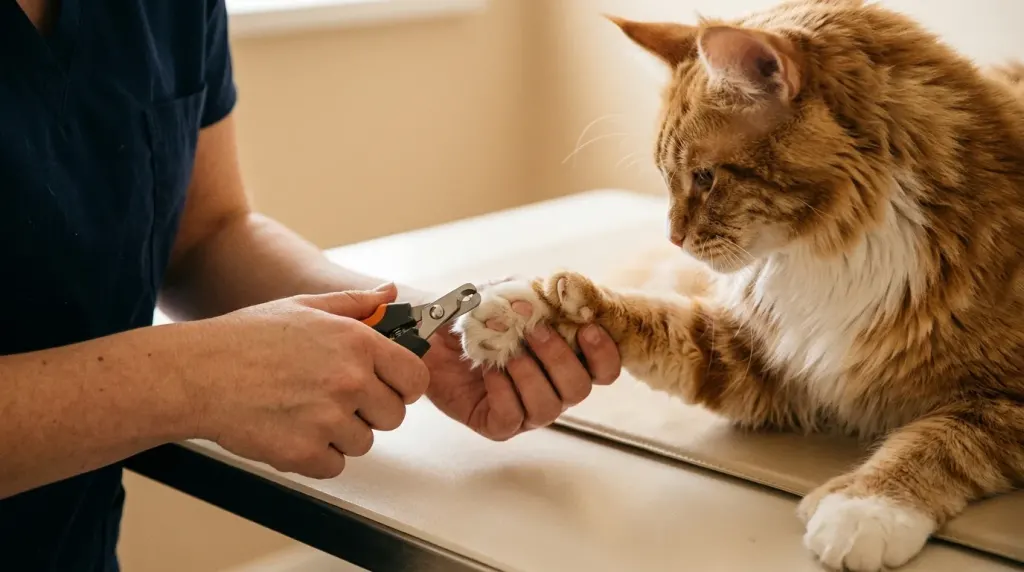
While polydactyly does not create internal medical complications, regular claw maintenance is essential to prevent ingrown nails on accessory digits:
- Bi-Weekly Paw Inspections: Check the recessed crevices between the thumb digit and the main paw pad. Claws on accessory dewclaws often do not contact scratching posts and will continue growing in a circular arc.
- Part the Interdigital Fur: Maine Coons have dense tufts of fur between their toe pads. Gently part the hair to locate small, hidden claws nestled between duplicate digits.
- Trim the Sharp Tips Safely: Use sharp cat nail clippers to snip the clear hook of each claw while strictly avoiding the pink, vascular quick.
- Clean Deep Folds: Wipe between extra digital skin folds with a damp cloth if litter granules or dirt accumulate.
You can easily incorporate these routine foot inspections into your broader schedule for how to groom a Maine Coon, ensuring coat and paw health are managed together.
Frequently Asked Questions About Maine Coon Toes
Do polydactyl Maine Coons have bigger paws?
Yes. Polydactyl Maine Coons have broader metacarpal and metatarsal skeletal bases, wider digital pads, and extra toe rays. Combined with the breed’s natural bone density and dense paw tufts, their feet appear noticeably wider and larger than standard feline paws.
Are polydactyl Maine Coon kittens more expensive?
Polydactyl kittens from preservation breeders often command a slight price premium due to dedicated genetic tracking and strong pet demand, though standard adoption costs generally align with the overall pricing structure for Maine Coon kittens from reputable breeders.
Can two standard Maine Coons produce a polydactyl kitten?
Yes, although it is uncommon. Feline polydactyly is inherited as an autosomal dominant trait with incomplete penetrance, meaning a cat can carry the mutated allele without physically displaying extra digits. If an 18-toed parent is a non-penetrant carrier of the dominant gene mutation, it can pass the allele to its offspring and produce polydactyl kittens.
Does having extra toes hurt a Maine Coon?
No. Polydactyly is a painless anatomical variation. Extra digits articulate naturally with normal tendons and muscles. As long as owners trim accessory claws regularly to prevent ingrown nails, polydactyl cats experience complete comfort throughout their lives.
Conclusion
Standard Maine Coon cats possess 18 toes distributed across four paws, while polydactyl individuals carry between 19 and 28 or more digits without compromising agility or vitality. Regular nail trimming on accessory claws and routine interdigital hygiene ensure that multi-toed Maine Coons enjoy active, comfortable lives as cherished family companions.
Leave a Reply