
Table of Contents
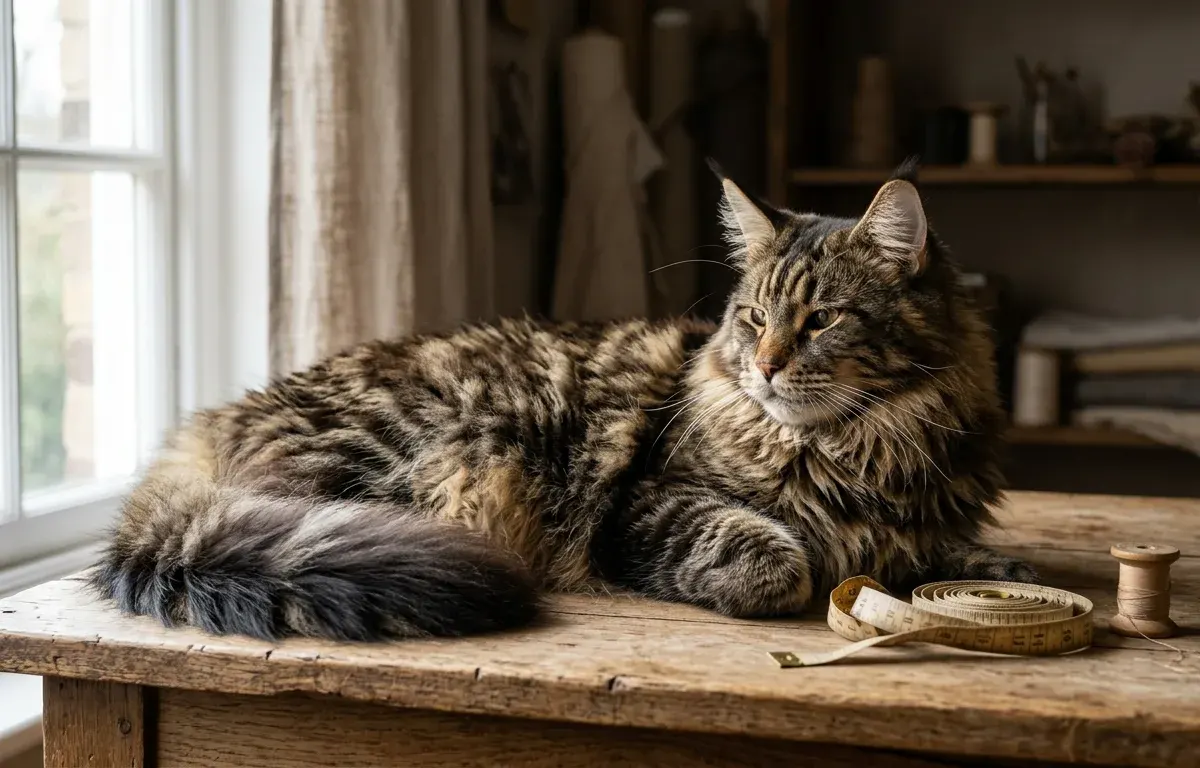
When evaluating how big do Maine Coon cats get, adult males typically weigh between 15 and 25 pounds (6.8 to 11.3 kg), while adult females range from 8 to 15 pounds (3.6 to 6.8 kg). Standing 10 to 16 inches (25 to 41 cm) tall at the shoulder, their total body length spans 30 to 40 inches (76 to 101 cm) or more from nose to tail tip. While standard domestic cats finish growing by their first birthday, Maine Coons develop gradually across several years depending on bloodline and sex to build their heavy bone structure and dense muscle frame.
- Adult male Maine Coons average 15 to 25 pounds (6.8 to 11.3 kg), whereas females average 8 to 15 pounds (3.6 to 6.8 kg).
- Standing height reaches 10 to 16 inches (25 to 41 cm), with total nose to tail length commonly exceeding 38 to 40 inches (96 to 101 cm).
- Full physical maturity requires several years of steady development because their growth plates close later than standard felines.
- At 8 weeks old, kittens weigh 1.5 to 3.5 pounds (680 to 1,600 grams), roughly twice the size of standard domestic kittens.
- The Guinness World Record for the longest domestic cat belongs to a Maine Coon measuring 48.5 inches (123 cm).
Average Maine Coon Size: Weight, Height, and Length
An average adult Maine Coon weighs between 8 and 25 pounds depending on sex and bloodline, stands 10 to 16 inches tall at the withers, and measures 30 to 40 inches long from the tip of the nose to the end of the tail bone.
Physical development in this breed exhibits pronounced sexual dimorphism. Males possess broad chests, heavy bone density, and substantial musculature that place them well above standard household cats. According to The Cat Fanciers’ Association (CFA) breed standard, the Maine Coon is a solid, rugged cat with a medium to large body build where males are disproportionately larger than females. Healthy adult males regularly weigh between 15 and 25 pounds (6.8 to 11.3 kg), with some large-boned individuals reaching up to 28 pounds without carrying excess fat.
Adult females present a noticeably more refined physical profile while maintaining the characteristic rectangular silhouette of the breed. Most mature females weigh between 8 and 15 pounds (3.6 to 6.8 kg), which is roughly comparable to large domestic shorthairs or smaller pedigrees. Prospective owners who evaluate large companion felines often compare these dimensions to other heavy breeds by identifying Ragdoll cat physical traits, where body mass is distributed across a stockier, less elongated torso.
| Physical Metric | Adult Male Maine Coon | Adult Female Maine Coon | Standard Domestic Cat |
|---|---|---|---|
| Average Weight | 15 to 25 lbs (6.8 to 11.3 kg) | 8 to 15 lbs (3.6 to 6.8 kg) | 8 to 10 lbs (3.6 to 4.5 kg) |
| Shoulder Height | 10 to 16 inches (25 to 41 cm) | 8 to 14 inches (20 to 35 cm) | 8 to 10 inches (20 to 25 cm) |
| Total Length (Nose to Tail) | 36 to 40+ inches (91 to 101+ cm) | 30 to 36 inches (76 to 91 cm) | 28 to 30 inches (71 to 76 cm) |
| Time to Full Maturity | 3 to 5 years | 3 to 4 years | 10 to 12 months |
Maine Coon Height and Length: Dimensions Beyond the Scale
Standing height for a Maine Coon ranges from 10 to 16 inches (25 to 41 cm), but the most dramatic physical dimension of the breed is overall body length, which regularly spans 30 to 40 inches (76 to 101 cm) when measured from the tip of the nose to the end of the tail.
The breed conformation standard outlined by The International Cat Association (TICA) breed standard requires a long, rectangular body with a broad chest and a tail that is at least as long as the torso. When gently laid forward along the spine, a correct Maine Coon tail reaches all the way to the shoulder blades. This flowing, heavily furred appendage adds 12 to 16 inches of visual length and functions in nature as an insulating wrap during cold weather.
Large paws further enhance the physical presence of the breed. Maine Coons feature wide, round paws equipped with dense tufts of hair extending up to an inch beyond the toes. These tufted feet act as natural snowshoes, distributing body weight evenly across snowy terrain. Historically, a significant portion of the foundation stock in New England carried polydactyl genes, resulting in extra toes that created an even wider base of support. Maintaining such a vast coat requires structured grooming schedules, much like understanding how often you should bathe a French Bulldog to keep skin folds and dense fur free of debris without stripping natural protective oils.
Maine Coon Kitten Growth: Weight Milestones from 8 Weeks to 1 Year
At 8 weeks of age, a healthy Maine Coon kitten weighs between 1.5 and 3.5 pounds (680 to 1,600 grams), gaining mass at a steady rate of approximately 1.5 to 2.5 pounds each month throughout the first year of life.
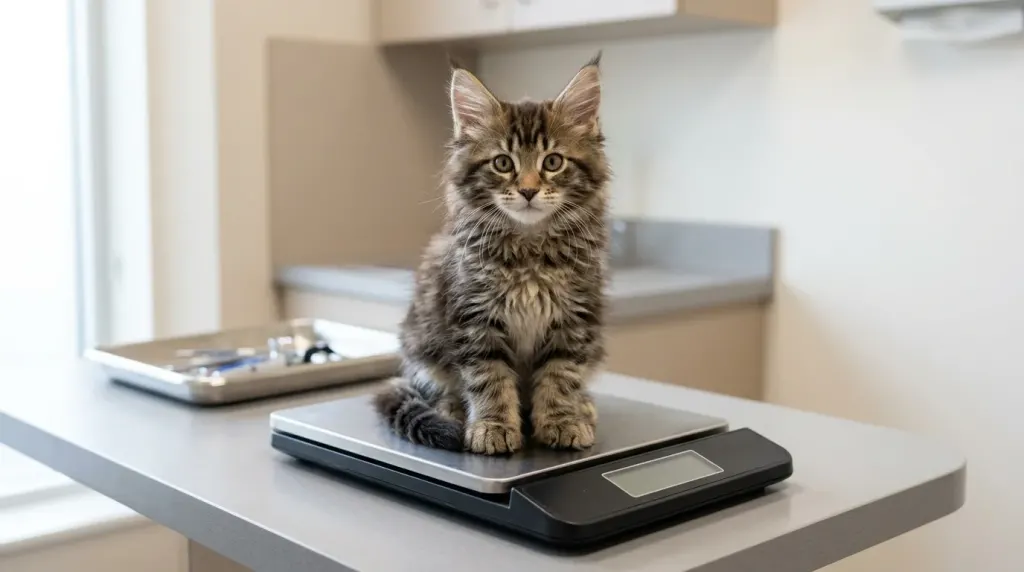
Standard domestic kittens generally weigh around 1.5 to 2.0 pounds at 8 weeks and gain about 1 pound per month, finishing their primary juvenile growth cycle around their first birthday depending on the individual cat. In contrast, Maine Coon kittens maintain a prolonged, rapid growth velocity. Male kittens frequently hit 3 pounds before 8 weeks if they come from European bloodlines, doubling the weight of ordinary domestic litters.
Establishing consistent feeding routines and boundary habits during these high-growth months mirrors the structured consistency recommended in early training methods for a Pug dog, preventing unruly behaviors before the animal reaches full physical power. Tracking milestone weights helps owners ensure steady skeletal development without encouraging excessive adipose deposition.
| Age Milestone | Male Weight Range | Female Weight Range | Average Monthly Velocity | Developmental Focus |
|---|---|---|---|---|
| 8 Weeks | 2.0 to 3.5 lbs (0.9 to 1.6 kg) | 1.5 to 3.0 lbs (0.7 to 1.4 kg) | 0.5 lbs / week | Weaning and initial skeletal frame development |
| 3 Months (12 Weeks) | 4.0 to 6.5 lbs (1.8 to 2.9 kg) | 3.5 to 5.5 lbs (1.6 to 2.5 kg) | 2.0 lbs / month | Rapid leg bone lengthening and paw growth |
| 6 Months | 7.5 to 12.0 lbs (3.4 to 5.4 kg) | 6.0 to 9.0 lbs (2.7 to 4.1 kg) | 1.5 to 2.0 lbs / month | Torso elongation and adult coat texture emergence |
| 9 Months | 10.0 to 15.0 lbs (4.5 to 6.8 kg) | 7.5 to 11.0 lbs (3.4 to 5.0 kg) | 1.0 to 1.5 lbs / month | Muscular thickening and jawline broadening |
| 12 Months (1 Year) | 12.0 to 17.0 lbs (5.4 to 7.7 kg) | 9.0 to 12.5 lbs (4.1 to 5.7 kg) | 0.5 to 1.0 lbs / month | Completion of primary juvenile bone growth |
Growth Timeline: When Do Maine Coons Reach Full Size?
Maine Coons do not finish growing at 12 months of age; they experience an extended development window that often continues until roughly four to five years of age depending on gender and genetics.
The biological explanation for this delayed maturation lies in feline epiphyseal plate closure. In typical domestic cats, the growth plates at the ends of the long bones fuse completely around their first year, capping skeletal height and length. In giant natural breeds like the Maine Coon, chondrocyte proliferation in the growth plates remains active for several additional years.
Development occurs across three distinct structural phases:
- Phase 1: Skeletal Framework (0 to 12 Months): The kitten builds the foundation of its long spine, wide ribcage, and elongated leg bones. At 1 year old, the cat has achieved approximately 75 percent of its final adult length and height.
- Phase 2: Muscle Density and Frame Broadening (Years 1 through 3): Bone lengthening slows down while muscle volume increases substantially. The shoulders widen, the deep rectangular chest drops, and the cat gains solid core strength.
- Phase 3: Mature Mass and Full Coat Density (Years 3 through 5): The cat finishes filling out its frame. The square muzzle reaches its full definition, the facial ruff reaches maximum thickness, and the body achieves its ultimate weight equilibrium.
This prolonged physical maturation requires sustained nutritional vigilance across early adulthood, similar to managing the long-term wellness and extended lifespan of Ragdoll cats that also develop at a gradual pace. Monitoring baseline body metrics from juvenile stages through senior years provides the same longevity benefits seen when tracking lifespan expectations for Pug dogs across their developmental phases.
Maximum Size Potential: How Big Can a Maine Coon Cat Get?
While typical domestic pet Maine Coons top out at 18 to 22 pounds for males, exceptional specimens from heavy European bloodlines can reach 25 to 28 pounds while maintaining an ideal body condition score.
Online claims of 35 or 40 pound healthy Maine Coons are almost universally exaggerated by perspective photography or involve morbidly obese cats. A structurally massive Maine Coon has heavy bone girth, a broad skull, and a long ribcage, but its body fat should remain minimal. Carrying excess weight puts severe mechanical stress on hip joints and increases cardiac workload.
Preventing excess fat accumulation on a large frame requires calibrated caloric intake and activity tracking, echoing the lean-body strategies vital in weight management and daily care for a Pug dog prone to weight-related mobility challenges. Bloodlines also influence maximum size potential: European lines emphasize heavy muzzle definition and bone mass, whereas American lines prioritize overall physical balance. Breeding for sheer mass over structural balance creates severe orthopedic risks. Registries like the CFA explicitly mandate that show quality must never be sacrificed for sheer size, emphasizing balanced musculoskeletal proportion and functional agility.
Record Breakers: How Big Is the Biggest Maine Coon Cat in the World?
The all-time Guinness World Record for the longest domestic cat belongs to a purebred Maine Coon named Stewie (Mymains Stewart Gilligan), who measured 48.5 inches (123 cm) from the tip of his nose to the end of his tail bone.
Stewie was officially measured in Reno, Nevada, in August 2010. His record demonstrated the remarkable length potential of the breed, spanning more than 4 feet in total length. In addition to Stewie, several other Maine Coons have held international size titles:
- Barivel (Italy): Verified by Guinness World Records in 2018 as the longest living domestic cat, measuring 47.2 inches (120 cm).
- Ludo (United Kingdom): Held the title in 2016 with a verified length of 46.6 inches (118.3 cm) and a body weight exceeding 34 pounds.
- Omar (Australia): Gained global attention measuring over 47 inches and weighing roughly 30 pounds, living comfortably as a family companion.
These verified measurements confirm that while wild hybrid felines may stand taller at the shoulder, the Maine Coon holds an undisputed position as the longest natural domestic cat breed in recorded history.
Why Are Maine Coons So Big? Evolution, Genetics, and Adaptation
Maine Coons developed their large body mass as a direct evolutionary adaptation to survive the severe sub-zero winters of Maine and the northeastern United States.
This biological phenomenon aligns with Bergmann’s Rule, an ecogeographical principle stating that within a broadly distributed taxonomic clade, populations of larger size are found in colder environments. A larger animal possesses a lower surface-area-to-volume ratio than a smaller animal, which substantially reduces the rate of core body heat loss in freezing temperatures.
Key physical adaptations include:
- Heavy Muscle and Bone Mass: Generated metabolic heat and provided physical endurance to traverse deep snowdrifts while hunting rodents on remote New England farms.
- Dense, Water-Repellent Triple Coat: A short undercoat covered by a long, silky guard coat insulated the cat from ice and freezing rain without matting easily.
- Long, Heavily Furred Tail: Allowed the cat to curl tightly into a ball and wrap its tail over its face and paws to create a warm breathing pocket.
- Large Snowshoe Paws: Wide footpads with stiff tufts between the toes prevented the cat from sinking into deep snow.
Natural selection prioritized hardy, cold-adapted bone structures that withstand harsh environments, in sharp contrast to specialized companion breeds where selective domestic breeding directly shapes longevity and structural health in French Bulldogs over time.
Are All Maine Coon Cats Big? Variations, Runts, and Female Sizes
Not every Maine Coon grows into a giant; healthy purebred adult females frequently weigh between 8 and 11 pounds, and pet-quality bloodlines can produce cats that remain close to standard domestic proportions.
Social media imagery frequently uses forced perspective, holding the cat close to the camera lens with outstretched arms to make an average 15-pound cat look like a 40-pound wild cougar. In reality, a substantial percentage of purebred Maine Coons are moderately sized.
Several factors dictate individual adult dimensions:
- Sex: Females average 30 to 40 percent less body weight than males.
- Parental Genetics: Kittens inherit frame size from the combined lineage of both the sire and dam.
- Litter Size and Runt Status: Kittens born significantly smaller in large litters may take longer to catch up, occasionally finishing slightly below the breed average.
- Pediatric Nutrition: Adequate protein intake during the first 24 months allows the skeletal frame to reach its full genetic potential.
- Neutering and Spaying Age: Early desexing before growth plate closure can slightly delay fusion, sometimes resulting in longer leg bones and a taller, leaner adult cat.
Tailoring daily care to the individual animal’s actual frame size rather than idealized breed myths ensures better health outcomes, a principle central to individual wellness routines to care for a French Bulldog of varying builds.
How Big Will a Maine Coon Mix Get? Predicting Mixed Breed Size
A Maine Coon mix typically reaches an adult weight of 10 to 18 pounds (4.5 to 8.2 kg), falling between the dimensions of an average domestic cat and the upper parameters of a purebred Maine Coon.
Because body size is a polygenic trait controlled by dozens of alleles, crossbreeding a Maine Coon with a standard domestic shorthair or domestic longhair generally moderates the final frame size. When crossed with another large pedigree, prospective owners can review how big Ragdoll cats get to understand how dual-large-breed genetics influence adult stature.
| Crossbreeding Combination | Predicted Adult Weight | Expected Shoulder Height | Key Physical Identifiers |
|---|---|---|---|
| Maine Coon x Domestic Shorthair | 10 to 15 lbs (4.5 to 6.8 kg) | 10 to 12 inches (25 to 30 cm) | Moderately long torso, subtle ear tufts, medium coat density |
| Maine Coon x Domestic Longhair | 12 to 18 lbs (5.4 to 8.2 kg) | 11 to 14 inches (28 to 35 cm) | Full ruff, bushy tail, rectangular back, heavy bone structure |
| Maine Coon x Ragdoll Mix | 12 to 20 lbs (5.4 to 9.1 kg) | 11 to 15 inches (28 to 38 cm) | Heavy muscular density, plush coat, large round paws |
| Maine Coon x Siamese Mix | 9 to 14 lbs (4.1 to 6.3 kg) | 10 to 13 inches (25 to 33 cm) | Lean elongated body, wedge-shaped head, vocal temperament |
Physical cues in young kittens can indicate whether a mix will lean toward the larger end of the spectrum. Kittens that inherit heavy bone structure display noticeably oversized paws with loose skin as early as two to three months of age, along with prominent ear furnishings and a distinct rectangular body shape.
Is the Maine Coon the Largest Cat Breed? Comparison with Ragdoll, Savannah & Norwegian Forest Cat
The Maine Coon is officially recognized as the largest non-hybrid domestic cat breed, surpassing other popular large pedigrees in overall skeletal length and bone substance.
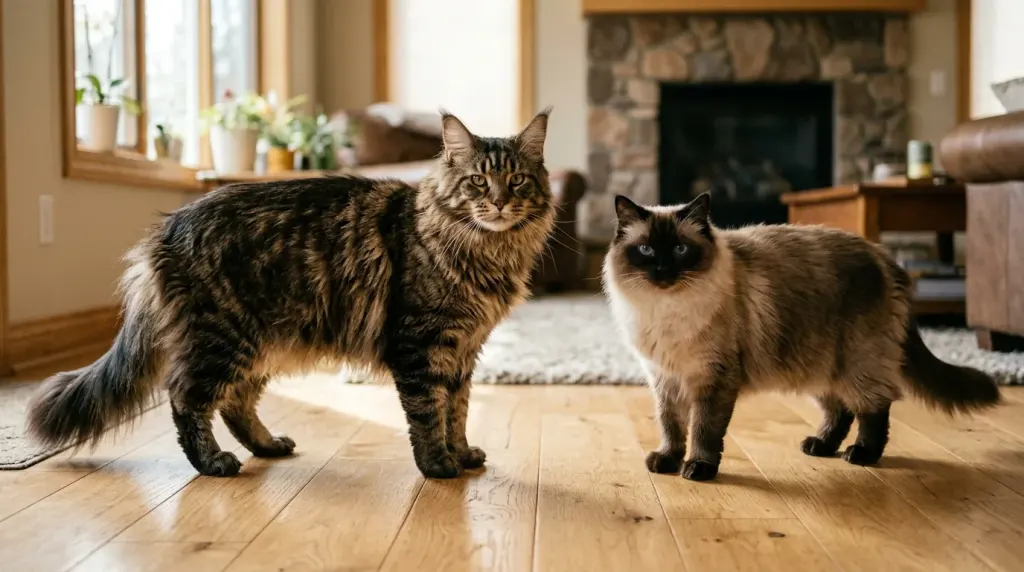
When comparing giant felines, it is essential to distinguish between natural domestic breeds and wild hybrid crosses. Early generation Savannah cats (F1 and F2), which are crosses between domestic cats and the wild African Serval, can stand 16 to 19 inches tall at the shoulder. However, because Savannahs are wild hybrids, the Maine Coon remains the largest purely domestic cat.
Prospective owners comparing large domestic breeds often weigh acquisition and maintenance budgets, reviewing the cost to buy a Ragdoll cat alongside the ongoing expenses of feeding and housing a massive Maine Coon. Budgeting for specialized large-breed veterinary care, heavy-duty accessories, and high-protein nutrition often reaches financial commitments comparable to the initial acquisition costs for French Bulldogs and other sought-after pedigree companions.
| Breed | Average Male Weight | Average Female Weight | Shoulder Height | Total Body Length | Growth Timeline |
|---|---|---|---|---|---|
| Maine Coon | 15 to 25 lbs (6.8 to 11.3 kg) | 8 to 15 lbs (3.6 to 6.8 kg) | 10 to 16 in (25 to 41 cm) | 30 to 40+ in (76 to 101+ cm) | 3 to 5 years |
| Savannah Cat (F1/F2 Hybrid) | 14 to 25 lbs (6.4 to 11.3 kg) | 12 to 18 lbs (5.4 to 8.2 kg) | 14 to 19 in (35 to 48 cm) | 20 to 25 in (51 to 63 cm) | 2 to 3 years |
| Ragdoll | 12 to 20 lbs (5.4 to 9.1 kg) | 10 to 15 lbs (4.5 to 6.8 kg) | 9 to 11 in (23 to 28 cm) | 24 to 36 in (61 to 91 cm) | 3 to 4 years |
| Norwegian Forest Cat | 12 to 18 lbs (5.4 to 8.2 kg) | 8 to 12 lbs (3.6 to 5.4 kg) | 9 to 12 in (23 to 30 cm) | 28 to 36 in (71 to 91 cm) | 3 to 4 years |
| Siberian Cat | 12 to 17 lbs (5.4 to 7.7 kg) | 8 to 12 lbs (3.6 to 5.4 kg) | 9 to 11 in (23 to 28 cm) | 24 to 32 in (61 to 81 cm) | 3 to 5 years |
Living with a Giant Cat: Home Preparation, Weight Management & Health Considerations
Accommodating an adult Maine Coon requires specialized home accessories, careful space planning, and proactive veterinary oversight to maintain lifelong joint and cardiac health.
Standard feline supplies sold in commercial pet stores are frequently too small for a 20-pound cat. Litter boxes must measure at least 24 inches long by 18 inches wide, or owners can use large plastic storage totes with an entry hole cut into the side. Cat trees must feature reinforced solid wood posts with heavy bases exceeding 25 pounds to prevent tipping when an adult leaps onto an upper platform.
In multi-pet households, a mature 20-pound Maine Coon occupies comparable floor space and spatial presence to small dog breeds; evaluating how big French Bulldogs get helps owners plan layout zones and feeding stations that prevent territory conflicts. Similarly, comparing home dimensions against how big Pug dogs get ensures that shared bedding areas, ramp access, and feeding stations are ergonomically proportioned for both species.
Note: Managing a Maine Coon requires maintaining an ideal body condition score (BCS 4 to 5 out of 9). Never overfeed a cat to force rapid weight gain, as excess adipose tissue accelerates hip dysplasia degeneration and exacerbates cardiac strain in felines predisposed to hypertrophic cardiomyopathy (HCM).
Frequently Asked Questions About Maine Coon Size
How big is an 8-week-old Maine Coon kitten?
At 8 weeks of age, a healthy Maine Coon kitten weighs between 1.5 and 3.5 pounds (680 to 1,600 grams). Males typically weigh 2.0 to 3.5 pounds, while females average 1.5 to 3.0 pounds. This early mass represents roughly double the weight of standard domestic kittens of identical age.
When do Maine Coons stop growing?
Maine Coons typically complete their full physical growth around four to five years of age, depending on individual genetics and sex. They achieve the majority of their skeletal length and standing height during their first two years, while muscular broadening, deep chest development, and full adult coat density continue developing through subsequent years.
Why are female Maine Coons so much smaller than males?
Female Maine Coons exhibit pronounced sexual dimorphism governed by genetics and hormonal development. Adult females weigh an average of 8 to 15 pounds, compared to 15 to 25 pounds for males. While females retain the breed’s rectangular profile and tufted ears, their skeletal frame is significantly more refined.
Can a purebred Maine Coon be small?
Yes, a purebred Maine Coon can remain relatively compact, with some healthy adult females weighing between 8 and 10 pounds. Bloodline genetics, large litter competition, or individual metabolic rates can result in a smaller adult frame without indicating any physical disorder or illness.
How can I tell if my Maine Coon is overweight or just large?
You can evaluate body condition by palpating the ribcage and spine. In a healthy large-framed Maine Coon, the ribs are easily felt under a light fat cover without applying heavy pressure, and a visible waistline exists behind the ribs when viewed from above. If the ribs cannot be felt or the abdomen sags with a thick fat pad, the cat is overweight rather than simply large-boned.
Leave a Reply