
Table of Contents
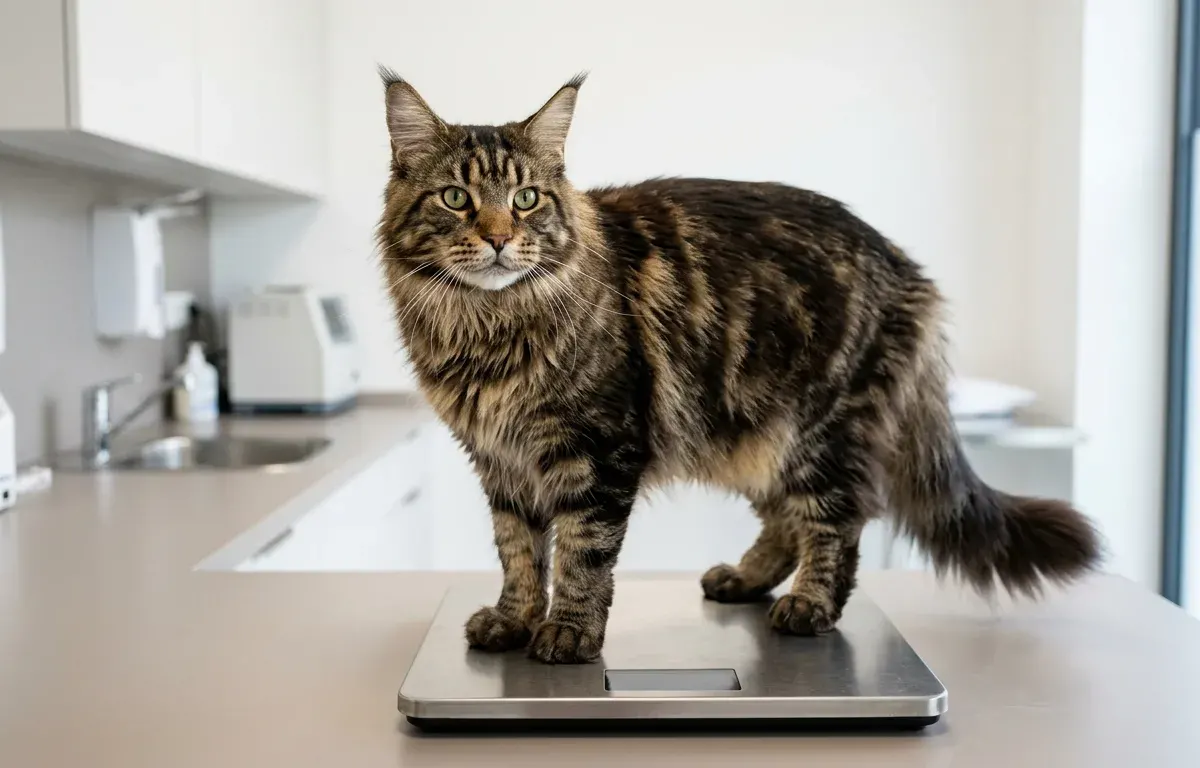
An adult Maine Coon cat typically weighs between 8 and 25 pounds (3.6 to 11.3 kg), depending primarily on biological sex and genetics. Mature male Maine Coons generally weigh between 15 and 25 pounds (6.8 to 11.3 kg), while adult females average between 8 and 15 pounds (3.6 to 6.8 kg). Unlike standard domestic felines that reach full size by 12 months, Maine Coons develop slowly and require 3 to 5 years of steady physical growth to reach their full adult frame, bone density, and muscle mass.
- Adult male Maine Coons average 15 to 25 pounds (6.8 to 11.3 kg).
- Adult female Maine Coons average 8 to 15 pounds (3.6 to 6.8 kg).
- Full physical maturity takes 3 to 5 years of steady growth rather than the standard 12 months.
- Kittens gain roughly 1 to 2 pounds (0.45 to 0.9 kg) per month throughout their first year.
- Heavy bone structure and dense double coats make physical touch and body scoring essential to distinguish lean muscle from obesity.
- Genetics, high-protein nutrition, and controlled activity levels dictate final adult frame size.
Maine Coon Weight Overview
The Maine Coon stands as one of the largest domesticated cat breeds in the world, distinguished by a rectangular body, broad chest, heavy bone structure, and a dense, water-resistant double coat. When pet lovers ask how much does a maine coon cat weigh, the answer reflects a broad spectrum influenced by biological sex, breeding lineage, and a lengthy maturation cycle.
Adult Maine Coons generally weigh between 8 and 25 pounds (3.6 to 11.3 kg) across the entire breed population. While an average domestic shorthair reaches its maximum frame at 9 to 10 pounds (4 to 4.5 kg), a healthy Maine Coon easily surpasses standard feline benchmarks. Prospective cat owners comparing large domestic felines often research how big Ragdoll cats get alongside Maine Coons, as both breeds represent the upper echelon of domestic cat size. Families budgeting for purebred pets also frequently evaluate how much Ragdoll cats cost when selecting a large, affectionate companion animal. However, the Maine Coon features a more rugged, muscular build developed originally for outdoor farm living in harsh New England winters.
According to the official Cat Fanciers’ Association (CFA) Maine Coon breed standard, the breed is classified as a medium to large working cat that is solid, rugged, and well-muscled throughout. The CFA standard explicitly notes that females are noticeably smaller than males and stresses that overall physical balance and structural health must never be sacrificed for sheer weight or bulk. The CFA Maine Coon standard emphasizes that cats must be well-proportioned and that overall quality and balance should never be sacrificed for sheer physical size.
Average Weight of an Adult Maine Coon
Across broad veterinary datasets, the overall average weight of a mature Maine Coon is approximately 15 to 18 pounds (6.8 to 8.2 kg) for males and 10 to 12 pounds (4.5 to 5.4 kg) for females. Combining both sexes yields an overall breed median of roughly 14 to 15 pounds (6.3 to 6.8 kg).
| Measurement Category | Female Maine Coon | Male Maine Coon | Combined Breed Average |
|---|---|---|---|
| Typical Weight Range | 8 to 15 lbs (3.6 to 6.8 kg) | 15 to 25 lbs (6.8 to 11.3 kg) | 8 to 25 lbs (3.6 to 11.3 kg) |
| Average Adult Weight | 10 to 12 lbs (4.5 to 5.4 kg) | 16 to 18 lbs (7.3 to 8.2 kg) | 14 to 15 lbs (6.3 to 6.8 kg) |
| Time to Full Skeletal Size | 3 to 4 years | 4 to 5 years | 3 to 5 years |
| Standard Body Length | 30 to 36 inches (76 to 91 cm) | 36 to 40 inches (91 to 102 cm) | 30 to 40 inches (76 to 102 cm) |
| Typical Shoulder Height | 10 to 14 inches (25 to 36 cm) | 12 to 16 inches (30 to 41 cm) | 10 to 16 inches (25 to 41 cm) |
Understanding these baseline averages helps pet parents set realistic growth expectations. Just as families study lifespan expectations for Ragdoll cats when welcoming a longhair pet, tracking Maine Coon weight against verified breed norms ensures that heavy frames develop without excess adipose tissue putting pressure on developing hips and joints.
Maine Coon Weight Ranges by Gender and Age
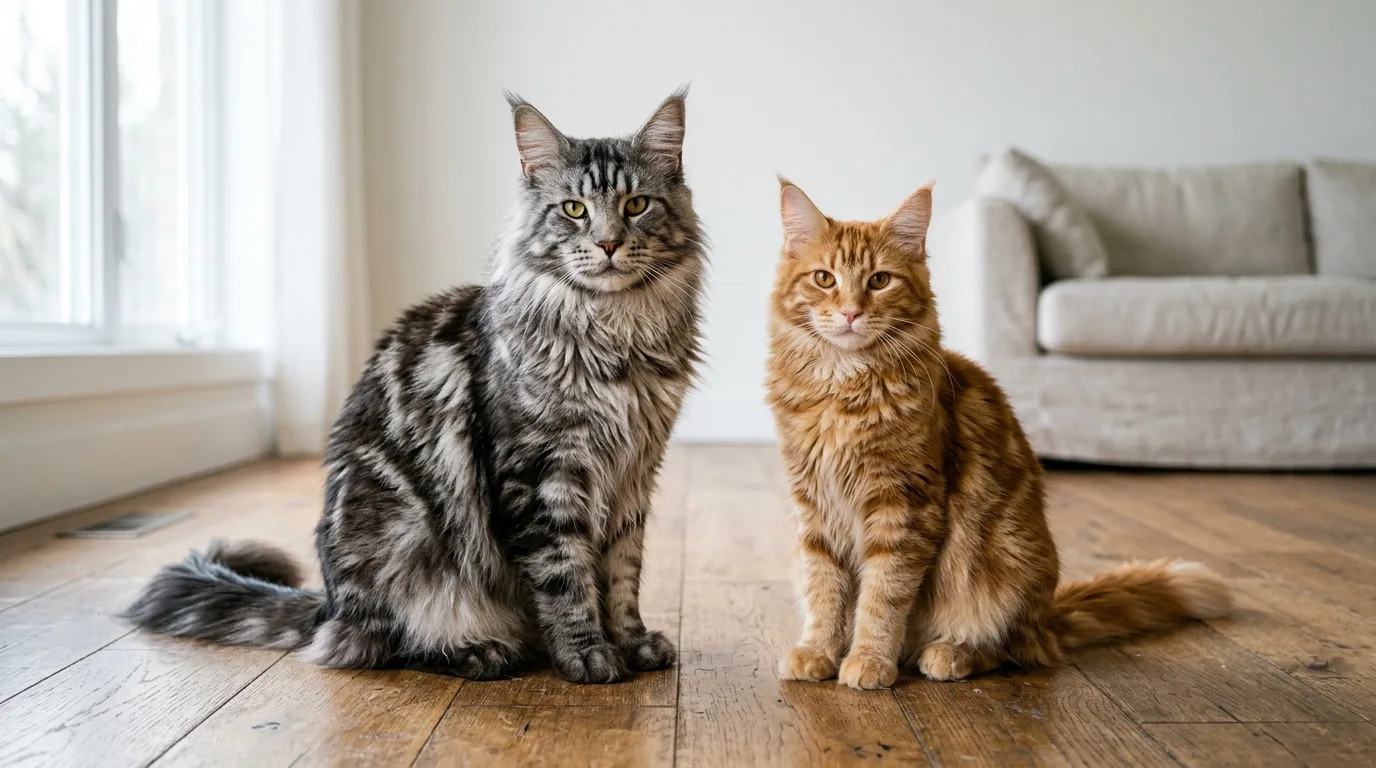
Sexual dimorphism is pronounced in the Maine Coon breed. Male cats consistently develop heavier bones, wider muzzles, broader chests, and substantially greater muscle volume than females. Adult male Maine Coons typically weigh 15 to 25 pounds (6.8 to 11.3 kg), while adult females typically weigh 8 to 15 pounds (3.6 to 6.8 kg).
Female Maine Coon Weight Range
Female Maine Coons typically reach an adult weight between 8 and 15 pounds (3.6 to 6.8 kg). A petite female from working lines may stabilize at 9 to 11 pounds (4.1 to 5.0 kg), maintaining a lean, agile conformation while still possessing the characteristic rectangular torso and bushy tail. Larger females with substantial bone mass frequently reach 13 to 15 pounds (5.9 to 6.8 kg) without carrying surplus body fat.
Male Maine Coon Weight Range
Male Maine Coons typically range from 15 to 25 pounds (6.8 to 11.3 kg) at full maturity. Young adult males often weigh between 14 and 17 pounds (6.3 to 7.7 kg) at two years of age before filling out through the shoulders, chest, and flanks during their fourth and fifth years. Exceptional males with large skeletal frames can reach 22 to 25 pounds (10.0 to 11.3 kg) in prime athletic condition.
When evaluating feline structural development, pet parents interested in identifying distinct physical traits of Ragdoll cats will note that Maine Coons display a much more prominent square muzzle and high cheekbones, complementing their athletic, muscular weight distribution. Weight variations between individual bloodlines are normal. A Maine Coon weighing 13 pounds can be completely healthy and structurally sound if its frame matches its weight. Attempting to force a smaller-framed cat to reach 20 pounds through overfeeding leads directly to feline obesity and orthopedic strain.
Maine Coon Growth Progression and Milestones
Maine Coons do not follow the rapid developmental curve of smaller domestic cats. Standard cats complete approximately 90% of their physical growth within the first 9 to 12 months. In contrast, Maine Coons are one of the slowest-maturing cat breeds, requiring 3 to 5 years to achieve full adult skeletal size, muscle mass, and coat development.
| Age Milestone | Female Weight Range (lbs) | Female Weight Range (kg) | Male Weight Range (lbs) | Male Weight Range (kg) |
|---|---|---|---|---|
| 1 Month (4 weeks) | 0.8 to 1.2 lbs | 0.36 to 0.54 kg | 1.0 to 1.5 lbs | 0.45 to 0.68 kg |
| 3 Months (12 weeks) | 3.0 to 4.5 lbs | 1.36 to 2.04 kg | 4.0 to 6.0 lbs | 1.81 to 2.72 kg |
| 6 Months (24 weeks) | 6.0 to 8.5 lbs | 2.72 to 3.86 kg | 8.0 to 12.0 lbs | 3.63 to 5.44 kg |
| 9 Months | 8.0 to 11.0 lbs | 3.63 to 4.99 kg | 11.0 to 15.5 lbs | 4.99 to 7.03 kg |
| 12 Months (1 Year) | 9.0 to 12.5 lbs | 4.08 to 5.67 kg | 12.5 to 17.5 lbs | 5.67 to 7.94 kg |
| 24 Months (2 Years) | 10.0 to 14.0 lbs | 4.54 to 6.35 kg | 15.0 to 20.0 lbs | 6.80 to 9.07 kg |
| 36 to 60 Months (3-5 Years) | 8.0 to 15.0 lbs | 3.63 to 6.80 kg | 15.0 to 25.0 lbs | 6.80 to 11.34 kg |
During the first 12 months, healthy Maine Coon kittens typically gain approximately 1 to 2 pounds (0.45 to 0.9 kg) per month during their primary growth period from 3 to 9 months of age. Growth often occurs in noticeable spurts where the body elongates before the chest broadens. Much like tracking how big Pug dogs get on a digital pet scale, recording monthly weigh-ins provides an objective record of healthy, steady development. Young animals also require significant rest for tissue repair, similar to managing how much sleep growing puppies need during major developmental growth phases.
Full-Grown Weight and Physical Maturity (3 to 5 Years)
A Maine Coon is not fully grown at one year old. Between 12 and 36 months, linear skeletal growth continues at a moderate pace while long bones solidify. Between 36 and 60 months (3 to 5 years), the cat enters the broadening phase, during which the rib cage expands, neck musculature thickens, and the full ruff and coat density emerge.
Owners must adjust their care routines to support this multi-year growth cycle. High-quality kitten or large-breed growth formulations should often be fed until at least 15 to 18 months of age under veterinary guidance to provide adequate calcium, phosphorus, and protein for sustained skeletal formation.
Comparing companion animal developmental timelines shows that prolonged growth is common among larger pets; for instance, understanding how big French Bulldogs get involves evaluating muscle maturation over 18 to 24 months. Dedicated owners often follow proper care guidelines for French Bulldogs and large cats to safeguard their joint health through tailored physical exercise and high-grade nutrition. For Maine Coons, patience is essential, as a two-year-old male weighing 16 pounds may gain another 4 to 6 pounds of lean muscle before celebrating his fifth birthday.
Maximum Weight and Key Influencing Factors
While online forums frequently circulate claims of 30 to 35-pound house cats, a lean, non-obese Maine Coon rarely exceeds 25 pounds (11.3 kg). Cats exceeding this threshold without clinical obesity possess exceptionally rare genetic structures.
Several primary factors determine where a Maine Coon lands on the weight scale:
- Genetics and Parental Lines: Skeletal framework is highly hereditary. Kittens from European breeding lines often exhibit heavier bone density and broader head structures than traditional American working lines. Prospective buyers reviewing adoption expenses for various purebred pets, including how much French Bulldogs cost, should always ask breeders for the verified adult weights of both parent animals.
- Nutritional Quality and Caloric Balance: A diet rich in animal-based proteins and essential fatty acids supports dense lean muscle development. Free-feeding high-carbohydrate dry kibble, on the other hand, creates fat deposits rather than functional muscle.
- Spay and Neuter Status: Altering a cat affects metabolic rate. Neutered males require careful portion control to prevent post-procedure weight gain from turning into visceral fat.
- Physical Exercise and Vertical Activity: Maine Coons are active jumpers and climbers. Establishing structured routines, similar to daily care routines for Pug dogs that incorporate active exercise, builds muscle tone across the hindquarters and back.
Note: Rapid weight gain after age two that is unaccompanied by increased shoulder width or skeletal lengthening indicates excessive fat deposition rather than breed-specific growth. Consult your veterinarian for a nutritional audit if body profile contours become rounded.
Assessing Body Condition: Muscle Mass vs. Overweight Felines
Because Maine Coons possess heavy coats up to 4 inches long with a thick undercoat and prominent belly ruff, visual inspection alone can be deceptive. A cat that appears massive may simply have a dense winter coat, while an overweight cat may conceal substantial fat padding beneath thick fur.
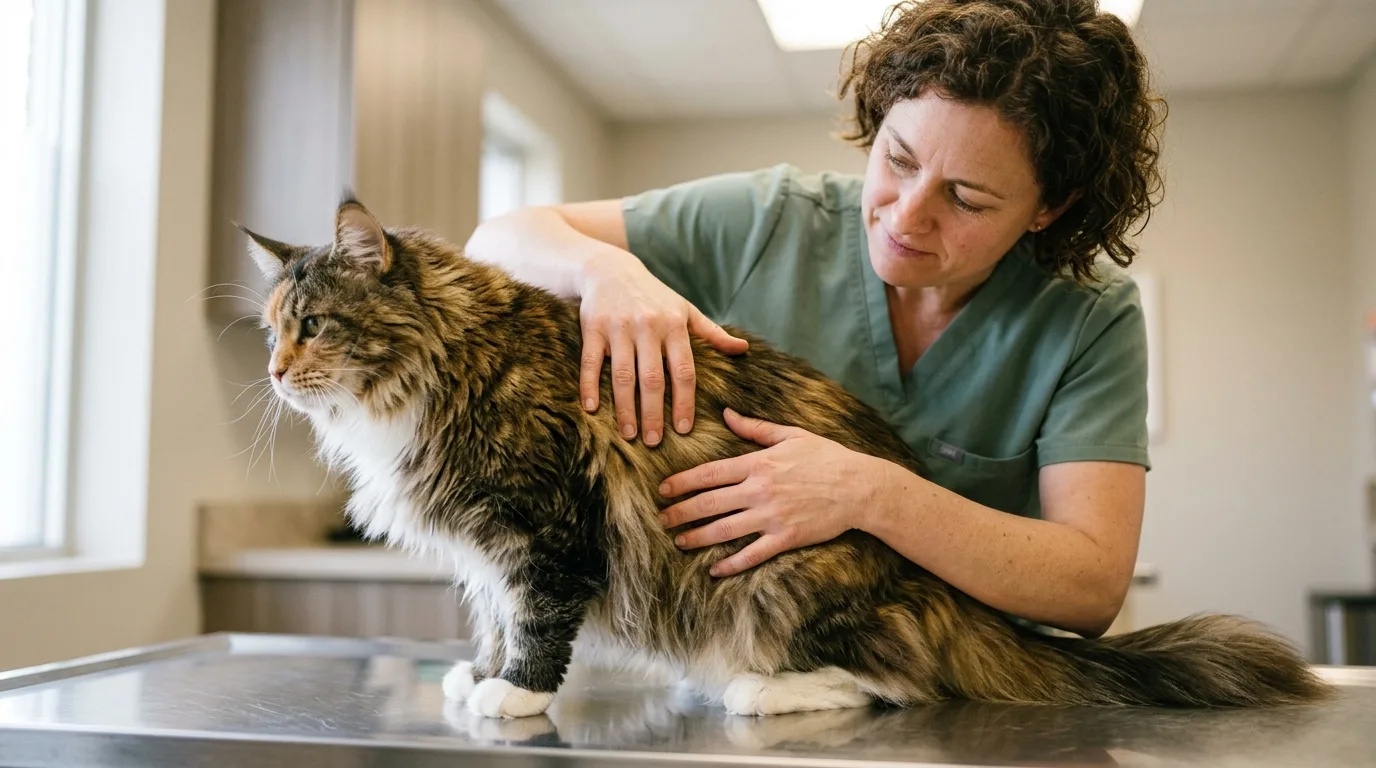
Veterinarians rely on the 9-point Body Condition Score (BCS) system rather than scale weight alone to assess health:
- Ideal Body Condition (Score 4-5): Ribs are easily palpable with a slight fat cover. The waist is visible behind the ribs when viewed from above. An abdominal tuck is discernible when viewed from the side, even with an intact primordial pouch.
- Overweight Condition (Score 6-7): Ribs are palpable with difficulty under a moderate layer of fat. The waist is barely visible from above, and the abdominal tuck is rounded.
- Obese Condition (Score 8-9): Ribs cannot be felt beneath heavy fat deposits. Prominent fat pads cover the lumbar area and face, with a distended abdomen and no waistline.
Pet owners managing companion animal weight, such as implementing weight management protocols for overweight Pugs, recognize that excess weight strains internal organs. In large felines, carrying surplus adipose tissue severely increases the risk of feline diabetes mellitus, hepatic lipidosis, and hip dysplasia.
Maintaining proper body condition requires measuring daily food portions on a gram scale, just as pet parents establish how much daily food a Pug should eat using strict caloric calculations rather than imprecise scoops. Regular physical palpation of the ribs and spine ensures that your Maine Coon remains strong, agile, and athletic throughout its life.
Frequently Asked Questions About Maine Coon Weight
How heavy does a Maine Coon get at 1 year old?
At one year of age, a healthy male Maine Coon typically weighs between 12.5 and 17.5 pounds (5.7 to 7.9 kg), while a female of the same age weighs between 9.0 and 12.5 pounds (4.1 to 5.7 kg). Kittens continue to gain frame and muscle mass for another two to four years.
What is the heaviest recorded Maine Coon cat?
Legitimate Guinness World Records for Maine Coons focus on length rather than weight to discourage owners from overfeeding their pets. The longest recorded domestic cat was a Maine Coon named Stewie, who measured 48.5 inches (123 cm) in length. Authentic, non-obese Maine Coons in verified registries rarely exceed 25 to 28 pounds (11.3 to 12.7 kg).
How do you know if your Maine Coon is overweight?
You can determine if your Maine Coon is overweight by feeling its rib cage and spine through the thick fur. You should easily feel the individual ribs with gentle finger pressure without having to press through a thick layer of fat. When viewed from above, your cat should have a visible taper at the waist behind the ribs.
How does Maine Coon weight compare to other large domestic breeds?
The Maine Coon is generally the heaviest of all pedigree domestic cats, rivaled closely only by the Norwegian Forest Cat (10 to 20 pounds) and the Ragdoll (10 to 20 pounds). While Savannah and Bengal cats may stand taller, the Maine Coon carries a denser bone structure and broader muscular frame.
Leave a Reply