

Table of Contents
Golden Retrievers typically stop growing in height around one year to 18 months of age when their skeletal growth plates close, though individual growth rates vary by sex and genetics. However, they continue to gain muscle mass, broaden across the chest, and develop their full double coat until reaching roughly 2 years of age (24 months). Mental and behavioral maturity generally solidifies between two and three years of age.
- Skeletal height is largely complete around one year to 18 months as distal growth plates calcify.
- Weight stabilization and muscular filling out continue through roughly 24 months of age.
- Standard adult male Goldens weigh 65 to 75 lbs and stand 23 to 24 inches tall; females weigh 55 to 65 lbs and stand 21.5 to 22.5 inches tall.
- Neutering before 6 months significantly increases the risk of orthopedic injuries and joint disorders.
- Large-breed puppy food with balanced calcium and phosphorus supports steady, safe skeletal development.
Golden Retrievers are among the most popular sporting dogs in the world, known for their friendly demeanor, high trainability, and athletic build. For new puppy owners asking when do Golden Retrievers stop growing, understanding their developmental timeline helps ensure appropriate nutrition, joint protection, and exercise at every stage.
The Quick Answer: What Age Do Golden Retrievers Stop Growing?
When assessing what age Golden Retrievers stop growing, veterinarians distinguish between skeletal height, muscular weight, and emotional maturity. Physical growth in this breed occurs across distinct phases rather than ending abruptly at a single milestone.
In terms of vertical height, most Golden Retrievers achieve 95% to 100% of their adult stature around one year to 18 months of age, depending on individual bloodlines. By this point, the epiphyseal growth plates at the ends of the long leg bones complete calcification and fuse, preventing further bone elongation. A dog that has reached 18 months will rarely gain additional height.
In terms of body mass, dogs continue filling out well past their first birthday. From 12 months through 24 months, young adults develop substantial pectoral muscle, thicken through the neck and shoulders, and establish their mature adult bone density. A male Golden that weighs 60 pounds at one year old may comfortably reach 70 to 75 pounds by age two without carrying excess body fat.
Mental maturity follows an even longer trajectory. Golden Retrievers often maintain excitable puppy temperament, playful impulsivity, and high energy levels until roughly two to three years of age. While domestic pets differ widely across species, such as when Maine Coons stop growing across an extended feline maturation span, canine skeletal development focuses physical height into the first two years while cognitive settling extends slightly longer.
Golden Retriever Growth & Weight Chart (Male vs. Female)
Tracking monthly weight gain provides an objective metric to confirm that a puppy is developing at a healthy, consistent pace. Undernutrition can stunt bone density, whereas overfeeding accelerates bone growth too quickly, placing excessive mechanical stress on immature cartilage. Tracking puppy weight curves is essential during early development, long before owners evaluate senior care stages like when Pugs are considered senior dogs or when large sporting breeds reach their mature senior years.

According to official American Kennel Club breed standard data, mature males stand 23 to 24 inches at the withers and weigh 65 to 75 pounds. Mature females stand 21.5 to 22.5 inches at the withers and weigh 55 to 65 pounds. Working field lines frequently display leaner, more athletic builds, whereas conformation show lines often sit at the upper boundaries of weight and bone thickness.
| Age / Milestone | Male Weight Range | Male Average | Female Weight Range | Female Average | Height & Skeletal Milestone |
|---|---|---|---|---|---|
| 7 Weeks | 4 – 17 lbs | 9 lbs | 4 – 17 lbs | 9 lbs | Initial weaning stage, rapid motor development |
| 3 Months | 16 – 43 lbs | 22 lbs | 16 – 43 lbs | 22 lbs | Primary socialization, early juvenile growth |
| 6 Months | 29 – 72 lbs | 44 lbs | 27 – 61 lbs | 43 lbs | Reaching roughly two-thirds of final adult weight |
| 12 Months (1 Year) | 65 – 77 lbs | 68 lbs | 55 – 90 lbs | 70 lbs | Full skeletal height achieved; growth plates closing |
| 24 Months (2 Years) | 65 – 80 lbs | 73 lbs | 55 – 90 lbs | 70 lbs | Full muscular width and adult coat complete |
The ranges in this chart reflect variations across genetic bloodlines, individual metabolism, and selective breeding lines. A puppy tracking along a steady growth curve within these benchmarks is typically progressing normally.
AKC Official Size Standards
| Sex | Standard Height at Withers | Standard Conformation Weight | Typical Field/Pet Range |
|---|---|---|---|
| Male | 23 – 24 inches (58 – 61 cm) | 65 – 75 lbs (29.5 – 34.0 kg) | 60 – 80 lbs (27.2 – 36.3 kg) |
| Female | 21.5 – 22.5 inches (55 – 57 cm) | 55 – 65 lbs (24.9 – 29.5 kg) | 50 – 75 lbs (22.7 – 34.0 kg) |
5 Golden Retriever Growth Stages: Month-by-Month Timeline
A Golden Retriever progresses through five major biological and developmental stages from birth to full adulthood. Each phase presents unique physical changes, behavioral shifts, and specific management requirements.
Stage 1: Neonatal (Birth to 3 Weeks)
During the first three weeks of life, newborn puppies are completely dependent on their mother for warmth, nourishment, and stimulation. Their eyes and ear canals remain closed at birth, typically opening around day 10 to day 14 depending on the individual puppy. Birth weights generally range from 10 to 16 ounces, usually doubling over the first week to ten days as nursing provides maternal colostrum and protective antibodies.
Stage 2: Socialization (3 to 12 Weeks)
The period between 3 and 12 weeks represents the critical developmental window for environmental acclimation and behavioral foundations. Puppies typically receive their first core vaccinations around six to eight weeks of age before transitioning to solid puppy kibble.
Weight gain during this phase averages 1.5 to 2 pounds per week for most puppies. Puppies learn essential social dynamics, bite inhibition, and pack communication through littermate interaction. Puppies also possess developing bladders during early greetings, and owners often notice dogs pee when they are excited or submissive before sphincter control strengthens. Positive reinforcement training during this window establishes lifelong emotional stability.
Stage 3: Juvenile Growth Spurts (3 to 6 Months)
From 3 to 6 months, Golden Retrievers enter the steepest section of their overall growth curve. Legs lengthen rapidly, giving puppies a temporarily lanky and disproportionate appearance. Around three to four months of age, deciduous baby teeth begin loosening as 42 permanent adult teeth erupt.
During secondary socialization and fear impact periods, reading body language becomes essential, such as observing what it means when dogs pull their ears back during unfamiliar interactions. Because rapid bone elongation leaves soft growth plate cartilage vulnerable to shearing forces, high-impact activities such as repetitive jumping from furniture or vehicles must be prevented.
Stage 4: Adolescence & Coat Change (6 to 18 Months)
Adolescence brings major hormonal, physical, and dermatological changes. Between roughly six and nine months of age, the soft puppy fuzz sheds out, replaced by a dense, water-repellent adult double coat that first emerges along the dorsal spine. Female Goldens typically experience their first estrus cycle between nine and 14 months depending on mature body size and genetics, while male testosterone levels surge, prompting increased marking and boundary testing. By 18 months, skeletal growth plates fuse completely, marking the end of height gains.
Stage 5: Adulthood & Filling Out (18 to 24 Months)
Between 18 and 24 months, Golden Retrievers reach full structural maturity. Weight shifts from skeletal expansion to lean muscle deposition, chest deepening, and skull broadening. Behavioral patterns stabilize, concentration improves, and adult working endurance reaches its peak.
How Big Will My Golden Retriever Be? Prediction Methods
Owners often wonder how large their puppy will grow before reaching adulthood. Just as owners of upright-eared puppies monitor breed-specific developmental signs like when French Bulldogs ears stand up, Golden Retriever owners can evaluate physical proportions and developmental formulas to project adult size.
Method 1: The 20-Week Formula
A standard veterinary formula for sporting dogs uses the puppy’s weight at 20 weeks (around five months of age) to estimate adult weight:
Estimated Adult Weight = (Weight at 20 Weeks / 20) * 52
For example, a male puppy weighing 28 pounds at 20 weeks yields (28 / 20) * 52 = 72.8 lbs, placing him directly in the standard AKC male weight range.
Method 2: The 6-Month Doubling Rule
At 6 months of age, a Golden Retriever has typically accumulated approximately 65% to 70% of their final adult mass. A practical rule of thumb for male dogs is to multiply their 6-month weight by two and subtract 5% to 10% to account for tapering growth curves:
Estimated Adult Weight ≈ Weight at 6 Months * 2
For instance, a 36-pound puppy at 6 months will generally mature between 65 and 72 pounds.
Method 3: Genetic Lineage & Parental Size
Reviewing the physical dimensions of both parents provides the single most accurate indicator of mature size. Female puppies generally mature close to the mother’s weight, while male puppies often match or slightly exceed the sire’s weight, assuming identical health and nutritional conditions.
Spaying, Neutering, and Growth Plate Closure
Decisions regarding the timing of spay or neuter surgery (gonadectomy) carry significant health implications for large-breed dogs. Sex hormones (estrogen and testosterone) send the biological signals responsible for closing long bone growth plates at appropriate developmental times.
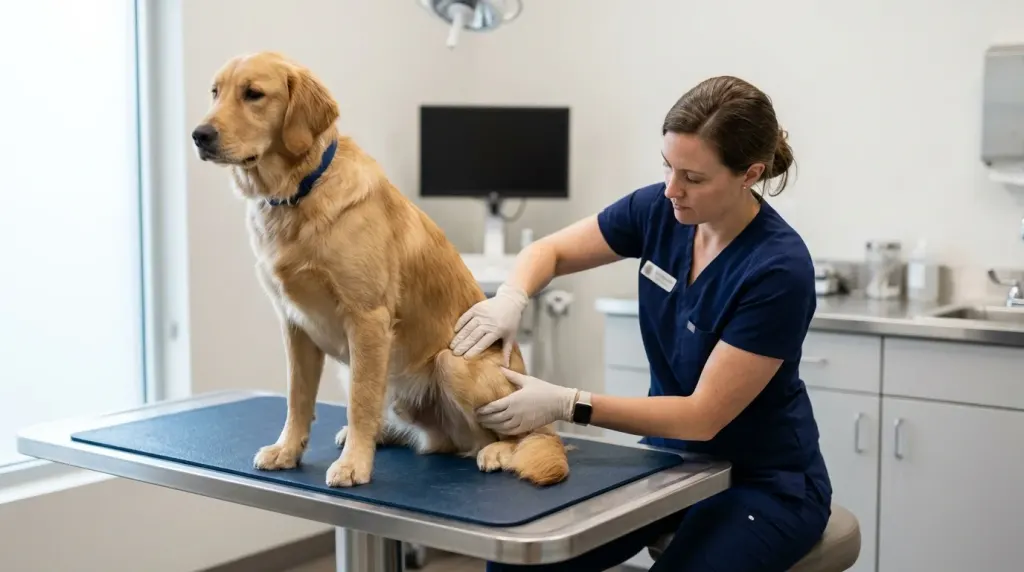
When a dog is neutered prematurely before 6 months of age, the absence of sex hormones delays growth plate closure. This allows the long bones of the legs to continue growing longer than genetically intended, altering joint angles, biomechanics, and ligament stability. Extensive clinical data shows that early surgical sterilization in Golden Retrievers alters musculoskeletal development. Delaying elective gonadectomy until after skeletal growth plates close around one year to 18 months of age preserves natural hormonal regulation and reduces joint vulnerability.
According to a landmark multi-year PLOS ONE Golden Retriever health study conducted on 3,044 dogs, neutering before 6 months of age increased the risk of cranial cruciate ligament (CCL) tears and joint disorders fourfold, yielding a hazard ratio of 4.06 (95% CI: 2.15-7.67) compared to sexually intact dogs. Furthermore, gonadectomy at any age was associated with an elevated risk of overweight and obesity, with hazard ratios ranging from 1.56 to 2.21 (95% CI: 1.28-2.68).
While surgical timing questions often arise in small companion breeds regarding when to neuter a French Bulldog, the biological stakes for large sporting dogs like Golden Retrievers involve distinct hormonal impacts on long bone growth plates. Owners should coordinate closely with their primary care veterinarian to determine an individualized surgical plan that protects joint integrity.
Supporting Healthy Growth: Diet & Exercise Rules
Guiding a Golden Retriever safely through puppyhood requires structured nutritional management and controlled physical activity to safeguard developing joints. Hormonal shifts also influence exercise stamina and metabolic rates during sexual maturation, contrasting with smaller breeds where owners track when French Bulldogs go into heat earlier in puppyhood.
Nutritional Guidelines for Large-Breed Puppies
Large-breed puppies require formulas specifically calibrated to control caloric density and maintain precise mineral ratios. Rapid weight gain combined with excessive dietary calcium can trigger severe developmental orthopedic disorders such as osteochondritis dissecans (OCD) and hypertrophic osteodystrophy (HOD).
- Calcium-to-Phosphorus Ratio: Must remain strictly balanced between 1.1:1 and 1.4:1.
- Caloric Density: Formulated to support steady, moderate growth rather than maximum growth rates.
- Transition Timing: Keep your dog on large-breed puppy food until roughly one year to 18 months of age (once growth plate closure occurs) before transitioning to adult maintenance formulas.
Exercise Guidelines & Joint Protection
Immature cartilage and open growth plates cannot tolerate repetitive concussive impact. Following structured exercise protocols prevents chronic joint trauma:
- The 5-Minute Rule: Provide 5 minutes of structured, low-impact exercise per month of age up to twice daily (for example, a 4-month-old puppy receives up to 20 minutes of walking split into two sessions daily).
- Surface Selection: Encourage play on natural turf, dirt trails, or carpet rather than hard concrete or asphalt.
- Avoid High Impacts: Prohibit dogs from jumping out of vehicle cargo areas or jumping over agility hurdles until 18 months of age.
According to Royal Kennel Club guidance on canine hip dysplasia, managing environmental factors, body weight, and exercise intensity during the first year of life significantly reduces clinical expression in genetically predisposed dogs.
Frequently Asked Questions
Do bigger paws mean a Golden Retriever puppy will be bigger?
Large paws in a young puppy indicate that the dog is currently experiencing a bone growth spurt, but paw size alone is not a definitive predictor of final adult weight. Paw size reflects bone thickness and cartilage development at that moment, whereas ultimate adult size is determined by genetics, parental lineage, and overall nutritional balance.
When should I switch my Golden Retriever from puppy to adult food?
Most veterinarians recommend switching a Golden Retriever from large-breed puppy food to adult maintenance food around one year to 18 months of age, depending on individual skeletal maturity. This transition should occur only after skeletal growth plates have closed and height expansion has stabilized to prevent unnecessary caloric excess and joint strain.



Leave a Reply