
Table of Contents
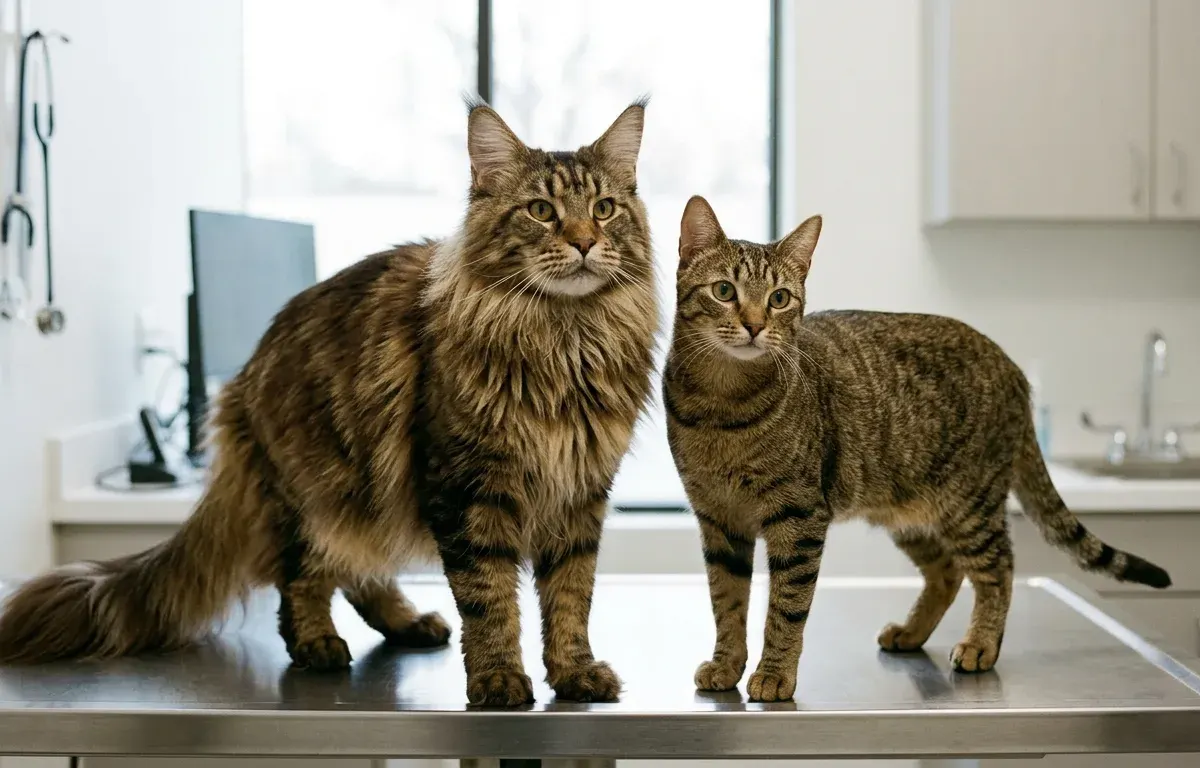
Purebred Maine Coon cats cannot have short hair. Every major feline registry, including the Cat Fanciers' Association (CFA) and The International Cat Association (TICA), classifies the Maine Coon strictly as a semi-longhaired breed. Genetically, feline long hair is an autosomal recessive trait governed by mutations in the FGF5 gene. Because purebred Maine Coons carry two copies of this recessive mutation, two registered parents can only produce long-haired offspring. Any cat displaying short fur alongside Maine Coon traits is a crossbred mix, an immature kitten, a professionally shaved cat, or a large domestic shorthair.
- Purebred Maine Coons always possess a medium-to-long, shaggy, water-repellent double coat per official breed standards.
- Feline coat length is controlled by the FGF5 gene, where short hair is dominant and long hair is autosomal recessive.
- Breeding two pedigreed Maine Coons produces 100% long-haired kittens because neither parent carries the dominant short-hair allele.
- Cats marketed as rare short-haired Maine Coons are crossbred mixes or domestic shorthairs sold by unverified sellers.
- Maine Coon kittens develop their full adult coat, chest ruff, and heavy hind britches gradually over three to four years.
- Professional grooming clips like lion cuts temporarily alter a Maine Coon's coat silhouette without changing its genetics.
Prospective pet owners often ask: are there short hair Maine Coon cats, or does every purebred feline feature a long coat? The straightforward biological and registry answer is no. A purebred Maine Coon always possesses a semi-long to long double coat, developed naturally through centuries of adaptation to northern winter climates.
Official Breed Standards: Why Purebred Maine Coons Cannot Have Short Hair
International feline registries maintain uniform standards defining the physical traits of pedigreed cats. In every recognized association, the Maine Coon is categorized strictly as a semi-longhair or longhair feline. A short or evenly trimmed coat is classified as a major fault that disqualifies a cat from purebred championship evaluation.
The breed evolved as a working barn cat in the harsh climate of New England. Thick, water-resistant fur, tufted snowshoe paws, and a long bushy tail were essential survival tools against freezing temperatures. When cat registries codified these physical traits, the rugged multi-layered coat became a mandatory breed requirement.
When evaluating the popularity and availability of purebred Maine Coons, prospective owners will find that certified preservation breeders focus on maintaining this historical coat structure.
| Registry / Association | Official Classification | Required Coat Texture and Structure | Short Coat Status |
|---|---|---|---|
| Cat Fanciers’ Association (CFA) | Longhair / Semi-Longhair | Heavy, shaggy, silky, longer on ruff and britches | Disqualified |
| The International Cat Association (TICA) | Semi-Longhair | Medium-to-long, dense, all-weather coat with tail plume | Disqualified |
| Governing Council of the Cat Fancy (GCCF) | Section 2 (Semi-Longhair) | Flowing, double coat with water-resistant guard hairs | Disqualified |
| Fédération Internationale Féline (FIFe) | Category 2 (Semi-Longhair) | All-weather coat, dense undercoat, full frontal shirtfront | Disqualified |
Cat Fanciers’ Association (CFA) Coat Standard Requirements
The Cat Fanciers’ Association (CFA) establishes strict criteria for Maine Coon coat conformation. The official CFA standard specifies that the coat must be heavy and shaggy, with fur shorter on the shoulders and longer on the stomach and hind legs. A full frontal ruff around the neck is desirable.
Under CFA show judging rules, an overall short coat or an even coat length that lacks natural shaggy layering is grounds for immediate penalization and championship disqualification. The standard leaves zero room for a short-haired variety within pedigreed bloodlines.
TICA, GCCF, and FIFe Classifications as Semi-Longhair
European and international registries follow the same structural rules. The International Cat Association (TICA) places the Maine Coon in its semi-longhair division, requiring a double coat with a resilient topcoat and a soft undercoat.
Similarly, the Governing Council of the Cat Fancy (GCCF) in the United Kingdom and FIFe in mainland Europe classify the breed in their semi-longhair groups. All three organizations require a substantial ruff, tufted paw pads, and a full tail plume that reaches at least to the shoulder blade. Strict anatomical standards govern physical furnishings across companion animals, just as breed clubs monitor how Pug ear structures affect dog comfort and standard appearance. None of these governing bodies recognize a short-coated variation.
The Genetics of Coat Length: The FGF5 Gene and Autosomal Recessive Inheritance
Feline coat length follows classic Mendelian genetics. Research documented by the UC Davis Veterinary Genetics Laboratory demonstrates that hair length in domestic felines is controlled by the fibroblast growth factor 5 (FGF5) gene located on feline chromosome B1.
In cats, the allele for short hair (L) is completely dominant, while the allele for long hair (l) is autosomal recessive. Because a purebred Maine Coon visibly exhibits long fur, it must carry two copies of the recessive mutation (l/l). It completely lacks the dominant short-hair gene.
Independent physical traits follow separate chromosomal pathways. For instance, the inheritance of polydactyl toe counts in Maine Coons is governed by a dominant genetic mutation that operates independently from the recessive FGF5 coat alleles. Evolutionary divergence studies frequently explore how specific mutations shaped domestic lines, similar to genomic research analyzing whether German Shepherds are related to wolves and ancient canid ancestors.
| Maternal Genotype (Dam) | Paternal Genotype (Sire) | Offspring Genotype | Offspring Phenotype | Genetic Status |
|---|---|---|---|---|
| Purebred Maine Coon (l/l) | Purebred Maine Coon (l/l) | 100% l/l | 100% Long-haired | Homozygous Recessive (Purebred) |
| Purebred Maine Coon (l/l) | Homozygous Shorthair (L/L) | 100% L/l | 100% Short-haired | Heterozygous Carrier (F1 Mix) |
| Purebred Maine Coon (l/l) | Heterozygous Shorthair (L/l) | 50% L/l, 50% l/l | 50% Short, 50% Long | Mixed Ancestry Litter |
How the FGF5 Gene Controls the Mammalian Hair Cycle
Mammalian hair growth progresses through four physiological stages: anagen (active growth phase), catagen (follicular regression), telogen (resting phase), and exogen (active shedding of the hair fiber).
In short-haired cats, a functional FGF5 gene produces an active signaling protein. This protein acts as a molecular stop switch that terminates the anagen growth phase, prompting the follicle to transition into catagen and telogen before the hair shaft grows long.
In long-haired cats, loss-of-function mutations in FGF5 disrupt this signaling switch. The hair follicle continues producing hair fiber for an extended duration during anagen, resulting in a plush semi-long coat before entering the exogen shedding phase.
The Recessive Nature of Long Hair in Purebred Bloodlines
Because long hair is an autosomal recessive trait, a cat must be homozygous recessive (l/l) to display long fur. Two long-haired cats cannot produce a short-haired kitten under any normal circumstance.
When two registered Maine Coons mate, each parent contributes one recessive (l) allele. Every resulting kitten inherits the (l/l) genotype, ensuring that 100% of the litter develops long fur. If a short-haired kitten appears in a litter from a Maine Coon queen, it confirms that an unpedigreed short-haired male mated with the mother. Coat density and shedding cycles also influence domestic dander distribution, which leads many families to examine whether French Bulldogs are hypoallergenic when comparing short-haired pets to heavy-shedding long-haired felines. The genetic rules governing feline hair length are absolute. A long-haired phenotype requires two recessive alleles, which means a purebred Maine Coon carries no hidden dominant short-hair genes. The appearance of short fur in a cat with Maine Coon features indicates crossbreeding or juvenile development, not a novel purebred genetic variation.
4 Real Reasons You Might See a “Short-Haired” Maine Coon
While purebred short-haired Maine Coons do not exist, many pet owners encounter cats that resemble short-haired versions of the breed. Four distinct real-world situations explain these sightings.
| Scenario | Primary Cause | Key Identifying Features | Verification Method |
|---|---|---|---|
| 1. Crossbred Mix | Outcrossing with a Domestic Shorthair | Large frame, tufted ears, sleek short body fur | Commercial feline DNA test |
| 2. Developing Kitten | Immature coat during juvenile development | Soft downy fur, developing guard hairs, emerging ruff | Observing coat maturation over time |
| 3. Grooming Haircut | Professional lion cut or hygienic clip | Shaved torso, full mane, booted paws, tail plume | Gradual regrowth as coat recovers |
| 4. Domestic Shorthair | Natural large frame and classic tabby pattern | Rounder head, smaller paws, straight nose bridge | Pedigree registry certificate |
Maine Coon Crossbreeds and Mixes (F1 and F2 Offspring)
When a purebred Maine Coon mates with a short-haired domestic cat, the first-generation (F1) offspring inherit the dominant short-hair trait from the domestic parent and the recessive long-hair trait from the Maine Coon parent. Because short hair is dominant, all F1 kittens develop short coats.
However, complex physical traits like large skeletal bone structure, muscular jawlines, high cheekbones, and lynx-tipped ears are polygenic. These structural traits are inherited independently from coat length. An F1 or F2 crossbred cat often displays the impressive build and the social and friendly temperament of Maine Coons while sporting a sleek, short coat.
Families adopting crossbred rescue cats frequently observe the gentle family companion traits of Maine Coons, making these mixed-breed felines wonderful household pets despite their lack of official pedigree status.
Kitten Coat Development and Maturation Stages
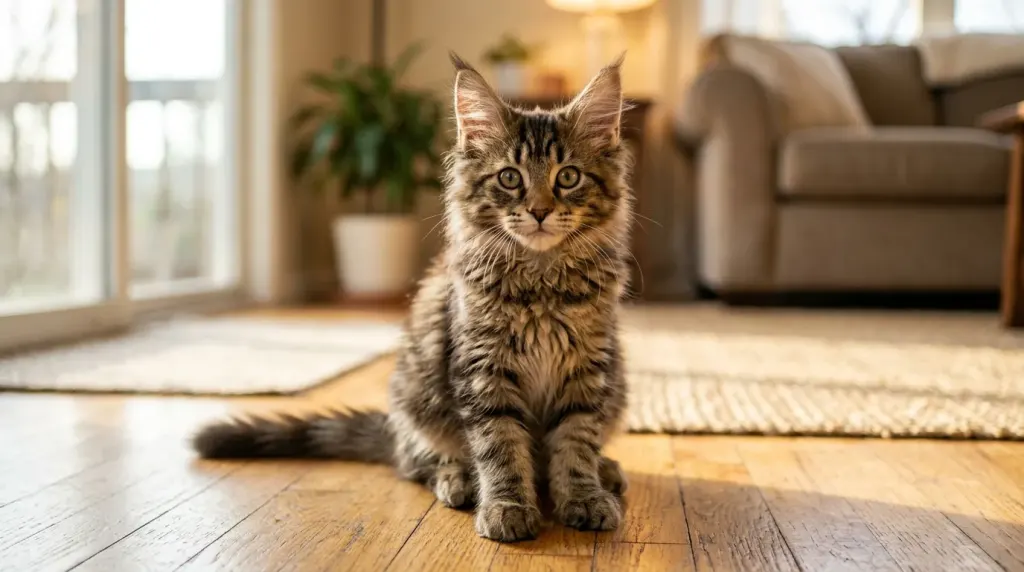
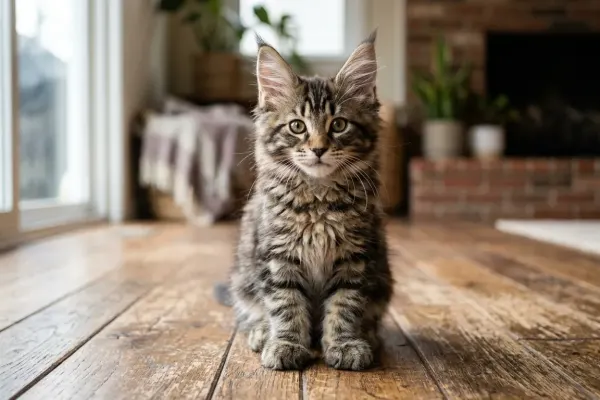
Maine Coon kittens are born with short, downy baby fur. During early development, their coats remain relatively short and soft, which sometimes leads new owners to question whether their kitten has true long fur.
Maine Coons are a slow-maturing breed, developing their full physical build and dense coat gradually over several growth stages:
- Kitten stage (early months): Short, soft juvenile down with minimal undercoat and light ear tufts.
- Adolescent stage (first year): Intermediate phase where body hair lengthens unevenly and the tail plume begins filling out.
- Young adult stage: Secondary guard hairs emerge, establishing the water-repellent topcoat texture.
- Mature adult stage: Full adult coat density is attained around three to four years of age as recognized by breed registries, showcasing the dramatic lion-like chest ruff, dense undercoat, and heavy hind britches.
Professional Grooming, Lion Cuts, and Shaving
A full-grown, pedigreed Maine Coon may appear short-haired after receiving a specialized grooming haircut. Because their thick double coats can develop severe mats without regular brushing, owners and veterinarians sometimes opt for a professional lion cut or sanitary clip.
In a lion cut, a groomer trims the dense fur on the torso down to a uniform short length (typically 1/8 to 1/4 inch), leaving the head mane, lower leg boots, and tail plume intact. From certain angles, or as the body hair gradually grows back over several months, the cat can easily be mistaken for a short-haired animal.
Domestic Shorthair Lookalikes and Breed Misidentification
Domestic Shorthairs (DSH) possess immense genetic diversity. Many random-bred domestic cats naturally develop large, muscular bodies weighing 14 to 18 pounds, broad muzzles, tufted toes, and classic brown mackerel tabby patterns that closely mirror Maine Coon markings.
Animal shelters, rescue volunteers, and pet classifieds frequently label large tabby cats as short-haired Maine Coons. Without certified registration paperwork from a recognized registry, a large, tufted tabby cat is almost certainly a handsome Domestic Shorthair rather than a pedigreed Maine Coon.
How to Identify a True Maine Coon Mix: Physical and Genetic Verification
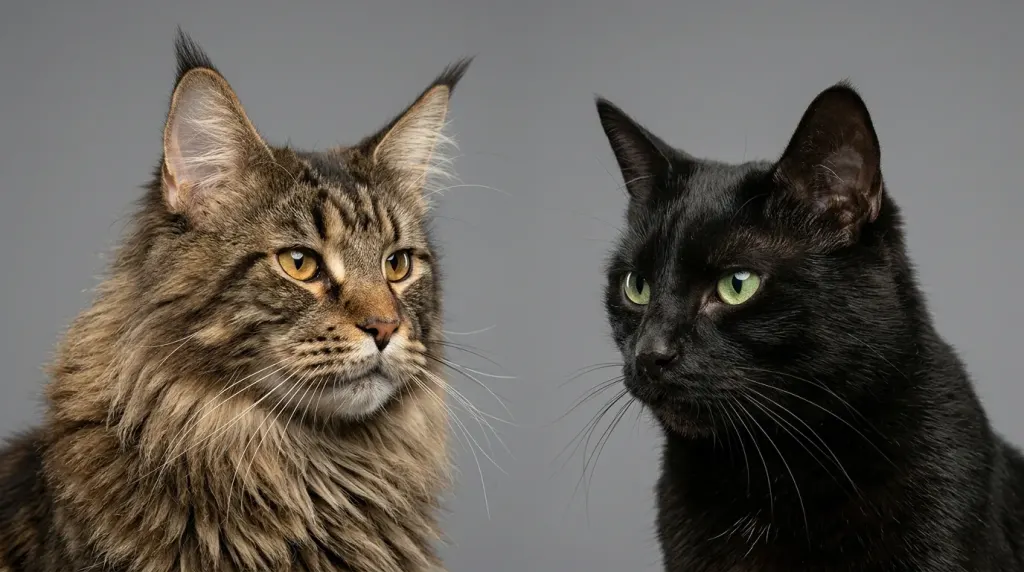
Distinguishing a true Maine Coon crossbreed from a standard Domestic Shorthair requires evaluating skeletal morphology alongside genetic testing methods.
Pet owners managing allergies in mixed-breed households often research whether Maine Coon cats produce fewer allergens to understand how dander and Fel d 1 protein production vary across purebred and mixed-ancestry felines.
| Physical Feature | Purebred Maine Coon | Maine Coon Shorthair Mix | Standard Domestic Shorthair |
|---|---|---|---|
| Head Geometry | Boxy square muzzle, high cheekbones, concave nose profile | Modified wedge or semi-square muzzle | Triangular or rounded head profile |
| Ear Conformation | Large, wide at base, tall with prominent lynx tips | Medium-large ears, light tipping possible | Medium ears, rounded tips, minimal tufting |
| Coat Structure | Heavy, layered, water-resistant semi-long double coat | Short to medium plush coat lacking heavy undercoat | Short, single or light double coat |
| Tail Plume | Long, flowing brush reaching at least to shoulder | Medium length with slight taper | Standard slender tail with smooth hair |
| Torso Build | Long, rectangular, heavily muscled frame with broad chest | Moderate rectangular or semi-cobby body | Medium, compact, or athletic frame |
| Lineage Proof | Certified 3 to 5 generation pedigree (CFA, TICA, GCCF) | Commercial DNA breed similarity estimate | No pedigree or registry documentation |
Morphological Markers: Head Geometry, Paw Tufts, and Body Build
When inspecting a cat for possible Maine Coon ancestry, look for specific skeletal markers rather than body weight alone:
- Muzzle and Chin: Maine Coons possess a distinctly square, blunt muzzle with a strong chin that forms a perpendicular line with the upper lip. Domestic shorthairs typically show rounded or tapered muzzles.
- Nasal Profile: In profile, a Maine Coon shows a gentle concave curve between the forehead and nose tip, differing from the straight nose profile of many domestic breeds.
- Ear Set and Furnishings: Large ears set high on the head, featuring heavy inner ear furnishings and pointed lynx tips at the apex.
- Paw Structure: Large, round paws equipped with heavy tufts of fur extending between the toes, originally functioning as natural snowshoes.
- Body Frame: A substantial, elongated rectangular torso with a broad, muscular chest. Body frame and muscular build reflect breed activity profiles, contrasting with compact companion animals where owners monitor whether Pugs are active dogs or low-energy lap companions.
Commercial Feline DNA Testing and Ancestry Panels
Commercial feline DNA testing services-including Wisdom Panel Complete for Cats, Basepaws Breed + Health, and veterinary panels from UC Davis VGL-sequence genetic markers across a cat’s genome to evaluate breed similarity against purebred reference populations.
These panels can confirm the presence of FGF5 coat alleles and identify shared chromosomal markers common to the Maine Coon breed. However, commercial DNA tests calculate genetic similarity percentages rather than issuing legal pedigree certificates. Official studbook registration with the CFA or TICA remains the sole legal proof of purebred status.
Note: A DNA test result showing high genetic similarity to Maine Coons indicates shared ancestral markers or crossbreeding. It does not convert a non-pedigreed cat into a registered purebred Maine Coon.
Beware of “Rare Short-Haired Maine Coon” Breeder Scams and Myths
Prospective kitten buyers should exercise caution when encountering online advertisements or backyard breeders marketing rare short-haired Maine Coons at premium prices.
Unethical sellers frequently charge purebred prices ($1,500 to $3,000 or more) for standard domestic shorthair litters by inventing fictitious coat varieties. Because official feline registries do not recognize a short-haired Maine Coon, any breeder advertising these kittens is engaging in deceptive marketing or demonstrating complete unfamiliarity with basic feline genetics.
Buyers seeking the affectionate and cuddly Maine Coon personality should verify that the breeder performs thorough genetic health screenings. Purchasing an unverified mix from an irresponsible seller risks missing essential health checks, which can lead to unexpected behavioral issues or aggressive behaviors in Maine Coon cats resulting from poor early socialization and unknown parentage.
When searching for a pedigreed kitten, follow these essential due diligence steps:
- Verify Cattery Registration: Confirm that the cattery is officially registered and in good standing with the CFA or TICA.
- Demand Official Pedigree Papers: Legitimate breeders always provide an official blue slip or 3 to 5 generation certified pedigree certificate upon purchase.
- Inspect Parental Health Testing: Request documented DNA screening results showing parents are clear of Hypertrophic Cardiomyopathy (MYBPC3 mutation), Spinal Muscular Atrophy (SMA), and Pyruvate Kinase Deficiency (PKDef).
- Avoid Unrecognized Color and Coat Claims: Be wary of sellers charging inflated fees for unrecognized coat lengths, exotic crossbreeds, or unstandardized physical variations.
Comparing Maine Coon Traits and Care with Other Family Pets
Prospective pet owners exploring Maine Coons often weigh the grooming demands of a large semi-longhaired cat against other popular household companions. While Maine Coons require routine brushing to prevent coat matting, their gentle, dog-like sociability makes them compatible with a wide variety of domestic pets.
Families evaluating different breeds frequently compare canine and feline companions, investigating whether French Bulldogs make good pets for homes that already house friendly cats. Both species thrive in structured indoor environments when provided with positive enrichment and early social exposure.
Training and communication also differ substantially across companion animals. While Maine Coons learn household routines quickly through playful interaction, canine guardians often study how smart French Bulldogs are when implementing daily obedience training. Understanding each animal’s distinct behavioral drives ensures a harmonious household for both long-haired felines and companion dogs.
Frequently Asked Questions About Maine Coon Fur and Coat Types
Can two purebred Maine Coons have a short-haired kitten?
No, two purebred Maine Coons cannot produce a short-haired kitten. Long hair is an autosomal recessive genetic trait. Because purebred parents carry only the recessive long-hair traits, they can only pass down long coat genetics to their offspring, resulting in long-haired kittens. If a short-haired kitten appears in a litter from a Maine Coon queen, mating with an unpedigreed short-haired cat occurred.
At what age does a Maine Coon get its full fluffy coat?
A Maine Coon develops its full adult coat gradually over several years, typically reaching full maturity around three to four years of age. While young kittens display soft, downy body hair, the prominent neck ruff, water-repellent guard hairs, and thick hind britches take multiple years of physical growth to reach maximum density.
Does shaving a Maine Coon damage its double coat?
Shaving a Maine Coon does not permanently destroy the hair follicles, but it can disrupt the natural texture and growth balance of its double coat. The soft undercoat typically grows back faster than the protective guard hairs, leading to temporary patching, altered fur texture, and an increased risk of matting during the extended regrowth period.
What is the closest short-haired breed to a Maine Coon?
The American Shorthair and the British Shorthair are the closest recognized breeds to the Maine Coon in terms of historical background, muscular build, and easygoing temperament. For owners seeking a large, sturdy cat with a friendly personality and low-maintenance grooming requirements, the American Shorthair is an outstanding choice.
Leave a Reply