
Table of Contents
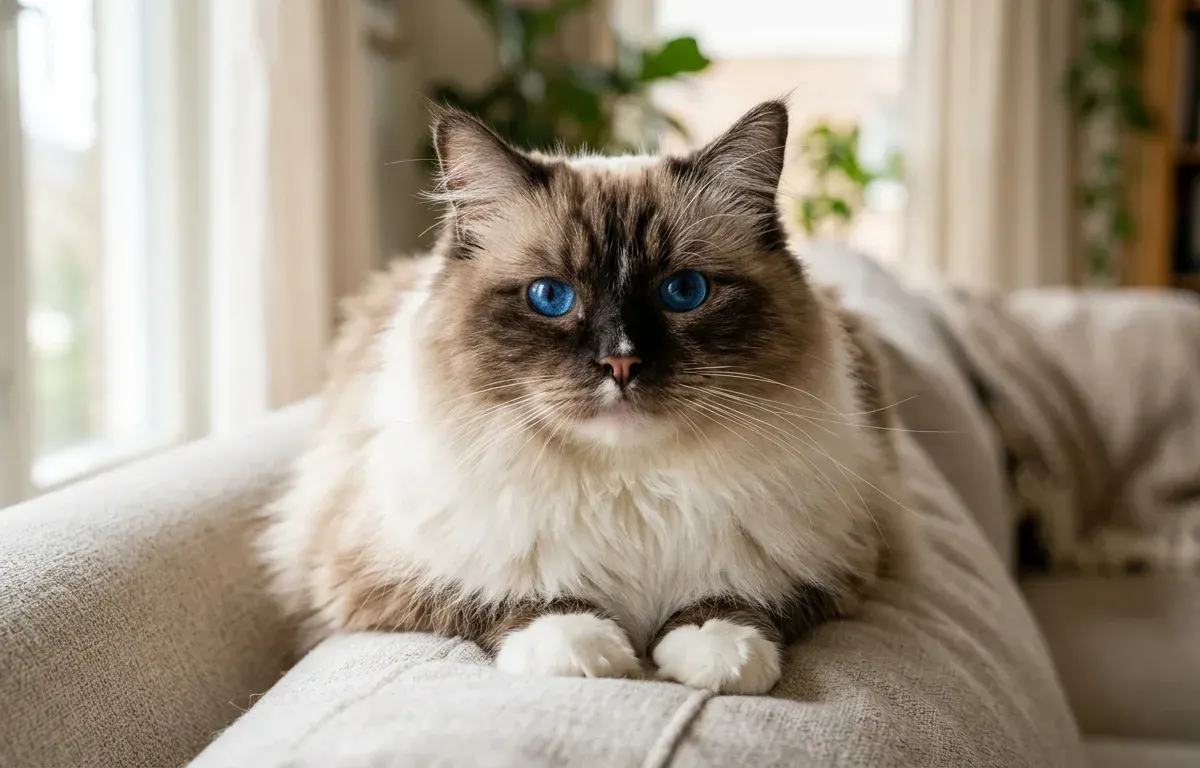
The ragdoll cat breed is a large, semi-longhaired feline celebrated for its striking blue oval eyes, silky plush coat, and exceptionally calm, affectionate personality. Developed in California during the 1960s, Ragdolls mature slowly, taking up to four years to reach full adult size, with adult males reaching 12 to 20+ pounds and females weighing 8 to 15 pounds. Known for their gentle nature, tendency to relax limply in safe arms, and dog-like devotion, Ragdolls thrive as strictly indoor family companions.
- Large, heavy-boned body frame with slow maturation taking up to four years to complete.
- All purebred pointed Ragdolls possess vivid blue oval eyes governed by the colorpoint gene.
- Three primary coat patterns (colorpoint, mitted, and bicolor) across six recognized point colors.
- Docile "puppy-cat" temperament characterized by doorway greetings and gentle handling tolerance.
- Moderate grooming needs due to a single coat with minimal undercoat matting.
- Genetic health testing for Hypertrophic Cardiomyopathy (MYBPC3 R820W mutation) is essential.
- Kitten purchase costs range from $1,000 to $3,500+ from ethical breeders, while rescue adoption averages $100 to $400.
The Ragdoll cat breed stands among the most popular and recognizable domestic felines in the world. Renowned for their soft semi-longhair coats, striking blue eyes, and serene demeanor, Ragdolls offer a distinct companion experience that bridges feline grace with canine-like loyalty. Understanding their physical standards, behavioral needs, and hereditary health considerations ensures prospective owners make well-informed decisions when welcoming one into their home.
Ragdoll Cat History and Origins
The story of the Ragdoll cat breed began in Riverside, California, during the early 1960s. Ann Baker, a Persian cat breeder, developed the foundation stock from a free-roaming white domestic longhaired female named Josephine. Following an automobile accident, Josephine recovered and subsequently produced litters of kittens that exhibited unusually docile, placid temperaments and a distinct habit of going completely limp when held.
Intrigued by these unique physical and behavioral traits, Baker selectively mated Josephine’s offspring with other longhaired domestic cats. Key foundation animals included a seal-pointed male named Daddy Warbucks and two females named Fugianna and Buckwheat. These careful pairings established the large frame, pointed coloration, and trusting disposition that define the modern breed. Enthusiasts interested in the historical background and founder controversies can read more about where Ragdoll cats originate from.
Official Breed Recognition by CFA and TICA
In 1971, Ann Baker created her own registry, the International Ragdoll Cat Association (IRCA), and placed strict contractual controls on breeding stock. Seeking broader acceptance and formal show standards, a group of dedicated breeders led by Denny and Laura Dayton separated from the IRCA in 1975 to establish the Ragdoll Fanciers’ Club International (RFCI).
The RFCI standardized the breed description and worked diligently with major feline registries. The International Cat Association (TICA) granted official recognition to the Ragdoll in 1979. Decades of dedicated breeding culminated in the Cat Fanciers’ Association (CFA) awarding full championship status in 2000. While modern registries recognize traditional pointed standards, historical breeding lines also yielded rare variants; feline enthusiasts researching what is a mink Ragdoll cat often explore how these unique bloodlines trace back to foundation stock.
Physical Characteristics of the Ragdoll Cat
Ragdolls possess a substantial, muscular morphology categorized under the large domestic feline class. They feature a broad chest, sturdy boning, and a moderately long, fleshy body that feels solid when lifted. The head forms a broad, modified wedge with flat contours between medium-sized ears that tilt slightly forward.
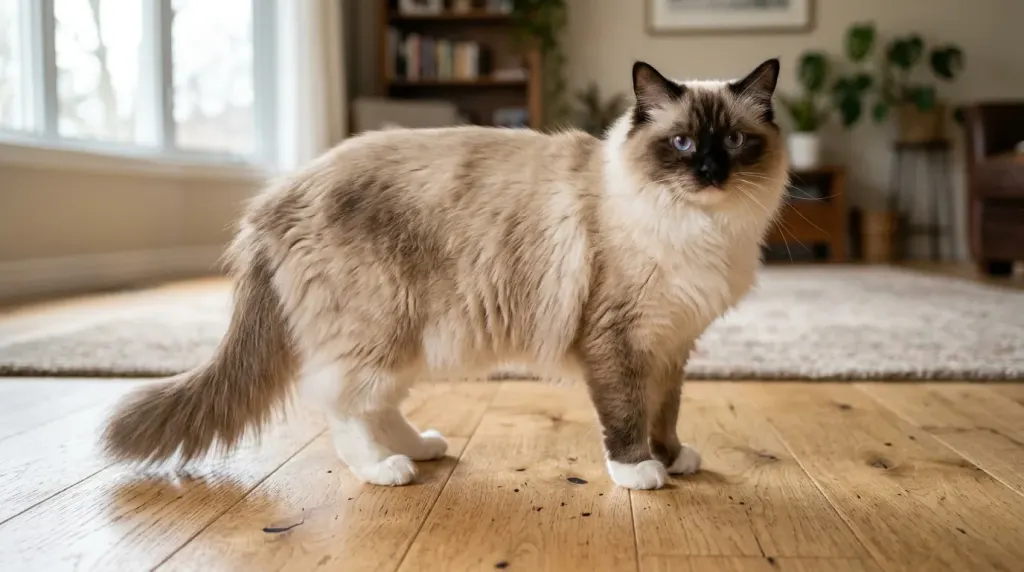
Their coat is semi-long, plush, and silky to the touch, with a decorative neck ruff and a bushy tail. When exploring how big Ragdoll cats get, pet owners discover that their impressive stature develops through an extended growth period compared to standard domestic cats.
Size and Weight by Gender
Ragdoll cats experience a slow metabolic and physical maturation cycle. While most domestic felines reach full adult size around 12 months, Ragdolls require 3 to 4 years to complete their skeletal growth, achieve full muscle density, and develop their rich adult coat pigmentation. According to the Los Angeles Times breed profile, adult males reach 12 to 20+ lbs (5.4 to 9.1+ kg) while females typically weigh 8 to 15 lbs (3.6 to 6.8 kg).
| Gender | Typical Weight Range | Time to Full Maturity | Body Frame Characteristics |
|---|---|---|---|
| Female | 8 to 15 lbs (3.6 to 6.8 kg) | 3 to 4 years | Medium to large frame, broad hips, sturdy boning |
| Male | 12 to 20+ lbs (5.4 to 9.1+ kg) | 3 to 4 years | Large frame, heavy-boned, broad chest |
Three Primary Coat Patterns and Six Point Colors
All purebred Ragdolls display pointed coloration, meaning their body fur remains lighter while their extremities (mask, ears, legs, and tail) exhibit darker pigmentation. Major registries recognize six official point colors: seal (deep brown), blue (cool slate gray), chocolate (warm milk chocolate), lilac (frosty pinkish-gray), red (warm orange), and cream (soft buff).
Registries categorize the breed into three primary coat patterns:
- Colorpoint: Classic pointed pattern with rich contrast between the light torso and dark extremities. No white markings are permitted anywhere on the body.
- Mitted: Features dark point coloration on the mask, ears, and tail, accented by clean white front paws (“mitts”), white back legs extending to the hock (“boots”), a white chin, and a central white belly stripe.
- Bicolor: Displays an inverted white “V” marking on the face that frames the nose leather without extending past the outer eye corners. The chest, stomach, and all four legs are white, while the back displays a colored saddle.
While traditional registries strictly maintain pointed colorations, prospective pet parents exploring coat color possibilities often wonder can Ragdoll cats be black or produce non-pointed dark coats.
Head Structure and Blue Eyes per Breed Standard
A defining hallmark of the purebred Ragdoll is its striking blue eye color. Official breed standards establish that all pointed purebreds must possess vivid blue oval eyes set wide apart at a slight slant, with deeper sapphire shades preferred in show evaluation.
True pointed Ragdolls are genetically homozygous for the recessive colorpoint allele (cs/cs) at the C locus. This temperature-sensitive enzyme restriction inhibits melanin synthesis in warmer body zones, simultaneously fixing eye color to blue. Non-pointed or non-blue-eyed variants cannot compete in championship classes.
Distinctive Temperament and Behavior
Ragdolls are famous for their sweet, even-tempered personality. Unlike high-energy, aloof breeds, Ragdolls actively seek out human interaction, following family members from room to room and resting nearby. Those asking are Ragdoll cats friendly will find that the breed demonstrates exceptional tolerance, warmth, and social engagement.
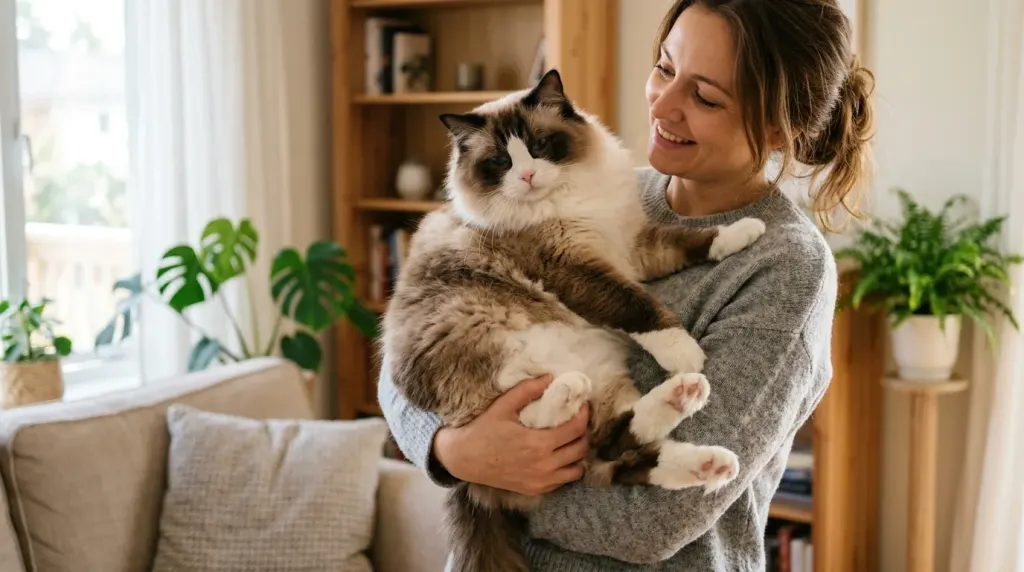
Their calm demeanor has earned them the widespread nickname “puppy-cats.” They greet owners at the front door, retrieve small thrown toys, and communicate through gentle vocal chirps rather than demanding yowls. A deeper look into Ragdoll cat behavior highlights their low startle reflex and preference for floor-level lounging over high vertical climbing.
Why Do Ragdoll Cats Go Limp When Held?
The breed’s namesake behavior is its tendency to relax its muscles completely when scooped into supportive human arms. When cradled securely, many Ragdolls voluntarily release postural tension, resting like a soft plush doll.
This limpness represents an emotional state of complete trust and contentment rather than a neurological abnormality. It is important to emphasize that not every individual Ragdoll goes limp on every occasion. Handling comfort, early socialization, and the handler’s technique play significant roles in whether a cat fully softens its posture.
Ragdolls and Relationships with Family Members
Because Ragdolls lack sharp territorial aggression, they integrate smoothly into active households with children and multi-pet families. Their patience makes them suitable companions for respectful kids who understand how to support a heavy cat properly.
Their placid demeanor allows them to adapt readily to household routines without reactive fear or destructive anxiety. Because they maintain gentle boundaries, they interact peacefully when children handle them with appropriate support.
Ragdoll Cat Care Essentials
Providing proper daily care ensures a Ragdoll stays healthy, comfortable, and mentally stimulated throughout its life. Because they are grounded cats that depend heavily on human companionship, their daily routine revolves around coat hygiene, weight control, and indoor enrichment.
Coat Grooming and Hygiene Routine
Although Ragdolls possess a semi-long, plush coat, they lack a dense undercoat. Consequently, their fur is significantly less prone to severe matting compared to double-coated breeds like Persians. Maintaining a clean, tangle-free coat requires a simple routine:
- Regular Brushing: Comb the coat a few times each week with a stainless steel comb to remove shed hairs and gently detangle friction zones around the armpits and belly.
- Seasonal Coat Management: Inquire into how much do Ragdoll cats shed during seasonal spring and autumn shifts, increasing brushing sessions as shedding picks up to minimize hairballs.
- General Hygiene: Trim claw tips periodically, check ears regularly for waxy buildup, and wipe eye corners with a damp cotton pad if minor tear staining occurs.
Consistent grooming habits established during kittenhood keep the single coat glossy and prevent digestive hairball formation.
Nutrition and Weight Control
Due to their large skeletal frame and laid-back indoor lifestyle, Ragdolls can easily become overweight if fed unrestricted diets. Obesity places heavy mechanical stress on their joints and increases the risk of metabolic complications.
- Measured Portions: Avoid free-feeding dry kibble. Feed adult Ragdolls two measured meals daily, providing approximately 20 to 30 calories per pound of ideal body weight.
- High-Protein Diet: Select formulas rich in animal-based protein and low in carbohydrate fillers to support lean muscle mass.
- Moisture Intake: Integrate high-quality wet food daily and use filtered water fountains to encourage hydration and protect kidney function.
For a complete breakdown of meal formulations by age group, consult the guide explaining what do Ragdoll cats eat.
Health Concerns and Lifespan
Ragdolls are generally sturdy and healthy cats, but like all pedigreed breeds, they carry hereditary predispositions to specific health conditions. Responsible breeding programs actively screen breeding stock to reduce the incidence of genetic disorders.
Prospective owners researching do Ragdoll cats have health problems must familiarize themselves with primary breed risks to ensure early detection and proactive veterinary care.
Hypertrophic Cardiomyopathy (HCM) and Genetic Testing
Hypertrophic Cardiomyopathy (HCM) is the most common hereditary cardiac condition in cats, characterized by an abnormal thickening of the left ventricular muscular walls. Veterinary genetics research documents that Ragdolls are predisposed to a specific mutation in the cardiac myosin-binding protein C gene, identified as the MYBPC3 R820W mutation.
The mutation is inherited as an autosomal dominant trait with incomplete penetrance:
- Homozygous (two mutated copies): Cats carry an extremely high risk of developing severe, early-onset heart failure, often before reaching 2 to 3 years of age.
- Heterozygous (one mutated copy): Cats may live normal lifespans without developing clinical disease but can pass the defective gene to their progeny.
Ethical breeders use accredited DNA testing laboratories to screen all parent cats, removing carriers from breeding lines. In addition to genetic testing, periodic veterinary echocardiograms provide direct visualization of cardiac structure.
Urinary Tract Issues and Average Lifespan
Male Ragdolls can be vulnerable to Feline Lower Urinary Tract Disease (FLUTD), including urinary crystal formation and sterile cystitis. Because large-framed males have narrower urethras, maintaining high dietary hydration through wet food and multiple fresh water stations is a vital preventative measure.
When protected strictly indoors, provided with routine preventive veterinary examinations, and fed high-quality nutrition, Ragdolls enjoy an average lifespan of 12 to 17 years, with healthy individuals occasionally reaching 18 years or more. Detailed longevity factors are outlined in the guide on how long do Ragdoll cats live. Pedigree health management relies on rigorous pre-breeding screening. While DNA tests confirm the presence of the MYBPC3 R820W mutation, cardiac health requires ongoing evaluation because non-genetic forms of cardiomyopathy can still occur. Combining parental DNA clearance with annual veterinary auscultation offers the strongest health safeguard for companion kittens.
Note: Because Ragdolls have a calm, stoic temperament, they often mask discomfort and rarely vocalize when ill. Any subtle behavioral shift, such as hiding, appetite loss, or shallow breathing, requires prompt examination by a licensed veterinarian.
Cost of Buying or Adopting a Ragdoll Cat
Acquiring a Ragdoll requires careful financial preparation, covering initial adoption or purchase fees as well as ongoing yearly maintenance expenses. Understanding how much are Ragdoll cats helps prospective owners plan an accurate long-term pet budget.
Breeder vs. Rescue Adoption Costs
The cost of bringing a Ragdoll home varies significantly based on the acquisition source, pedigree lineage, and included veterinary services.
| Acquisition Path | Estimated Initial Cost Range | Included Services and Health Records |
|---|---|---|
| Reputable Breeder | $1,000 to $3,500+ | TICA/CFA pedigree registration, core vaccinations, microchip, parental HCM DNA testing |
| Shelter or Rescue Adoption | $100 to $400 | Spay/neuter surgery, basic vaccinations, microchip, initial veterinary exam |
| Annual Care Maintenance | $800 to $1,500 per year | High-protein diet, quality litter, annual veterinary wellness exams, preventive care |
Purchasing from a certified breeder ensures purebred lineage and documented genetic health clearances. Alternatively, adopting through dedicated feline rescues offers a rewarding pathway to provide a loving home to a cat in need at a lower initial cost. Beyond upfront fees, prospective adopters evaluating is it hard to take care of a Ragdoll cat can plan their daily routine alongside ongoing maintenance expenses.
Ragdoll vs. Birman: Key Differences
Ragdolls are frequently confused with the Sacred Birman due to their shared pointed coloration, semi-longhair coats, and blue eyes. However, distinct morphological and genetic differences separate the two breeds:
- White Markings: Purebred Birmans must always possess symmetrical white “gloves” on their front paws and white “laces” extending up the back of their rear hocks. Ragdolls come in three distinct patterns (colorpoint, mitted, and bicolor).
- Body Size and Weight: Ragdolls are significantly larger and heavier. Adult male Ragdolls weigh 12 to 20+ pounds, whereas adult male Birmans typically weigh between 8 and 12 pounds.
- Head Shape: The Ragdoll head is a broad, modified wedge with flat contours between the ears, while the Birman exhibits a rounder skull with full cheeks and a Roman nose.
- Blue Eye Standards: Both breeds require sapphire eyes, leading owners to verify do all Ragdoll cats have blue eyes across all recognized coat patterns under established breed standards.
- Multi-Pet Adaptability: Both breeds possess calm personalities, but when assessing how do Ragdoll cats get along with dogs, the Ragdoll’s low reactivity makes it particularly resilient in households with canine companions.
Frequently Asked Questions About Ragdoll Cats
Do all Ragdoll cats have blue eyes?
Yes, all purebred pointed Ragdoll cats must possess vivid blue oval eyes according to official pointed breed standards. The blue eye color is tied to the pointed coat genetics that restrict darker pigmentation to the cooler extremities. Cats with green, gold, or odd eyes do not meet purebred pointed breed standards.
How big do Ragdoll cats get?
Ragdolls are among the largest domestic cat breeds. Adult males typically weigh 12 to 20+ pounds (5.4 to 9.1+ kg), while adult females weigh 8 to 15 pounds (3.6 to 6.8 kg). They grow slowly, taking up to four years to reach their full physical frame and adult weight.
Are Ragdoll cats good with children?
Yes, Ragdolls make outstanding pets for families with children. Their placid temperament, gentle physicality, and patient handling tolerance allow them to interact peacefully with kids, provided children are taught to handle the cat gently and avoid dropping its heavy body.
Why do Ragdoll cats go limp when held?
Ragdolls go limp due to a voluntary muscular relaxation response that occurs when they feel secure and supported in human arms. This trait was selectively bred from the foundation cats developed by Ann Baker in the 1960s and reflects complete emotional trust.
Do Ragdoll cats shed heavily?
Ragdolls shed moderately throughout the year, with increased shedding during seasonal coat changes in spring and autumn. Because they possess a single coat without a dense undercoat, regular brushing a few times each week is sufficient to manage loose hair and prevent matting.
Leave a Reply