
Table of Contents
Many cat lovers ask: can Ragdoll cats be black? Traditional purebred Ragdoll cats cannot be solid black under official Cat Fanciers' Association (CFA) and The International Cat Association (TICA) breed standards. Every purebred Ragdoll inherits two copies of the recessive colorpoint gene (cs/cs), which restricts dark pigment exclusively to cooler extremities such as the face, ears, paws, and tail while keeping the body lighter. Cats marketed online as "black Ragdolls" are typically seal point Ragdolls with deep pigmentation, crossbred domestic cats, or non-pointed variants registered under specialized divisions.
- Standard Ragdoll cats are genetically colorpointed and cannot possess a uniform solid black coat.
- Temperature-sensitive tyrosinase enzymes restrict dark pigment to extremities while leaving torso fur pale.
- Official CFA and TICA standards require blue eyes and point contrast for championship competition.
- Solid black cats advertised as Ragdolls are usually mixed breeds or dark seal point coats.
Why the colorpoint gene makes solid black impossible
Feline coat pigmentation is governed by biochemical pathways at the C locus, which controls the production of tyrosinase, an enzyme required to synthesize melanin. According to research on feline point coloration genetics, two copies of the recessive Siamese colorpoint allele (cs/cs) alter this enzyme in traditional Ragdoll cats, making it temperature sensitive.
The temperature-sensitive tyrosinase enzyme functions only at lower body temperatures. In warmer areas of the cat’s torso, the enzyme remains inactive, preventing heavy melanin synthesis and leaving the body fur light cream or beige. At cooler body extremities, such as the ears, face, lower legs, and tail, the enzyme operates normally, producing dense pigment.
Because every standard Ragdoll is homozygous for this colorpoint gene (cs/cs), pigment is biochemically restricted from spreading across the torso. Even if a cat possesses the genetic code for black pigment (the B allele responsible for seal coloration), the colorpoint mechanism prevents that black pigment from covering the entire body. A cat cannot be both a traditional colorpointed Ragdoll and a solid black cat, because the colorpoint genotype naturally inhibits full-body dark coat expression. Owners seeking to understand what defines a Ragdoll cat will find that this genetic constraint is central to the breed’s identity.
What CFA and TICA breed standards say about color
Major cat registries maintain strict definitions regarding recognized Ragdoll coat patterns and colors. According to official breed documentation from the Cat Fanciers’ Association (CFA) and TICA breed standards, the Ragdoll is defined specifically as a pointed breed. Championship competition requires a distinct contrast between a pale body and darker points.
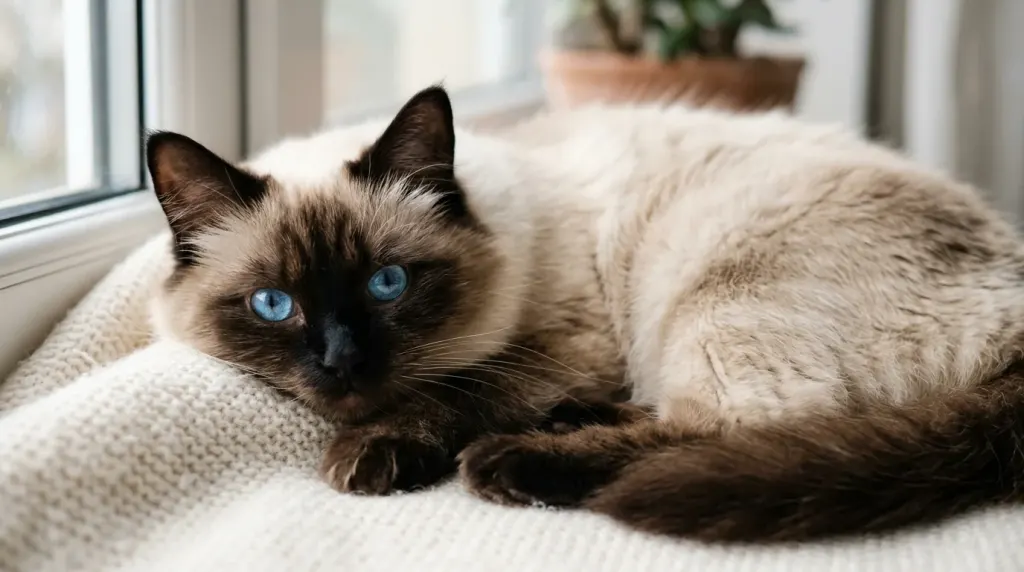
The CFA recognizes exactly six official point colors across three primary pattern variations:
| Point Color | Point Description | Body Tone | Recognized Eye Color |
|---|---|---|---|
| Seal | Deep dark brown to blackish brown | Pale fawn to cream | Vivid Blue |
| Blue | Slate blue to silvery gray | Soft bluish white | Vivid Blue |
| Chocolate | Warm milk chocolate brown | Ivory to warm cream | Vivid Blue |
| Lilac | Frosty gray with pinkish tone | Magnolia white | Vivid Blue |
| Red | Warm deep orange to red | Clear white to cream | Vivid Blue |
| Cream | Soft buff cream | Clear white | Vivid Blue |
These six point colors appear across three recognized patterns: colorpoint (solid points with no white), mitted (white paws, chin, and belly stripe), and bicolor (an inverted V mask on the face with white legs and chest). A uniform solid black coat does not exist within these official guidelines. Under CFA rules, any non-pointed coat or non-blue eye color is classified as a disqualifying fault in championship classes. Reviewing standard Ragdoll breed characteristics confirms that adherence to these color point standards is mandatory for pedigree registration.
Why blue eyes are the giveaway
Eye color serves as a reliable genetic marker when evaluating a Ragdoll’s authenticity. In pointed felines, the colorpoint gene inhibits melanin deposition in the irises, causing light to refract blue.
According to CFA breed standards, blue eye color is required in all championship Ragdolls, and any eye color other than blue results in immediate disqualification. Consequently, a solid black cat with yellow, green, or copper eyes cannot be a traditional pointed Ragdoll.
What people actually see when they call a cat a “black Ragdoll”
When prospective owners or online listings refer to a “black Ragdoll,” they are usually looking at one of three distinct feline categories:
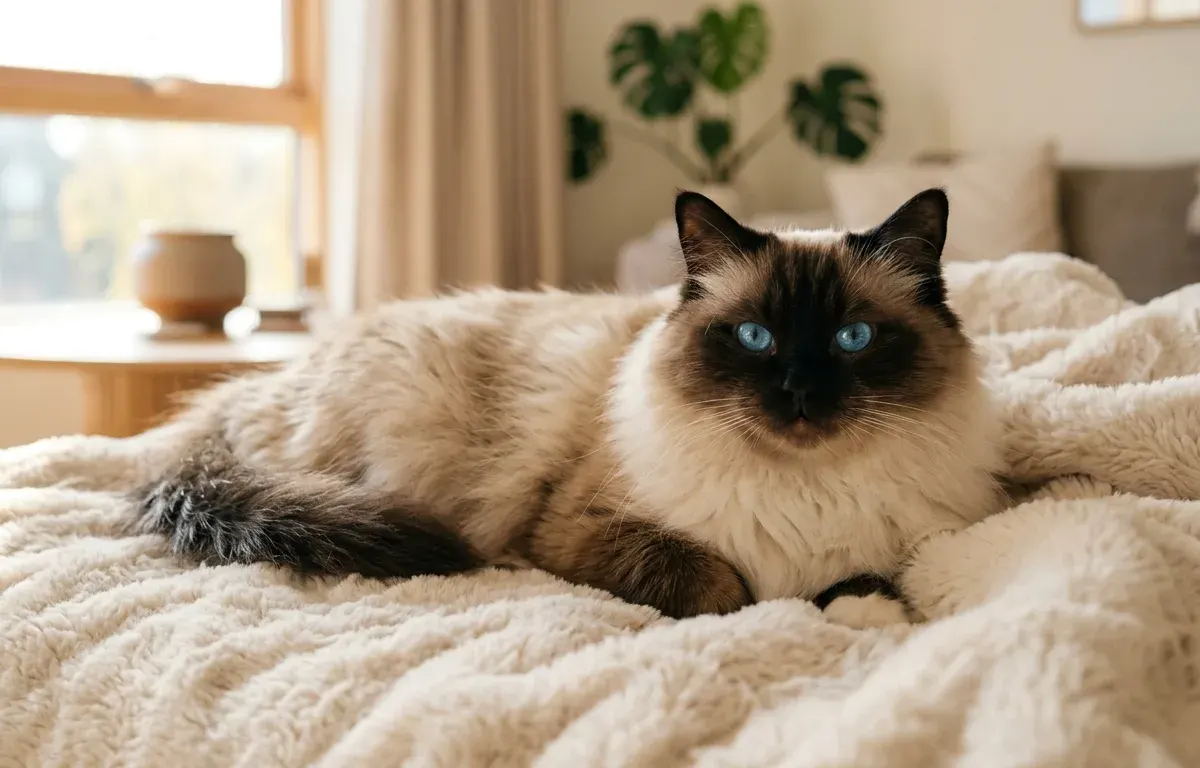
- Dark Seal Point Ragdolls: Seal point Ragdolls possess the genetic coding for black pigment (dense eumelanin). As seal points age or spend time in cooler environments, their points can darken significantly, sometimes appearing almost black on the ears, face, and paws. However, a close inspection reveals a lighter cream or tan body, maintaining the required point contrast.
- Domestic Crossbreeds: A cross between a Ragdoll and a black domestic shorthair or longhair cat can inherit semi-long fur and a docile personality while expressing a solid black coat. These cats are affectionate companions, but they are mixed breeds rather than purebred Ragdolls.
- Non-Pointed Solid Variants (Cherubim Lines): Certain breeders work with non-pointed Ragdoll lines, sometimes registered through specialized divisions in TICA or historical outcross programs. These cats carry the dominant full-color allele (C), allowing solid black fur to cover the torso. Buyers interested in unique coat variations should also research Mink Ragdoll coat variation to understand how different alleles alter body contrast and eye shade.
Market demand for rare coat colors often leads sellers to label dark seal points or domestic mixes as “rare black Ragdolls.” Prospective owners should examine pedigree documentation and eye color before paying inflated prices for non-standard coats.
Note: Genetic testing for the C locus can definitively determine whether a cat carries the traditional pointed genotype (cs/cs) or dominant full-color alleles.
Due to marketing surrounding non-traditional colors, solid or mink variants are sometimes sold at premium prices. Comparing options in a comprehensive Ragdoll price guide by quality and source helps buyers distinguish authentic pedigree pricing from novelty color markups.
The historical exception – Blackie, the breed’s black ancestor
The history of the Ragdoll breed includes an interesting foundation cat with a solid black coat. During the 1960s in California, breed founder Ann Baker developed the initial Ragdoll stock using several neighborhood cats.
Among these early animals was Blackie, a solid black male cat born to a white Persian-type female named Josephine. While Blackie contributed to early breeding experiments, the recognized pointed Ragdoll lines descended primarily through Daddy Warbucks, a seal point male, and his pointed offspring. Modern registry standards established that only pointed descendants retain official championship status.
How to tell a genuine Ragdoll from a black look-alike
Evaluating whether a cat is a true Ragdoll involves checking three physical and administrative criteria:
- Examine Eye Color: Purebred pointed Ragdolls always have blue eyes. If a black cat has green, gold, or copper eyes, it is not a pointed Ragdoll.
- Inspect Coat Contrast: Look closely at the coat under bright natural light. A true Ragdoll displays a clear contrast between darker extremities and a lighter torso, even if the seal points are very dark.
- Verify Official Pedigree Papers: Authentic Ragdolls come with registration certificates from established organizations such as the CFA or TICA, detailing certified lineage for multiple generations.
Utilizing a step-by-step Ragdoll identification guide allows cat lovers to verify physical traits systematically. Furthermore, checking whether every Ragdoll truly has blue eyes reinforces why eye color remains the definitive test for pointed breeds.
Frequently Asked Questions
Are black Ragdoll cats purebred?
Solid black cats can be purebred in a genealogical sense if both parents are registered Ragdolls carrying solid coat genetics. However, because major registries like the CFA require pointed coats for championship status, solid black Ragdolls are classified as non-standard or pet-quality rather than show-standard purebreds.
What is the rarest official Ragdoll color?
Among the six official CFA-recognized colors, lilac point is considered the rarest due to the double-recessive gene combination required (dilute blue combined with chocolate). Black is not classified as a rare Ragdoll color because it is not an accepted show color within the standard pointed breed definition.
Do Ragdoll kittens have dark fur when born?
No. Traditional pointed Ragdoll kittens are born completely white because the warm environment of the mother’s womb suppresses the temperature-sensitive tyrosinase enzyme. Point coloration begins developing on the ears and nose within 1 to 2 weeks after birth and continues to mature over 2 to 4 years.
Can a Ragdoll cat have black fur and blue eyes?
A purebred pointed Ragdoll can have very dark seal points (which appear blackish brown) paired with blue eyes. However, a uniform solid black body paired with blue eyes is extremely rare in felines and does not occur in standard Ragdoll lines.
Understanding feline genetics clarifies why traditional Ragdolls cannot possess solid black coats. Whether adopting a classic seal point or learning about breed history, consulting guidance on common Ragdoll health problems to screen for ensures every cat receives optimal long-term care regardless of coat variation.
Leave a Reply