
Table of Contents
If you wonder do Ragdoll cats shed, the answer is yes, but their routine hair loss is light to moderate compared to double-coated breeds. Because Ragdolls possess a silky single coat with minimal undercoat, dead hairs slide off easily during routine grooming rather than matting in thick layers. However, shedding increases temporarily during spring and autumn seasonal moulting periods.
- Ragdolls shed less loose hair than dense double-coated breeds such as Persians or Maine Coons.
- Single-layer coat structure reduces undercoat trapping and lowers hairball frequency.
- Coat density and shedding volume reach full adult maturity between 2 and 3 years of age.
- Seasonal moulting occurs twice a year in spring and autumn, requiring daily 10-minute combing.
- Ragdolls are not hypoallergenic because cat allergies stem from Fel d 1 protein in saliva and dander.
Do Ragdoll cats shed at all?
Ragdoll cats shed dead hair continuously as part of their natural feline hair growth cycle. However, overall hair volume lost on a daily basis remains lower than most other long-haired cat breeds.
The primary factor behind this manageable hair loss lies in coat composition. Breed standards published by the Cat Fanciers’ Association (CFA) describe the Ragdoll coat as medium-long, soft, and plush with a silky texture that lies close to the body. Unlike breeds with thick woolly undercoats, Ragdoll fur releases loose guard hairs without heavy matting.
Owner experience varies depending on grooming consistency. While loose hairs drift onto rugs or clothing, routine weekly combing prevents buildup. For owners evaluating overall Ragdoll cat breed characteristics and coat traits, shedding stays within predictable, light-to-moderate limits year-round.
Why Ragdoll coat structure affects shedding
Understanding how feline fur layers interact explains why Ragdolls produce less airborne fluff than other plush breeds.
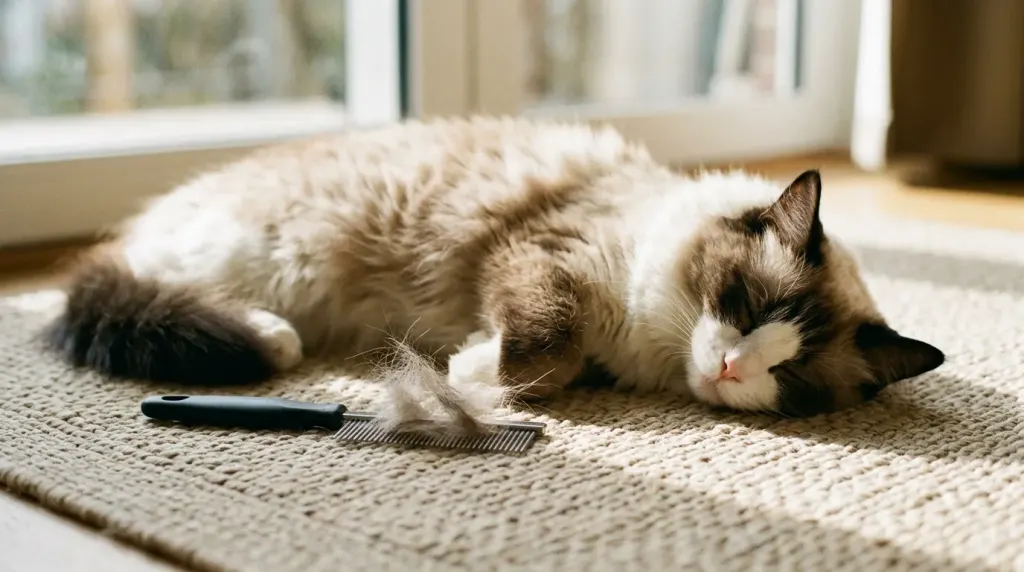
Double-coated breeds possess two distinct layers: a dense, woolly undercoat for thermal insulation and a longer topcoat of guard hairs. When double-coated cats shed, dead undercoat hairs become trapped underneath, creating stubborn mats unless brushed thoroughly with specialized dematting tools.
In contrast, Ragdolls feature a single-layer coat structure with soft guard hairs and minimal undercoat. This unique structure provides clear practical benefits for cat owners:
- Fewer hairballs: Loose fur detaches effortlessly during self-grooming, reducing swallowed hair volume and digestive hairballs.
- Easier grooming: A standard steel pet comb slides smoothly through the coat without snagging on dense undercoat tangles.
- Lower ambient shed: Hair releases gradually rather than shedding in heavy undercoat clumps.
Recognizing how to identify a Ragdoll cat by physical coat traits helps prospective owners appreciate how soft texture simplifies daily maintenance. Furthermore, tracking Ragdoll color point development and physical features demonstrates that coat texture remains consistent across color varieties.
Do Ragdoll cats shed a lot, or is that a myth?
A common contradiction appears in online pet forums where some owners ask if a Ragdoll cat sheds a lot, while breed standards classify their hair loss as moderate. This discrepancy stems from three specific observational factors rather than excessive shedding volume:
- Individual hair length: Single guard hairs from a Ragdoll measure 2 to 3 inches in length. A short-haired cat dropping 50 short hairs might go unnoticed, whereas 50 long Ragdoll hairs form visible wisps on dark clothing or furniture.
- Adult coat maturation: Ragdoll kittens are born with short, pale coats. As Ragdolls mature slowly over 2 to 3 years, their fur increases in length and plushness. Owners often misinterpret this normal adult coat development as a sudden spike in shedding.
- Seasonal coat shifts: During seasonal changes, Ragdolls experience short periods of increased hair loss that can give the impression of heavy year-round shedding.
When evaluated under normal indoor conditions, a healthy Ragdoll cat does not shed a lot of fur. Daily hair loss remains steady and easily controlled through basic care habits. Perceived shedding volume in Ragdolls is driven primarily by fur length visibility rather than actual hair count. Long silky guard hairs gather into visible clumps, making regular combing essential even though total coat loss is low.
Note: Sudden, patchy hair loss accompanied by skin redness, scabbing, or persistent scratching is not normal shedding. Consult a licensed veterinarian promptly to investigate external parasites, fungal infections, or dietary allergies.
Do Ragdoll cats moult and how it differs from daily shedding?
Cat owners often ask whether Ragdoll cats moult and how moulting differs from standard daily shedding. Feline physiology distinguishes between these two processes clearly:
- Daily shedding: The steady, low-level replacement of individual hairs that reach the end of their growth cycle (telogen phase) year-round.
- Seasonal moulting: Synchronized coat turnover triggered by changing daylight hours and ambient temperatures twice per year.
Ragdoll cats do moult in spring and autumn. During the spring moult, the cat sheds its thicker winter growth to prepare for warmer weather. During the autumn moult, summer fur sheds out to allow fresh, dense winter growth to emerge.
How much do Ragdoll cats shed during seasonal moulting?
During 4 to 6 weeks of seasonal moulting, shedding volume increases noticeably. While non-moulting periods require combing 2 to 3 times per week, seasonal moulting requires daily 10-minute combing sessions.
Without daily intervention during a seasonal moult, loose guard hairs accumulate around friction points such as armpits, trousers, and behind the ears. Prompt grooming during these transitional weeks keeps loose hair off household furnishings and prevents hairball formation. If abnormal coat thinning occurs outside seasonal shifts, examine underlying Ragdoll health issues that cause abnormal hair loss to rule out systemic illness.
How to manage Ragdoll cat shedding at home
Managing Ragdoll hair loss requires a proactive home routine focusing on grooming, nutrition, and environmental control.

Establish a regular combing routine
In line with feline grooming recommendations from the Cornell Feline Health Center, routine combing removes dead fur before it drops onto household surfaces:
- Use a stainless-steel comb with wide teeth to gently separate guard hairs and check for small mats.
- Follow with fine-toothed steel tines to collect loose underfur near the skin.
- Finish with a soft-bristled brush or slicker brush to distribute natural skin oils across the hair shafts.
Provide balanced nutrition and hydration support
Follicle strength depends directly on dietary nutrients. Diets rich in high-quality animal protein and essential Omega-3 and Omega-6 fatty acids strengthen hair roots, reduce dry skin dander, and minimize premature shedding. Combining balanced meals with proper hydration keeps the skin elastic. Reviewing optimal dietary nutrition for Ragdoll cats ensures your cat receives proper nutrient ratios. Consistent care also supports Ragdoll average lifespan and long-term care factors by maintaining overall skin integrity.
Maintain indoor humidity
Dry indoor heating during winter strips moisture from feline skin, causing dry dander and brittle hair breakage. Operating a cool-mist humidifier maintains indoor air moisture, keeping skin supple and reducing static electricity in long fur.
Are Ragdoll cats hypoallergenic despite shedding less?
Prospective owners seeking low-allergen pets often inquire whether Ragdolls are hypoallergenic due to their lack of a dense undercoat.
Ragdoll cats are not hypoallergenic. Clinical research on feline Fel d 1 allergen distribution confirms that feline allergies in humans are triggered primarily by the Fel d 1 glycoprotein. This protein is produced in feline sebaceous skin glands, salivary glands, and tear ducts.
When a Ragdoll self-grooms, Fel d 1 in saliva spreads across the fur. As saliva dries, microscopic allergen flakes (dander) become airborne. Because Ragdolls secrete standard levels of Fel d 1, individuals with diagnosed cat allergies will experience allergic reactions regardless of low coat shedding.
Do Ragdoll cats shed more than other cat breeds?
No, Ragdolls shed less total hair volume than double-coated breeds like Persians, Maine Coons, or British Shorthairs. Their single coat structure prevents heavy undercoat blowout, though their long guard hairs make shed fur easy to spot.
Is Ragdoll shedding worse around a certain age?
Ragdoll shedding volume increases between 2 and 3 years of age. Because Ragdolls mature slowly, their coat reaches full adult length, plushness, and density around age 3, resulting in higher shedding volume compared to kittenhood.
When is Ragdoll hair loss considered abnormal?
Hair loss is abnormal when accompanied by bald patches, skin redness, crusting, or constant scratching. Normal shedding occurs evenly across the body without exposing bare skin.
Leave a Reply