
Table of Contents
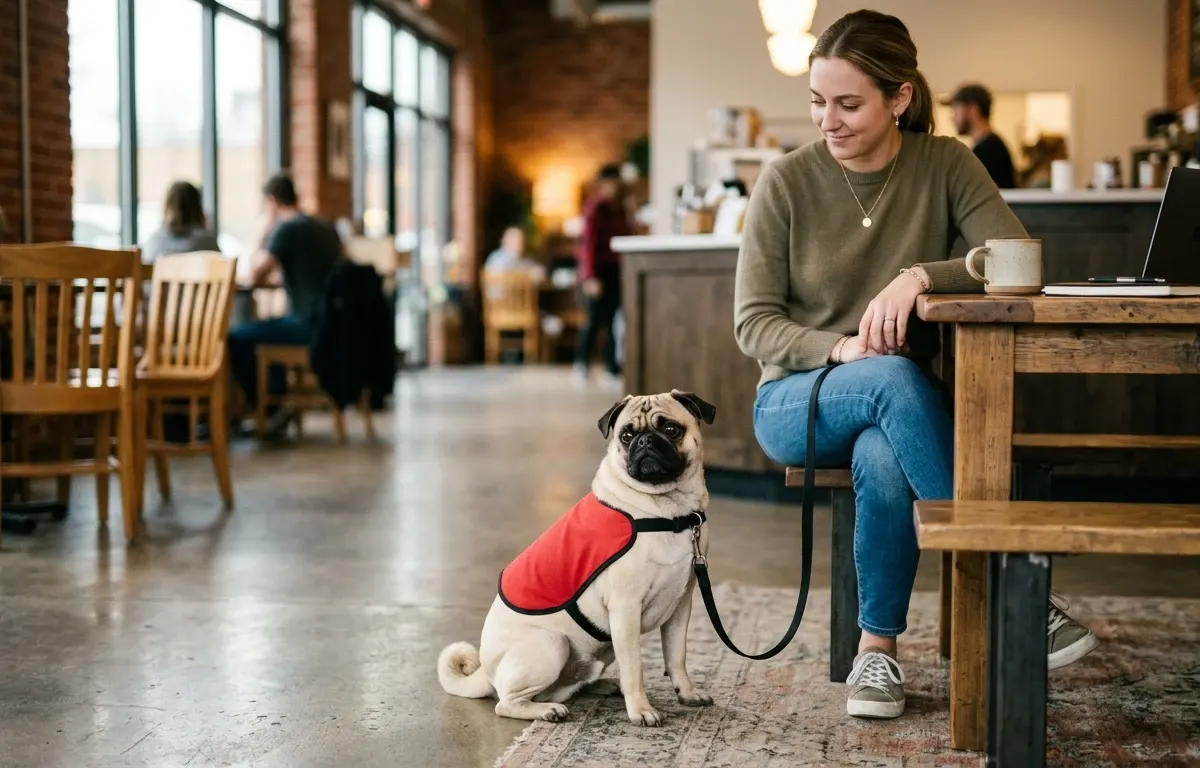
Can pugs be service dogs? Under United States federal law, yes. Title II and Title III of the Americans with Disabilities Act establish that service dog eligibility depends on individualized task training rather than breed or body weight. However, because of their small frame and brachycephalic airway anatomy, pugs cannot perform heavy physical support tasks like wheelchair pulling or balance bracing. They perform best in psychiatric assistance, medical alerting, and light sensory grounding roles.
- Federal ADA regulations permit pugs as service animals without breed bans or size restrictions.
- Physical size (14 to 18 pounds) limits pugs to light tasks, ruling out mobility support and guide work.
- Pugs excel as psychiatric service dogs, offering deep pressure therapy, panic interruption, and tactile grounding.
- Handlers can train their own service dogs without mandatory government registration or commercial certifications.
- Brachycephalic airway syndrome requires careful pacing, heat management, and strict weight control.
Can Pugs Be Service Dogs?
Federal law provides an affirmative answer when evaluating if a pug can qualify as a legitimate service animal. The Americans with Disabilities Act service animal regulations define a service animal as any dog individually trained to do work or perform specific tasks for the benefit of an individual with a physical, sensory, psychiatric, intellectual, or other mental disability. The statute focuses entirely on function and training rather than breed pedigree.

Pugs were historically bred as affectionate companions in Chinese royal courts. While they lack the working stamina of herding or sporting breeds, an individual pug service dog can master specialized assistance tasks. Because adult pugs typically weigh 14 to 18 pounds according to the American Kennel Club Pug breed standard, their small skeletal frame cannot safely withstand mechanical pulling forces or human body weight. Working roles for pugs must center on sensory cues, psychiatric mitigation, and light object retrieval.
| Working Category | Feasibility for Pugs | Primary Operational Reason |
|---|---|---|
| Psychiatric Support (PSD) | High | Natural human focus, compact size for lap pressure and grounding |
| Medical Response / Alerting | Moderate | Capable of scent alerting and auditory cue response with early training |
| Light Retrieval Tasks | Moderate | Limited to dropped items under one pound (pills, remotes, keys) |
| Mobility / Wheelchair Pulling | Infeasible | Small skeletal frame (14-18 lbs) cannot support mechanical weight |
| Guide Dog for Blind Handlers | Infeasible | Short stature and walking stride cannot safely direct human navigation |
Understanding travel and public space logistics is also essential for handlers. Under the Air Carrier Access Act, compact service dogs travel directly in the footwell area, avoiding the tight cabin spacing issues encountered when assessing whether French Bulldogs can fly on planes in commercial cargo or passenger sections.
Legal Framework and Certification Realities
The United States Department of Justice oversees ADA compliance across state and local government facilities (Title II) and public accommodations like restaurants, stores, and hotels (Title III). Under federal guidelines, public entities cannot exclude a trained service dog based on breed stereotypes, municipal breed-specific legislation, or arbitrary weight limits.
When a person enters a public establishment with a service pug and the disability is not visible, staff members may ask only two specific questions:
- Is the dog a service animal required because of a disability?
- What work or task has the dog been trained to perform?
Staff cannot demand proof of disability, request medical documentation, require a working demonstration, or demand special ID cards, vests, or training certificates. Online registries and downloadable digital certificates hold no legal standing under federal law. A business may only exclude a service animal if the dog is out of control and the handler fails to take corrective action, or if the dog is not housebroken.
Temperament and Training Considerations for Pugs
Evaluating whether pugs make good service dogs requires examining Pug behavior and temperament on an individual basis. Pugs are famously people-oriented, affectionate, and attuned to human emotional states. These qualities make them sensitive partners for handlers experiencing psychological distress.
However, pugs also possess an independent streak and lower physical endurance compared to sporting breeds. Unlike high-drive working breeds or athletic dogs where trainers examine if French Bulldogs can run for long conditioning intervals, a working pug requires short, highly rewarding practice sessions. Handlers must address impulse control and environmental habituation early. Training routines should build stable neutrality around strange dogs, loud noises, and crowded public spaces. Temperament vetting is the primary filter in service dog selection. While many pugs make loyal companion animals, only individuals with low reactivity, high social resilience, and steady focus under ambient stress can manage public access environments successfully.
What Tasks Can a Pug Be Trained To Do?
A service animal’s legal status depends on task specificity. The dog must perform trained actions that actively mitigate the handler’s disability symptoms. Pugs are particularly adept at psychiatric and sensory tasks:
- Deep Pressure Therapy (DPT): The dog drapes its 14 to 18-pound body across the handler’s lap, thighs, or chest. This steady tactile pressure stimulates the parasympathetic nervous system, helping reduce heart rate and calm sensory overload during panic attacks.
- Panic and Dissociation Interruption: The dog recognizes physical cues like leg shaking, weeping, or repetitive scratching, responding by nudging the handler’s hands with its nose or placing paws on their knees to break the emotional spiral.
- Nightmare Interruption: The dog wakes a handler during severe PTSD nightmares through gentle pawing or nuzzling.
- Medication Reminders: Responding to a scheduled smartphone chime by nudging the handler or retrieving a lightweight medication pouch.
- Tactile Grounding: Providing focused skin-to-fur contact to help handlers reorient during episodes of severe anxiety or depersonalization.
For handlers seeking training motivation, high-value food rewards must be calculated into daily nutritional intake. Low-calorie treat options like carrots for French Bulldogs and small fruit pieces like blueberries for French Bulldogs provide clean rewards without causing rapid weight gain.
Training Pathways and Welfare Considerations
Prospective handlers asking whether pugs can be trained as service dogs can choose between professional assistance dog training programs, partnering with a private certified professional trainer, or pursuing self-directed owner-training. Federal ADA regulations grant owner-trained service dog teams the exact same public access protections as teams trained by accredited commercial institutions.
| Training Stage | Primary Objective | Typical Timeframe |
|---|---|---|
| 1. Foundation Manners | Crate training, housebreaking, loose-leash walking, basic cues | 2 to 4 months |
| 2. Public Neutrality | Desensitization to crowds, elevators, sudden noises, strange dogs | 3 to 6 months |
| 3. Task Specialization | Teaching disability-specific actions (DPT, cue alerts, retrieval) | 4 to 8 months |
| 4. Public Access Testing | Proofing commands in supermarkets, restaurants, transit hubs | 2 to 4 months |
According to benchmark recommendations published by the International Association of Assistance Dog Partners training standards, a service dog partnership requires at least 120 hours of structured training over six months or longer, with a minimum of 30 hours devoted to proofing reliable obedience in distracting public access settings. Handlers beginning with core obedience and household manners should establish solid baseline routines through structured guides on training a Pug dog before advancing to complex disability mitigation tasks.
Because pugs respond best to positive reinforcement, handlers must structure reward delivery carefully without overloading daily calories. Diced pieces of plain lean chicken for French Bulldogs or small bites of cooked eggs for French Bulldogs serve as high-value reinforcers during demanding public distraction sessions while keeping overall body weight in check.
Real-World Examples and Limitations of Working Pugs
In practical service work, pugs are used as service dogs primarily by individuals managing psychological conditions, autism, and mild hearing impairment. Their small size makes them easy to transport in compact cars, under restaurant tables, and in small urban apartments.
However, physical limitations are absolute. A pug cannot provide stability for balance impairments, open heavy spring-loaded doors, or pull wheelchairs. Attempting to force physical assistance on a toy breed risks spinal disc herniation and joint injury. Working sessions must also accommodate the breed’s energy limits, ensuring the dog receives regular rest periods throughout the day.
During active working shifts, handlers should carry refreshing, high-moisture snacks such as sliced cucumbers for French Bulldogs to maintain oral hydration without adding heavy calories. If a working pug experiences mild digestive sensitivity from travel stress or environmental changes, offering bland staples like rice for French Bulldogs helps settle the stomach and prevents missed working days.
Pug-Specific Considerations and Alternatives
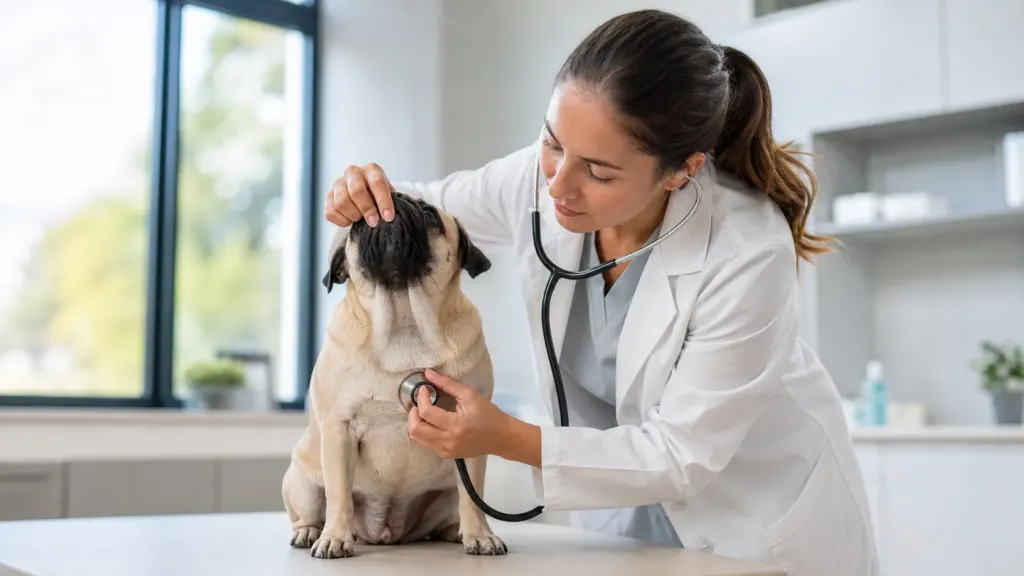
When evaluating if pugs make good service dogs for your specific lifestyle, their unique anatomy demands special operational protocols. Handlers must balance working duties against the breed’s physical vulnerabilities.
| Health Factor | Impact on Service Duties | Required Management Protocol |
|---|---|---|
| Brachycephalic Airway (BOAS) | Restricted oxygen intake in warm weather or during exertion | Limit shifts above 80°F (27°C); use chest harnesses exclusively |
| Heat Regulation Vulnerability | Inefficient cooling through panting leads to rapid heat stress | Provide cooling mats, fresh water, and air-conditioned rest breaks |
| Spinal and Joint Sensitivity | Inability to bear external weight or resist heavy pulling force | Prohibit mobility, bracing, and heavy payload tasks entirely |
| Weight Gain Sensitivity | Extra body fat narrows airways and doubles breathing resistance | Maintain strict 4/9 to 5/9 Body Condition Score with measured meals |
According to Dr. Jane Ladlow, Lead Veterinary BOAS Researcher at the University of Cambridge and developer of the Kennel Club Respiratory Function Grading Scheme, noisy breathing is never normal, and dogs showing significant respiratory obstruction should not be subjected to heavy working exertion. The RFGS evaluates brachycephalic dogs on a scale from Grade 0 (unaffected) to Grade 3 (severe clinical BOAS). Only pugs testing at Grade 0 or Grade 1 should be considered for service work.
Note: Service pugs should never be worked in outdoor temperatures exceeding 80°F (27°C) or high humidity. Handlers must discontinue work immediately if the dog exhibits loud stridor, excessive panting, or tongue discoloration.
Long-term physical maintenance requires consistent anti-inflammatory and joint support. Incorporating clean omega-rich proteins like salmon for French Bulldogs into regular meal plans protects joint flexibility in working dogs. Handlers must also recognize that flat-faced breeds struggle with water cooling, and owners should exercise the same extreme caution seen when assessing if French Bulldogs can swim safely, relying on shade and cooling vests rather than deep water exposure.
| Legal Category | Public Access Rights | Housing Rights (FHA) | Primary Function |
|---|---|---|---|
| Service Dog | Full public access under ADA | Full access without pet fees | Individually trained disability tasks |
| Emotional Support Animal (ESA) | No public access in stores/restaurants | Housing protection with doctor letter | Comfort through presence alone |
| Therapy Dog | Access only to invited facilities | Standard pet rules apply | Comforting patients and students |
If a pug’s respiratory health or temperament makes public service work unsafe, keeping the dog as an Emotional Support Animal (ESA) supported by documentation from a licensed healthcare professional under U.S. Department of Housing and Urban Development assistance animal guidance or volunteering with a therapy dog organization provides meaningful avenues for connection without the rigorous demands of public access. Prospective handlers drawn to compact companion traits can also compare a dog that looks like a pug among similar breeds to find a partner whose physical stamina better matches their daily assistance needs. Breed enthusiasts who appreciate companion crafts can also try crocheting a Pug dog to create a handmade amigurumi keepsake.
Practical Roadmap: If You Think a Pug Could Be a Service Dog
Bringing a pug into service work requires structured planning, objective health screening, and transparent progress tracking. Following a methodical roadmap protects both handler independence and canine welfare.
| Roadmap Step | Phase Focus | Key Requirements and Milestones |
|---|---|---|
| Step 1: Veterinary Clearance | Health & Airway Screening | Comprehensive physical exam, Cambridge BOAS grading (Grade 0 or Grade 1 required), and weight and joint assessment |
| Step 2: Temperament Assessment | Behavioral Suitability | Environmental neutrality test (strange dogs, traffic, crowds), sound sensitivity evaluation, and handler engagement and recovery testing |
| Step 3: Foundation & Task Training | Skills & Disability Mitigation | Complete basic obedience cues without leash tension, master 1 to 2 specialized disability mitigation tasks, and log minimum 120 instruction hours (IAADP guideline) |
| Step 4: Public Access Proofing | Real-World Neutrality | Practice in dog-friendly hardware stores and cafes, proof 3-minute down-stay under foot traffic, and confirm reliable focus around dropped food and strangers |
| Step 5: Working Protocol & Retirement | Operational Welfare & Longevity | Establish weather-dependent shift limits and rest intervals, maintain annual veterinary health checks, and plan gradual workload reduction around senior years (age 8+) |
During specialized task training, handlers teaching scent retrieval or medication reminders can use small spreads of peanut butter for French Bulldogs inside puzzle toys as high-focus incentive. For general portion control, low-calorie sliced apples for French Bulldogs deliver healthy fiber without adding unwanted pounds.
Frequently Asked Questions About Pug Service Dogs
Can a pug be a service dog?
Yes. Under Title II and Title III of the Americans with Disabilities Act, any dog breed can qualify as a service animal if it is individually trained to perform specific tasks that directly mitigate a handler’s disability.
Are pugs suitable as service dogs?
Pugs are suitable for psychiatric assistance, tactile grounding, and light alert tasks. They are not suitable for mobility assistance, balance support, wheelchair pulling, or guide work due to their small size and brachycephalic airway limitations.
What tasks can a pug perform?
Trained pugs can deliver deep pressure therapy across a handler’s lap, interrupt panic or dissociation episodes through nudging, wake handlers during nightmares, retrieve dropped lightweight items under one pound, and alert to medication alarms.
What legal restrictions exist for service animals?
The ADA allows public establishments to ask only two questions if the handler’s disability is not obvious: whether the dog is a required service animal and what tasks it performs. Businesses cannot require certification cards, medical notes, or task demonstrations.


Leave a Reply