
Table of Contents
Can French Bulldogs swim? While some paddle or enjoy shallow water, owners should never assume the breed can swim safely without support. The physique of stocky, short-legged, flat-faced dogs works against them in deep water. You should stay within reach, use a correctly fitted flotation vest beyond wading depth, and never treat paddling as proof of safety.
- Brachycephalic (flat-faced) dogs possess anatomical traits that make swimming physically demanding and risky.
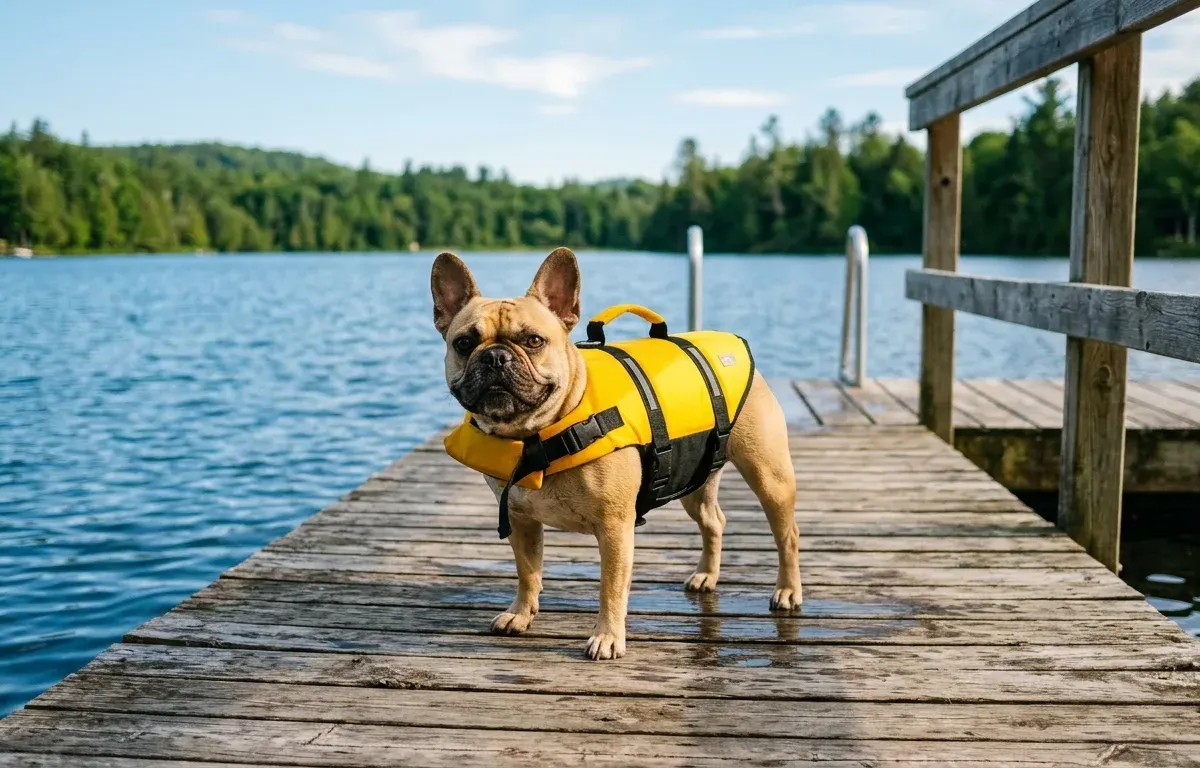
- A well-fitted life jacket is mandatory for water activities, providing buoyancy and a rescue handle.
- Teach your dog how to exit a pool safely before allowing deeper access.
- Watch for signs of exertion, such as heavy panting or a blue tint to the gums, and stop the session immediately.
- Contact a veterinarian promptly if your dog inhales water or experiences a submersion event.
Why swimming is difficult for many French Bulldogs
French Bulldogs are brachycephalic, meaning affected dogs can have narrowed nostrils, elongated soft palates, and small airways that restrict airflow. Combined with a front-heavy, barrel-shaped body and short legs, sustained water activity is a poor fit for a dog already working to breathe. A heavy physical build makes it harder for them to stay afloat, requiring significantly more energy just to keep their heads above the surface.
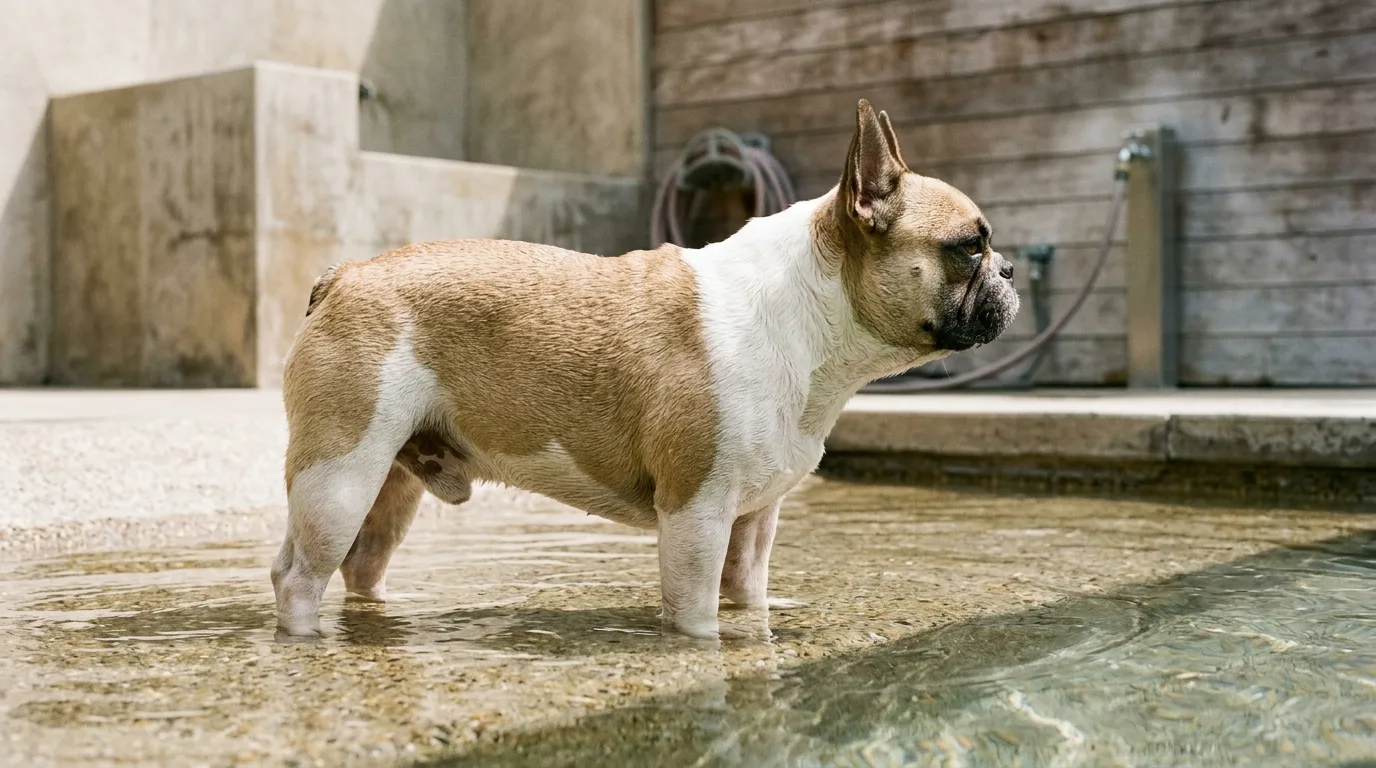
This anatomy-based risk does not mean every individual dog reacts identically. Some dogs enjoy splashing in shallow areas or show high energy on land. However, considering their historical purpose was not aquatic work, owners must remain cautious. The demand for their distinct flat-faced look is largely why French Bulldogs are so popular, but this conformation inherently limits their swimming ability. Paddling behavior does not equate to safe, independent swimming.
Breathing, heat, and exertion change the risk
A dog with noisy breathing, prior exercise intolerance, overheating, collapse episodes, or an active health concern should be assessed by its veterinarian before planned swimming. According to UC Davis clinical guidance, owners must closely monitor the breathing rate and body temperature of brachycephalic dogs during exercise and keep them at a healthy weight.
You should pause and ask your vet first if you notice unusual symptoms or if your dog has existing conditions like heart disease or arthritis. Understanding if French Bulldogs can run or sustain exercise safely helps connect their general stamina limits to the heavy exertion required in the water.
When controlled water play may be reasonable
Controlled wading may be reasonable for an individual dog that is comfortable, healthy enough, and continuously supervised within reach. The goal is calm exposure and a reliable exit, not endurance or independent deep-water swimming. Because water retrieval and aquatic tasks are not what French Bulldogs were originally bred for, you should never force a dog into the water. Instead, give frequent breaks because moving in water is hard work.
- Start where the dog can comfortably stand with its head well above water.
- Choose calm, comfortably warm water without currents or waves.
- Permit refusal; if the dog wants to leave, let it exit immediately.
- Keep sessions short to prevent fatigue.
- Provide fresh drinking water nearby so the dog does not drink from the pool or lake.
This consent-based introduction shares principles with how to train a French Bulldog effectively, relying on positive reinforcement and patience rather than force.
A life jacket is essential support, not a safety guarantee
No, a life jacket does not make swimming entirely safe. A dog life jacket adds flotation and provides a rescue handle, but it does not stop panic, breathing trouble, cold stress, waves, currents, or exhaustion. VCA Hospitals advises that stocky, short-legged breeds such as bulldogs require a life jacket anytime they go in the water. The jacket must stay on at all times on a boat, and owners must never leave a dog unattended around water.
- Ensure a secure, snug fit that supports the chest and belly.
- Check that the jacket allows unrestricted neck and limb movement.
- Choose a highly visible color.
- Verify the top handle is sturdy enough to lift the dog’s full weight.
- Perform a dry-land fit test before heading to the water.
- Replace damaged or worn-out gear immediately.
Teach the exit before allowing deeper water
The dog should be guided repeatedly to the pool steps or a stable dog ramp before any voluntary entry. The most common hazard is a dog that enters the water but cannot figure out how to get out. You should fence and cover pools to stop unsupervised dips, and actively teach your dog to climb out of a pool, into a boat, or onto a dock unassisted using dog-friendly ramps or steps.
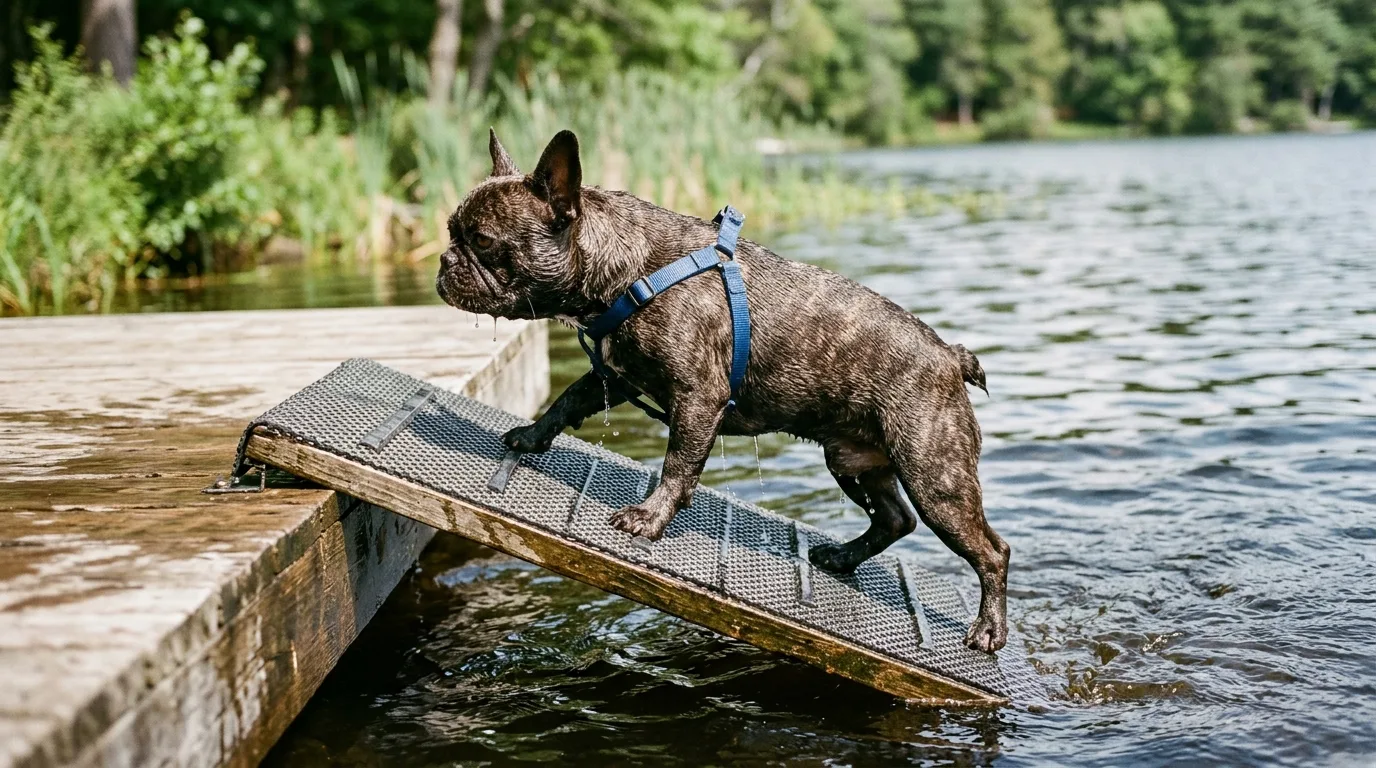
- Walk the dog to the exit ramp or steps multiple times from different angles.
- Reward the dog for successfully using the exit route.
- Never assume the dog will naturally find the stairs in a moment of panic.
Choose the water setting carefully
A shallow, calm, and closely controlled setting is easier to manage than deep or moving water, but no setting replaces direct supervision. Open water adds waves, currents, sudden temperature changes, difficult exits, and the risk of contamination. You should avoid big waves, riptides, strong currents, and dangerously cold water.
Treat pools, kiddie pools, lakes, beaches, docks, and boats as distinctly different environments. A pool can still be dangerous if a dog cannot exit, while natural bodies of water introduce unpredictable elements. If the dog shivers after cold immersion, warm it up immediately and read about why your French Bulldog is shaking to recognize emergency signs.
Pools and kiddie pools
No, a shallow pool is not automatically safe. While a shallow pool reduces depth, it does not eliminate the risks of unsupervised access, rapid fatigue, slippery sides, poor water hygiene, or an inaccessible exit. You must maintain active supervision within arm’s reach and provide stable access in and out.
| Safe Setup | Unsafe Setup |
|---|---|
| Active supervision within arm’s reach | Leaving the dog unattended for even a minute |
| Dog ramp or accessible, wide steps | Smooth, vertical pool sides with no clear exit |
| Secure physical barriers (fencing) | Unfenced pool access from the yard |
| Clean, properly treated water | Stagnant or heavily chlorinated water |
Lakes, beaches, boats, and moving water
Lakes, beaches, and boats add changing conditions an owner cannot fully control. Do not enter water with strong currents, riptides, large waves, dangerous cold, or uncertain exits. You must keep a life jacket on continuously on watercraft and bring the dog’s own fresh water. Also, ensure the leptospirosis vaccine is current before visiting natural water sources.
- Lakes and Rivers: Watch for sudden drop-offs, strong undercurrents, and waterborne parasites.
- Beaches: Avoid large breaking waves and riptides. Prevent the dog from drinking saltwater, which causes dehydration and toxicity.
- Boats: Keep the life jacket fastened at all times, as a sudden fall into deep, moving water is an immediate emergency.
Stop early and act quickly after a water incident
End water activity at the first sign of breathing difficulty, weakness, panic, disorientation, or inability to hold a normal position. After a suspected water inhalation or submersion, contact a veterinarian promptly. A JAVMA retrospective of freshwater submersion in small animals found that respiratory dysfunction was prominent and respiratory failure was a leading finding in affected animals.
You must separate “ending the session” from “urgent veterinary contact.” Never attempt improvised first-aid procedures or delay professional advice just because the dog initially seems normal. If vomiting occurs after a water incident, it should be reported alongside other symptoms, as understanding why your French Bulldog keeps throwing up in this context requires clinical assessment.
Signs to end water activity immediately
Stop immediately if you notice laboured or noisy breathing beyond the dog’s normal pattern, heavy panting that does not settle, a blue or purple tint to the gums or tongue, marked weakness, panic, repeated attempts to climb out, or a refusal to continue. Move the dog to a cool, shaded place, offer fresh water, and call your vet if signs do not resolve quickly.
- Heavy panting that fails to subside during rest
- Raspy, wheezing, or unusually loud breathing
- Blue, purple, or pale gums
- Stumbling, extreme fatigue, or sudden weakness
- Frantic splashing or panicked behavior
What to do after a fall-in or submersion
Remove the dog from the water at once, using the life-jacket handle if worn. Keep the dog calm and warm, and call a veterinarian or emergency clinic if there is coughing, breathing difficulty, weakness, altered behavior, or suspected inhalation.
- Lift the dog out immediately using the life jacket handle or by supporting the chest and hindquarters.
- Move to a quiet, dry, and warm environment to prevent shock and hypothermia.
- Observe closely for coughing, raspy breathing, lethargy, or distress.
- Contact an emergency veterinary clinic for guidance.
- Do not try to force water from the lungs or perform procedures without direct professional instruction.
After-water care and safer activity choices
Rinse off salt or pool chemicals with clean water, dry the dog thoroughly, provide fresh drinking water, and monitor their recovery. Rinsing after a swim is important, and you should clean the ears with a veterinarian-approved drying agent to prevent infection. Never let dogs drink pool, lake, river, or sea water.
If your dog cannot safely tolerate water exercise, choose shaded, cool-hour, low-intensity alternatives. Ear care prevents painful moisture-related infections, so you should learn how to clean French Bulldog ears. Monitoring their rest afterward is also necessary; understanding if French Bulldogs sleep a lot normally helps you judge whether post-activity lethargy is typical or a sign of exhaustion.
Frequently Asked Questions about can french bulldogs swim
Can French Bulldog puppies swim?
Do not assume a puppy knows how to swim or how to exit. You should never assume a dog can swim naturally, and you must never let a dog swim unattended. Keep a puppy’s exposure shallow, calm, short, and within arm’s reach, focusing entirely on safe entry and exit rather than swimming distance.
Can French Bulldogs swim with a life jacket?
A properly fitted life jacket provides flotation and a handle to lift the dog out, but it does not make unsupervised or rough-water swimming safe. Stocky, short-legged breeds such as bulldogs always need a life jacket anytime they go in the water, and it should remain fastened at all times on a boat.
Do all French Bulldogs dislike water?
No. A dog can enjoy splashing or wading and still be unable to swim safely or sustain water exercise. If a dog isn’t leaping in, it may be tired, in pain, or unsure, and you should never force it. Judge safety by the individual dog’s health, breathing, comfort, the water conditions, and your ability to intervene instantly.


Leave a Reply