
Table of Contents
If you are wondering "can French Bulldogs run", they can enjoy short bursts of play, but they are not endurance runners. Their brachycephalic (flat-faced) anatomy makes them prone to breathing difficulties and overheating, meaning sustained running or hot-weather exercise is highly unsafe. A short daily walk combined with supervised indoor play is much safer than jogging.
- Short, self-paced sprints are fine for healthy Frenchies in cool weather.
- They are poor jogging partners and usually tire within 10 to 15 minutes of continuous running.
- Hot and humid weather dramatically increases their risk of life-threatening heat stroke.
- Unusually noisy breathing, weakness, or blue gums are emergencies requiring immediate veterinary care.
Can French Bulldogs run safely?
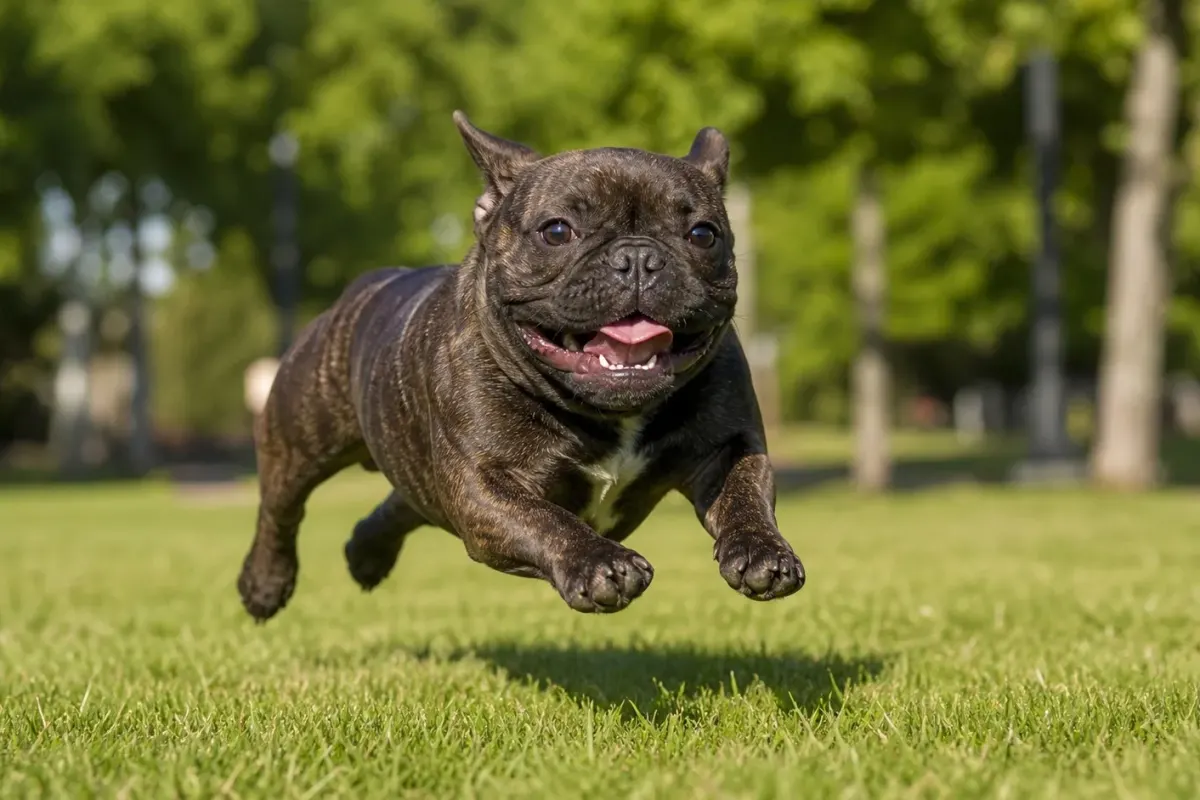
A healthy French Bulldog can dash across the yard, chase a toy, or experience brief zoomies. However, repeated, forced, or prolonged running is a poor default. Understanding what a French Bulldog’s compact, flat-faced build means for care is critical, as their airway restriction severely reduces their exercise tolerance and worsens the risk of overheating in warm or humid conditions.
Sprinting for a few seconds is vastly different from trotting or jogging continuously alongside a person. An enthusiastic dog is not necessarily a safe-to-exercise dog, as they often push themselves past their physical limits before owners notice the danger signs. In clinical assessments, such as those reviewed by Veterinary Evidence for brachycephalic dogs, exercise tolerance is fundamentally lower because the respiratory system struggles to meet the increased oxygen demand of running muscles.
Why short-nosed anatomy changes exercise tolerance
Brachycephalic airway syndrome (BOAS) involves multiple structural abnormalities, including narrowed nostrils (stenotic nares) and an elongated soft palate. According to VCA Animal Hospitals, severely affected dogs make more airway noise, tire easily with exertion, and may collapse or faint after exercise. Their shortened muzzles significantly reduce the surface area available for evaporative cooling when panting, which makes heat management much harder and drastically limits their running stamina. Their shortened muzzles also reduce panting efficiency, which makes heat management much harder. A French Bulldog’s enthusiasm can mask their physical limitations. Their drive to play often outlasts their ability to breathe and cool down effectively.
Short sprint versus owner-led run
A backyard burst is entirely different from taking a dog for a run. A dog that chooses a few seconds of play can stop, seek shade, and self-regulate. On a leash run, the human sets the speed and distance, pushing a French Bulldog past early fatigue signals. Owner-focused sources like FrenchBulldogOwner report that Frenchies typically tire and risk overheating within about 10 to 15 minutes of continuous running. Forcing them to sustain a jogging pace for distances like a 5K is extremely dangerous and practically guarantees respiratory distress.
How fast can a French Bulldog run?
A French Bulldog can look surprisingly quick over a very short distance, but there is no official breed-wide top-speed standard. While owner-oriented estimates from sites like FrenchBulldogOwner commonly cluster around 12 to 15 mph for brief bursts, this speed is only achieved in play and cannot be maintained. This is a broad estimate, not a fitness goal or a reason to test a dog’s maximum speed. Speed is not endurance, and pushing a brachycephalic dog to sprint repeatedly is dangerous.
What changes an individual dog’s pace and tolerance?
Age, body condition, airway health, orthopedic history, surface, and weather all change how a dog copes with activity. A lean dog with no obvious breathing difficulty and an ideal body condition score may handle brief playtime well, whereas an overweight Frenchie faces compounded respiratory strain. SustainableVet highlights that strict weight management is one of the most effective non-surgical ways to manage mild BOAS symptoms and improve exercise tolerance.
Veterinary guidance from PetPlace and VCA Animal Hospitals indicates that brachycephalic breeds should avoid strenuous exercise, especially in warm weather, as their airways cannot efficiently cool their bodies.
If your dog has a history of back pain or weakness, such as IVDD in French Bulldogs, this entirely changes the exercise conversation and often limits activity to slow walking.
Why speed is not a health target
The useful question is whether the dog stays comfortable and recovers normally, not whether they reach a specific speed. Relying on reward-based French Bulldog training to build reliable recall and stop cues is much safer than forced chasing or running alongside a bicycle. Encourage low-pressure play with breaks instead of repeated sprinting.
Note: Do not use speed estimates as training targets. Measuring a French Bulldog’s top speed often leads to overexertion and respiratory distress.
When running is higher risk
Avoid vigorous activity in warmth or humidity, when a dog has noisy or labored breathing, after recent illness or injury, or with known airway, heart, orthopedic, or spinal disease. Brachycephalic dogs are over-represented in heatstroke cases and should not exercise in warm weather. If you notice your French Bulldog shaking, assess them for signs of pain, stress, or overheating, though shaking has multiple causes and requires careful observation.
Hot and humid weather
It is safest to skip vigorous outdoor exercise when it is warm or humid. Flat-faced breeds cool poorly through panting. According to VCA Animal Hospitals, a dog’s normal body temperature is 100°F to 102.5°F (38°C to 39.2°C), and temperatures above 105°F (40.5°C) indicate severe heat stroke. Because they cannot sweat effectively, exercising a French Bulldog on a hot, humid day can push their body temperature into the danger zone very quickly. Stick to early mornings or late evenings, utilize shaded areas, and always provide fresh water.
Puppies, seniors, and dogs with health concerns
Age changes exercise rules. Puppies are still developing, and Dogster notes that a common guideline for growing puppies is about 5 minutes of exercise per month of age, twice a day. Forced running can damage their growing joints and growth plates. Seniors may have reduced mobility or unrecognized arthritis pain, making high-impact activity harmful. Dogs with known breathing difficulty, lameness, or back problems need a veterinarian’s tailored activity plan rather than a generic routine. For more context on different life stages, read about when to neuter a French Bulldog.
Safer ways to exercise a French Bulldog
For most Frenchies, brief walks, gentle play, training games, and indoor enrichment beat sustained runs. Guidance from Dogster and PetPlace indicates that roughly 30 to 60 minutes of total daily exercise, broken up into short 15-minute walks, is usually sufficient, avoiding anything too intense.
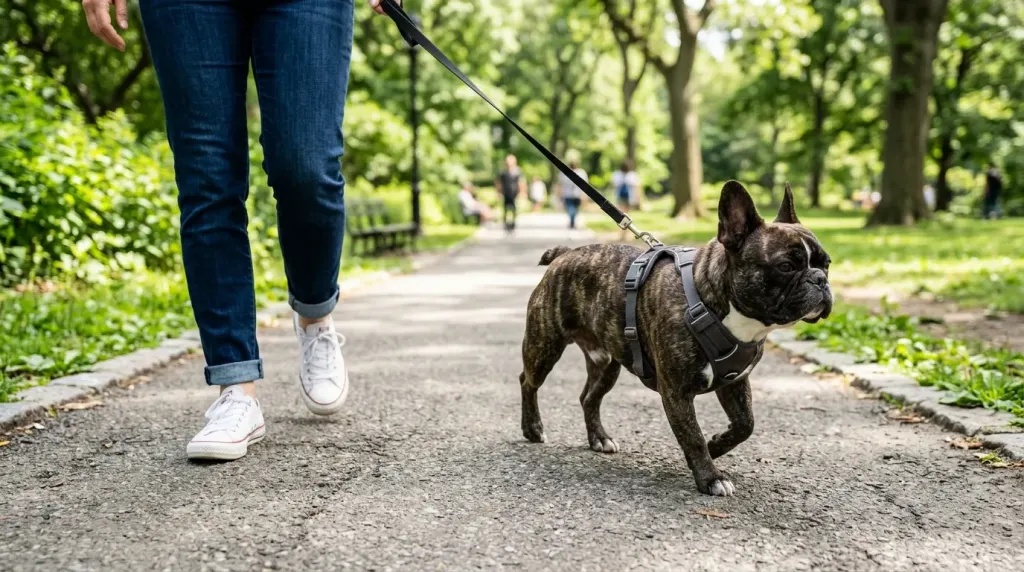
Let the dog set the pace. Use frequent breaks, pick cool times, choose comfortable surfaces like grass, and use mental enrichment to reduce the need for intense physical activity. Establishing a routine, similar to potty training a French Bulldog, helps keep their outdoor schedule predictable and manageable.
Build a low-risk activity routine
Start with short, calm sessions in comfortable conditions and stop while the dog is still coping well. Build a routine through consistency, not forced distance. Make recovery, breathing, gait, and willingness to continue matter more than time or miles.
Gear and environment choices
Choose a secure harness rather than a neck collar, carry water when conditions warrant, and favor shaded, predictable routes. SustainableVet recommends walking a French Bulldog on a harness instead of a collar to reduce pressure on their compromised airways and trachea. Always avoid heat and humidity. While water play can be cooling, remember that French Bulldog swimming carries its own severe risks due to their dense bodies and top-heavy build, and requires a life jacket and separate precautions.
Signs to stop and call a veterinarian
Stop immediately if breathing becomes unusually noisy or labored, the dog is weak, staggers, vomits, develops blue or pale gums (cyanosis), collapses, or fails to recover promptly in a cool setting. Collapse, marked breathing difficulty, or suspected heat stroke is an emergency. VCA Animal Hospitals advises cooling the dog with cool (not freezing) water and contacting a veterinarian right away. If your dog vomits after exertion, read why a French Bulldog keeps throwing up to understand when it becomes urgent.
What normal recovery should look like
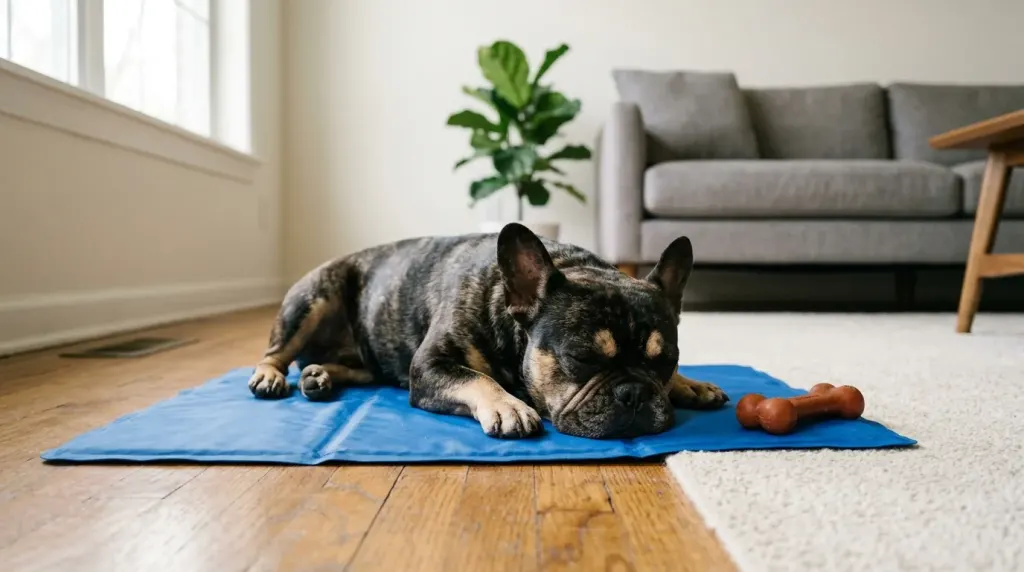
A dog should settle comfortably after resting in a cool environment and return to normal behavior and gait. If they seem excessively lethargic after cooling down, understanding normal French Bulldog sleep patterns can help distinguish between standard rest and concerning exhaustion. Persistent heavy or noisy breathing, reluctance to move, lameness, vomiting, weakness, or unusual behavior warrants stopping future vigorous activity and contacting a veterinarian immediately.
FAQ about French Bulldog running
Are French Bulldogs good running partners?
Usually no. They enjoy short play bursts, but airway and heat-management limits make them a poor match for regular jogging or distance runs. Owner-focused sources report they tire and can overheat after about 10 to 15 minutes of continuous running.
Can a French Bulldog run off leash?
Only in a securely fenced area with close supervision, where the dog can stop and cool down on its own. Prioritize a shaded, enclosed space and the ability to end play the moment their breathing changes.
Is panting always a reason to stop?
Panting can accompany normal activity, but unusually loud, strained, prolonged, or escalating panting, especially with heat, weakness, vomiting, or gum-color changes, is a reason to stop and assess the dog urgently.
Can indoor play replace a run on hot days?
Often, yes. Indoor, climate-controlled training games and gentle play can meet activity needs while avoiding the heat and humidity that dramatically raise heatstroke risk for flat-faced breeds.

Leave a Reply