
Table of Contents
So, can Pug dogs swim? While most Pugs instinctively paddle when placed in water, they are not natural or capable swimmers. Their flat brachycephalic faces, compressed airways, heavy barrel chests, and short legs make staying afloat exhausting and dangerous. Without a properly fitted canine life jacket and direct supervision, Pugs face a severe risk of rapid fatigue and drowning.
- Pugs possess low natural buoyancy because their dense bone structure and heavy chest pull their front end downward in water.
- Brachycephalic Obstructive Airway Syndrome (BOAS) severely limits their oxygen intake and makes cooling down through panting ineffective during swimming.
- A canine life jacket with a chin support flap and a sturdy grab handle is mandatory for any water activity.
- Shallow wading in ankle-deep water, splash pads, or cooling mats are much safer ways for Pugs to enjoy warm summer days.
Can Pug Dogs Swim?
Most Pugs instinctively paddle when they find themselves in deep water, but moving their legs does not make them natural or capable swimmers. You should never assume your dog knows how to swim based on breed alone. Comfort, cardiovascular fitness, airway health, water conditions, and a reachable exit determine whether a dog is safe in the water. According to VCA Animal Hospitals, drowning can occur simply from exhaustion or a dog being unable to exit a pool. It helps to understand what a Pug looks like underneath the skin: their compact frame and heavy chest make floating difficult without assistance. Because they have a disproportionately large head, dense bone structure, and minimal buoyant fat, a Pug’s natural center of gravity pulls their front end down. To keep their nose above the surface, they must tilt their head sharply backward, which forces their back legs deeper into the water and requires tremendous energy to maintain.
Paddling is not the same as safe swimming
Staying afloat, keeping the muzzle above the surface, turning, and finding a way out are distinct skills. A Pug might paddle frantically yet panic or fail to reach the steps. VCA warns that even experienced swimmers can drown in strong currents or when they cannot figure out how to leave a swimming pool. Do not mistake early paddling for proof of competence.
Why Pugs Struggle in the Water
Pugs are brachycephalic dogs, which fundamentally compromises their respiratory efficiency. Their short muzzle, stocky body, barrel-shaped chest, and short legs make it biomechanically difficult to keep their airway above the surface. Furthermore, Pugs carry a high ratio of dense muscle and heavy bone relative to their overall size, reducing their natural buoyancy compared to water-retrieving breeds. Many Pugs suffer from Brachycephalic Obstructive Airway Syndrome (BOAS). This anatomical limitation means they often have narrowed nostrils (stenotic nares), an elongated soft palate that partially blocks the windpipe, tonsillar eversion, and a hypoplastic (abnormally narrow) trachea. This cascade of structural issues causes severe exercise intolerance and extreme heat intolerance. The Orthopedic Foundation for Animals (OFA) defines BOAS by these signs, noting that the increased effort to breathe creates chronic negative pressure in the airway. During the physical exertion of swimming, this negative pressure spikes dramatically, which can rapidly lead to laryngeal collapse, a life-threatening obstruction where the cartilage of the voice box folds inward. A 2026 PLOS ONE study confirms the Pug remains one of the most clinically affected breeds, with over half of the studied population showing significant respiratory compromise at rest. When you understand why Pug dogs snort at rest, it becomes clear why physical exertion in water carries an exponentially higher risk. The heavy muscular output required for paddling rapidly increases their oxygen demand, but their compromised airway cannot physically intake enough air, leading to hypoxia (oxygen deprivation) within just a few minutes of swimming.
How BOAS changes the water decision
BOAS directly impairs a dog’s primary thermoregulation mechanism: panting. Dogs do not sweat to cool down; they rely entirely on evaporating moisture from their respiratory tract. If your Pug already shows labored breathing, overheats easily, or has a history of fainting (syncope), their cooling mechanism is already failing on land, and you should not test them in water. Many owners mistakenly believe that swimming in cool water will automatically regulate their dog’s body temperature. However, the immense physical effort of swimming combined with an inability to pant effectively means a Pug’s core body temperature can actually spike into hyperthermia (over 103°F or 39.4°C) dangerously fast, even in lukewarm or cool water. VCA advises checking with your veterinarian first, as concurrent conditions frequently seen in Pugs, such as osteoarthritis, myxomatous mitral valve disease, and idiopathic epilepsy, make swimming exceptionally dangerous. A seizure in the water is almost always fatal due to immediate aspiration, and a weak heart cannot handle the sudden, massive cardiovascular strain of panic-paddling.
Note: If your Pug has diagnosed airway, heart, or seizure disease, or has shown breathing distress, talk to your veterinarian before any water activity.
When breathing sounds are a stop signal
An everyday snort does not diagnose BOAS, but breathing that becomes louder, harsher, or more effortful during activity is a clear stop signal. If you notice heavy panting or coughing, get your dog out of the water immediately. You should track whether Pug dogs snore or breathe loudly at rest to establish their normal baseline. Do not dismiss worsening respiratory noise as a typical breed trait.
Decide Before Your Pug Enters the Water
You should default to skipping deep-water activities if your dog has active breathing trouble, is unfit, has an open wound, or faces cold water with no safe exit. Always avoid dangerously cold water, big waves, riptides, and strong currents. You must also consider your dog’s age and mobility, especially when Pugs become senior dogs. A ready, supervising adult must be present at all times.
When a Pug should stay out of the water
Keep your Pug out of the water if they show labored breathing, overheating, or collapse. A known heart, lung, or neurologic condition is a strict barrier. A dog in pain, nursing an open wound, or unable to enter and exit calmly should stay dry. How to take care of a Pug involves knowing their limits. Any suspected breathing emergency requires urgent veterinary care, not home monitoring.
Use a Life Jacket and Plan the Exit
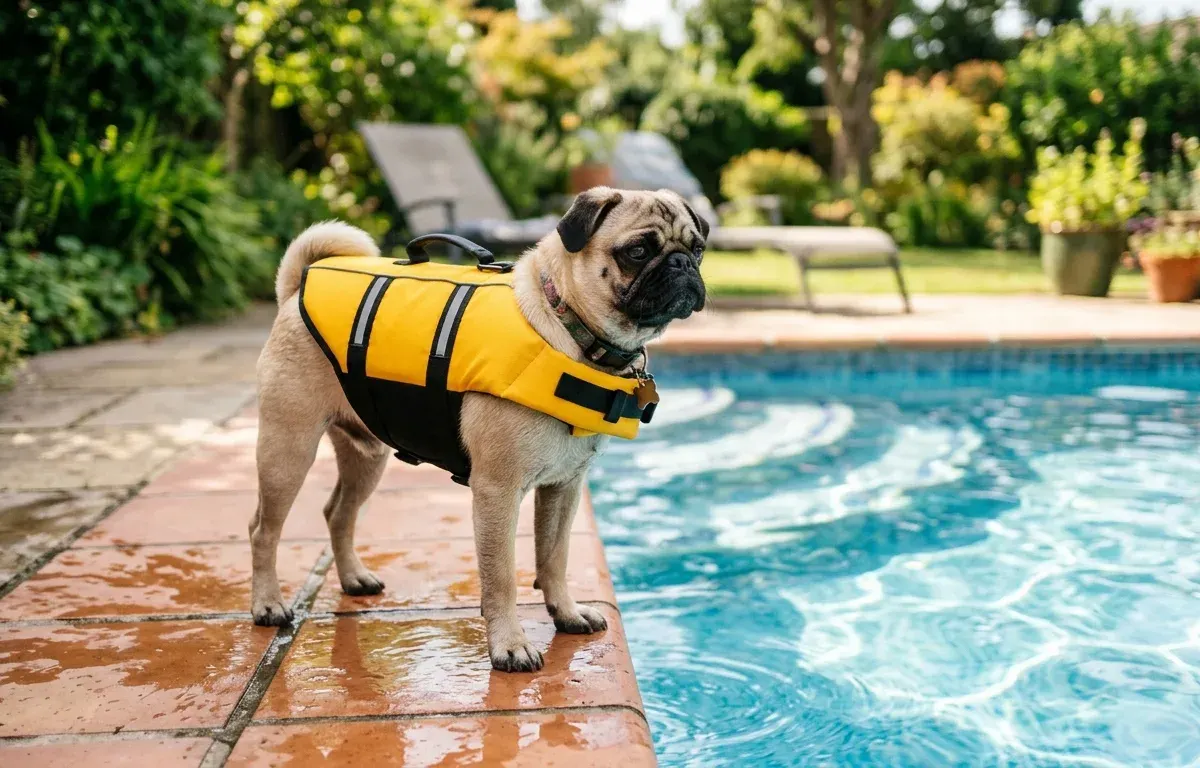
VCA states that stocky, short-legged breeds like Pugs always need a life jacket whenever they go in the water. Flotation supports safety by keeping their heavy chest horizontal, but it never replaces hands-on adult supervision. You must also teach your dog to climb out of a pool, boat, or dock unassisted, using pet-safe ramps or wide steps.
Fit and test the vest on land first
Before you check how big Pugs get to order a vest, use a soft measuring tape to determine your dog’s chest girth (the widest part behind the front legs), neck circumference (where the collar sits), and back length exactly. A jacket that is too tight around the chest will artificially restrict rib cage expansion, further compressing their already compromised brachycephalic airway and accelerating hypoxia. Choose a vest made from high-density closed-cell foam or neoprene, with extra flotation material explicitly positioned under the chin or chest to actively keep the head elevated. Confirm the jacket features heavy-duty reinforced stitching and a strong, wide top grab handle so you can lift their entire body weight out of the water instantly in an emergency. Test the fit on dry land first by securing all straps and lifting the dog slightly by the handle. You should be able to slide exactly two fingers flat under the straps. A jacket that shifts, twists, or slips over the dog’s head in the water gives false confidence and can tragically trap the dog underneath the surface. Furthermore, never attach a leash to a life jacket D-ring while the dog is swimming, as a snagged leash can instantly pull the dog underwater.
Make an unassisted pool exit non-negotiable
Never assume your dog has the spatial awareness to get out of a pool alone, especially when they are panicked or their vision is obscured by splashing water. Before ever allowing full water access, you must physically walk your Pug repeatedly to the physical steps or a specialized pet-safe pool ramp (which should feature high-traction surfacing and a gentle incline). Guide them through the exit route with high-value treats dozens of times from different entry points in the pool so they firmly memorize the spatial location of the exit. Fence the pool entirely with a physical barrier and use a rigid, weight-bearing pool cover when it is unused (floating solar covers are incredibly dangerous, as dogs can slip underneath them and become trapped invisible from the surface). Dogs of all breeds frequently drown in residential pools not because they cannot swim, but simply because they become exhausted circling the edge trying to pull themselves over a sheer vertical wall without realizing the stairs are just feet away.
Introduce Water Slowly, Never by Force
Start with voluntary contact in warm, shallow, calm water where your dog can stand and turn easily. Reward them with treats and praise, stop if they hesitate, and never throw or pull them into the water. VCA explicitly warns against forcing a dog to swim, as reluctance often signals fatigue or pain. If you know how to train a Pug puppy using positive reinforcement, apply those exact methods to water acclimation.
Start with wading, not swimming
Begin with heavily controlled wading in shallow water where your Pug can stand completely securely on all four paws, with the water level reaching no higher than their elbows. They must have an immediate, unblocked route to dry ground. Warm water (around 75-80°F or 24-27°C) is significantly easier on their muscles and prevents the rapid cold shock that can induce panic or cardiovascular stress. A bathtub equipped with a non-slip rubber mat, a shallow children’s wading pool (hard plastic to avoid claw punctures), or a heated canine therapy pool makes an excellent starting point. The singular goal of these early sessions is to closely observe their psychological comfort, body language, and baseline respiratory rate in the water, not to build cardiovascular endurance or force swimming behavior.
Choose Water Conditions Carefully
Calm, shallow, clear water with a known exit is the easiest environment to manage. Surf, currents, deep open water, and warm stagnant ponds present severe risks. In any setting, your Pug needs close supervision, frequent breaks, fresh drinking water, and protection from overheating. Because they adapt well to indoor spaces, evaluating whether are Pugs good apartment dogs often highlights that they do not need outdoor extremes to stay happy.
Lakes and ponds: avoid suspected blue-green algae
If you suspect your Pug has been exposed to blue-green algae, contact a veterinarian or a pet poison control center IMMEDIATELY. This is a critical, time-sensitive emergency, do not wait for symptoms to appear.
Do not let your Pug drink from or swim in freshwater lakes or ponds with visible scum, foam, strong unnatural colors, or a bad odor. Toxic blooms often resemble spilled green paint, pea soup, or green flakes suspended in the water. According to the Cornell Riney Canine Health Center, there is no reliable way to tell visually whether a specific algae bloom is producing toxins. Harmful cyanobacteria produce highly potent cyanotoxins (like microcystins, which destroy the liver, and anatoxins, which attack the central nervous system). You must avoid all suspected blooms entirely. Even a microscopic amount, such as a Pug simply licking their wet paws or grooming their fur after wading in contaminated water, can deliver a lethal dose of hepatotoxins or neurotoxins. Clinical symptoms including severe muscle tremors, acute seizures, excessive drooling, respiratory paralysis, and collapse can onset in as little as 15 to 20 minutes. There is absolutely zero time to wait and watch; aggressive veterinary intervention is required the moment exposure is suspected.
Beaches and boats add current and saltwater risks
Open water conditions change rapidly. Avoid big waves, riptides, strong currents, and cold water. Keep your Pug in their life jacket at all times on any watercraft, and confine dogs living on boats at night. Bring fresh water from home and discourage saltwater drinking.
Recognize Emergencies and Act Promptly
If your Pug shows any signs of distress during or after swimming, contact your veterinarian or emergency clinic IMMEDIATELY. Do not wait and monitor their symptoms to see if they improve.
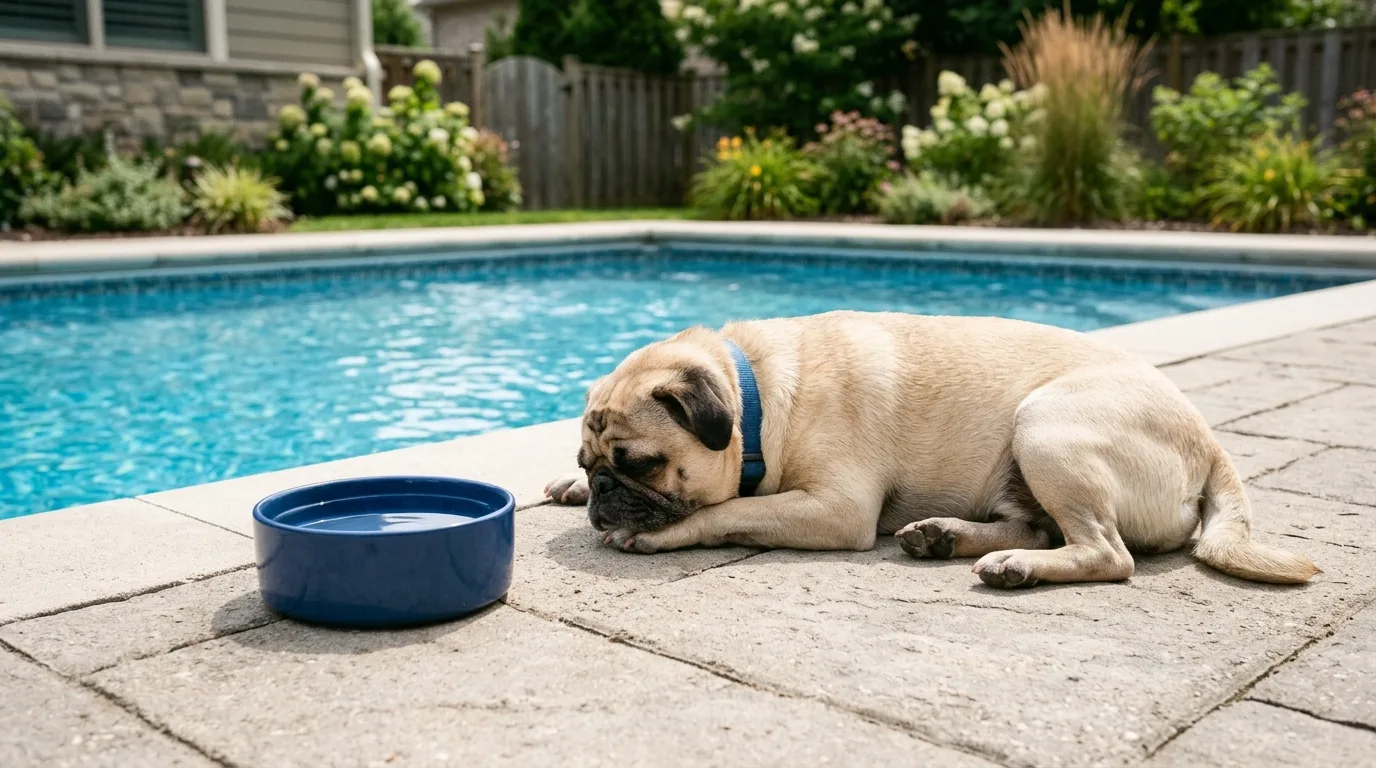
During normal water play, you must proactively remove your Pug from the water at the very first subtle sign of fatigue: frantic or uncoordinated paddling, trouble keeping their heavy head elevated, lowering of the hindquarters, unusual tiredness, coughing, wheezing, or shivering. If you observe rapid, shallow breathing, a change in gum color to blue, grey, or stark white (cyanosis indicating lack of oxygen), capillary refill time longer than two seconds, vomiting, or collapse, you are dealing with an acute medical emergency. It is easy to wonder what causes a Pug to keep moving and not lay down when they return home, but severe restlessness, pacing, or inability to settle after swimming are massive red flags. These behaviors often point to life-threatening exhaustion, the onset of secondary drowning, or severe systemic oxygen deprivation that requires immediate oxygen therapy and medical stabilization.
Don’t rely on a fixed minute limit
There is no universal safe time limit for every Pug. Keep early sessions to roughly five minutes with breaks, but the real rule is to stop before fatigue sets in. Judge their stamina by their breathing, comfort, and the water conditions. VCA stresses the need for frequent breaks because swimming is demanding work for flat-faced breeds.
Rinse, Dry, and Reassess After Water Play
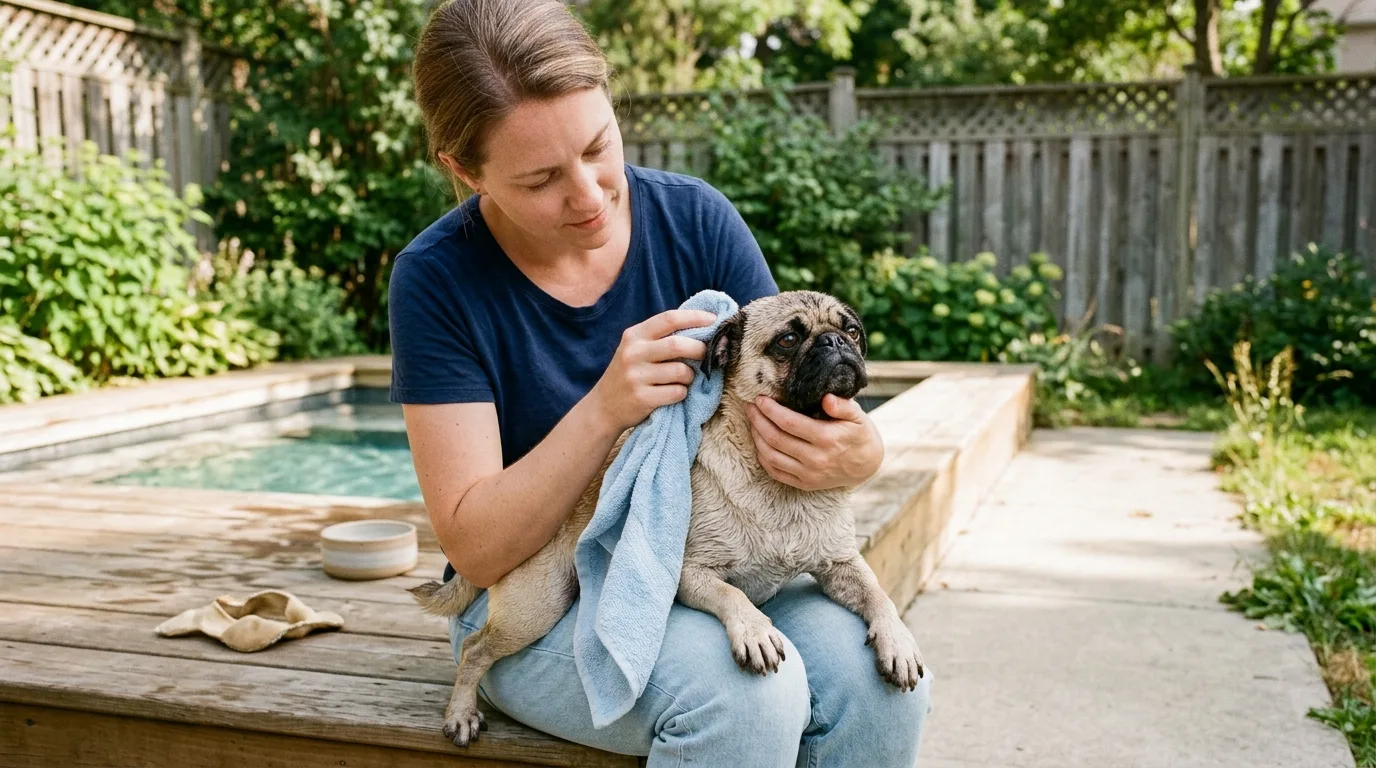
Rinse away chlorine, salt, or debris with clean water. Dry the coat thoroughly, check the skin folds, and offer fresh water. VCA recommends rinsing after a swim and cleaning the ears with a drying agent to remove moisture, which helps prevent infections. Reviewing Pug ear anatomy and infection risks shows why keeping the ear canal dry is critical.
If your Pug drinks or inhales water
Contact a veterinarian IMMEDIATELY if you suspect your Pug has swallowed large amounts of water or inhaled water into their lungs. Do not wait to see if symptoms resolve. Never attempt to induce vomiting at home unless explicitly instructed to do so by a veterinary professional during that specific emergency call, as vomiting severely increases the risk of aspirating stomach contents into the lungs.
You must strictly prevent your Pug from deliberate or accidental drinking from pools, lakes, or the sea. Swallowing large volumes of freshwater rapidly can lead to a condition called water intoxication (dilutional hyponatremia). When too much water enters the bloodstream, sodium levels drop dangerously low, which disrupts cellular osmotic balance and causes immediate brain swelling (cerebral edema). Early signs of water intoxication include extreme lethargy, loss of coordination (ataxia), nausea, glazed eyes, and muscle twitching, which rapidly progress to seizures, coma, and death if untreated.
Furthermore, because Pugs have a compressed facial structure, they are highly prone to inhaling water while paddling (aspiration). Inhaling even a very small amount of water, from a splashed wave or dipping their nose, can trigger secondary drowning (also known as dry drowning or aspiration pneumonia). This inflammatory reaction causes fluid to actively build up inside the lungs (pulmonary edema) hours or even days after the swim, physically blocking oxygen exchange. Symptoms like a persistent crackling cough, lethargy, or increased respiratory rate hours after swimming warrant an emergency vet visit.
Safer Ways for a Pug to Enjoy Water
A Pug does not need to swim to enjoy the summer. Supervised shallow wading, a lightly filled splash area, cool indoor play, or a shaded walk are often safer options. Never force water participation and always keep fresh water and shade available. Understanding that are Pugs lap dogs explains why they generally prefer low-intensity companionship over intense physical exercise.
Frequently Asked Questions about Pug swimming
Can pugs swim in a pool?
They may paddle in a pool but you should never assume they can swim safely. Use a well-fitted life jacket, stay within arm’s reach, teach them the route to the steps or ramp, and fence the pool against unsupervised access.
Do pugs need a life jacket?
Yes. VCA states that stocky, short-legged breeds like Pugs always need a life jacket whenever they enter the water. A jacket supports safety but does not replace adult supervision.
Can a pug drown?
Yes, any dog can drown, even one that has paddled successfully before. Dogs often drown from exhaustion, currents, or failing to find a pool exit. A Pug’s flat face and quick fatigue make this risk higher.
Can a pug with breathing problems swim?
Do not use water to test their breathing limits. BOAS reduces exercise and cooling capacity. A Pug with known airway, heart, or neurologic disease requires veterinary advice before attempting any water activity.
How long can a pug swim?
There is no universal time limit. Keep early sessions short, around five minutes, and provide frequent breaks. Stop the session at the first sign of fatigue or breathing difficulty.

Leave a Reply