
Table of Contents
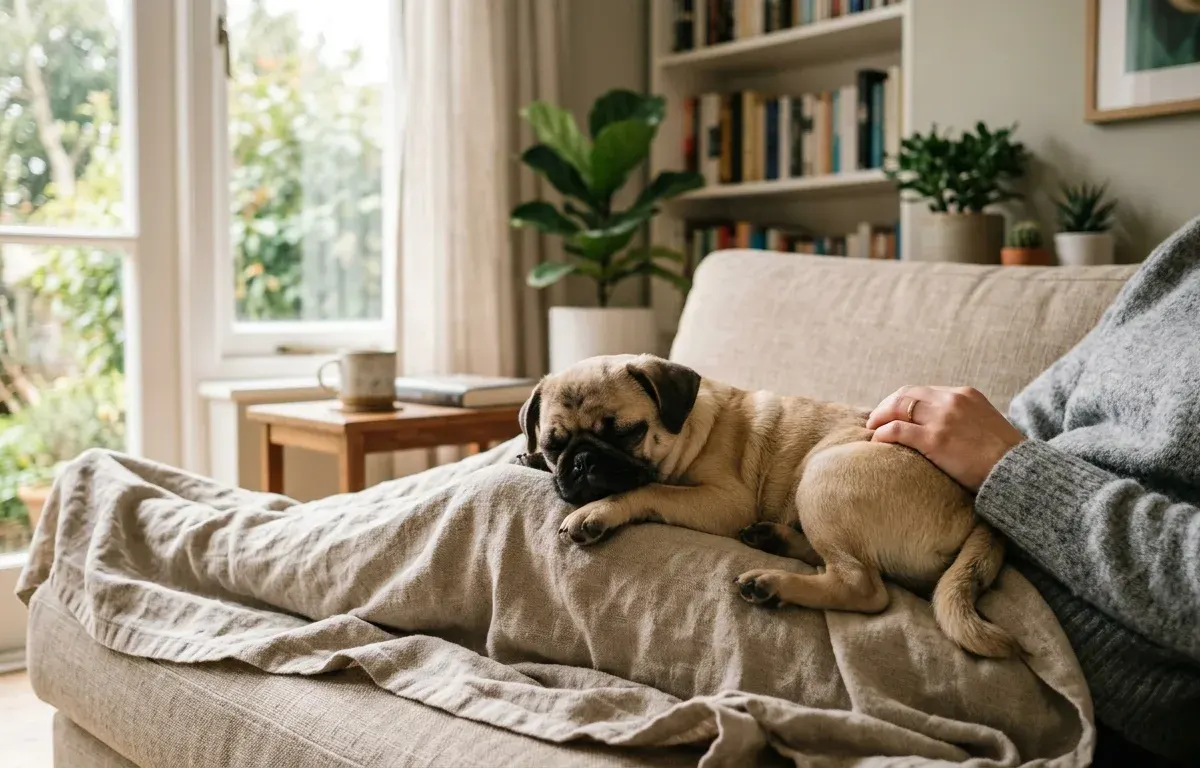
Are pugs lap dogs? Yes, they are quintessential lap dogs. Bred exclusively for companionship in ancient China with no working, hunting, or guarding history, pugs are classified in the AKC Toy Group. They retain a compact physique and an affectionate temperament built entirely for close human proximity.
- Pugs were bred solely as royal companions and have no history of field or working jobs.
- They often exhibit "velcro dog" behavior, following owners from room to room.
- Jealousy or nudging behavior can occur when their owner's attention shifts to rivals.
- Pugs bond warmly with the entire household rather than being exclusive one-person dogs.
- While prone to separation anxiety, general environmental fearfulness is not a standard breed trait.
Are Pugs Good Lap Dogs? Breed Origins and Historical Purpose
Pugs are among the purest lap-dog breeds because centuries of selective breeding in China intentionally removed independent hunting and guarding drives. Originating around 400 BCE, their sole historical job was providing warmth and quiet companionship to Chinese royalty.
- Ancient origins: Bred during the Han and Shang dynasties as prized indoor companions. They were highly valued by emperors and kept in luxury, often guarded by soldiers. Their distinctive facial wrinkles were intentionally bred to resemble the Chinese character for “prince” (wang).
- European arrival: Transported to Europe in the 16th century by the Dutch East India Company.
- Royal association: Widely popularized by the House of Orange in the Netherlands. In 1572, a pug named Pompey purportedly saved the life of the Prince of Orange by barking to warn him of approaching assassins, cementing the breed’s status as a favored royal lap dog. They were later championed by Queen Victoria in the 19th century, who bred them and established their popularity in the United Kingdom.
- Breed standard: The American Kennel Club (AKC) classifies pugs in the Toy Group, with a standard weight of 14 to 18 pounds perfectly suited for resting comfortably on a lap. Their sturdy but compact build allows them to be substantial enough not to feel fragile, yet small enough to be easily picked up.
These dogs are excellent family pets because their original design remains unchanged. As intelligent and deeply affectionate companions, they thrive on consistent human interaction rather than outdoor exploration.
What Was the Pug Originally Bred to Do?
Pugs had absolutely no working role in the field. Herding, hunting, pointing, and ratting were never part of the breed’s function, meaning they lack the high prey drive or independent working instincts seen in terriers or hounds. Their sole historical job was providing companionship to Chinese royalty and, later, European nobility. Because they were never expected to work independently away from their human handlers, their core instinct is to remain as close to their owners as physically possible.
Are Pugs Still Lap Dogs Today? Modern Household Role
Pugs remain dedicated lap dogs today because, unlike working breeds that transitioned away from field duties into modern suburban homes, pugs never had another job to transition from. Companionship has been their constant, uninterrupted role across two millennia.
- Indoor lifestyle: Their brachycephalic (flat-faced) anatomy makes them highly sensitive to heat and humidity, strictly reinforcing an indoor, lounging lifestyle. They physically cannot sustain prolonged strenuous outdoor activity.
- Exercise needs: They require only moderate daily exercise, such as a short 20-minute walk in cool weather, making them excellent apartment dogs.
- Remote work companions: Their quiet nature, low exercise threshold, and immense desire for proximity make them highly suited for households where owners are present most of the day or work from home.
According to the AKC, pugs “live to love and to be loved in return,” a temperament description that perfectly aligns with modern household expectations for an attentive, low-energy companion dog.
Are Pugs Velcro Dogs? Proximity-Seeking Behavior
Pugs frequently qualify as velcro dogs, a behaviorist term for breeds that shadow their owners from room to room and seek constant physical contact. This habit directly stems from their history as purpose-bred companions.
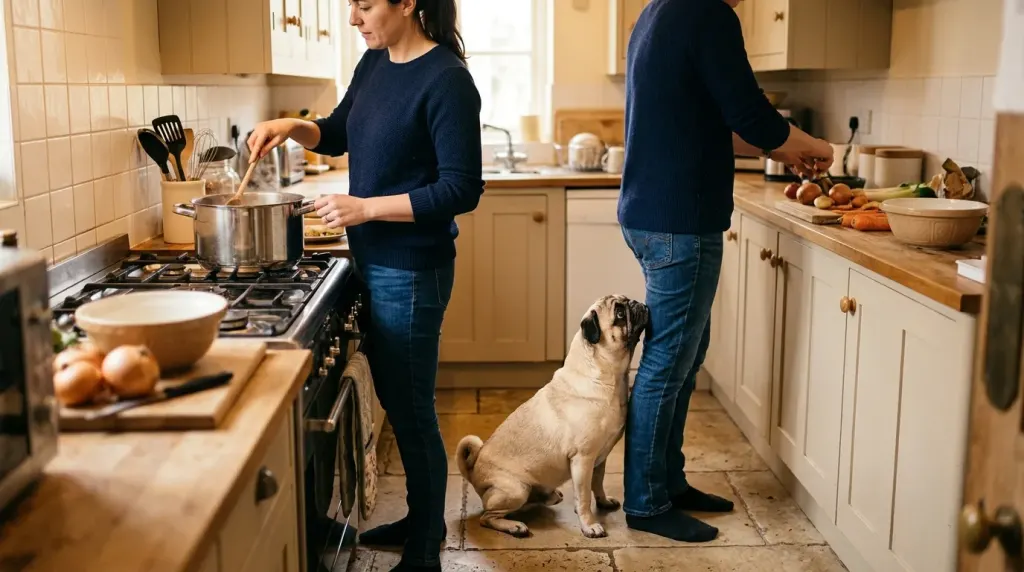
A typical pug will follow you into the bathroom, lean its entire body weight against your legs while you stand in the kitchen, and sleep pressed firmly against your side on the couch. Because the AKC breed standard emphasizes their even temper and loving nature, it is well understood that heavily people-oriented breeds actively seek out this intense level of physical connection. For pugs, this proximity-seeking behavior is the primary reward system they were bred to prioritize over food or toys. Incorporating this shadowing into their daily routine and care is simply part of owning the breed; owners should expect to trip over a sleeping pug at their feet.
Are Pugs Clingy and Needy Dogs? Attachment Across Life Stages
Pugs are widely recognized as clingy and needy because of a high, consistent desire for social interaction. However, the intensity of this attachment shifts across life stages, often starting high, mellowing slightly, and then rising again in seniority.
How Does Clinginess Change From Puppy to Senior Pug?
- Puppies (0-12 months): Cling intensely for security while exploring their environment and learning household routines. Crate training can be particularly challenging for pug puppies because isolation goes against their bred-in instincts.
- Adults (1-7 years): Settle into affectionate but predictable patterns. They are usually content to sleep quietly in a dog bed nearby while you work, rather than needing to be directly on your lap at every second.
- Seniors (8+ years): Often become significantly more dependent. As senior pugs experience natural sensory decline, such as reduced hearing or vision (frequently due to cataracts or nuclear sclerosis), they rely more heavily on their owners for navigation, comfort, and reassurance, leading to increased clinginess.
Owners must distinguish normal breed neediness, such as following you to the kitchen, from true separation distress, which involves panic when physical access to the owner is restricted.
Are Pugs Jealous Dogs? Attention-Seeking Around Rivals
Pugs can display distinct jealous behavior when an owner’s attention shifts to another pet or person. This directly aligns with peer-reviewed findings in Scientific Reports, which demonstrated that dogs generally exhibit jealousy-like responses (such as pulling on a leash or interrupting) to protect a valued social bond from a perceived rival.
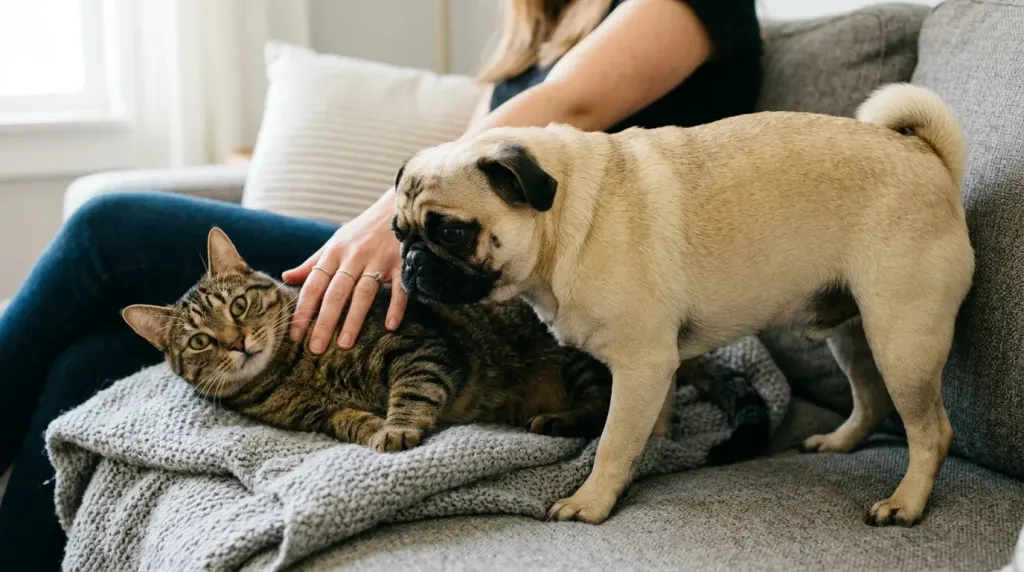
Instead of guarding physical territory or food, a pug guards your affection. This usually takes the form of wedging themselves between you and the rival, persistently nudging your hand with their snout, or demanding lap access when another animal is being petted. In multi-pet households, this is easily managed through fair, structured attention distribution and positive reinforcement. If they become overly aroused in their demand for attention, it can occasionally lead to excitement-related reactions, but the root cause is a strong desire for social inclusion rather than true aggression.
Are Pugs Loyal Dogs? Bonding With the Whole Household
Pugs are immensely loyal, but in a broad, non-territorial sense. Unlike guardian breeds (like Rottweilers or Mastiffs) that express loyalty through exclusion and defense of a single primary handler, pugs bond warmly and openly with every household member.
The AKC breed profile highlights their remarkably even temper and loving nature. When properly socialized, pugs are typically friendly toward guests and other animals. Their characteristic greeting rituals involve full-body wiggling, enthusiastic tail wagging, and licking. Their loyalty is highly inclusive, making them eager to add new friends, visitors, and delivery drivers to their social circle without suspicion.
Are Pugs Naughty Dogs? Mischief Versus Misbehavior
Pugs display occasional naughty behavior, but this is typically playful, stubborn, and attention-seeking rather than destructive or aggressive. Distinguishing harmless mischief from real aggression is crucial to understanding the breed’s comedic nature.
Common mischief includes stealing small soft items like socks, stubbornly refusing to walk in the rain, snitching food scraps dropped on the floor, or experiencing sudden bursts of indoor running known as Frenetic Random Activity Periods (FRAP), commonly called the “zoomies.” These behaviors are best managed through short, highly motivated positive-reinforcement training sessions using high-value treats. They act out to engage you in play or because they are food-driven, never to challenge your authority in a dominance hierarchy.
Are Pugs Anxious Dogs? Separation Anxiety vs. Everyday Nervousness
Pugs are highly prone to separation anxiety due to their profound human dependency, but a well-socialized pug is not typically fearful of everyday situations or novel environments. The anxious behavior is tied specifically to being left alone, not to general environmental nervousness.
Symptoms of severe separation anxiety include:
- Pacing, panting, or drooling heavily as you prepare to leave the house.
- Whining, howling, or barking excessively within minutes of your departure.
- Destructive chewing near exit points like doors or windows.
- Inappropriate elimination indoors despite being fully house-trained.
While general canine separation anxiety is commonly estimated to affect roughly 14% to 20% of dogs overall, companion breeds like the pug are considered highly susceptible because of their deeply ingrained need for human proximity. Leaving a pug alone for 8 to 10 hours a day on a regular basis will almost certainly lead to behavioral and emotional distress.
Note: If your dog shows persistent, severe anxiety or engages in self-injury when left alone, it requires evaluation by a licensed veterinarian or a veterinary behaviorist who may recommend counter-conditioning or medication.
Are Pugs Emotional Dogs? Empathy and Mood Mirroring
Pugs are highly emotionally responsive and perceptive, often mirroring an owner’s mood. They can become lively and playful when you are upbeat, and will quietly approach for gentle physical contact when they sense you are sad or stressed.
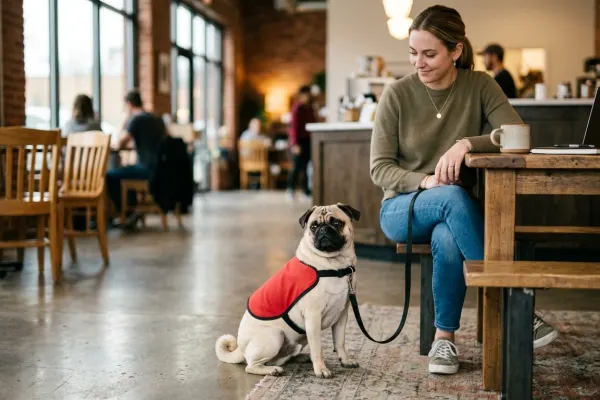
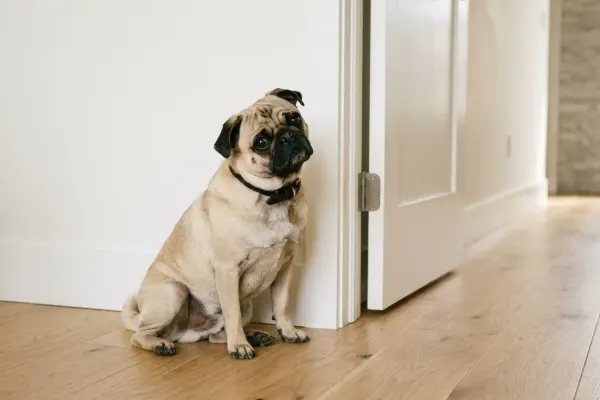
Their facial expressiveness, highlighted by deep wrinkles, a shortened muzzle, and large dark eyes, helps them communicate effectively with humans. While recent peer-reviewed studies note that brachycephalic (flat-faced) dogs can sometimes be harder for humans to read visually than long-nosed breeds due to their static facial structure, pugs make up for it with highly attentive body language, such as the classic head tilt. This steady, non-judgmental companionship and high empathy make them excellent candidates for therapy dog roles in hospitals or nursing homes.
Frequently Asked Questions about pugs
How much attention do pugs need daily?
Pugs require several hours of passive companionship and active interaction each day. Because they were bred solely to be with people, they do extremely poorly if isolated in a backyard or left in a separate room away from the family hub. They thrive when they can simply be in the same space as their owners while they work, watch television, or sleep.
Do pugs sleep with their owners?
Yes, the vast majority of pugs strongly prefer to sleep in the same bed as their owners. Their historical role was to provide physical warmth to Chinese royalty, and they naturally seek out continuous physical contact at night. If sleeping in the human bed is not possible, they should absolutely have a comfortable, warm dog bed in the same room to prevent nighttime distress and anxiety.
Can pugs be left alone?
Pugs can be left alone, but generally for no more than four to six hours at a time for a healthy adult dog. Puppies under six months and senior dogs require much more frequent check-ins and potty breaks. Because they are highly prone to separation anxiety and lack independent hobbies, long workdays away from home usually require a dog walker, a pet sitter, or a structured doggy daycare environment to keep them mentally and emotionally healthy.
Leave a Reply