
Table of Contents
When learning how to train a French Bulldog, the most effective approach is to manage their environment, teach one clear behavior at a time, and reward correct choices immediately. Because Frenchies are a companion breed, they respond best to short, positive sessions rather than long drills or harsh corrections.
- Use reward-based methods to build reliable behaviors.
- Begin household routines immediately when a puppy arrives.
- Raise the difficulty of tasks gradually to prevent frustration.
- Protect against heat stress during outdoor practice.
- Seek professional help if you observe sudden fear or aggression.
Are French Bulldogs easy or hard to train?
A Frenchie becomes reliable when training is predictable and worthwhile to the dog. Slower progress usually reflects an adolescent testing boundaries, competing distractions, or inconsistent household rules. It rarely means the dog lacks the capacity to learn.
Training progress depends heavily on how clearly the owner communicates. According to the American Kennel Club (AKC), setting clear routines and using high-value rewards yields much faster results than trying to force obedience. Rejecting the outdated “dominance” framing helps owners focus on what actually works, preventing the rehearsal of unwanted behavior and rewarding the actions they want to see.
Understanding what French Bulldogs were bred for provides helpful context. As a breed developed primarily for companionship, they are naturally inclined to engage with their owners. They just need clear instructions and a reason to cooperate. Adequate rest also supports learning, so knowing whether French Bulldogs sleep a lot helps owners time their sessions when the dog is actually ready to focus.
Train the routine, not a stereotype
A dog that appears to ignore a learned cue may be more interested in the environment, may need a more valuable reward, or may face a task that got too hard. Return to an easier version, reward the correct response more often, and rebuild gradually rather than repeating the cue or escalating pressure.
- When the dog is unresponsive: The distraction level is likely too high. Move to a quieter room.
- If the dog wanders away: The reward may not be valuable enough. Switch to a higher-value treat.
- If the dog seems confused: The task may have advanced too quickly. Drop back to the previous, easier step.
When do French Bulldogs calm down?
There is no universal age at which a French Bulldog suddenly becomes calm. Adolescence begins and ends at varying times depending on the individual dog, so consistent practice, sleep, enrichment, and management remain important throughout. A sudden shift to hiding, pain signs, appetite loss, or aggression warrants veterinary attention rather than dismissal as a phase.
| Stage | Expected behavior | Action needed |
|---|---|---|
| Puppyhood | Short attention span, high energy bursts. | Focus on gentle exposure and short, frequent practice. |
| Adolescence | Testing boundaries, seemingly forgetting cues. | Maintain consistency. Do not resort to punishment if progress stalls. |
| Adulthood | Settling into routines, more reliable habits. | Keep enforcing house rules and providing mental enrichment. |
Build the setup before teaching cues
Training starts before the first cue: remove predictable temptations, agree on house rules, prepare small high-value rewards, and pick a low-distraction space. Puppy-proofing the living area and beginning healthy household routines as soon as a Frenchie arrives prevents bad habits from forming.
If the immediate priority is toilet training, establish an elimination plan first. A structured approach to how to potty train a French Bulldog makes other household manners much easier to manage. Early handling acclimation is also crucial. For example, learning how to clean French Bulldog ears helps the dog tolerate routine care without fear.
Choose rewards and mark the right moment
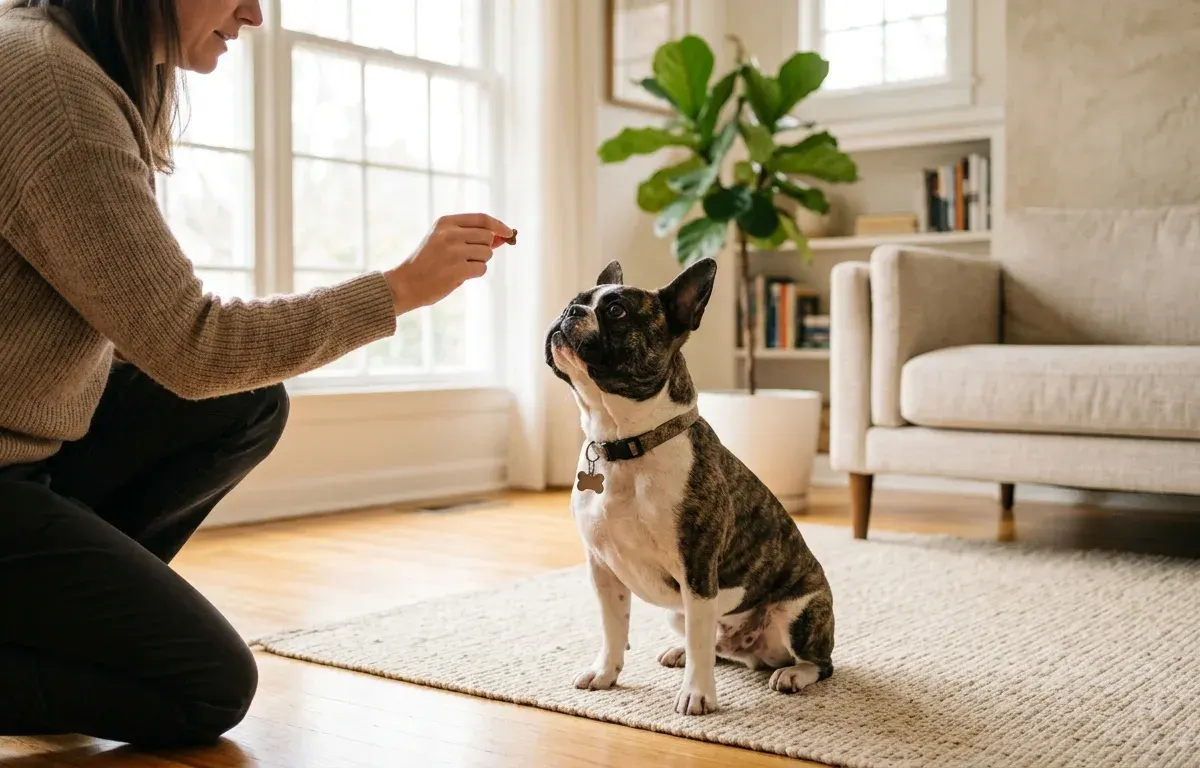
A reward must matter to the individual dog and arrive quickly enough for the dog to connect it with the behavior. Start in a quiet setting, use tiny food rewards, praise, or play, and upgrade reward value when the environment gets harder. For food-motivated dogs, using safe fruit treats like strawberries for French Bulldogs cut into tiny pieces offers a high-value, healthy motivator during basic drills.
According to the American Veterinary Society of Animal Behavior (AVSAB) Position Statement on Humane Dog Training, evidence supports the use of reward-based methods for all canine training, noting that there is no evidence that aversive training is necessary for dog training or behavior modification.
- Cue: Give the instruction once.
- Behavior: Wait for the dog to perform the action.
- Marker: Say “Yes!” or click the instant they do it right.
- Reward: Deliver the treat or toy immediately.
Raise criteria in small steps
Build a behavior through achievable approximations. Reward the current criterion consistently, then make only one element harder: duration, distance, distraction, or location.
| Skill | Current step | Next step |
|---|---|---|
| Sit | Sits in the living room. | Sits in the living room with the TV on (distraction). |
| Come | Comes from 5 feet away indoors. | Comes from 10 feet away indoors (distance). |
Make rules consistent across people and rooms
Dogs learn from consequences in each context. If one person rewards jumping or repeats cues while another does not, the dog gets conflicting information. Agree on a household standard for cues, release words, feeding, greetings, and permitted spaces. Consistency is repeatedly cited as decisive for Frenchie training.
Teach core skills in the right order
Start with attention to name, a reward marker, and a release cue. Move to sit, down, stay, recall, leave it, and calm greetings. Keep criteria simple and add environments only after reliable success. Sit and leash walking are among the earliest recommended skills.
Developing basic obedience helps manage the dog safely outdoors. For instance, a reliable recall and solid leash manners are necessary to safely manage whether French Bulldogs can run in open spaces. Proper foundational skills also keep them safe near pools or lakes, addressing concerns about whether French Bulldogs can swim.
| Goal | First step | Success criterion | Common error |
|---|---|---|---|
| Sit | Lure the nose up and back. | Dog sits when lured without hesitation. | Pushing the dog’s rear down. |
| Down | Lure from a sit straight down to the floor. | Dog drops elbows to the floor. | Repeating the cue multiple times. |
Attention, name response, and a release cue
Say the dog’s name once in a calm setting; when it looks toward you, mark and reward. Pair this with a release cue that clearly signals when an exercise ends. Do not use the name repeatedly as a reprimand or as background noise.
Sit, down, and stay: build duration gradually
Teach a position in a low-distraction area, reward the instant the dog reaches it, and add the verbal cue only once the motion is predictable. For stay, change one variable at a time, such as a second of duration, a small step of distance, or mild distractions.
Recall and leave it: prioritize safety over perfection
Make coming to you consistently rewarding and never punish the dog after it arrives. Begin indoors or on a long line, reward generously, and add distraction only after repeated success. For “leave it,” trade for a better reward rather than forcing an object from the mouth.
Train a French Bulldog puppy from day one
Begin immediately with short positive handling, predictable feeding and rest, safe exposure to daily life, and simple training games. The AKC advises starting when the puppy comes home and cautions that strenuous running and jumping should wait while joints develop.
Understanding the puppy’s physical development explains certain behaviors. Chewing, for instance, correlates directly with how many teeth French Bulldogs have and when their adult teeth erupt.
- First week: Focus on crate comfort, name recognition, and toilet routines.
- First month: Introduce basic handling, socialization to household noises, and short sessions for sit or down.
- Next months: Gradually expose the puppy to new environments while maintaining high reinforcement for basic cues.
Socialize safely; do not simply overwhelm
Start socialization the week the puppy comes home, but keep exposure safe, gradual, and voluntary; never force an interaction when the puppy shows fear or avoidance. Coordinate class and vaccination timing with the puppy’s veterinarian rather than delaying all experiences until vaccination is complete.
Crate comfort, chewing, and calm handling
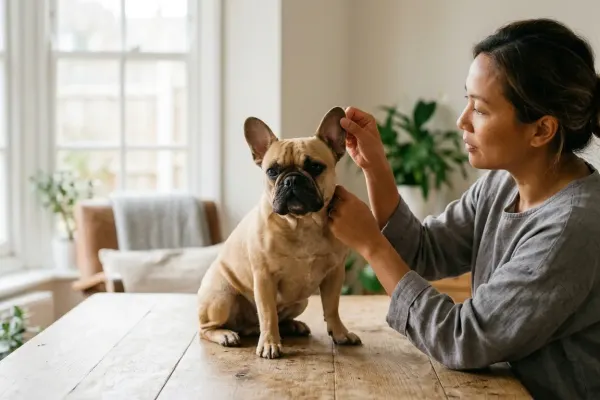
Make the crate a voluntary resting place by pairing it with meals, chews, and short calm periods. You should never use it as punishment. Pair gentle touches of paws, ears, face, and body with rewards so routine care becomes predictable, and offer appropriate chews during teething.
Leash manners, exercise, and heat-aware training
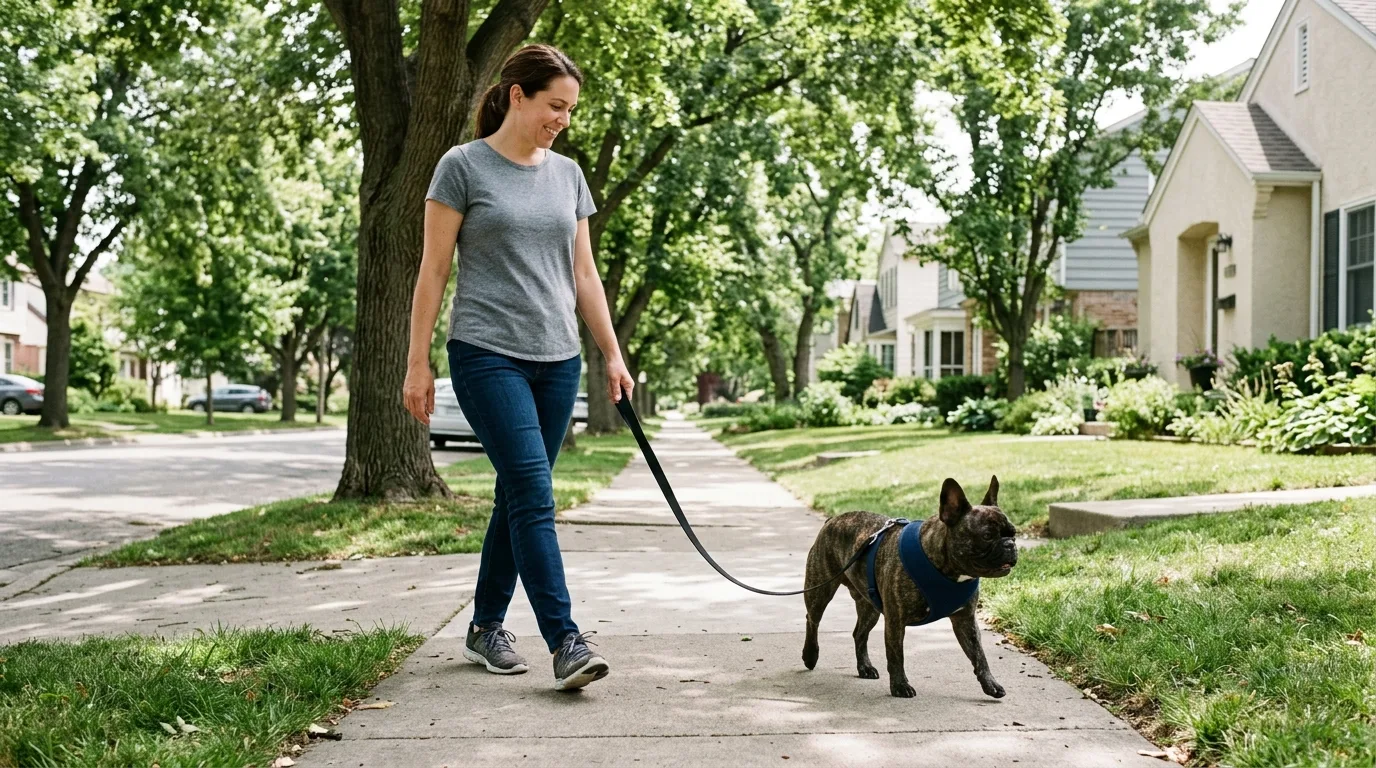
Start leash practice in quiet, cool conditions and reward the dog for choosing to stay near you. French Bulldogs are brachycephalic, so compressed airways make cooling by panting less efficient; the AKC lists brachycephalic dogs among those needing careful observation for breathing difficulty, and exertion adds airway stress.
Because they are prone to overheating, physical exertion must be strictly monitored. Owners should understand limits regarding can French Bulldogs run? safely in warm weather. Similarly, water activities require extreme caution, which is covered in detail under can French Bulldogs swim?.
Note: Due to their short, flat faces, French Bulldogs are highly susceptible to heat stroke. Keep training sessions brief, practice indoors during hot weather, and monitor their breathing closely.
Teach loose-leash walking with reward placement
Reward the dog beside you before the leash tightens, then pause or calmly change direction when it pulls so forward motion never rewards pulling. Begin in a low-distraction place, use very short routes, use a harness rather than a collar, and allow planned sniff breaks as an earned activity.
Recognize when training must stop
Stop activity, move to a cooler place, and assess the dog if breathing becomes labored, panting turns frantic, drool becomes thick, or gums look bright red. The AKC advises moving an overheating dog to a cooler area and cooling with cool water, then seeking veterinary care; brachycephalic dogs need especially close monitoring.
Fix common training setbacks without punishment
Most setbacks improve when the owner identifies the trigger, prevents repeated rehearsal, lowers difficulty, and rewards a practical alternative. Avoid choke chains, prong collars, e-collars, and leash corrections. The AVSAB states evidence supports reward-based training and that aversive methods should not be used.
When dealing with abrupt changes in behavior, consider underlying medical causes. For example, sudden reluctance to move might be linked to what IVDD in French Bulldogs is. If the dog exhibits unexpected trembling during a session, evaluating why a French Bulldog is shaking can help determine if it is a training issue or a health emergency.
Jumping, barking, and demanding attention
Prevent the unwanted behavior from earning attention, then reward an incompatible alternative such as four paws on the floor, settling on a mat, or a brief wait before greetings. For barking, identify the cause (boredom, anxiety, or attention-seeking) and address it rather than reinforcing it; practice first without visitors, then add difficulty.
Regression, fear, aggression, or sudden behavior change
Seek veterinary assessment for sudden behavior change, hiding, appetite loss, destructive distress, resource guarding, lunging, or biting. VCA Animal Hospitals notes that several of these signs can indicate abnormal distress; a veterinarian can screen for medical contributors and direct the owner to a qualified reward-based behavior professional when needed.
Create a training routine that lasts
Use brief practice moments embedded in daily life, such as before meals, doors, greetings, walks, and rest, rather than relying only on occasional formal sessions. Several short daily sessions outperform one long one for a Frenchie, and desired behavior should keep earning reinforcement even after it is learned.
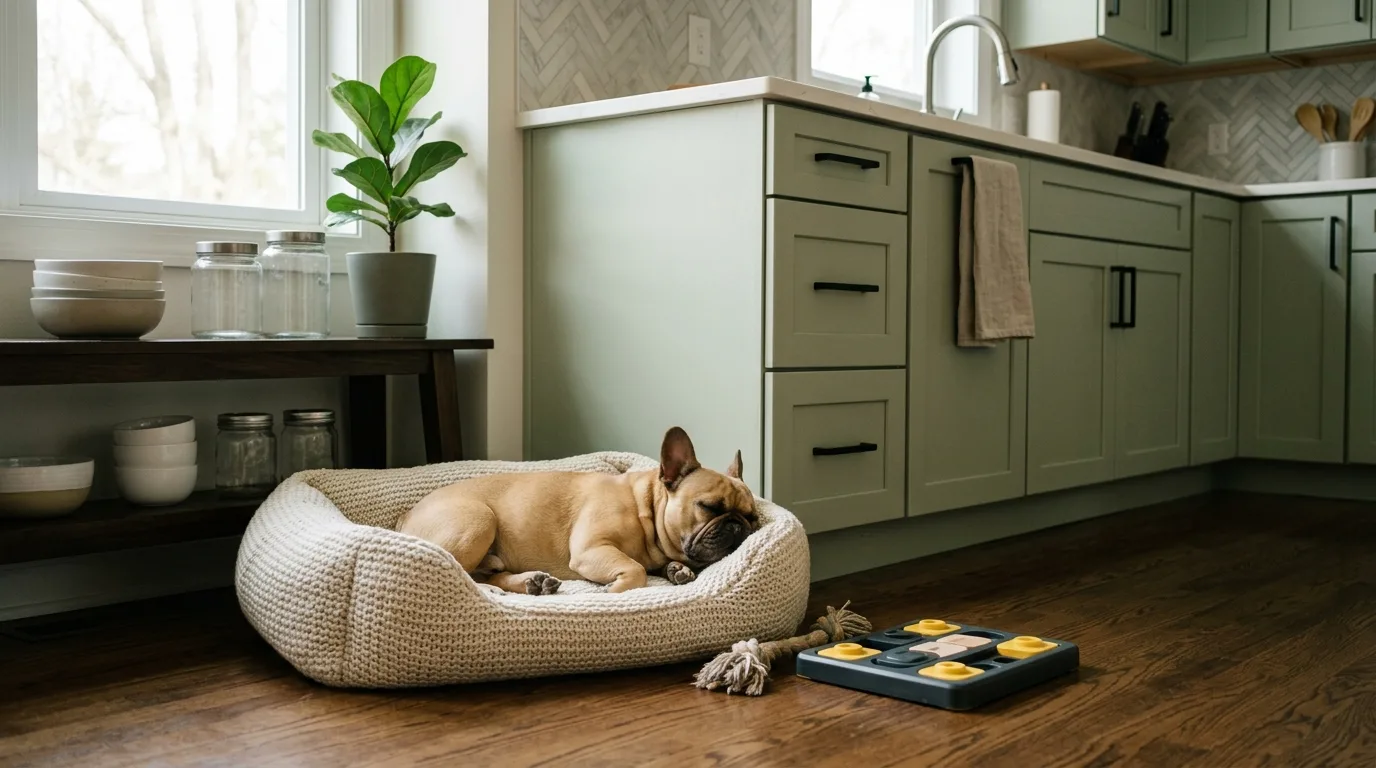
Integrating training into daily life means navigating ordinary breed quirks. Food rewards may sometimes need adjusting based on why French Bulldogs fart so much. Additionally, owners should pause face-handling practice and consult a vet if they need to determine why a French Bulldog’s eyes may be red.
A simple weekly plan
Choose one primary skill for the week, practice it in several short contexts, and log what changed: location, distraction, distance, duration, and reward. If success drops below roughly four in five reps, return to the last easy version instead of adding corrections.
| Day | Primary skill focus | Location | Reward |
|---|---|---|---|
| Monday | Sit and wait for meals. | Kitchen | Daily kibble. |
| Wednesday | Loose-leash walking. | Hallway indoors | High-value treats. |
| Friday | Recall. | Fenced yard | Favorite toy. |
Frequently asked questions about how to train a French Bulldog
Are French Bulldogs easy to train?
They can be very responsive when the owner keeps a stable routine and uses meaningful rewards. They may seem less responsive when expectations vary, the environment is too distracting, or adolescence increases independence. Consistent, short, reward-based repetition works far better than labeling the dog stubborn.
Are French Bulldogs hard to train?
They are not universally hard to train, but some owners need more patience with distractions and consistency. Make the task easier, improve the reward, and build the behavior in small steps rather than escalating pressure or using punishment.
When do French Bulldogs calm down?
There is no fixed age. Many dogs pass through adolescence beginning around 6 to 12 months, sometimes lasting into 18 to 24 months. Maturity, routine, health, and individual temperament all affect their daily energy and behavior.
How do you train an older French Bulldog?
Begin exactly as with a puppy: find a reward the dog values, teach one small behavior in a quiet setting, and build difficulty gradually. If an older dog suddenly resists handling, walking, or familiar cues, arrange a veterinary assessment before assuming it is a training problem.

Leave a Reply