
Table of Contents
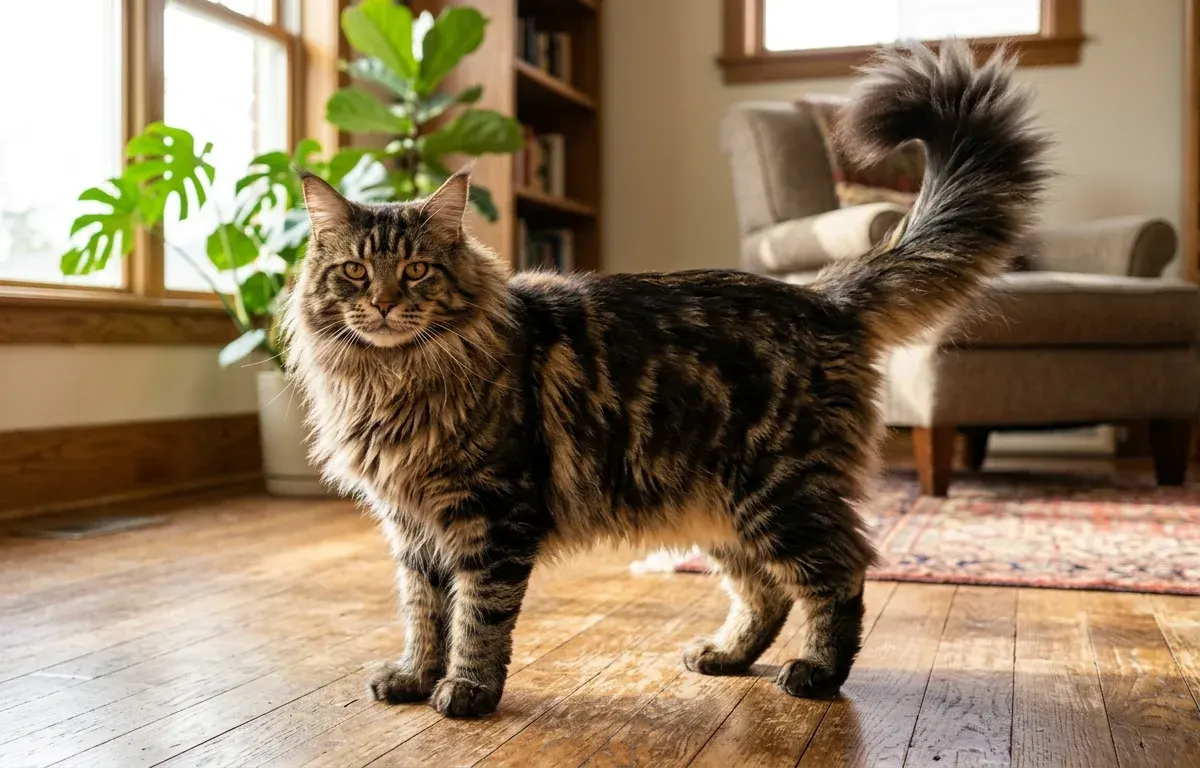
A Maine Coon is a massive, rugged cat characterized by a rectangular muscular body, a visibly square muzzle, high-set pointed ears with lynx tips, and an exceptionally bushy plumed tail that reaches its shoulders. When identifying what does a maine coon look like, key visual hallmarks include a multi-layered shaggy double coat with a lion-like frontal ruff, broad chest, heavy bone structure, and oversized round paws with dense fur tufts between the toes. Adult males typically weigh 15 to 25 pounds, while females weigh 10 to 15 pounds, taking three to five full years to reach complete physical maturity.
- Muscular rectangular frame with substantial bone density, weighing 10 to 25 pounds at adult stage.
- Boxy, square muzzle paired with a firm vertical chin, high cheekbones, and a gentle concave nasal profile.
- Large, upright ears equipped with sharp vertical lynx tips and dense protective inner furnishings.
- Multi-length water-repellent coat featuring a heavy frontal mane, thick hind britches, and a long plumed tail.
- Large snowshoe paws with thick interdigital fur tufts designed for winter terrain.
- Extended growth trajectory requiring three to five years to achieve full skeletal and coat development.
General Appearance and Distinctive Features of a Maine Coon
The Maine Coon is celebrated for its imposing physical stature, substantial bone density, and athletic, rectangular silhouette. Developed as a resilient working barn cat during the harsh winters of coastal Maine and New England, every visual characteristic of the breed reflects practical, cold-climate survival adaptations. Rather than presenting a delicate or compact appearance, a Maine Coon possesses a solid, broad-chested torso with medium-length, heavily muscled limbs that create a grounded, commanding presence.
According to web communication and informational hierarchy standards published by the University of Mississippi, organizing visual breed markers into distinct structural tiers ensures pet owners can reliably evaluate anatomical characteristics. When viewing a Maine Coon from the side, the torso forms a distinct horizontal rectangle. The backline remains level from the shoulder blades down to the muscular hips. Sexual dimorphism is prominent across the breed. Fully mature males regularly reach between 15 and 25 pounds (6.8 to 11.3 kg), whereas adult females generally weigh between 10 and 15 pounds (4.5 to 6.8 kg).
| Physical Feature | Standard Specification | Functional Adaptation |
|---|---|---|
| Body Silhouette | Elongated rectangle with broad muscular chest | Heat retention and core athletic stamina |
| Adult Weight | Males: 15-25 lbs; Females: 10-15 lbs | High bone mass and muscular resilience |
| Head Profile | Medium wedge with a gentle concave nasal curve | Clear predatory vision and scent tracking |
| Muzzle Structure | Visibly square, blunt, with perpendicular chin | Secure grip on winter prey |
| Ear Conformation | High-set, upright, with prominent lynx tips | Acute auditory targeting and wind protection |
| Coat Layering | Shaggy, multi-length, dense water-repellent fur | Thermal insulation against snow and freezing rain |
| Tail Proportions | Flowing plume equal to body length | Wraps around face and body for thermal protection |
| Paw Conformation | Large, rounded, with heavy hair tufts between toes | Natural snowshoes that distribute body weight |
Evaluating purebred conformation involves assessing physical balance and functional proportions. Just as evaluating what a French Bulldog looks like or studying what a Pug dog looks like requires examining specific head-to-body ratios and heavy boning, identifying a Maine Coon centers on recognizing its long rectangular frame paired with an athletic, functional build.
Head Profile, Square Muzzle, and Ear Morphology
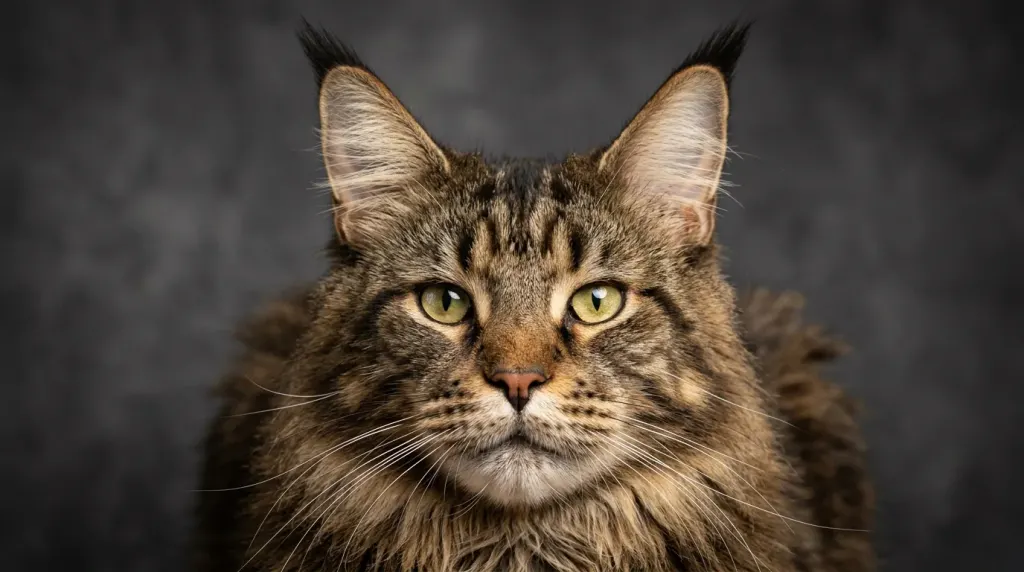
The head structure of a Maine Coon is one of its most reliable visual identifiers, separating authentic specimens from domestic longhaired cats that simply carry fluffy coats. Recognizing what do maine coon cats look like begins with examining the specific geometric planes of the face, muzzle, and ear set.
| Facial Feature | Anatomical Marker | Distinctive Visual Trait |
|---|---|---|
| Lynx Tips | Apical ear tufts | Stiff vertical hair extending directly from ear tips |
| Ear Conformation | High and upright | Large, wide base, set approximately one ear-width apart |
| Eye Placement | Wide-set and slightly oval | Large, expressive eyes in shades of green, gold, or copper |
| Cheekbones | High and prominent | Frames the modified wedge contour of the skull |
| Muzzle Structure | Boxy and square | Blunt 90-degree angle with substantial jaw width |
| Chin Alignment | Firm and vertical | Aligns perpendicularly with the upper lip and nose tip |
Square Muzzle and Chin Alignment
The head is a modified medium wedge, slightly longer than it is wide, framed by high, prominent cheekbones. When observed directly from the front, the muzzle is unmistakably square, boxy, and blunt-ended. The jawline is strong and deep, creating a blunt 90-degree visual angle rather than tapering into a delicate point.
In profile, the nasal bridge exhibits a gentle concave curve (a subtle stop) positioned between the eyes, leading smoothly to a straight nose leather. The chin is firm, vertical, and deep, aligning in a clean perpendicular line with the upper lip and the tip of the nose. This sturdy facial architecture developed naturally to help working cats catch rodents in deep snowdrifts. Understanding how functional working roots shape anatomy, similar to exploring what breeds make a French Bulldog, clarifies why the Maine Coon retains its powerful jaws.
Ear Set, Lynx Tips, and Expressive Posture
Maine Coon ears are large, broad at the base, and taper upward to sharp points. They are set high on the skull, spaced approximately one ear’s width apart, tilting only slightly outward rather than flaring widely to the sides. Two distinct types of fur growth define the ears:
- Lynx Tips (Apical Tufts): Stiff vertical hair tufts growing directly from the top tips of the ear leather, resembling the pointed ears of a wild Canada lynx.
- Inner Ear Furnishings: Dense, horizontal wisps of bushy fur erupting from inside the ear canal, curling outward to shield sensitive ear membranes from wind, freezing moisture, and forest debris.
Feline ear mobility conveys attentiveness and environmental awareness, whereas studying canine body signals such as dogs pulling their ears back illustrates how different companion animals express focus and emotional states through facial posturing.
Coat Layering, Lion-Like Ruff, and Plumed Tail
The coat of a Maine Coon is a sophisticated, all-weather defense system. Unlike breeds with uniform fur length, the Maine Coon features an uneven, shaggy double coat that changes density and length across different sections of the body.
| Body Region | Fur Layer and Length | Functional Cold-Weather Adaptation |
|---|---|---|
| Head & Shoulders | Short, smooth guard fur | Streamlines movement through heavy brush and snow |
| Chest & Throat | Voluminous frontal lion ruff | Provides critical thermal protection for core organs |
| Flanks & Back | Semi-long, water-repellent guard hairs | Sheds rain, ice, and melting snow efficiently |
| Hind Britches | Thick, woolly leg trousers | Insulates the hindquarters against freezing ground contact |
| Underbelly | Long, shaggy, insulated undercoat | Protects vulnerable abdominal area from snowdrifts |
| Flowing Tail | Bushy 12 to 16-inch tapering plume | Wraps around paws and face to trap warm air while resting |
Coat Texture and Layered Distribution
The coat consists of a soft, thermal undercoat covered by longer, glossy guard hairs. Natural protective oils make the outer fur water-resistant, allowing snow and rain to roll off without soaking through to the skin. The fur is relatively short over the shoulders and nape, lengthening progressively along the back, ribcage, flanks, and underbelly. The hind legs feature dense, shaggy fur that forms thick “britches” extending down to the hocks.
Digital information guidelines established by Michigan State University show that consistent structural documentation provides clear reference points for readers assessing animal traits. In contrast to the uniform, plush feel of a mink Ragdoll cat or the distinctive pointed patterns seen when exploring what is a Ragdoll cat, a Maine Coon coat feels textured, resilient, and distinctly layered to the touch.
The Frontal Neck Ruff and Flowing Plume Tail
The neck and chest display a dramatic frontal ruff, often referred to as a lion’s mane. This ruff begins under the chin and broadens across the entire chest, reaching peak fullness during cold winter months in mature males.
The tail is another defining breed feature. It is exceptionally long, wide at the base, and tapers gradually to a fine point. Covered in flowing, bushy fur, the tail plume easily measures 12 to 16 inches. When held alongside the flank, the fluffy tip should reach the cat’s shoulder blades. In outdoor winter conditions, Maine Coons curl this tail completely around their paws, chest, and face to trap warm air while resting.
Paw Anatomy, Snowshoe Tufts, and Bone Structure
Beneath the heavy fur lies a sturdy skeletal frame designed for physical endurance. A true Maine Coon possesses thick, substantial leg bones set wide apart on a broad torso, creating an athletic and grounded stance.
| Paw Feature | Anatomical Structure | Winter Terrain Function |
|---|---|---|
| Paw Dimensions | Large, round, and broad | Distributes heavy body weight across soft snowdrifts |
| Interdigital Tufts | Stiff 1-inch fur tufts between toes | Provides traction on ice and prevents snow pack |
| Paw Pads | Thick, tough leather pads | Insulates digital tissue against frozen terrain |
| Toe Stance | Wide-set grip (historical polydactyly) | Enhances balance and climbing agility on rugged surfaces |
Oversized Snowshoe Paws
Maine Coon paws are exceptionally large, round, and broad. Long, stiff tufts of fur grow outward from between every toe pad, often extending an inch past the bottom of the foot. These tufts function as natural snowshoes:
- Weight Distribution: The broad surface area prevents the heavy cat from sinking deeply into soft snow.
- Traction on Ice: The stiff interdigital hairs provide grip on frozen terrain.
- Thermal Insulation: The thick hair pads protect the sensitive digital skin from direct contact with freezing surfaces.
Polydactylism (the presence of extra digits on front or rear paws) occurred naturally in approximately 40% of early New England Maine Coons. While modern show standards accept five toes on the front paws and four on the back, historical polydactyl lineages are celebrated for their agility on icy coastal farms.
Historical working utility explains why natural foundation breeds develop unique limb adaptations. Whereas historic urban companion roles clarify what French Bulldogs were originally bred for or what Pugs were bred for, the Maine Coon was refined through active farm pest control, preserving heavy bone density and muscular agility.
What Maine Coon Kittens Look Like vs. Adult Development
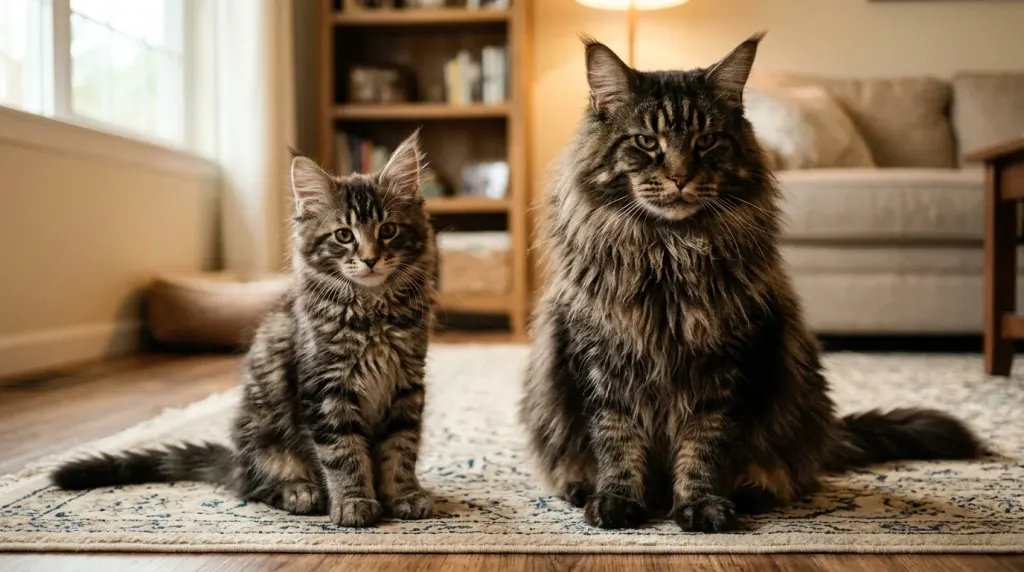
Many prospective cat owners wonder what do maine coon kittens look like and how early breed-specific traits emerge. Unlike average domestic cats that reach adult size within their first year, Maine Coons develop slowly over an extended developmental timeframe.
| Development Stage | Structural Milestones | Coat Characteristics |
|---|---|---|
| Early Kittenhood | Oversized upright ears and large paws | Soft juvenile fuzz with budding ear furnishings |
| Adolescent Phase | Rapid bone lengthening and square muzzle emergence | Tail plume emerges; guard hairs form along spine |
| Young Adulthood | Torso broadens across chest and shoulders | Hind britches fill in; frontal ruff becomes visible |
| Full Maturity | Substantial adult frame (10-25 lbs) and heavy jawline | Full lion-like frontal ruff and heavy all-weather coat |
Growth Milestones Across 5 Years
During early kittenhood, a Maine Coon kitten rarely displays the majestic lion mane or massive body length of a mature cat. However, distinct structural clues reveal its purebred heritage early in life:
- Disproportionate Paws: Kittens display noticeably large, heavy paws with prominent toe tufts well before their bodies catch up in proportion.
- Prominent Upright Ears: The ears appear tall and oversized on a kitten’s head, often developing visible inner furnishings and budding lynx tips early in development.
- Boxy Muzzle Formation: During the first year of growth, the muzzle broadens into its characteristic square shape, avoiding the soft, rounded contours of ordinary domestic kittens.
- Elongated Torso: Handling a young Maine Coon reveals an unusually long ribcage and sturdy spinal structure.
| Age Milestone | Structural Development | Coat and Mane Growth |
|---|---|---|
| 2 to 4 Months | Large upright ears, wide paws, slender body | Soft kitten fuzz, developing ear furnishings |
| 5 to 12 Months | Rapid skeletal lengthening, visible square muzzle | Tail begins pluming; guard hairs emerge along spine |
| 1 to 2 Years | Muscular torso broadens, cheekbones widen | Hind britches fill in; light neck ruff becomes visible |
| 3 to 5 Years | Full skeletal mass (10-25 lbs), heavy jawline | Full frontal lion mane, dense multi-layered coat |
Supporting this prolonged growth cycle requires balanced caloric intake and essential nutrients. Dietary considerations during extended bone development share similarities with managing what Ragdoll cats eat or monitoring specific Pug dietary needs to prevent joint strain and excess weight gain during growth stages.
Note: A full frontal ruff and heavy winter coat rarely appear before two years of age. Maine Coons undergo multiple seasonal shedding cycles before establishing their dense adult coat around their third year.
How to Distinguish a Maine Coon From Other Longhaired Breeds
Because several domestic cat breeds feature long fur and large builds, understanding what does maine coon cats look like compared to other forest and pointed breeds is essential for accurate visual identification. The most commonly confused breeds are the Norwegian Forest Cat, the Siberian, and the Ragdoll.
| Breed | Geometric Silhouette | Defining Geometric Hallmark |
|---|---|---|
| Maine Coon | The Box (Rectangle) | Visibly square muzzle, gentle concave profile stop, high lynx ears |
| Norwegian Forest Cat | The Triangle | Straight nasal slope without stop, equilateral triangular head |
| Siberian Cat | The Circle (Barrel) | Rounded modified wedge head, barrel-shaped torso, rounded contours |
| Ragdoll Cat | The Oval | Broad modified wedge head, striking oval blue eyes, color points |
Visual Comparison: Box vs. Triangle vs. Circle vs. Oval
Cat judges use basic geometric silhouettes to differentiate large longhaired breeds:
- Maine Coon (The Box / Rectangle): Rectangular torso, boxy square muzzle, gentle concave profile curve, high-set ears with lynx tips.
- Norwegian Forest Cat (The Triangle): Equilateral triangular head shape, completely straight nasal profile without a stop, flat forehead, almond-shaped eyes, and higher hind legs.
- Siberian (The Circle / Barrel): Rounded modified wedge head, barrel-shaped compact torso, arched backline, and nearly round eyes.
- Ragdoll (The Oval / Pointed Wedge): Broad modified wedge head, medium-sized ears, striking oval blue eyes, and distinctive pointed color patterns.
| Trait | Maine Coon | Norwegian Forest Cat | Siberian Cat | Ragdoll Cat |
|---|---|---|---|---|
| Body Silhouette | Long, rectangular, heavy bone | Sturdy, high hindquarters | Compact, barrel-shaped torso | Long, broad, muscular frame |
| Head Geometry | Modified wedge, square muzzle | Equilateral triangle | Rounded modified wedge | Broad modified wedge |
| Nasal Profile | Gentle concave curve (subtle stop) | Completely straight slope | Slight concave curve | Gentle dip with straight nose |
| Eye Shape | Large, slightly oval, wide-set | Large, almond-shaped | Large, almost round | Distinct oval, vivid blue |
| Ear Set | High, upright, prominent lynx tips | Wide at base, follows head line | Medium, slightly tilted forward | Medium, set wide apart |
| Coat Style | Shaggy, uneven, heavy frontal ruff | Semi-long, glossy topcoat | Dense, triple-layered | Plush, silky, non-matting |
Reviewing distinct companion animal classifications, such as studying the ancestral breeds of the Pug or understanding what is a French Bulldog, demonstrates why natural working breeds like the Maine Coon maintain functional, weather-adapted physical structures rather than extreme ornamental characteristics.
Frequently Asked Questions About What Maine Coons Look Like
How can you tell if a cat is a true Maine Coon without papers?
Visual markers such as a square muzzle, high-set tufted ears, large snowshoe paws, a rectangular body, and a long plumed tail provide strong breed clues. However, mixed-breed domestic longhaired cats frequently share similar traits. The only definitive proof of purebred Maine Coon lineage is certified pedigree documentation from recognized feline registries such as CFA or TICA.
Can a purebred Maine Coon have short hair?
No. Purebred Maine Coons carry the recessive longhair gene and invariably develop semi-long to long fur. While kittens and adolescent cats may appear relatively sleek before their adult guard hairs and frontal ruff emerge, an adult cat with a permanently short, flat coat is not a purebred Maine Coon.
What coat colors and patterns are recognized in Maine Coons?
Maine Coons are recognized in over 75 distinct color combinations and coat patterns, including classic tabby, mackerel tabby, solid black, solid white, red, blue, cream, tortoiseshell, and silver shaded. The brown classic tabby pattern, with its rich dark swirls, is the most iconic traditional pattern. Official breed standards do not accept pointed patterns, chocolate, cinnamon, or lavender.
At what age does a Maine Coon get its full lion mane?
Ear furnishings and tufts typically emerge during early kittenhood, but the full lion-like frontal ruff, thick hind britches, and broad muscular chest develop gradually over several years. Most Maine Coons achieve their complete coat volume and physical density as mature adults around three to five years of age.
How long is a Maine Coon tail compared to its body?
A Maine Coon tail is roughly equal in length to the distance between the base of its tail and the base of its neck. When extended along the cat’s side, the bushy plumed tip should reach the shoulder blades, allowing the cat to wrap it completely around its body during sleep.
Leave a Reply