
Table of Contents
To understand what breeds make a French Bulldog, we must look to the late 1800s. They were developed from small English Toy Bulldogs that lace workers brought from Nottingham to northern France. French breeders shaped them into a distinct type, and American fanciers fixed the bat ear as the standard. Today, a Frenchie is a recognized purebred bred from established lineages, not a standing cross of two modern breeds.
- The clearest foundation is the 19th-century English Toy Bulldog, which carried a touch of terrier liveliness.
- The breed's identity was shaped across three countries: England (foundation), France (refinement), and America (bat ear standard).
- A modern French Bulldog is a purebred dog, not an ongoing mix of an English Bulldog and a terrier.
- Fluffy coats are a disqualification in the show ring but can still appear in pedigreed purebred dogs.
The short answer: which breeds are behind the Frenchie
The strongest documented foundation for the French Bulldog is the small English Toy Bulldog. This was a lighter bulldog weighing 12 to 25 pounds, developed from the older, athletic bulldogs of 150 to 200 years ago. That toy line itself carried a touch of terrier liveliness from earlier bull-and-terrier crossing.
This background is why people often use “bulldog plus a bit of terrier” as a historical shorthand when asking what two breeds make a French Bulldog. However, it is an oversimplification. The breed’s development involved decades of population refinement rather than a single, clean formula of two modern purebreds mixed together. Understanding what French Bulldogs were originally bred for helps explain how this working-class companion evolved into what a French Bulldog is today.
| Contributor | What can be stated confidently |
|---|---|
| English Toy Bulldog | The primary foundation stock brought to France by English lace workers. |
| Terrier influence | Contributed liveliness to the early bulldog lines before the French breed was formalized. |
| Local French dogs | Likely crossed with the toy bulldogs, though their exact breeds are not strictly documented. |
Why the Toy Bulldog is the clearest documented foundation
Historically, the French Bulldog descends from an English Bulldog, but not the heavy modern version you see today. The foundation was the smaller Toy Bulldog developed in the 19th century. These 12-to-25-pound dogs were popular with English Midlands lace artisans. They provided the core physical traits that would later be refined in France.
What terrier and local French dogs did and did not contribute
The toy bulldog line likely carried some terrier genetics from earlier bull-and-terrier breeding, which gave the dogs a distinct liveliness. Local Parisian ratter dogs are part of the popular origin story, often cited as the other half of the mix. However, the exact identity of those local French dogs is far less documented than the Toy Bulldog foundation. Historians agree they played a role, but naming a specific modern breed as the definitive second half of the mix lacks historical proof.
How England, France, and America shaped one breed
England provided the foundation through the old bulldog and its toy version. France developed a more uniform, compact type without the extreme underjaw and named it the Bouledogue Français. Finally, American fanciers organized the French Bull Dog Club of America in 1897 and wrote a standard that allowed only the bat ear.
Understanding this three-country timeline shows why French Bulldogs are so popular and how responsible French Bulldog breeding focuses on maintaining a highly specific, globally recognized type.
England: small bulldogs before the French name
In the 19th century, the Industrial Revolution displaced many lace workers in Nottingham, England. When these artisans emigrated to northern France, they brought their small Toy Bulldogs with them. These foundational dogs were athletic and featured a mix of ear types, including rose and upright ears. They were not a direct copy of today’s heavy English Bulldog.
France: refinement into the Bouledogue Français
The imported toy bulldogs quickly became fashionable in France. While the British largely lost interest in the toy variety, French breeders became the guardians of the breed. They developed a more uniform, compact dog with straight legs and no extreme underjaw. At this point, the breed still featured a mix of bat ears and rose ears, but it had become distinctly French.
America: the bat ear became the defining standard
American fanciers finalized the breed’s trademark look. After a Westminster judge favored rose-eared dogs, angered American breeders founded the FBDCA in 1897. They wrote the first breed standard permitting only the bat ear. According to the French Bull Dog Club of America, that standard established the bat ear as a defining hallmark, and any other ear shape remains a disqualification in conformation today.
A modern French Bulldog is not a two-breed mix
A modern Frenchie with a documented French Bulldog pedigree is a purebred dog. It is not an ongoing English Bulldog and terrier cross. When people wonder what a French Bulldog is mixed with today, or what other dogs French Bulldogs are mixed with to get exotic traits, they often confuse historical crossbreeding with modern practices. A true purebred is not mixed with any other breed. Understanding what specific breed makes a French Bulldog requires separating its 19th-century foundation from current registry standards. The term “purebred” means a dog has documented ancestry within an established breed registry. It does not mean the breed formed without any crossbreeding during its 1800s development.
Every recognized breed has a development history. Knowing that history is helpful for managing their specific physical traits, such as monitoring IVDD in French Bulldogs or setting safe exercise and running limits for French Bulldogs. However, historical ancestry does not change a dog’s modern purebred status.
| Classification | Meaning |
|---|---|
| Historical ancestry | The 19th-century foundation (Toy Bulldogs, terriers, local French dogs) that formed the breed. |
| Modern purebred | A dog bred exclusively from recognized French Bulldog lines with a verifiable pedigree. |
Purebred, pedigree, and breed standard are different terms
A pedigree records a dog’s lineage, proving its parentage. A breed standard sets the physical and temperamental traits expected in the conformation show ring. A dog can have a nonstandard physical trait, which affects its show eligibility, without that trait proving the dog is mixed. Appearance alone does not establish an individual dog’s full ancestry.
Why a Frenchie cross is different
A puppy born from one French Bulldog parent and one parent of another breed is a mixed-breed dog, even if it physically resembles a Frenchie. The fact that the French Bulldog was created through crossbreeding in the 1800s does not make a first-generation crossbred puppy a purebred French Bulldog today.
Are fluffy French Bulldogs purebred?
A fluffy or long-haired French Bulldog can have a documented French Bulldog pedigree, meaning coat length alone cannot prove a dog is mixed. However, the FBDCA standard explicitly calls for a short, smooth coat. It lists “coats other than short and smooth” as a disqualification in conformation. Therefore, a fluffy Frenchie is outside the show standard, even if its paperwork proves it is purebred.
Because coat variations are often marketed aggressively, understanding what pedigree paperwork actually means is crucial when evaluating the full cost of a French Bulldog.
| Evidence | What it tells you |
|---|---|
| Long coat appearance | The dog carries the recessive long-hair gene, which disqualifies it from conformation shows. |
| Verifiable pedigree | The only accurate way to confirm if the dog descends entirely from recognized French Bulldog lines. |
What “fluffy” does and doesn’t tell you
A long coat does not automatically mean a Frenchie has a different modern breed in its immediate parentage. Conversely, it does not guarantee the dog is purebred either. Appearance cannot replace documentation. The proper evidence of parentage is a verifiable pedigree and transparent records from the breeder.
What the ancestry explains and what it does not
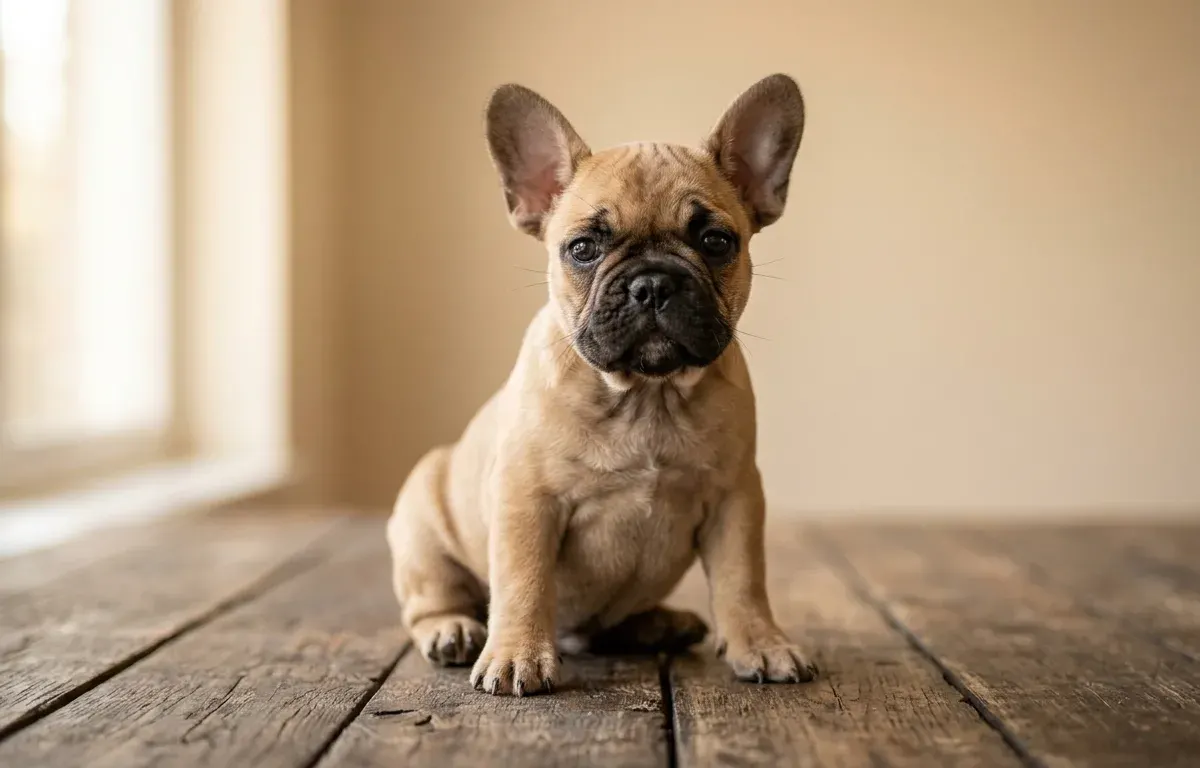
The breed’s history explains the compact bulldog body and the trademark bat ears, but it should not be used to guarantee the temperament or health of an individual dog. The current standard identifies heavy bone, a compact muscular build, a smooth coat, and bat ears as the breed’s physical hallmarks.
Knowing this history provides helpful context for routine care, such as learning how to clean French Bulldog ears or understanding how many teeth French Bulldogs have in their short-muzzled heads. It does not replace a veterinary assessment. Ancestry explains why the breed looks the way it does, but relying on historical narratives to predict an individual puppy’s health is ineffective. A dog’s specific lineage and health screening matter far more than the 19th-century origins of the breed as a whole.
The bat ear is a breed hallmark, not proof of one ancestor
The bat ear became the defining feature of the breed through American selection and the 1897 standard. It did not become a hallmark because one specific modern breed must be present in every Frenchie’s ancestry.
How to use this when researching a puppy
When researching a puppy, ask for a verifiable pedigree, appropriate registration records, and the health screening results recommended for the breed. Treat marketing labels like “rare,” “exotic,” or claims about specific ancestry percentages as prompts to ask for documentation, not as proof in themselves.

Reviewing factual records helps you understand the realities of the lineage, just as knowing how many puppies French Bulldogs have or the French Bulldog pregnancy timeline provides factual context for how a litter was produced.
Note: Records help you evaluate breeding claims, but they do not replace veterinary advice or a full assessment of an individual dog.
Records beat a marketing label
Documentation is always more informative than a verbal claim. Request pedigree and registration records, review disclosed screening results, and ask direct questions about the parentage. A responsible breeder will provide this transparency rather than relying solely on appearance or historical narratives to justify a puppy’s status.
Frequently asked questions about what breeds make a French Bulldog
Are fluffy French Bulldogs purebred?
A fluffy French Bulldog can be purebred if it has a verifiable pedigree showing only French Bulldog ancestry. However, the long coat is a disqualifying fault under the breed standard, meaning these dogs cannot compete in conformation shows. Coat length alone does not prove a dog is a mixed breed.
Conclusion
The French Bulldog is an established purebred dog with a well-documented history, not a modern two-breed mix. The breed traces mainly to the small English Toy Bulldog, which carried a touch of terrier liveliness. It was refined into a distinct, compact type in France, and had its hallmark bat ears standardized by American fanciers in 1897. When evaluating a specific dog today, rely on verifiable pedigree and health screening documentation rather than historical origin stories or marketing labels.


Leave a Reply