
Table of Contents
When asking what dogs make a pug, canine history reveals that the Pug is an ancient, distinct purebred dog rather than a modern hybrid created by crossing two separate breeds. Its primary genetic foundation is the Lo-sze, a short-coated, flat-faced companion dog treasured in Chinese imperial courts for over two thousand years. During the 19th century in England, breeders selectively refined the breed by blending the Morrison and Willoughby bloodlines, incorporating limited infusions from the English Bulldog and Asian Happa dogs to solidify bone structure, velvet coat texture, and facial wrinkling.
- Pugs descend directly from ancient Chinese royal companion dogs known historically as Lo-sze.
- The breed is not a 50/50 designer cross between a Bulldog and a Pekingese.
- Victorian breeders in England refined the modern Pug standard by combining the Willoughby and Morrison strains.
- Limited 19th-century infusions of English Bulldog and Happa dog genetics helped establish modern bone density and coat traits.
- Major international registries, including the American Kennel Club since 1885, recognize the Pug as an independent purebred breed.
Origins and the Concept of Breed Formation in Pugs
Understanding what dogs make a pug requires stepping away from modern designer crossbreeding and looking into centuries of selective canine development. Unlike recent hybrid dogs that originate from mating two distinct registered breeds, the Pug represents one of the oldest identifiable canine lineages in the world. Royal court chronicles from ancient China describe flat-faced, compact lapdogs known as the Lo-sze (or Lo-Chiang-Sze) as early as the Han and Song dynasties. These dogs lived exclusively in imperial palaces, cared for by dedicated attendants and protected as royal property.
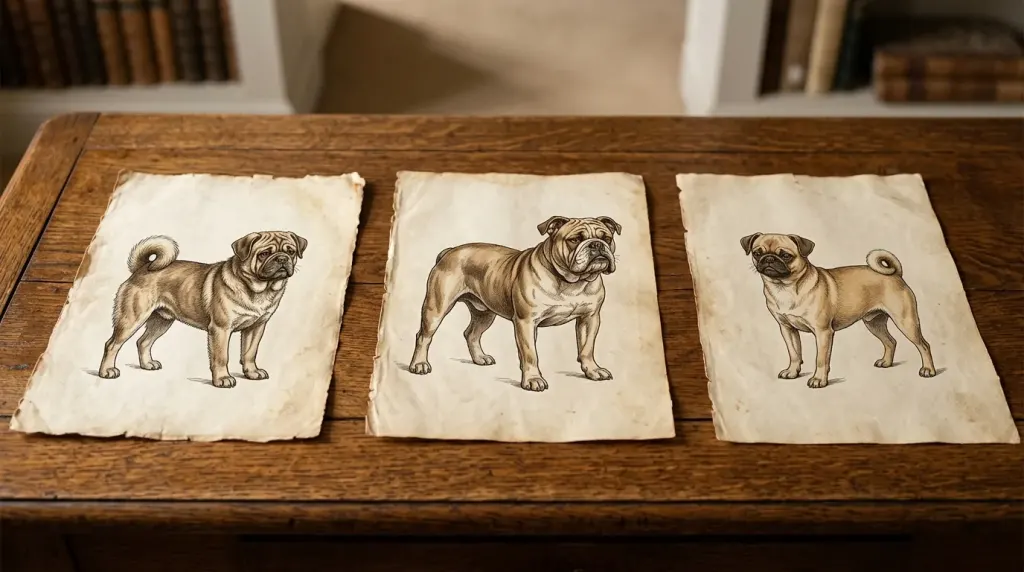
When exploring what dogs were bred to make a pug, historical records confirm that imperial breeders focused on selecting specimens with short statures, pliable facial folds, and affectionate dispositions. Dutch merchants with the Dutch East India Company brought these dogs to Europe in the late 16th century. Once in Europe, the breed became an immediate favorite among aristocratic households, notably the Dutch House of Orange and the British royal family. Readers tracing where Pug dogs originate from will find that this Asian foundation provided the essential blueprint for the breed long before modern kennel clubs established formal studbooks.
Because ancient Chinese society valued personal companionship over utility, early breeders shaped the animal solely for domestic life. Exploring what Pug dogs were bred for highlights how this centuries-long selection for human companionship produced an attentive, docile animal suited to indoor living rather than hunting or herding tasks.
| Historical Era | Major Breed Development Milestone |
|---|---|
| Ancient China (Han/Song Dynasties) | Development of the Lo-sze lapdog |
| Late 16th Century | Dutch maritime import into Europe |
| Mid-19th Century | Formation of Willoughby and Morrison breeding lines |
| 1860 | Arrival of pure Happa dogs in the UK |
| 1885 | Official recognition by the AKC |
What Were the Primary Contributing Breeds?
Although the ancient Lo-sze provided the baseline stock, the Pug as seen in modern homes owes much of its uniformity to 19th-century British refinement. During the early Victorian era, European specimens suffered from inconsistent conformation, leggy builds, and variable head shapes. Two major breeding kennels took on the task of standardizing the breed: the Willoughby line, founded by Lord and Lady Willoughby d’Eresby, and the Morrison line, established by Charles Morrison.
Historical analyses of what dog breeds make a pug reveal that 19th-century English breeders used limited infusions from the English Bulldog and the Happa dog to correct physical faults in these lines. The Willoughby strain produced lean, silver-fawn dogs with dark tracings, while the Morrison strain yielded stockier, apricot-fawn dogs with clean facial masks. Understanding what dogs made a pug distinctive in European courts requires examining the introduction of short-coated Asian companion dogs. Following the 1860 events at the Old Summer Palace in Beijing, pure Chinese imports known as “Moss” and “Lamb” arrived in England. Their progeny, a stud dog named “Click,” was bred into both the Willoughby and Morrison lines, uniting the two rival strains into the modern breed standard.
- Ancient Chinese Lo-sze: Foundational imperial companion dog providing the baseline compact structure and shortened muzzle.
- Early European Import Stock: Maritime imports from the 16th to 18th centuries establishing royal companion lines in the Netherlands and Britain.
- Willoughby Strain (Mid-19th Century): English line bred by Lord Willoughby d’Eresby, known for lean frames, stone-fawn coats, and dark tracings.
- Morrison Strain (Mid-19th Century): English line bred by Charles Morrison, noted for cobbier builds and rich apricot-fawn coloration with clean masks.
- 1860 Happa Outcross (“Click”) and English Bulldog Infusion: The pivotal cross of pure Asian Happa stock (“Click”) and selective Bulldog breeding that unified the Willoughby and Morrison strains into the modern breed standard.
- Modern Purebred Pug: Fully stabilized, closed-studbook purebred dog recognized internationally.
Historical Timelines and Geographic Notes
The path from Asian imperial companion to standardized western show dog spans multiple continents and cultural shifts:
- Pre-17th Century (China): Development of the flat-faced Lo-sze alongside long-haired imperial breeds.
- 16th to 18th Century (The Netherlands and Europe): Importation by maritime traders; adoption by William III and Mary II, which brought the breed to England in 1689.
- 1840 to 1880 (United Kingdom): Creation of the Willoughby and Morrison lines, followed by the stabilizing influence of the Happa dog “Click.”
- 1885 to Present (Global): Formal recognition by the American Kennel Club and establishment of the national breed parent club in 1931.
How Physical Appearance and Temperament Arose
The distinctive physical appearance of the Pug reflects generations of purposeful anatomical selection. Fanciers deliberately cultivated the brachycephalic skull, wide chest, compact cobby body, and curled tail that define what a Pug dog looks like today. The broad jaw and deep wrinkles inherited from the combination of Lo-sze structure and Victorian Bulldog crosses gave the face its characteristic square silhouette.
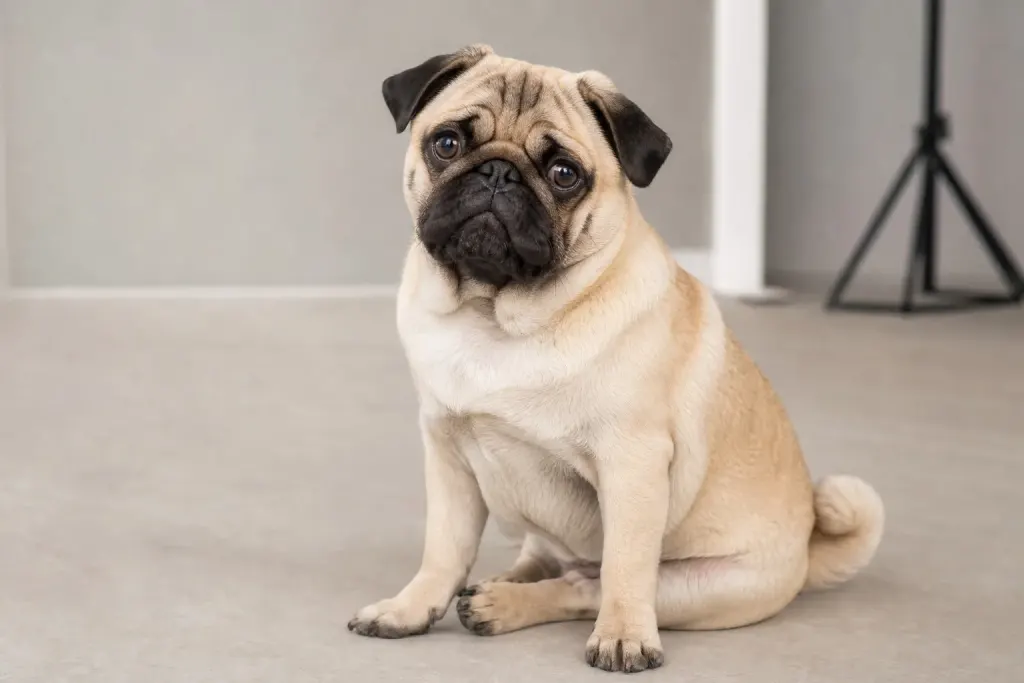
These structural adaptations also influence daily behavior and physical habits. The shortened upper airway and elongated soft palate mean owners often notice breathing snorts during excitement or moderate activity. Similarly, nighttime breathing sounds lead many families to observe regular snoring, which stems directly from the soft tissue conformation in their compact heads.
| Breed Component | Historical Origin | Conformation Benefit | Modern Trait Manifestation |
|---|---|---|---|
| Lo-sze Foundation | Ancient China | Compact frame, tail curl, friendly temperament | Sturdy companion build, signature tightly curled tail |
| English Bulldog Cross | Victorian England | Bone density, chest width, deep skin folds | Wide chest, solid musculature, prominent nose roll |
| Happa Dog Import | 1860s China to UK | Clean head shape, dark mask, smooth coat | Clear black mask, velvet ear texture, glossy short coat |
What Two Dogs Make Up a Pug?
Many prospective dog owners ask what two dogs make a pug, operating under the assumption that the breed was created by crossing two distinct modern breeds. Search queries asking what 2 dogs make a pug reflect a widespread misconception that pugs are fifty-fifty designer hybrids. Explaining what two dogs make up a pug begins with dispelling the myth of a recent hybrid origin.
The popular belief that crossing an English Bulldog with a Pekingese produces a Pug is biologically and historically incorrect. While the Pug shares an ancient ancestral branch with the Pekingese and received minor Bulldog genetic infusions over 150 years ago, it is an independent purebred lineage. Today, deliberate crosses such as the Pug Chihuahua mix (the Chug) or the Puggle (Pug crossed with Beagle) do combine two purebred parents, but the standard Pug itself is never bred from two separate breeds.
Variant Origins and Modern Misperceptions
Typographical search variants like what 2 dogs make s pug stem from the same curiosity about whether two parent breeds create the pug phenotype. In canine genetics, breed formation through historical refinement is fundamentally different from first-generation hybrid vigor. In a landmark genomic study published in Cell Reports (Parker et al., 2017), researchers analyzed phylogenetic relationships across 161 modern dog breeds. The genetic data demonstrated that Pugs form a distinct evolutionary group alongside other Asian toy breeds, showing substantial haplotype sharing across small European breeds because Pugs were historically used to reduce the size of other companion lines. Misidentifying the Pug as a two-breed cross often leads buyers to confuse purebred standards with first-generation designer mixes. Purebred Pugs breed true to standard for health, temperament, and size, whereas accidental or intentional crossbreeds show wide phenotypic variance.
Note: Facial wrinkles and shortened respiratory anatomy require routine hygiene and climate monitoring, as deep skin folds can accumulate moisture and compact nasal passages reduce heat dissipation efficiency.
Modern Understanding and How to Interpret Breed Histories
Interpreting canine breed histories requires evaluating 19th-century kennel records alongside modern genetic mapping. Early kennel club registrations occasionally used imprecise terminology, referring to small Asian imports as “Dutch pugs,” “Chinese pugs,” or “Mopshonds.” Modern canine organizations have standardized these definitions to prevent confusion between ancestral founding strains and contemporary purebred stock.
Today, the Fédération Cynologique Internationale Standard N° 253 classifies the Pug under Group 9 (Companion and Toy Dogs), Section 11 (Small Molossian Type Dogs). This categorization recognizes both the small companion role and the historic molosser-influenced head conformation without implying any ongoing need for crossbreeding.
Understanding historical breed traits also informs daily care. Centuries of selection as indoor companions cemented the traditional Pug lap dog role, making them clingy and prone to sedentary behavior. Consequently, managing what Pug dogs eat with balanced portion control is vital to avoid obesity, which places unnecessary strain on their compact joints and airways.
Key Historical Terms in Pug Ancestry
To clarify historical texts and breeder documentation, several key terms describe the lineage:
- Lo-sze: The ancient Chinese short-coated companion dog recognized as the direct ancestor of the Pug.
- Happa Dog: A small, smooth-coated Asian lapdog closely related to imperial Chinese breeds, imported in the 1860s to refine British Pug lines.
- Brachycephalic: Anatomical term for canines with shortened cranial bones, resulting in a broad, flattened facial profile.
- Willoughby Strain: An early English breeding line characterized by stone-fawn coats and darker head tracings.
- Morrison Strain: A foundational English breeding line known for richer apricot coats, compact frames, and clean masks.
- Molosser Influence: Historical morphological traits such as heavy bone structure and broad jaw alignment shared across mastiff-type lineages.
Frequently Asked Questions About What Dogs Make a Pug
What breeds were used to breed a pug?
The foundational breed of the Pug is the ancient Chinese Lo-sze lapdog. In 19th-century England, breeders refined the established stock using selective crosses with the English Bulldog for heavier bone density and Asian Happa dogs for refined head conformation and coat quality.
Are pugs purebred or mixed dogs?
Pugs are purebred dogs recognized by kennel clubs worldwide, including the American Kennel Club since 1885 and the Fédération Cynologique Internationale. Although historical outcrosses occurred during the 1800s to standardize traits, the Pug has maintained closed-studbook purebred status for well over a century.
How did pugs originate?
Pugs originated in ancient China during the Han and Song dynasties as imperial lap companions. Dutch traders brought the dogs to Europe in the late 16th century, where they became popular among European monarchs before Victorian fanciers established the modern standard.
Leave a Reply