
Table of Contents
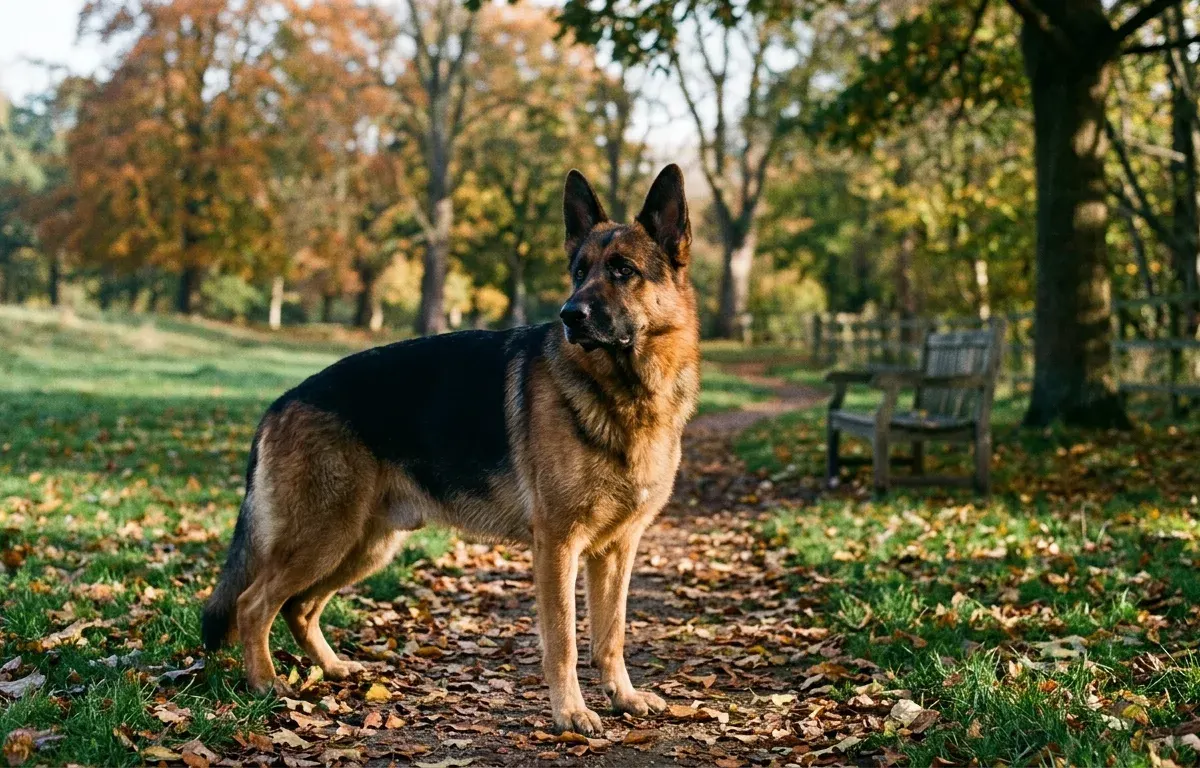
Knowing how to tell if a German Shepherd is purebred involves evaluating four core pillars: physical breed standards, behavioral traits, certified pedigree paperwork, and canine DNA testing. A purebred German Shepherd exhibits erect pointed ears, dark almond-shaped eyes, a dense weather-resistant double coat, a bushy low-set tail, and a length-to-height body ratio of 10 to 8.5. While visual characteristics confirm breed conformity in mature dogs, definitive verification requires registration certificates from recognized kennel clubs like the AKC or SV, or an accredited genetic test panel.
- Adult males stand 24 to 26 inches at the withers and weigh 65 to 90 pounds; females stand 22 to 24 inches and weigh 50 to 70 pounds.
- Hallmark physical traits include erect pointed ears, dark almond eyes, 42 teeth with scissor dentition, and a thick double coat with a woolly undercoat.
- Puppy ears naturally flop at birth and gradually stand erect between 8 weeks and 6 months, often softening temporarily during teething.
- Working lines feature straight backs and compact bone structures, whereas show lines present a sloping topline and angled hocks.
- Certified 3 to 5 generation pedigree papers from the AKC or SV, or a canine DNA panel test, provide the only conclusive proof of purebred lineage.
10-Point Purebred German Shepherd Identification Checklist
Determining whether a German Shepherd Dog (GSD) is purebred requires examining specific anatomical benchmarks established by international kennel standards. While identifying purebred pedigree standards in cats emphasizes facial symmetry and color points, evaluating a German Shepherd requires comparing skeletal proportions against kennel club benchmarks.
The following checklist summarizes the ten essential physical, genetic, and documentary markers used by judges, veterinarians, and breed specialists to verify purebred lineage:
| Benchmark | Purebred Standard Characteristic | Mixed-Breed Red Flag |
|---|---|---|
| 1. Head Structure | Chiseled, wedge-shaped head, cleanly proportioned without excessive bulk | Rounded dome, short bully muzzle, or exaggerated facial wrinkles |
| 2. Ear Shape & Carriage | Erect, moderately pointed, open forward, parallel when alert (after 6 months) | Permanently dropped, hound-like folded ears, or rounded ear tips |
| 3. Eye Shape & Color | Medium almond-shaped eyes, dark brown, confident and intelligent expression | Round bulging eyes, light yellow irises, or blue eyes (except in rare dilute lines) |
| 4. Bite & Dentition | Complete set of 42 teeth meeting in a clean scissor bite | Undershot or overshot bite, level bite, or missing premolars |
| 5. Body Proportions | Rectangular build with a length-to-height ratio of 10 to 8.5 | Square body outline (equal height and length) or swayback |
| 6. Tail Carriage | Bushy, sabre-like tail hanging low in a gentle curve; never curled tightly | Curly tail resting on the back, corkscrew tail, or docked tail |
| 7. Coat Composition | True double coat: harsh, straight outer guard hairs over dense woolly undercoat | Single coat lacking undercoat, curly wool-like fur, or corded hair |
| 8. Standard Coloration | Black and tan, black and red, sable, bi-color, or solid black | Merling, brindle stripes, or piebald patches (outside rare Panda mutations) |
| 9. Temperament | Self-confident, courageous, alert, aloof with strangers, highly trainable | Extreme unprovoked aggression, chronic timidity, or hyperactive lack of focus |
| 10. Documentation | Official 3-5 generation pedigree from the AKC, SV, UKC, or an Embark DNA certificate | Hand-written notes, pet store certificates without registry numbers, or missing parents |
Puppy growth charts help breeders track physical development, similar to monitoring adult dog height and weight dimensions across different companion breeds.
How to Tell if a German Shepherd Is Purebred: Head, Ears, and Structural Anatomy
Visual assessment serves as the primary initial screening method when evaluating an adult dog. The official AKC German Shepherd breed standard specifies exact physical proportions: mature males must stand 24 to 26 inches at the withers and weigh between 65 and 90 pounds, while mature females stand 22 to 24 inches and weigh between 50 to 70 pounds. The breed belongs to the Herding Group and carries an average life expectancy of 12 to 14 years.
Head Structure, Facial Expression, and Ear Development Timeline
The head of a purebred German Shepherd is noble, cleanly chiseled, and strong without coarseness. The muzzle is wedge-shaped with a straight bridge, terminating in firm, dark lips and a solid black nose leather. The eyes are medium-sized, almond-shaped, set slightly obliquely, and dark brown. Light, round, or protruding eyes detract from the characteristic alert expression and frequently indicate crossbreeding with sporting or hound breeds.
Ear carriage represents one of the most distinctive visual traits of the breed:
- Adult Carriage: Ears should be medium-sized, pointed, open toward the front, and carried vertically erect when the dog is attentive. Tipped or drooping ears in a mature dog over one year old indicate poor cartilage genetics or mixed parentage.
- Puppy Ear Timeline: German Shepherd puppies are born with soft, dropped ears. Between 8 and 12 weeks of age, the auricular cartilage begins firming up. During early developmental weeks, meeting puppy developmental sleep requirements supports tissue repair and auricular cartilage strengthening.
- Teething Phase: Between 16 and 20 weeks of age, normal canine dentition and teething timelines temporarily redirect calcium away from ear development, often causing erect ears to soften or drop temporarily. Both ears typically stabilize permanently by 5 to 6 months of age.
A puppy whose ears alternate between standing and flopping during the four-month teething window is following normal physiological development. However, if a puppy shows no sign of ear lift by seven months, or possesses rounded ear tips with thin cartilage, non-purebred ancestry or weak auricular genetics should be suspected.
Dentition and Skull Symmetry
A purebred German Shepherd must possess a full set of 42 teeth (20 in the upper jaw and 22 in the lower jaw). The teeth must meet in a well-fitted scissor bite, where the upper incisors closely overlap the lower incisors in a tight grip. An overshot bite (where the upper jaw protrudes past the lower teeth) or an undershot bite (where the lower jaw protrudes forward) represents a major structural fault that strongly suggests mixed lineage from brachycephalic or bull-type breeds.
Body Conformation: Working Line vs. Show Line German Shepherds
A purebred German Shepherd is built for endurance and functional trotting. The body is longer than tall, ideally adhering to a proportion of 10 to 8.5 (measured from the prosternum to the rear point of the pelvis compared to height at the shoulder).
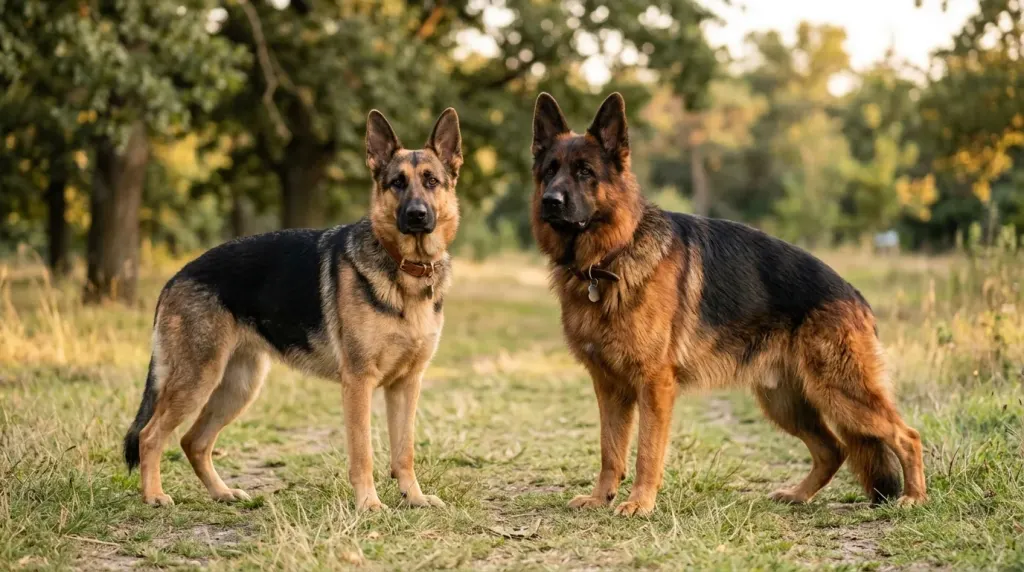
The breed exhibits two major conformational styles based on historical breeding lineages:
- Working Lines (DDR, Czech, West German Working):
- Topline: Straight, level back with minimal slope toward the croup.
- Structure: Compact bone density, deeper rib cages, shorter loins, and moderate rear angulation.
- Purpose: Bred primarily for police work, search and rescue, and sport (IGP/Schutzhund), emphasizing agility, stamina, and physical durability.
- Show Lines (West German Show Line, American Show Line):
- Topline: Distinct sloping topline flowing from prominent withers downward toward a gently angled croup.
- Structure: Greater length of body, pronounced hindquarter angulation, and a specialized flying trot suited for conformation rings.
Establishing regular routine cleaning routines for canine ears prevents dirt accumulation in upright auditory canals after rigorous field workouts.
Active working dogs require careful monitoring during outdoor training, as recognizing canine heat stress and exhaustion protects working lines from hyperthermia during high-intensity tracking sessions.
The tail of a purebred German Shepherd is bushy and reaches at least to the hock joint. At rest, the tail hangs downward in a gentle sabre curve. When the dog is excited or moving, the tail raises slightly, but it should never curl tightly over the back or form a closed ring.
How to Identify Purebred German Shepherd Coat Types and Color Standards
Purebred German Shepherds possess a weather-resistant double coat designed to protect the dog across diverse climates:
- Outer Coat: Dense, harsh, straight hairs that lie close and flat against the body.
- Undercoat: Soft, dense, woolly fur that provides thermal insulation.
- Plush vs. Long Coat: The standard stock coat (plush coat) features medium-length hair with slight feathering on the forelegs and breeching on the thighs. The long stock coat features longer, silky hair with prominent ear tufts and feathered tails; long coats with an undercoat are fully accepted by the AKC and SV.
Standard Purebred Coat Colors:
- Black and Tan (Classic saddle pattern with tan points)
- Black and Red (Deep mahogany red with black saddle)
- Sable (Agouti banding with black-tipped hairs)
- Bi-Color (Predominantly black body with tan markings on paws and face)
- Solid Black (Uniform jet black without brown undertones)
Recognized Variations & Rare Genetic Traits:
- Solid White (AKC Code 199; purebred but disqualified in conformation show rings)
- Panda Shepherd (Spontaneous mutation in the KIT gene causing white facial and body markings)
- Blue & Liver (Recessive dilute alleles altering black pigment to slate grey or chocolate)
Dense double coats require weekly line-brushing, adopting undercoat shedding and dematting techniques to prevent dead undercoat buildup without stripping natural oils.
Washing double-coated dogs requires careful scheduling, as determining bathing frequency for pet coats ensures the water-resistant protective layer remains intact throughout seasonal shedding cycles.
Brindle striping, merle patterns, or patches of curly wire hair do not occur naturally within purebred German Shepherd genetics and confirm mixed parentage.
Purebred German Shepherd Temperament, Working Drives, and Training Biddability
An authentic German Shepherd displays a distinctive temperament characterized by poise, self-confidence, and keen environmental awareness. The breed is naturally watchful and self-assured, demonstrating polite aloofness toward strangers rather than indiscriminate eagerness or nervous suspicion.
While companion breeds benefit from structured basic obedience training for dogs, German Shepherds thrive on complex problem-solving commands and task-driven jobs. A purebred GSD possesses high biddability, intense focus during training, strong prey and tracking drives, and protective instincts over their household pack.
Establishing consistent daily routines during early puppyhood simplifies effective puppy housebreaking and potty training before commencing advanced obedience exercises.
Key behavioral markers of a purebred German Shepherd include:
- High Working Drive: Eager engagement in interactive tracking, retrieving, and agility exercises.
- Discriminating Protective Instincts: Natural assessment of new situations without unprovoked reactivity.
- Pack Loyalty: Deep bonding with family members and a desire for structured daily involvement.
- Environmental Stability: Calm composure when exposed to unusual surfaces, loud sounds, and busy urban environments.
How Can You Tell if a German Shepherd Is Purebred Through Pedigree Papers and DNA Testing?
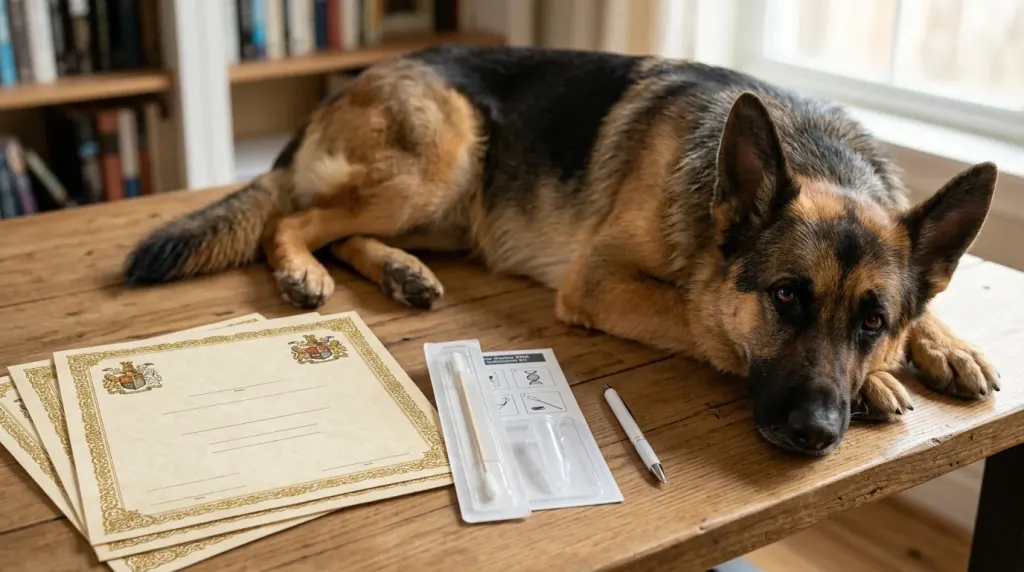
While physical traits offer strong visual clues, documentation from recognized canine registries and genetic testing provide legal, genealogical, and biological confirmation of purebred status.
Recognized Kennel Club Registries and Registration Certificates
To establish verified lineage, a dog must be registered with a recognized national or international kennel organization that maintains closed studbooks:
- American Kennel Club (AKC): The premier registry in the United States. Purebred German Shepherds receive an AKC Registration Certificate containing an individual registration number (typically starting with the prefix DN followed by eight digits).
- Verein für Deutsche Schäferhunde (SV): The founding German breed club. SV registration requires rigorous breed surveys (Körung), character tests, and strict working qualifications.
- United Kennel Club (UKC) & Canadian Kennel Club (CKC): Legitimate North American registries adhering to strict pedigree recording standards.
- Fédération Cynologique Internationale (FCI): The governing body overseeing national kennel clubs across Europe, Asia, and Latin America.
Maintaining balanced skeletal growth relies on tracking breed-specific growth milestones to avoid premature joint strain in developing working dogs.
Calculating precise daily caloric intake according to portion control guidelines for canine nutrition helps working dogs maintain lean muscle mass without overloading hip joints.
Essential Elements on an Official AKC Registration Certificate:
- Registered Name of the Dog
- AKC Individual Registration Number (e.g., DN12345678)
- Sire (Father) Name and Registration Number
- Dam (Mother) Name and Registration Number
- Certified Breeder Name
- Microchip or Tattoo Identification Number
- Recorded Color and Coat Type
Deciphering Pedigree Codes: Health Clearances and Working Titles
A certified three-generation or five-generation pedigree traces the dog’s ancestry, confirming that every parent, grandparent, and great-grandparent belongs to the German Shepherd breed. Authentic pedigrees frequently feature health and working acronyms:
- OFA Hip & Elbow Clearances: Denoted as OFA Excellent, Good, or Fair for hips, and OFA Normal for elbows, verifying screening by the Orthopedic Foundation for Animals.
- SV “a”-Stamp (HD/ED): German certification for hip dysplasia (“a”1 Normal, “a”2 Fast Normal, “a”3 Noch Zugelassen).
- Working Titles: Schutzhund/IGP titles (IGP 1, IGP 2, IGP 3), Companion Dog (CD), or Utility Dog (UD), confirming proven working ability in the lineage.
- Breed Survey Rating: Körung (Kkl 1 or Kkl 2), indicating that the dog was evaluated by an SV breed master and officially recommended for breeding.
Note: Commercial registries that issue instant certificates online without verifying parentage (such as Continental Kennel Club, National Kennel Club, or universal pet registries) are not accepted as proof of purebred lineage by veterinary or canine authorities.
How Canine DNA Panels Screen for Purebred Lineage
For dogs acquired from rescues, shelters, or unverified breeders where paperwork is absent, canine DNA testing offers an accurate, scientifically validated method to determine breed purity.
Laboratories such as Embark Veterinary and Wisdom Panel use single nucleotide polymorphism (SNP) microarrays to analyze hundreds of thousands of genetic markers across the canine genome, cross-referencing profiles against reference databases containing purebred German Shepherds worldwide.
Beyond verifying breed ancestry, a comprehensive genetic panel evaluates health predispositions:
- Degenerative Myelopathy (DM): A progressive spinal cord disease where DNA testing identifies whether a dog is clear, a carrier, or at risk for hereditary spinal cord degeneration.
- Hyperuricosuria (HUU): A genetic disorder affecting uric acid metabolism that can predispose dogs to bladder stones.
- Multidrug Resistance 1 (MDR1): A hereditary condition affecting sensitivity to certain common veterinary medications like ivermectin.
- Coefficient of Inbreeding (COI): Estimates genetic diversity and inbreeding levels based on shared chromosomal segments across generations.
Frequently Asked Questions About German Shepherd Purebred Status
Can a purebred German Shepherd puppy have floppy ears?
Yes, all purebred German Shepherd puppies are born with soft, dropped ears. As auricular cartilage strengthens during puppyhood, the ears typically begin lifting around two to three months of age. Ear carriage often fluctuates during the teething phase before stabilizing in an erect position as cartilage hardens, usually standing permanently by five or six months of age.
What is the primary difference between working line and show line German Shepherds?
Working line German Shepherds possess a straighter back, compact bone structure, and high working drive suited for police tasks and canine sports. Show lines feature a sloping topline, deeper hindquarter angulation, and a specialized gait tailored for conformation dog shows. Both varieties represent purebred German Shepherds when bred from registered parentage.
Are white, blue, or liver German Shepherds considered purebred?
Yes, white, blue, and liver German Shepherds can be purebred dogs. Solid white is recognized by the AKC under registration code 199, though it is disqualified from conformation show rings. Blue and liver result from recessive dilution traits that alter black pigment to slate grey or rich liver brown without compromising purebred ancestry.
How accurate are commercial DNA test kits for verifying purebred status?
Accredited canine DNA test panels such as Embark and Wisdom Panel achieve high accuracy in detecting purebred German Shepherd ancestry. By analyzing comprehensive genetic markers against global breed reference databases, these tests reliably differentiate purebred dogs from mixed-breed crosses.


Leave a Reply