
Table of Contents
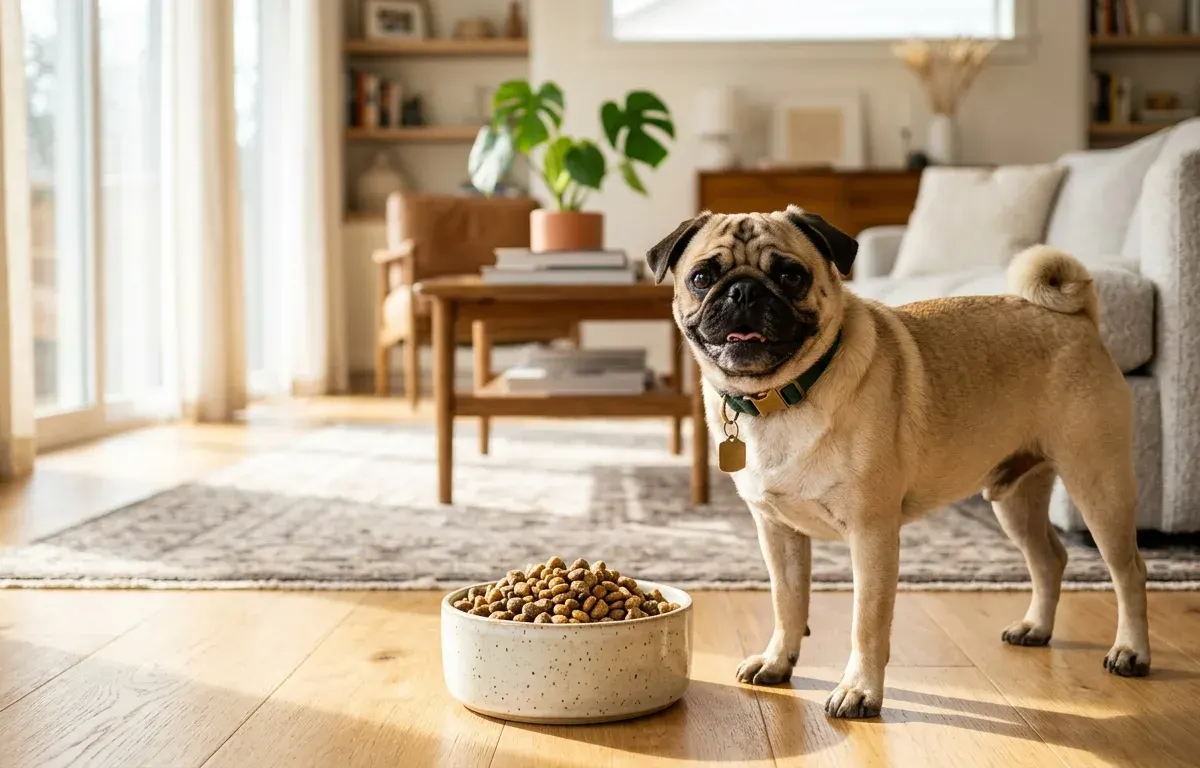
When determining how much dog food should a pug eat, a healthy adult pug weighing between 14 and 18 pounds typically needs 0.5 to 1 cup of standard dry dog food per day, divided into two separate meals. This volume equates to roughly 55 to 120 grams of dry kibble and delivers approximately 300 to 450 calories daily, depending on the dog's age, metabolic rate, and activity level. Growing pug puppies require three to four smaller meals daily, while seniors and inactive adults benefit from reduced portions to prevent unwanted weight gain.
- Most adult pugs weighing 14 to 18 pounds thrive on 0.5 to 1 cup of dry kibble daily, split across morning and evening meals.
- Daily energy requirements range from 300 to 450 calories based on body mass, spay or neuter status, and daily exercise.
- A 10-pound pug has a baseline resting energy requirement of about 218 calories, translating to 240 to 300 total daily calories.
- Commercial packaging guidelines offer starting ranges; weighing portions in grams on a kitchen scale provides the most reliable portion control.
- Pug puppies under six months need three to four daily meals, whereas adult and senior pugs maintain stable energy on two meals.
Pug Anatomy and Energy Needs Overview
Understanding how much dog food should a pug eat begins with recognizing the unique physiological traits of this beloved toy breed. Pugs possess compact, muscular frames paired with brachycephalic facial structures. Because their short airways make strenuous aerobic exercise challenging, pugs burn fewer calories throughout the day than longer-muzzled working breeds of similar weight.
Their lower baseline energy expenditure means that even a minor daily calorie surplus quickly leads to excess body fat. Knowing how big pugs get helps owners establish whether their dog sits within the healthy breed standard of 14 to 18 pounds or requires tailored weight intervention. Pugs have hearty appetites and rarely self-regulate their food intake. Setting consistent meal schedules and measuring every portion prevents the gradual weight creep common in the breed.
Weight-Based Guidelines by Weight Category
The exact volume of food your pug requires depends directly on their target adult weight, current body condition, and metabolic speed. Standard adult commercial dry dog food contains roughly 350 to 400 calories per standard measuring cup.
When evaluating how much dog food to feed a pug, start with these baseline daily feeding ranges:
- 10 to 12 pounds (petite or growing young adult): 0.5 to 0.75 cups per day (approx. 55 to 75 grams).
- 13 to 15 pounds (small adult): 0.75 to 0.85 cups per day (approx. 75 to 90 grams).
- 16 to 18 pounds (standard breed size): 0.85 to 1 cup per day (approx. 90 to 110 grams).
- 19 to 22 pounds (large framed or overweight adult): 1 to 1.25 cups per day (approx. 110 to 135 grams, pending veterinary body condition assessment).
Dry Dog Food Portion Chart for Adult Pugs
The following chart outlines daily energy targets and corresponding dry kibble portions based on standard commercial kibble containing 375 kcal per cup:
| Pug Weight (lbs) | Pug Weight (kg) | Daily Calorie Range (kcal) | Daily Dry Food (Cups) | Daily Dry Food (Grams) |
|---|---|---|---|---|
| 10 lbs | 4.5 kg | 240 – 300 kcal | 0.5 – 0.75 cup | 55 – 75 g |
| 14 lbs | 6.4 kg | 320 – 400 kcal | 0.75 – 1.0 cup | 75 – 100 g |
| 18 lbs | 8.2 kg | 390 – 460 kcal | 0.85 – 1.15 cups | 95 – 120 g |
| 22 lbs | 10.0 kg | 450 – 520 kcal | 1.0 – 1.25 cups | 115 – 140 g |
Monitoring how much dry dog food should a pug eat using this table provides a dependable starting framework that you can refine as your dog matures.
Feeding Amounts for Pug Puppies and Senior Pugs
Pug puppies undergo rapid physical development during early growth, requiring higher caloric density per pound of body weight than mature adults. Young puppies generally begin with measured portions of specialized puppy kibble divided across three to four smaller meals daily, with serving sizes adjusted as they reach healthy weight milestones.
As dogs age, basal metabolic rates gradually slow and daily energy expenditure often declines. Because the transition to senior life varies by individual activity level, mobility, and muscle condition, learning when pugs become senior dogs helps owners identify when to consult a veterinarian about dietary adjustments. Aging pugs that become less active typically benefit from modest calorie reductions to protect aging joints from excess load.
How to Calculate Daily Calories for a Pug Using RER and DER
Relying solely on measuring cups can introduce significant estimation errors because kibble shape and density vary widely between brands. Calculating exact caloric requirements offers superior nutritional precision.
According to the WSAVA Global Nutrition Guidelines, determining a dog’s energy requirement starts with their Resting Energy Requirement (RER), which is then adjusted by a Daily Energy Requirement (DER) factor based on life stage and lifestyle.
Applying the RER Formula for a 10-Pound Pug
Resting Energy Requirement reflects the baseline calories an animal burns at rest to maintain essential organ function, cellular repair, and body temperature. When determining how many calories should a 10 pound dog pug eat, owners can calculate RER using the standard allometric formula:
RER (in kcal/day) = 70 x (Body Weight in kg)^0.75
For a 10-pound pug, the calculation proceeds as follows:
- Convert weight to kilograms: 10 lbs / 2.205 = 4.54 kg.
- Calculate 4.54 raised to the 0.75 power: 4.54^0.75 = 3.11.
- Multiply by 70: 70 x 3.11 = 217.7 kcal/day (approx. 218 kcal).
This confirms that a 10-pound pug requires approximately 218 baseline calories daily before factoring in movement, play, and digestive expenditure.
Adjusting DER Multipliers for Activity Level and Spay/Neuter Status
To establish total daily maintenance calories, multiply baseline RER by the appropriate Daily Energy Requirement (DER) factor based on your dog’s lifestyle and reproductive status:
- Intact adult pug (moderate activity): DER = 1.6 to 1.8 x RER (approx. 350 to 390 kcal for a 10-lb dog).
- Neutered or spayed adult pug (typical household): DER = 1.2 to 1.4 x RER (approx. 260 to 305 kcal for a 10-lb dog).
- Sedentary or obesity-prone adult pug: DER = 1.0 to 1.2 x RER (approx. 218 to 260 kcal for a 10-lb dog).
- Weight loss protocol: DER = 1.0 x RER based on target ideal weight.
For a typical neutered 10-pound pug with moderate indoor activity, a multiplier of 1.3 yields 283 total daily calories. Reviewing what do pug dogs eat helps owners select high-protein, fiber-rich foods that provide fullness within this exact calorie target.
Note: When preparing fresh food or switching diet styles, verify nutrient balance against an approved homemade dog food recipe for a pug so total energy remains strictly calibrated.
How to Read Feeding Charts on Commercial Dog Food Packaging
Every bag of commercial pet food includes a printed feeding table. These tables provide broad recommendations based on general canine averages rather than breed-specific metabolic rates.
Feeding guidelines printed on pet food bags are designed as broad population starting points rather than individualized prescriptions. Owners should always treat packaging numbers as an initial estimate to adjust based on their dog’s body condition score and daily energy expenditure.
Converting Iams Dog Food Feeding Guidelines for a 25 lb Pug
Commercial diets group recommendations into wide weight brackets. For example, standard adult dry formulas from Iams typically display the following feeding brackets:
- 5 to 10 lbs (2.3 to 4.5 kg): 0.5 to 0.75 cups daily.
- 10 to 20 lbs (4.5 to 9.1 kg): 0.75 to 1.33 cups daily.
- 20 to 30 lbs (9.1 to 13.6 kg): 1.33 to 1.75 cups daily.
When calculating how much iams dog food for a 25 lb pug to feed, an owner reading the packaging would see a recommendation of 1.5 to 1.75 cups daily. However, a 25-pound pug is significantly heavier than the 14 to 18-pound standard adult breed size. Unless the dog is an unusually tall crossbreed, 25 pounds represents severe obesity.
Feeding 1.5 cups daily would maintain an unhealthy excess mass, exacerbating respiratory difficulties. Extra weight places immense pressure on soft palate tissues, causing why pugs snort and struggle to breathe comfortably during sleep or exercise. Owners of a 25-pound pug should calculate calorie portions targeting an ideal weight of 16 to 18 pounds (roughly 1 cup daily) under veterinary supervision.
Daily Feeding Schedule and Meals per Day by Age
Establishing a predictable daily feeding routine supports smooth digestion and prevents gastric discomfort. Pugs should never be free-fed (leaving food in the bowl all day) because their strong appetite will lead to continuous overeating.
Meal Schedule for Pug Puppies Under 6 Months
Young pug puppies benefit from frequent, spaced meals to accommodate small stomach capacities and maintain consistent energy levels:
- Weaning puppies (roughly 2 to 3 months): Typically 3 to 4 smaller meals spaced across the day, tailored to the puppy’s appetite and energy.
- Growing puppies (around 3 to 6 months): Usually 3 meals per day as stomach volume increases and digestion stabilizes.
- Young adults (approaching 6 months and older): Gradually transitioning toward 2 meals per day as rapid skeletal development moderates.
Dividing the daily portion into multiple servings accommodates individual growth rates and protects developing digestive tracts.
Feeding Frequency for Adult and Senior Pugs
Adult and senior pugs thrive when fed twice daily, spaced 8 to 12 hours apart. Deciding how much to feed a pug dog at each meal is as simple as dividing their total daily cup or gram measurement into two equal morning and evening servings.
Integrating scheduled meal times into a complete daily pug dog care routine fosters good household behavior, supports gastrointestinal health, and contributes to how long pugs live in active comfort.
Adjusting Portions for Activity Level and Body Condition
Portion sizes must adapt as your dog’s lifestyle, reproductive status, and age shift over time. Regular hands-on physical evaluations ensure you catch weight changes before they become serious health concerns.
Identifying Underfeeding and Overfeeding Using the Body Condition Score
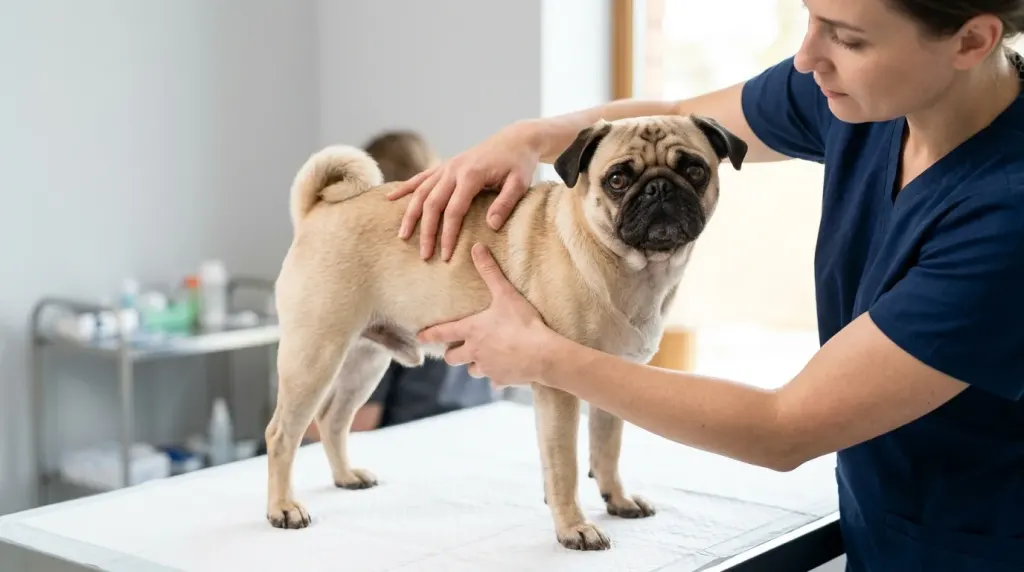
The 9-point Body Condition Score (BCS) system provides an objective, hands-on method to assess whether your pug receives the right amount of daily food:
- BCS 1 to 3 (Underweight): Ribs, spine, and pelvic bones are easily visible with no palpable fat covering. Increase daily food intake by 10% to 15%.
- BCS 4 to 5 (Ideal Body Condition): Ribs are easily felt beneath a slight fat layer. An observable waistline is visible behind the ribs from above, and an abdominal tuck is evident from the side profile.
- BCS 6 to 9 (Overweight to Obese): Ribs are difficult or impossible to feel under thick fat padding. Waistline and abdominal tuck are absent; fat deposits accumulate over the lower back, neck, and tail base. Reduce daily food intake by 10% to 15%.
Overfeeding or feeding inappropriate rich table scraps frequently leads to digestive disturbances such as pug gas and flatulence, while digestive upset can also trigger noticeable pug drooling tendencies after meals.
Why Pugs Are Prone to Obesity and Weight Management Strategies
Pugs face genetic, anatomic, and behavioral factors that make them prone to rapid weight gain. Their brachycephalic airway anatomy limits vigorous exercise, while their lower resting metabolic rate requires careful portion discipline.
Using a digital kitchen scale to measure pet food in grams eliminates the 20 to 30 percent measurement error common with standard volume cups, ensuring your dog receives consistent daily calories without accidental overfeeding.
Effective practical strategies to keep your pug at an ideal weight include:
- Weigh Food on a Digital Gram Scale: Measuring by weight removes variations caused by kibble settlement and scoop size.
- Account for Treat Calories: All treats and training rewards must stay below 10% of total daily caloric intake.
- Use Crunchy, Low-Calorie Vegetables: Offer raw baby carrots, cucumber slices, or green beans as low-calorie rewards instead of high-fat processed biscuits.
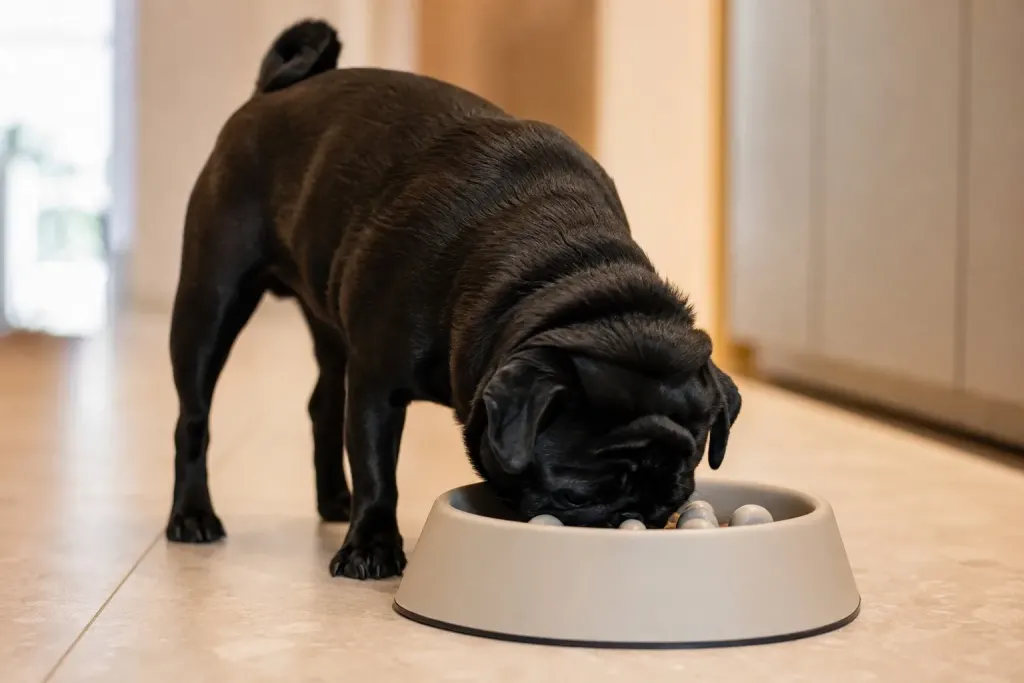
- Deploy Interactive Slow-Feeder Bowls: Puzzle feeders slow rapid ingestion, promote satiety, and provide mental stimulation during mealtime.
- Monitor Behavioral Triggers: Pugs often display enthusiastic begging behaviors that resemble starvation. Redirecting focus toward play or gentle grooming curbs food obsession without adding extra calories, helping address issues like why pugs lick so much when seeking owner attention.
- Support Mobility During Weight Loss: For senior or arthritic pugs undergoing weight management, maintaining cleanliness with items like a pug diaper size guide ensures home hygiene and skin comfort as activity levels gradually rebuild.
Knowing how much should you feed a pug dog empowers you to maintain your companion’s vitality, joint mobility, and long-term health.
Frequently Asked Questions About Feeding a Pug
How much food should a pug puppy eat daily?
Daily feeding amounts for a pug puppy depend on their current weight, target adult size, and kibble calorie density. Young puppies around 2 to 3 months of age typically start on approximately 0.5 to 0.75 cups of puppy food daily, split across three to four small meals. As the puppy grows through 3 to 6 months, portion sizes scale up with body weight while meal frequency gradually tapers toward two feedings per day.
Is kibble or wet food better for a pug?
Both high-quality dry kibble and canned wet food provide complete nutrition when formulated to meet nutritional standards. Dry kibble promotes dental friction against tartar, while wet food has higher moisture content, helping increase meal volume and fullness for calorie-restricted adult pugs. Many owners successfully feed a combination of both formats while keeping total daily calories within target.
What should I do if my pug is always acting hungry?
Pugs have an exceptionally strong food drive and will often beg enthusiastically even after finishing an adequate meal. Never increase food portions simply because your pug acts hungry. Instead, use slow-feeder bowls to extend eating duration, divide meal kibble into training rewards, or provide vet-approved low-calorie vegetable snacks such as green beans.
Leave a Reply