
Table of Contents
To know how to tell if a French Bulldog is overheating, watch for frantic panting with a wide, flattened tongue, thick foamy drool, deep crimson or purple gums, and restless pacing. Because their brachycephalic flat faces restrict respiratory cooling, mild heat stress can escalate to life-threatening heatstroke within 10 to 15 minutes. If rectal temperature reaches 104.0°F (40.0°C) or your dog stumbles and vomits, move indoors immediately, apply tepid water to the paws and groin with fan airflow, and transport to an emergency veterinary clinic.
- Early overheating signs include rapid loud panting, thick foamy drool, bright red gums, and restless pacing.
- Severe heatstroke warning signs include purple or pale gums, stumbling ataxia, vomiting, muscle tremors, and collapse.
- Rectal temperature between 101.0°F and 102.5°F is normal; 104.0°F indicates heat exhaustion, and 106.0°F+ represents critical overheating.
- Cool an overheating Frenchie using tepid tap water (60°F to 65°F / 15°C to 18°C) on paws and groin with fan airflow; never use ice water.
- Stop active water cooling once rectal temperature drops to 103.0°F (39.4°C) to prevent hypothermia, and have a veterinarian evaluate internal organ function.
Signs of Overheating in French Bulldogs
Recognizing the earliest indications of thermal distress in a French Bulldog can prevent mild heat exhaustion from advancing into fatal heatstroke. Dogs regulate internal body temperature primarily through evaporative cooling in the upper respiratory tract (panting) and peripheral vasodilation (widening blood vessels near the skin surface in the ears, face, and paws). Unlike humans, dogs possess functional sweat glands only on their paw pads.
The shortened facial anatomy and compact build characteristic of the French Bulldog dog breed restrict upper airway clearance, making heavy panting mechanically inefficient. French Bulldogs possess stenotic nares (pinched nostrils), an elongated soft palate, and narrowed tracheal diameters. When a Frenchie pants rapidly in warm weather, the forced turbulence causes soft tissues in the larynx to become irritated and swollen. This airway swelling (laryngeal edema) restricts oxygen intake and forces the dog to expend greater muscular effort, generating additional internal heat in a dangerous compounding spiral.
Clinical symptoms of overheating in French Bulldogs typically progress through three distinct severity stages:
Early Warning Signs (Mild Heat Stress)
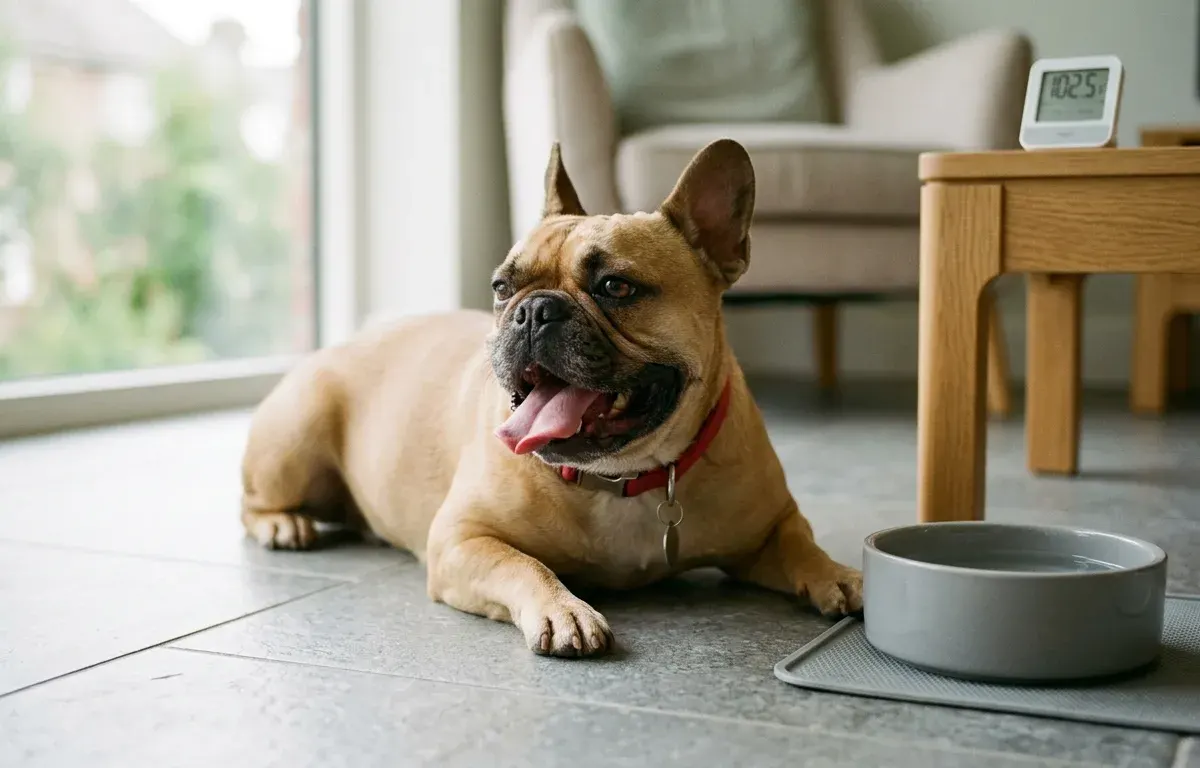
- Frantic, Heavy Panting: Breathing becomes rapid, shallow, and noticeably louder than usual, often accompanied by a wide, flattened tongue curling upward at the edges.
- Thick, Foamy Drool: Excessive saliva thickens into sticky, ropey foam around the lips and muzzle, creating a noticeable departure from normal French Bulldog drooling patterns.
- Bright Red Mucous Membranes: Gums, tongue, and the inner lining of the lips turn deep crimson or brick red as peripheral blood vessels dilate to release thermal load.
- Widened Eyes and Restlessness: The dog displays an anxious facial expression with enlarged pupils and searches frantically for shade or cool tile flooring.
Moderate Symptoms (Heat Exhaustion)
- Loud Rasping Stridor: Breathing produces harsh snoring, rattling, or roaring sounds as swollen airway tissues obstruct normal air movement.
- Extended Neck Posture (Orthopneic Stance): The dog extends its head and neck forward while holding its elbows outward to maximize thoracic volume and ease oxygen intake.
- Weakness and Motor Ataxia: The dog stumbles, wobbles on its hind legs, or sits down abruptly and refuses to walk during outdoor exercise.
- Intense Radiating Heat: The inner pinnae (ears), groin, armpits, and paw pads feel hot to human touch.
Critical Symptoms (Severe Heatstroke)
- Cyanosis (Discolored Gums): Gums and tongue transition from red to pale gray, dark purple, or slate blue, indicating severe cellular oxygen deprivation.
- Vomiting and Diarrhea: The dog expels frothy bile or loose stool, which may contain blood as intestinal mucosal barriers sustain thermal injury.
- Neurological Impairment: The dog becomes disoriented, displays muscle tremors, experiences seizures, or collapses into an unresponsive stupor.
| Severity Stage | Rectal Temperature Range | Primary Physical Symptoms | Immediate Action Required |
|---|---|---|---|
| Mild Heat Stress | 102.6°F to 103.9°F (39.2°C to 39.9°C). | Rapid panting, thick saliva, bright red gums, seeking shade. | Move indoors to air conditioning, offer cool water, rest. |
| Moderate Heat Exhaustion | 104.0°F to 105.7°F (40.0°C to 40.9°C). | Loud rasping stridor, stumbling, warm groin and paws, extreme lethargy. | Apply cool water to paws and belly, run a fan, check temperature. |
| Critical Heatstroke | 105.8°F+ (41.0°C+). | Gray/purple gums, vomiting, tremors, collapse, non-responsiveness. | Immediate active cooling and emergency veterinary transport. |
According to clinical guidance on canine overheating from the American Kennel Club, flat-faced breeds require diligent monitoring in warm weather because compromised airways make evaporative cooling significantly less effective, making air-conditioned rest essential when temperatures and humidity climb.
Common Environmental Triggers and Risk Factors
Understanding the primary triggers of canine hyperthermia allows owners to modify daily environments before thermal stress occurs. French Bulldogs are anatomical outliers in the canine world, combining high body density with restricted respiratory cooling pathways.
High ambient temperature is only one component of heat stress. Relative humidity plays an equally critical role. When ambient humidity exceeds 60 percent, moisture cannot evaporate readily from the dog’s tongue and respiratory lining during panting, rendering evaporative cooling virtually useless.
Key environmental situations that frequently trigger severe overheating in French Bulldogs include:
- Warm-Weather Outdoor Exercise: Even moderate physical activity in temperatures above 75°F (24°C) elevates metabolic heat production faster than a brachycephalic airway can expel it. Owners must carefully evaluate how vigorously French Bulldogs can run in warm weather and keep exertion minimal.
- Aquatic and Beach Hazards: Although water seems cooling, high humidity around swimming pools or lakes combined with poor buoyancy creates severe physical strain. Owners wondering whether French Bulldogs can swim must recognize that their heavy bone density causes rapid exhaustion, accelerating thermal collapse if life vests and close supervision are missing.
- Confined Spaces and Parked Vehicles: Enclosed cars trap solar radiation like greenhouse ovens. On an 80°F (27°C) sunny day, interior cabin temperatures reach 99°F in 10 minutes and 109°F within 20 minutes, even with cracked windows.
- Radiant Ground Heat: Dark asphalt absorbs radiant solar energy, reaching temperatures up to 135°F on sunny days. Because French Bulldogs have short legs and low ground clearance, their chest and abdomen absorb intense reflected thermal energy.
How to Check Your Dog at Home (Assessing Severity)
When you suspect your French Bulldog is experiencing heat distress, perform a systematic four-step clinical check to evaluate physiological severity.
Step 1: Evaluate Breathing Effort and Upper Airway Sounds
Observe your dog’s chest wall movements and listen carefully to respiratory noises. Normal canine panting is smooth and rhythmic. If your French Bulldog exhibits loud snoring rattles, gasping, or flared nostrils with exaggerated abdominal contractions, airway swelling is already obstructing oxygen exchange.
Step 2: Inspect Mucous Membrane Color and Capillary Refill Time
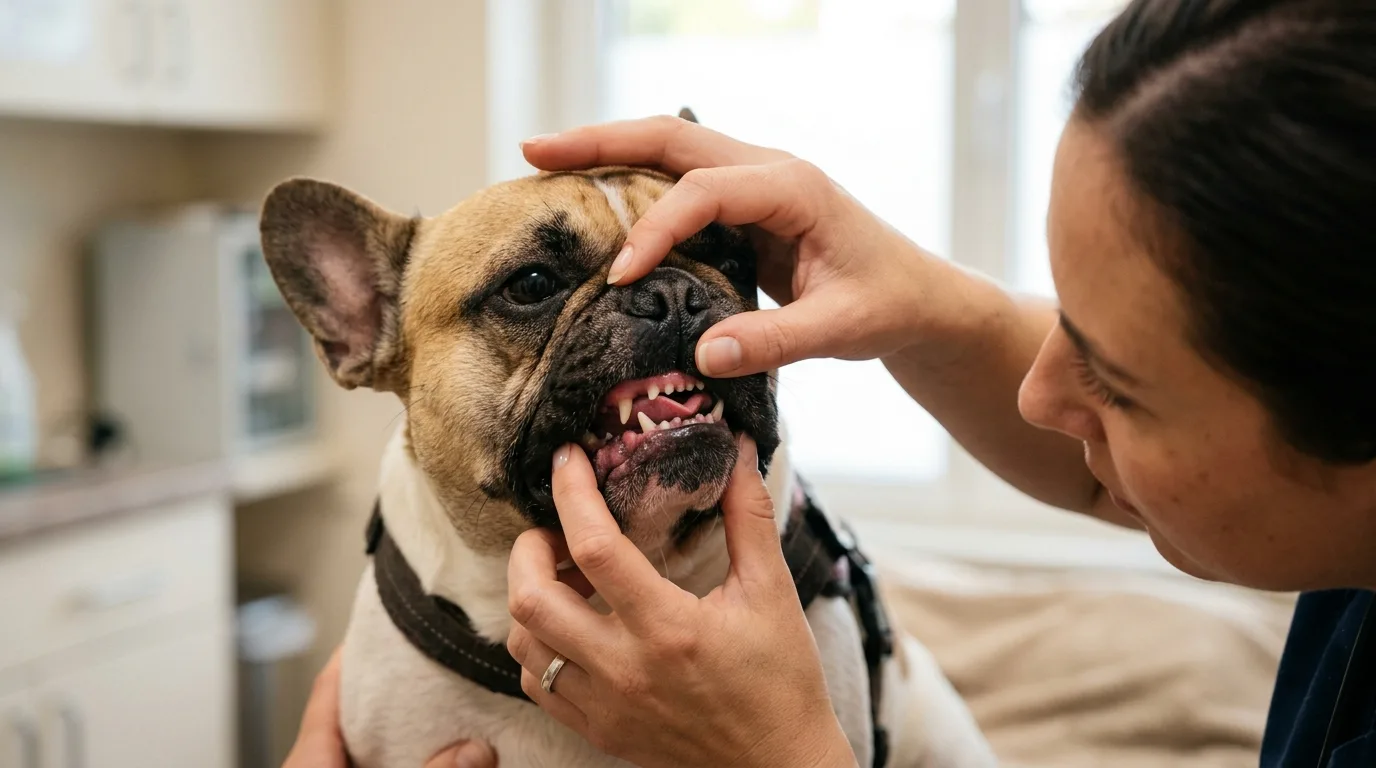
Gently lift your French Bulldog’s upper lip to examine gum color:
- Healthy Baseline: Salmon-pink and glistening with moisture.
- Early Heat Stress: Brick-red, deep crimson, or dry and sticky to the touch.
- Critical Emergency: Pale, muddy gray, or blue-purple.
Test Capillary Refill Time (CRT) by pressing your thumb firmly against the upper gum tissue for two seconds, then releasing. In a healthy dog, the white thumbprint returns to pink within 1 to 2 seconds. A delayed refill time of 3 seconds or longer indicates poor peripheral circulation and cardiovascular compromise.
Step 3: Measure Rectal Body Temperature Accurately
A digital rectal thermometer provides the only accurate measurement of core canine body temperature. Infrared skin thermometers and ear thermometers are unreliable for assessing systemic heatstroke in dogs.
- Lubricate the metal tip of a digital thermometer with petroleum jelly or water-based lubricant.
- Have a second person gently restrain and comfort the dog in a standing or lying position.
- Insert the thermometer probe approximately 1 to 1.5 inches into the rectum.
- Hold the device steady until the digital alert beeps, then record the reading.
Normal canine core temperature is 101.0°F to 102.5°F (38.3°C to 39.2°C). A reading between 102.6°F and 103.9°F requires indoor rest and monitoring. Any reading of 104.0°F or higher confirms heat exhaustion requiring active cooling, while a reading of 105.8°F or higher confirms life-threatening heatstroke.
Step 4: Assess Motor Coordination and Neurological Responsiveness
Call your dog’s name and encourage gentle movement across the room. Sudden pacing, agitation, or refusal to follow familiar commands represent distress-driven shifts in French Bulldog behavior during early heat stress. Severe thermal exhaustion causes unresponsiveness that differs fundamentally from the relaxed posture and typical daily patterns of how much French Bulldogs sleep. If your dog stumbles, exhibits glazed unblinking eyes, or cannot stand upright, immediate stabilization and clinical intervention are mandatory. Checking rectal temperature and gum color provides objective clarity during an emergency. Relying solely on visual breathing effort can lead owners to underestimate internal organ stress, as brachycephalic dogs continue panting long after dangerous thermal thresholds are crossed.
Immediate First Aid for an Overheating French Bulldog
Prompt, controlled cooling is essential to stop thermal cellular damage while avoiding cardiovascular shock. Follow these first-aid steps sequentially:
- Relocate to a Controlled Climate: Move your dog indoors into an air-conditioned room immediately, or place the dog in front of a vehicle air vent operating at maximum airflow.
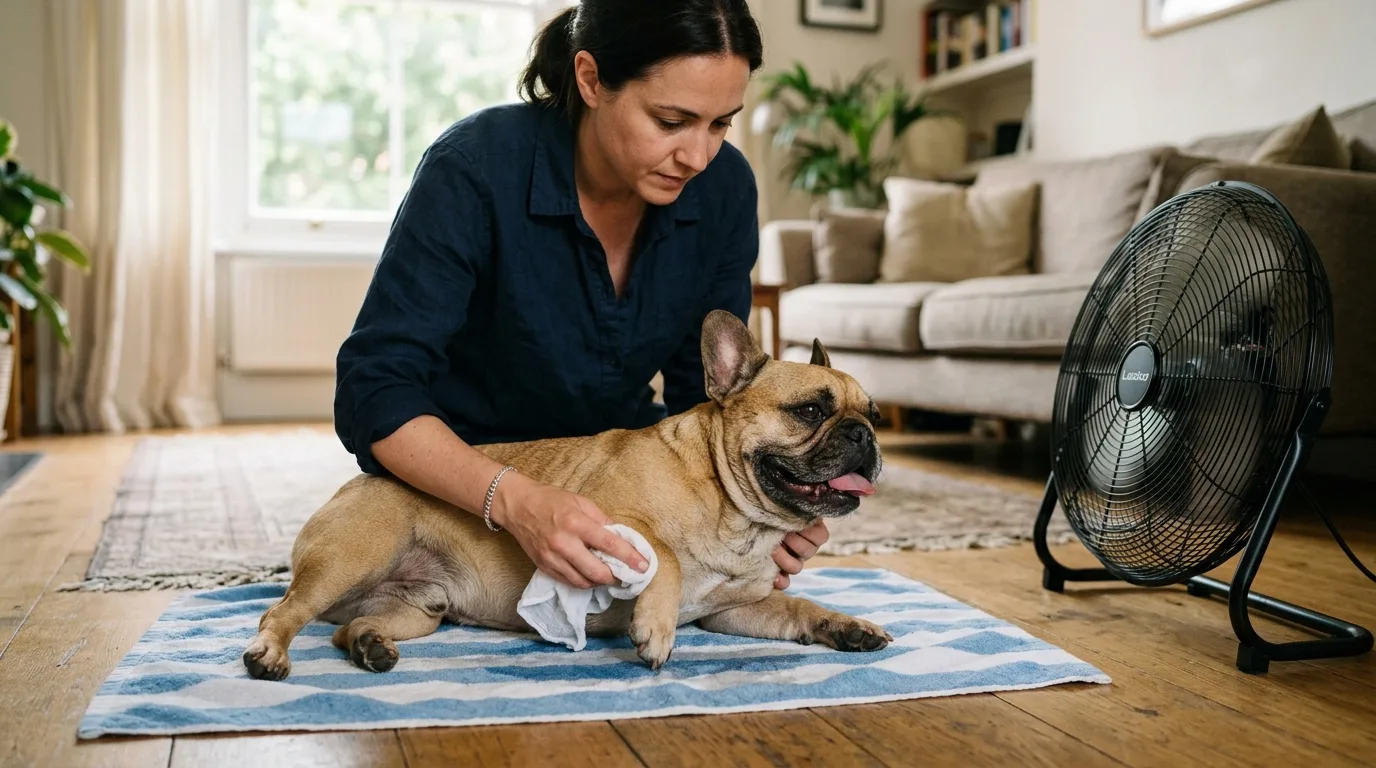
- Apply Tepid, Cool Water: Wet your dog’s paws, inner thighs, groin, armpits, and neck with cool tap water (around 60°F to 65°F / 15°C to 18°C). Applying room-temperature tap water to the paw pads, groin, and underarms provides one of the most effective methods to cool down a French Bulldog without causing vascular shock.
- Generate Continuous Airflow: Position an oscillating fan directly toward your wet dog to speed up evaporative cooling across exposed skin.
- Offer Small Amounts of Drinking Water: If the dog is conscious and able to swallow normally, provide a shallow bowl of cool, fresh water. Never force water down an animal’s throat, as gasping dogs can easily aspirate liquid into their lungs.
- Recheck Temperature Every 5 Minutes: Monitor rectal temperature continuously. Stop active water cooling once the thermometer reads 103.0°F (39.4°C). The dog’s body will continue cooling naturally; continuing active water cooling past 103.0°F risks hypothermia.
Unlike controlled warm-water sessions used when owners evaluate how often you should bathe a French Bulldog, emergency cooling requires tepid tap water around 60°F to 65°F (15°C to 18°C) combined with gentle airflow.
Note: First-aid cooling stabilizes core body temperature during transit but does not replace professional veterinary examination. Internal complications, including acute renal failure, cerebral edema, and abnormal blood clotting disorders, can develop 24 to 48 hours after a severe overheating incident.
What Never to Do During Heat Emergencies
- Do Not Use Ice Baths or Freezing Water: Plunging an overheating dog into ice water causes peripheral cutaneous blood vessels to constrict violently. This vasoconstriction traps boiling core blood inside internal organs and induces shivering, which generates additional metabolic heat.
- Do Not Wrap the Dog in Soaked Blankets: Draping a wet towel over a dog without constant replacement creates a sauna-like insulation layer that traps radiant heat against the skin.
- Do Not Administer Human Medications: Never give aspirin, acetaminophen, or ibuprofen. Heatstroke impairs renal and hepatic function, and human antipyretics will trigger fatal organ toxicity.
Red Flags: When to See an Emergency Vet Immediately
Seek emergency veterinary treatment without delay if your French Bulldog displays any of the following clinical red flags:
- Rectal temperature exceeds 104.5°F (40.3°C) or fails to decline after 10 minutes of active home cooling.
- Mucous membranes appear pale gray, dark purple, or brick red.
- The dog collapses, loses consciousness, or cannot stand independently.
- Involuntary muscle spasms, seizures, or rigid limb tremors occur.
- The dog passes bloody vomit, black tarry stool, or bloody diarrhea.
- Severe breathing distress, high-pitched choking, or gasping continues even in an air-conditioned room.
Because dense muscle mass and stocky proportions dictate how big French Bulldogs get, their low ratio of surface area to body weight accelerates internal heat retention during acute physical stress. Prompt veterinary intervention prevents irreversible damage to the kidneys, liver, and cardiac tissue, safeguarding the overall health and factors that influence how long French Bulldogs live.
During emergency hospital management, veterinary teams establish intravenous catheter access to deliver cool crystalloid fluids, administer humidified oxygen therapy to support compromised lungs, and monitor plasma levels for systemic inflammatory response syndrome (SIRS) and disseminated intravascular coagulation (DIC).
Warm-Weather Prevention and Long-Term Care Strategies
Preventing thermal exposure is significantly easier than managing advanced heat exhaustion. Integrating proactive heat management into daily routines remains a cornerstone of responsible, long-term French Bulldog care throughout humid summer months.
- Schedule Walks During Off-Peak Hours: Exercise your Frenchie only during the coolest hours of the morning (before 8:00 AM) and late evening (after 7:30 PM). Keep outdoor bathroom trips under 5 to 10 minutes when ambient temperatures exceed 75°F (24°C).
- Monitor the Heat Index and Humidity: Relative humidity above 60 percent drastically reduces the efficiency of evaporative cooling through panting. Even if outdoor ambient temperatures read a modest 78°F (26°C), high humidity can elevate the effective heat index past 85°F (29°C), creating severe risks for flat-faced dogs.
- Maintain Facial and Ear Hygiene: Regular grooming and knowing how to clean French Bulldog ears prevent bacterial or yeast infections in skin folds and ear canals that compound physical discomfort and elevate stress during hot weather. Routine body checks and understanding natural tail structure and tail-fold care in French Bulldogs keep sensitive skin pockets clean and prevent painful inflammation in high humidity.
- Provide Hydrating Summer Snacks: Offering hydrating, low-calorie fruit snacks or checking whether French Bulldogs can eat pineapple safely helps replenish moisture and keep dogs refreshed during hot weather without upsetting sensitive stomachs.
- Protect Against Radiant Asphalt Heat: Asphalt absorbs solar radiation and can reach surface temperatures of 135°F on an 85°F sunny day. Always test the ground with the back of your bare hand for seven seconds before walking your dog.
- Maintain Indoor Climate Control: Keep indoor residential temperatures set between 68°F and 72°F (20°C to 22°C) with active air conditioning. Provide elevated dog cots and cooling gel pads to encourage conductive heat loss.
- Never Leave a Dog Inside a Parked Vehicle: Even with windows cracked on a mild 70°F (21°C) day, vehicle interior temperatures can exceed 100°F within 10 minutes and 120°F within 20 minutes, creating a fatal environment for a brachycephalic animal.
Frequently Asked Questions About French Bulldog Overheating
At what temperature does a French Bulldog begin to overheat?
A French Bulldog can begin experiencing mild heat stress when outdoor temperatures rise above 75°F (24°C), especially if humidity exceeds 60 percent. Because high humidity inhibits evaporative cooling through panting, heat index values over 80°F (27°C) pose severe risks to brachycephalic dogs even during light physical exertion.
How quickly can a French Bulldog develop life-threatening heatstroke?
A French Bulldog can transition from normal breathing to life-threatening heatstroke in as little as 10 to 15 minutes in extreme heat, high humidity, or enclosed spaces like a parked car. Their narrow airways swell rapidly under heavy panting, which accelerates respiratory distress and internal temperature spikes.
Should I put ice on an overheating French Bulldog?
No, you should never place ice cubes, ice packs, or ice-cold water directly on an overheating French Bulldog. Extreme cold causes surface blood vessels to constrict, trapping scorching blood inside vital internal organs, and induces shivering, which increases internal body heat. Always use cool or tepid tap water.
Why are French Bulldogs more prone to overheating than other breeds?
French Bulldogs are disproportionately susceptible to heat stress due to their flat-faced brachycephalic anatomy. Elongated soft palates, narrow nostril openings, and compressed tracheal passages restrict airflow, making panting mechanically inefficient. The physical work of panting generates significant metabolic heat while failing to cool the body effectively.


Leave a Reply