

Table of Contents
Adult French Bulldogs typically stand 11 to 12 inches (28 to 31 cm) tall at the withers and weigh between 16 and 28 pounds (7 to 13 kg), with males generally heavier and broader than females. Skeletal frame growth generally concludes near one year of age as growth plates close, though individual dogs often continue gaining muscle density and chest width through their second year. Standard sizes are anchored by major kennel clubs, where exceeding 28 pounds results in conformation disqualification under American Kennel Club rules.
- Height is measured strictly at the withers (shoulder blades), averaging 11 to 12 inches regardless of bat-ear height.
- The American Kennel Club disqualifies any French Bulldog weighing over 28 pounds from conformation competition.
- Fédération Cynologique Internationale benchmarks male weights at 9 to 14 kg and females at 8 to 13 kg.
- Skeletal height generally stabilizes by the first year, while muscle development continues into the second year.
- Body condition scoring by a veterinarian provides a more accurate health measure than scale weight alone.
Growth basics and size ranges
Understanding how big French Bulldogs get begins with how breed registries evaluate their physical proportions. French Bulldogs are classified as small companion dogs built with heavy bone, muscular shoulders, and a low center of gravity. When prospective owners ask how big french bulldogs get, official standards focus on compactness and balance rather than vertical height. Learning the defining traits of a French Bulldog highlights how their broad chest, short back, and sturdy limbs create substantial physical heft in a small frame.
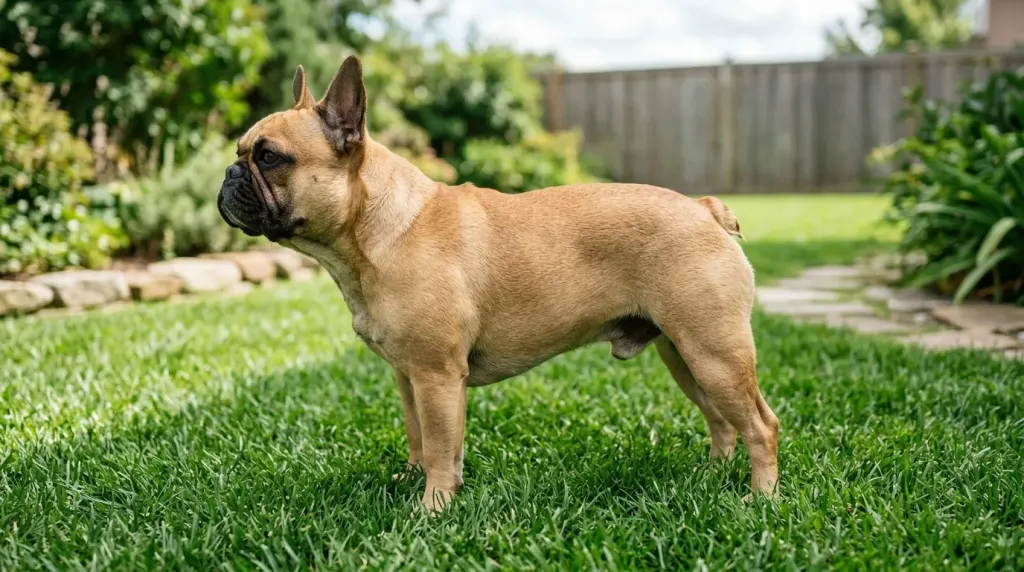
Height is measured strictly from the ground to the withers, which is the ridge between the shoulder blades. Bat ears, while prominent, do not count toward official height measurements. Standard shoulder height ranges between 11 and 12 inches (28 to 31 cm) for most adult dogs.
To determine how heavy do french bulldogs get, kennel registries publish distinct guidelines. Under the American Kennel Club standard, any dog exceeding 28 pounds (12.7 kg) is disqualified from conformation judging. The Fédération Cynologique Internationale specifies separate parameters for males and females, establishing male weight between 9 and 14 kg (19.8 to 30.8 lbs) and female weight between 8 and 13 kg (17.6 to 28.6 lbs). The United Kennel Club similarly caps conformation weight at 28 pounds.
| Registry | Standard Height Range | Recognized Weight Range | Conformation Rule |
|---|---|---|---|
| American Kennel Club (AKC) | Proportional (typically 11 to 12 in) | Up to 28 lb (12.7 kg) | Disqualification over 28 lb |
| Fédération Cynologique Internationale (FCI) | Males: 27 to 35 cm; Females: 24 to 32 cm | Males: 9 to 14 kg; Females: 8 to 13 kg | 500 g tolerance for exceptional specimens |
| United Kennel Club (UKC) | Proportional (typically 10 to 12 in) | Up to 28 lb (12.7 kg) | Disqualification over 28 lb |
Factors that influence size
A French Bulldog puppy‘s adult size depends on genetics, nutrition, endocrine health, and pediatric care. Understanding how big do french bulldogs grow requires examining both parentage and environmental management during early puppyhood.
Genetics establish the upper biological limit of an individual dog’s skeletal frame. Puppies born to stocky, heavy-boned parents usually inherit thicker bone structure and wider chests. However, genetic variation within a single litter can still produce puppies of noticeably different adult weights. Male puppies frequently develop broader heads and thicker necks than female littermates due to natural sexual dimorphism.
Nutrition during the first year plays a decisive role in physical development. Feeding a balanced, breed-appropriate diet supports steady bone growth without accelerating weight gain prematurely. Overfeeding does not make a dog grow a larger skeletal frame; instead, excess calories deposit fat over developing joints and increase stress on growing cartilage. Mindful dietary management, including caution when feeding high-calorie extras like peanut butter, prevents early obesity that could compromise structural soundness.
Pediatric health also affects physical maturation. Parasitic burdens, early digestive illnesses, or hormone imbalances can temporarily slow growth, while premature neutering before growth plate closure may cause long bones to grow slightly longer, resulting in a taller and less compact outline.
How size relates to health and function
Physical size directly influences a French Bulldog’s mobility, spine integrity, and respiratory efficiency. Because the breed is chondrodysplastic and brachycephalic, excess weight or oversized conformation carries elevated medical risks.
In terms of cranial dimensions and neuroanatomy, curious owners often inquire how big is a french bulldogs brain. Research in canine cranial morphology shows that a French Bulldog’s brain volume averages between 70 and 80 cubic centimeters, weighing roughly 70 to 85 grams. While canine brain size scales allometrically with overall body mass, the shortened brachycephalic skull compresses the cranial vault. This structural compression shifts the olfactory bulbs downward and reorganizes internal brain orientation within the compact skull without reducing total neural function.
Physical bulk places extra strain on the spine and airway. The breed’s compact, dense build increases susceptibility to spinal conditions like IVDD in French Bulldogs, where excess body weight accelerates disc degeneration. Furthermore, heavier soft tissue around the neck narrows the upper airway, exacerbating Brachycephalic Obstructive Airway Syndrome (BOAS).
According to Royal Veterinary College VetCompass research led by Dr. Dan O’Neill, Associate Professor of Companion Animal Epidemiology: “The popularity of extreme body shapes has created significant welfare concerns, making it vital to prioritize functional anatomy and moderate body condition over exaggerated bulk or weight.” Managing a French Bulldog’s physical condition is far more protective than aiming for a specific high number on the scale. Keeping an adult dog lean reduces pressure on the vertebral column and allows for easier airflow during breathing and light exercise.
Measuring and interpreting size
Accurate measurement helps owners track healthy growth and distinguish muscular development from excess body fat.

To measure height at home, use a firm measuring tape or a canine wicket while the dog stands squarely on a level surface. Position the measuring tool at the base of the front paw and measure straight up to the highest point of the shoulder blades (the withers). Keep the dog calm and still; reward-based handling taught during early training a French Bulldog makes regular veterinary measurements stress-free.
When assessing weight, owners should evaluate body condition score (BCS) alongside the scale. A 9-point body condition scoring system evaluated by a veterinarian provides objective data:
- Rib Palpation: Ribs should be easily felt under a light layer of fat without pressing firmly.
- Waist Definition: Viewed from above, an observable hourglass indentation should appear behind the ribs.
- Abdominal Tuck: Viewed from the side, the underline should slope upward gently from the chest to the flank.
Practical note: If an adult French Bulldog exhibits noisy or labored breathing at rest, difficulty climbing stairs, or sudden hind-leg weakness, seek prompt veterinary evaluation rather than attempting home exercise adjustments.
Breeding, genetics, and size outcomes
Ethical breeding standards establish clear limits on physical size to protect the long-term welfare of companion dogs. Understanding responsible French Bulldog breeding practices helps prospective owners avoid purchasing dogs bred for extreme or unhealthy dimensions.
Historically, the original French Bulldog purpose centered on creating a companion canine with moderate proportions, capable of moving comfortably without breathing distress. In recent years, commercial trends have promoted exaggerated variations, such as oversized “micro” or “giant” bulldogs.
Reputable breeders avoid pairing dogs that produce excessively heavy frames or overly short limbs. Selecting breeding stock that falls squarely within the 16 to 28 pound range helps maintain natural gait and functional respiratory capacity across generations.
Frequently asked questions
How big are French Bulldogs on average?
On average, adult French Bulldogs stand 11 to 12 inches tall at the withers and weigh between 18 and 28 pounds. Males are generally heavier and more muscular than females, with broad shoulders and a deep chest.
What is the typical weight range for a French Bulldog?
The typical weight range spans 16 to 28 pounds (7 to 13 kg). In official kennel club conformation, weights above 28 pounds are disqualified, while weights below 16 pounds often reflect smaller structural frames or lighter bone density.
Do male and female French Bulldogs differ in size?
Yes. Males typically reach 20 to 28 pounds with wider heads and broader chests, whereas females usually weigh between 16 and 24 pounds with slightly more refined facial features and narrower ribcages.
When do French Bulldogs stop growing?
Skeletal height and length typically stabilize by about one year of age as growth plates close, though timing varies slightly by individual puppy. Dogs continue filling out in chest width and muscle mass until reaching full physical maturity around two years of age.
Can growth problems indicate health issues?
Yes. Stunted height, sudden weight loss, or disproportionate limb development can indicate underlying parasitic infections, nutritional deficiencies, or orthopedic conditions. Any unexpected growth interruption warrants a veterinary consultation.
Size and daily life: implications for care
A French Bulldog’s physical size shapes daily feeding portions, indoor housing needs, and exercise routines. Because they carry dense muscle on compact limbs, their energy expenditure differs significantly from longer-legged breeds.
Daily exercise should match their muscular build and respiratory tolerance. While light daily walks and interactive play are beneficial, checking whether French Bulldogs can run for extended periods helps owners set realistic activity boundaries that prevent overheating and joint fatigue.
Their compact stature also makes them adaptable to apartment living and family homes, provided their environment includes temperature management and ramp access for sofas or beds. Monitoring daily activity and understanding daily French Bulldog behavioral needs ensures they remain mentally engaged without overexerting their joints.
Conclusion and next steps
Adult French Bulldogs are compact, muscular companions that reach an average height of 11 to 12 inches and a healthy weight of 16 to 28 pounds. Skeletal growth is largely complete by one year of age, followed by gradual muscle development through two years of age.
Rather than focusing solely on scale numbers, prioritize a balanced body condition score and regular veterinary checkups to keep your dog active, agile, and healthy throughout adulthood.



Leave a Reply