
Table of Contents
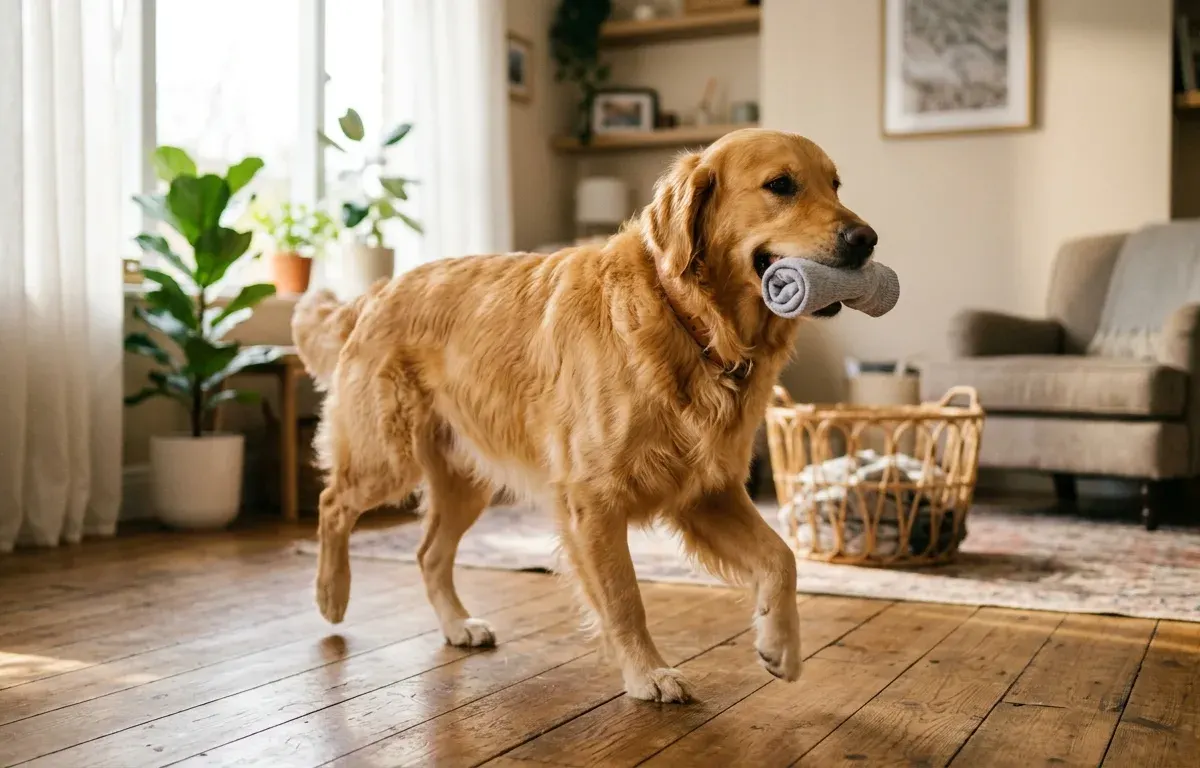
Golden Retrievers like socks primarily due to their natural retrieving instincts ("soft mouth" drive) and the comforting concentration of their owner's scent on worn foot fabric. Socks feel soft, lightweight, and rewarding to hold, often serving as a self-soothing item or a playful way to initiate attention. However, while carrying socks is harmless mouthing, chewing or swallowing socks poses severe gastrointestinal obstruction risks requiring immediate management and trade-up training.
- Bred to Retrieve: Gundog ancestry gives Golden Retrievers a hardwired urge to carry soft, pliable objects in their mouths without damaging them.
- Scent Security: Human feet have dense apocrine sweat glands; worn socks carry high concentrations of your pheromones, providing stress relief and familiarity.
- Keep-Away Reinforcement: Chasing your dog when they grab a sock turns theft into a rewarding game of tag.
- Obstruction Danger: Swallowing socks can cause life-threatening gastrointestinal blockages; never pull a swallowed object or play tug-of-war.
- Trade-Up Solution: Replace socks with high-value treats and textured puzzle toys using positive reinforcement "drop it" and "trade" cues.
Golden Retrievers are famous for their affectionate personalities, boundless enthusiasm, and one peculiarly common household habit: an absolute obsession with socks. Whether your dog greets you at the front door with a rolled-up gym sock, hoards laundry in their dog bed, or parodies an elusive thief the moment you fold clothes, this behavior is deeply ingrained in canine biology. Understanding why Golden Retrievers like socks helps owners separate charming breed quirks from genuine health hazards.
Why Do Golden Retrievers Like Socks? The 5 Biological and Behavioral Reasons
Golden Retrievers are attracted to socks due to a combination of genetic retrieving drives, strong olfactory attachment to their owner’s scent, sensory texture appeal, boredom, and learned attention-seeking behaviors. While human laundry may look ordinary to us, a used cotton sock represents a multisensory treasure trove of scent, texture, and interactive value to a sporting dog.

Gundog Heritage and the “Soft Mouth” Instinct
Historically bred in nineteenth-century Scotland to retrieve shot waterfowl from both land and water without puncturing flesh, Golden Retrievers possess a hereditary trait known as a “soft mouth.” This evolutionary background leaves them with a lifelong oral fixation. Holding items in their jaws feels intrinsically satisfying and calming for a retriever.
According to the American Kennel Club guidance on why dogs chew socks, sporting breeds often hold soft clothing items to fulfill an oral sensory need, and turning laundry theft into a high-stakes chase accidentally teaches the dog that stealing items guarantees undivided human attention. Unlike hard sticks or plastic toys, a cotton or wool sock provides a pliable, lightweight texture that closely mimics the gentle carrying sensation their ancestors were bred to enjoy.
High Concentration of Owner Scent and Pheromones
Dogs possess an olfactory system up to 100,000 times more sensitive than a human’s, allowing them to decode complex chemical signatures. The human foot contains roughly 250,000 sweat glands along with apocrine glands that secrete concentrated personal pheromones and sebum.
When you wear a pair of socks throughout the day, the fabric absorbs your unique scent profile. For an emotionally bonded Golden Retriever, your worn sock smells intensely of you. Sniffing and holding your sock provides comfort, reduces stress during periods of separation, and serves as an emotional pacifier. Seeking out comforting household items is a common coping mechanism in companion animals, much like how Pug dogs burrow into blankets for scent security when seeking reassurance from familiar human smells.
Sensory Texture and Teething Relief
The knit weave, elastic stretch, and warmth of a sock make it exceptionally satisfying to chew and mouth. For young Golden Retriever puppies between 3 and 7 months of age, chewing on compressed textiles provides soothing counter-pressure against inflamed gums as adult teeth emerge.
In adult dogs, the mechanical texture of a sock offers tactile stimulation that smooth rubber toys cannot easily replicate. Fabric offers pliable resistance under jaw pressure, satisfying the retriever need to compress items gently without destroying them.
Attention-Seeking and the “Keep-Away” Game
Dogs are astute observers of human reactions. If your Golden Retriever picks up an ordinary dog toy, you might barely look up from your computer or phone. But the instant your dog snatches a clean dress sock or a dirty gym sock, you likely stand up, shout their name, and give chase around the living room.
From your dog’s perspective, this reaction is a jackpot reward. Chasing turns the sock into a high-value trophy and initiates a thrilling game of keep-away. Highly social dogs that crave continuous companionship often develop dramatic routines to engage their owners, similar to how clingy French Bulldogs demand constant proximity when feeling isolated.
Boredom and Lack of Mental Enrichment
Golden Retrievers are working dogs designed for stamina, task completion, and active problem-solving. When an adult Golden does not receive sufficient daily physical exercise (typically 60 to 90 minutes) or cognitive stimulation, they look for creative ways to entertain themselves.
An open laundry basket becomes a foraging puzzle. Sifting through clothes, selecting an item, and carrying it around the house provides a brief dopamine boost that helps alleviate under-stimulation.
Carrying vs. Eating Socks: Normal Behavior vs. Pica and Health Hazards
While carrying or gently holding a sock is normal retriever behavior, chewing off pieces or swallowing socks indicates potential Pica or compulsive disorder and presents severe medical hazards. Owners must clearly differentiate between harmless carrying and dangerous ingestion.
| Behavioral Category | Observed Action | Underlying Motivation | Medical Risk Level | Primary Action Needed |
|---|---|---|---|---|
| Benign Carrying (Mouthing) | Dog gently holds sock, wags tail, shows it to owner during greetings | Retriever instinct, displacement joy, scent comfort | Low (safe if monitored) | Allow peaceful carrying; trade calmly for a toy if needed |
| Playful Keep-Away | Dog grabs sock and darts away, inviting chase | Learned attention-seeking, boredom | Low to Moderate | Do not chase; initiate the Trade-Up protocol with treats |
| Destructive Shredding | Dog rips fabric, chews holes, swallows small threads | Oral frustration, teething, lack of chew toys | Moderate to High | Remove access immediately; replace with durable textured chew |
| Compulsive Ingestion (Pica) | Dog gulps socks whole, eats fabric secretly or rapidly | Pica, nutritional deficit, severe stress, compulsive disorder | Critical Medical Hazard | Immediate veterinary evaluation; strict environmental containment |
While gentle carrying fulfills an instinctual retriever drive, repetitive oral obsessions can also indicate underlying anxiety or sensory fixation, comparable to excessive licking habits in Pug dogs when self-soothing under stress. If your dog shifts from carrying socks to swallowing them, immediate intervention is necessary.
When a dog ingests foreign fabric, digestive disturbances and gas entrapment frequently follow, producing sudden gastrointestinal upset far more acute than chronic flatulence and gas buildup in French Bulldogs. Swallowed socks cannot break down in gastric acid. Once inside the gastrointestinal tract, a sock can bunch into an accordion-like mass, causing mechanical blockage or cutting off blood supply to intestinal tissue. Golden Retrievers are disproportionately represented in veterinary emergency rooms for foreign body ingestion because their high food motivation and enthusiastic mouthing habits frequently lead to accidental gulping during grab-and-run scenarios.
Symptoms of a Sock Obstruction and When to Call the Vet
If a Golden Retriever ingests a sock, symptoms of gastrointestinal blockage typically manifest within 12 to 72 hours and require immediate veterinary consultation. Fabric foreign bodies represent one of the most common causes of emergency canine abdominal surgery.
| Time Elapsed Since Ingestion | Typical Physical Signs | Primary Risk Factor | Recommended Veterinary Action |
|---|---|---|---|
| 0 to 2 Hours | Minimal signs; dog may appear energetic and normal | Foreign body remains located inside the stomach cavity | Contact your vet immediately; veterinarian can induce vomiting safely or retrieve via endoscopy |
| 12 to 24 Hours | Repeated vomiting, acute nausea, refusal of food, drooling | Sock moves into pylorus or upper duodenum, causing partial blockage | Urgent veterinary visit for abdominal radiographs or ultrasound |
| 24 to 72 Hours | Complete anorexia, lethargy, abdominal guarding, absence of stool | Complete intestinal obstruction, intestinal necrosis, bacterial peritonitis | Emergency hospitalization; surgical exploratory laparotomy |
A true gastrointestinal obstruction causes acute clinical distress; while dietary indiscretion or gastritis can trigger frequent vomiting episodes in French Bulldogs, persistent dry heaving, projectile emesis, and inability to hold down water point toward a physical blockage requiring emergency surgical evaluation.
Severe abdominal pain from a compacted textile blockage can rapidly trigger systemic shock, producing intense discomfort and acute shivering and shaking in French Bulldogs and other canine breeds as internal peritoneal pressure escalates.
Critical Medical Rules for Suspected Sock Ingestion:
- Never pull a visible sock string: If you see a thread or piece of fabric protruding from your dog’s mouth or rectum, do not pull it. Pulling a linear foreign body can saw through delicate intestinal walls.
- Do not induce vomiting at home without veterinary instruction: Administering household remedies like hydrogen peroxide can cause severe hemorrhagic gastritis and aspiration pneumonia. Always allow a veterinary clinic to handle emesis using controlled medications.
How to Safely Stop Your Golden Retriever from Stealing and Chewing Socks
Eliminating sock theft requires a dual approach: foolproof environmental management (blocking access) and positive reinforcement training using the “Trade-Up” and “Drop It” cues. Punishing or wrestling your dog only increases their desire to hide and swallow items quickly.

Environmental Management: Deny Access First
The fastest way to break the habit is to remove the opportunity. Understanding your dog’s distinct breed drives is crucial for behavioral success. While companion breeds known for lower exercise needs explain why French Bulldogs are so popular among apartment dwellers, a sporting Golden Retriever requires consistent environmental safeguards and active management to prevent problem behaviors like laundry theft.
Implement these basic household rules:
- Keep dirty laundry inside tall hampers with secure, latching lids.
- Keep bedroom and closet doors closed when unattended.
- Place clean laundry baskets on elevated tables or behind baby gates while folding.
- Check under couches, beds, and desk areas for stray gym socks.
The “Trade-Up” Protocol
When you catch your Golden Retriever with a sock, your goal is voluntary release. Chasing or prying open jaws triggers panic and competitive swallowing.
- Step 1: Stay Calm. Avoid shouting or running toward your dog.
- Step 2: Present High-Value Rewards. Grab a high-value treat that smells stronger than the sock (freeze-dried liver, hot dog slivers, or sharp cheese) or an exciting squeaky toy.
- Step 3: Offer the Trade. Hold the treat directly in front of your dog’s nose. Say your cue word, such as “Drop it” or “Trade.”
- Step 4: Reward and Secure. As soon as your dog drops the sock to eat the treat, toss the treat a few feet away. While your dog eats, calmly pick up the sock and store it safely.
Caution: Forcibly wrestling a sock out of a Golden Retriever’s mouth often triggers a competitive swallow reflex, turning a manageable retrieval into an emergency ingestion.
Fulfilling Exercise Demands to Reduce Oral Theft
Providing structured cardiovascular exercise helps energetic retrievers discharge pent-up arousal safely. Unlike brachycephalic dogs that experience upper airway restrictions and frequent snorting sounds in Pugs, young Golden Retrievers thrive on 60 to 90 minutes of active running, swimming, and outdoor fetch to satisfy their physical stamina and reduce boredom-driven scavenging.
Safe Chew Toys and Alternatives to Protect Your Laundry and Your Dog
To satisfy your retriever’s instinctual oral drives without risking gastrointestinal blockages, provide durable, textured toys that mimic the comforting mouthfeel of socks.
| Toy Category | Sensory Property Replicated | Best Toy Examples | Safety and Supervision Guidelines |
|---|---|---|---|
| Soft Fabric Dummies | Soft mouthfeel, lightweight carrying comfort | Canvas training bumpers, stuffed retrieval plushies | Use exclusively for interactive fetch and supervised retrieval |
| Textured Rubber Chewers | Chew resistance, gum stimulation | KONG Classic, West Paw Toppl | Fill with frozen wet food or peanut butter for 30+ minutes of oral enrichment |
| Braided Rope Toys | Fibrous texture, gentle flossing feel | Natural untreated cotton rope toys | Inspect regularly; discard immediately if threads unravel |
| Scent-Enriched Puzzles | Olfactory search and discovery drive | Snuffle mats, treat-dispensing balls | Wash mats weekly to maintain clean scent cues |
When selecting fabric or plush alternatives, always inspect seams and remove unraveling threads. Loose synthetic fibers and lint from chewed socks or low-quality toys can easily enter a dog’s facial area and cause ocular inflammation, similar to the environmental irritants and allergies that cause red and irritated eyes in French Bulldogs. Choosing well-constructed, non-toxic pet products ensures your dog satisfies their natural mouth feel safely.
Frequently Asked Questions About Golden Retrievers and Socks
Why does my Golden Retriever greet me with a sock in their mouth?
Carrying a sock during greetings is an instinctual displacement behavior. Golden Retrievers experience an intense surge of excitement when their family returns home. Grabbing a soft, scent-heavy item gives their mouth a productive task, helps channel arousal, and satisfies their genetic retrieving drive.
Why do dogs prefer dirty socks over clean ones?
Dirty socks contain concentrated human sweat, skin oils, and apocrine pheromones. Clean socks carry laundry detergent fragrances that mask your personal scent. To a dog, a worn sock is a rich, reassuring olfactory portrait of their favorite human.
What should I do immediately if my Golden Retriever swallows a sock?
Call your veterinarian or an emergency animal hospital immediately. If you seek professional veterinary care within 2 hours of ingestion, a veterinarian can safely induce vomiting or perform an endoscopic removal while the sock is still in the stomach, avoiding invasive abdominal surgery.
Can a dog pass a sock on their own?
While some large dogs occasionally pass small ankle socks without incident, fabric frequently bunches up, absorbs intestinal fluid, and lodges tightly in the small intestines. You should never wait and hope a sock passes. Contact a veterinarian for monitoring protocols and diagnostic imaging.
Why does my puppy growl when I try to take a sock away?
Growling over a stolen sock indicates resource guarding. Your puppy views the sock as a prized possession, and approaching aggressively signals that you intend to steal it. Never punish growling, as it warns of discomfort. Instead, use the trade-up method with higher-value treats to teach your puppy that giving up items is rewarding.



Leave a Reply