
Table of Contents
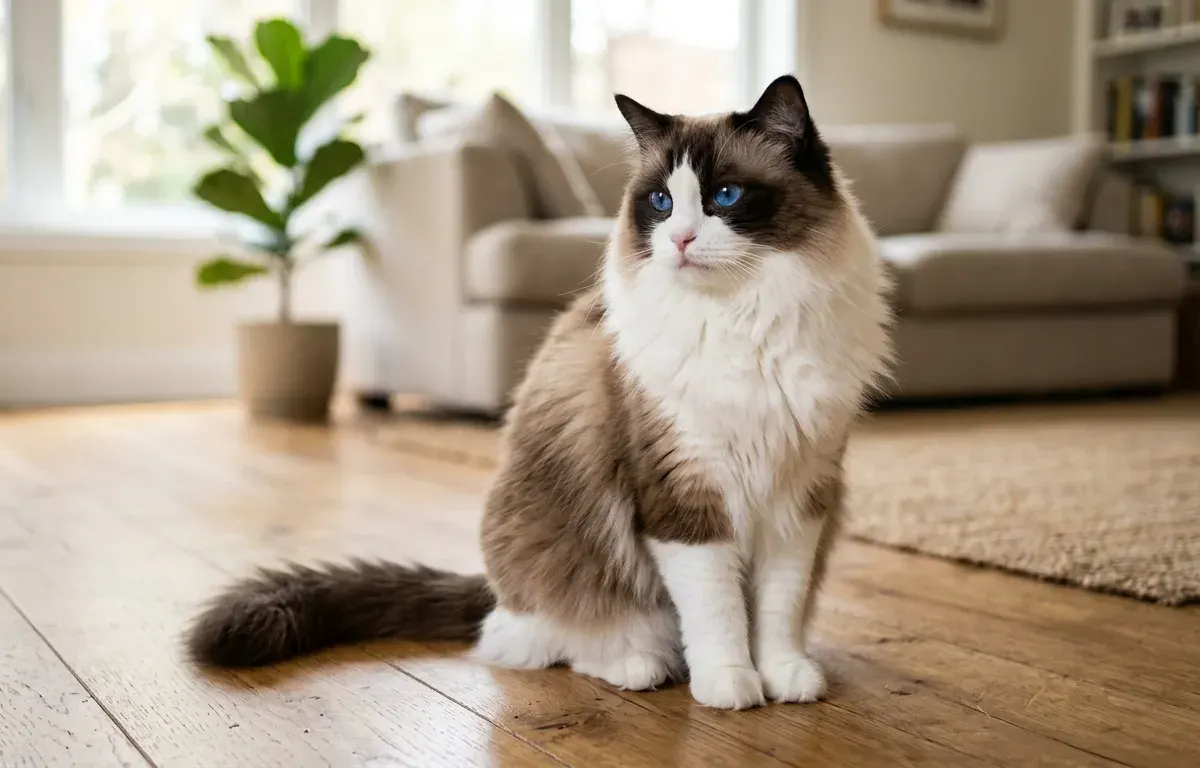
Learning how to identify a Ragdoll cat requires evaluating four key physical traits: large muscular body structure, striking oval blue eyes, a point-colored coat pattern, and a semi-long coat with a silky texture. While characteristic behavioral traits such as relaxing completely when held provide helpful context, official confirmation of a purebred Ragdoll requires pedigree registration papers or genetic testing for the cs/cs colorpoint allele.
- Purebred Ragdoll cats feature large muscular frames, blue oval eyes, and point-colored coats in colorpoint, mitted, bicolor, or van patterns.
- Adult males weigh 12 to 20 pounds (5.4 to 9.1 kg) and females weigh 8 to 15 pounds (3.6 to 6.8 kg), taking 3 to 4 years to reach full size.
- The breed originated in 1960s California from a free-roaming white coat female named Josephine mated with foundation cats carrying Persian, Birman, and Burmese traits.
- Pedigree papers from registries like CFA or TICA and DNA testing remain the only definitive methods to verify purebred status.
Physical Traits That Identify a Ragdoll Cat
Identifying a Ragdoll cat starts with examining distinct physical markers defined by official breed standards. The Cat Fanciers’ Association (CFA) Ragdoll Breed Standard evaluates physical traits across three main categories: head structure, body build, and coat characteristics. A true Ragdoll combines a substantial heavy-boned body with soft facial contours and a medium-long coat that resists matting.
| Physical Feature | Male Ragdoll Benchmark | Female Ragdoll Benchmark |
|---|---|---|
| Adult Body Weight | 12.0 to 20.0 lbs (5.4 to 9.1 kg) | 8.0 to 15.0 lbs (3.6 to 6.8 kg) |
| Physical Maturation Period | 3 to 4 years for full muscle and coat development | 3 to 4 years for full muscle and coat development |
| Eye Color & Shape | Deep blue, large oval shape | Deep blue, large oval shape |
| Coat Length & Texture | Semi-long, plush, dense with minimal undercoat | Semi-long, plush, dense with minimal undercoat |
Ragdoll kittens are born completely white. Their distinctive color points begin appearing around 10 to 14 days of age and continue darkening until the cat reaches full physical maturity between 3 and 4 years of age.
Eye Color and Coat Pattern
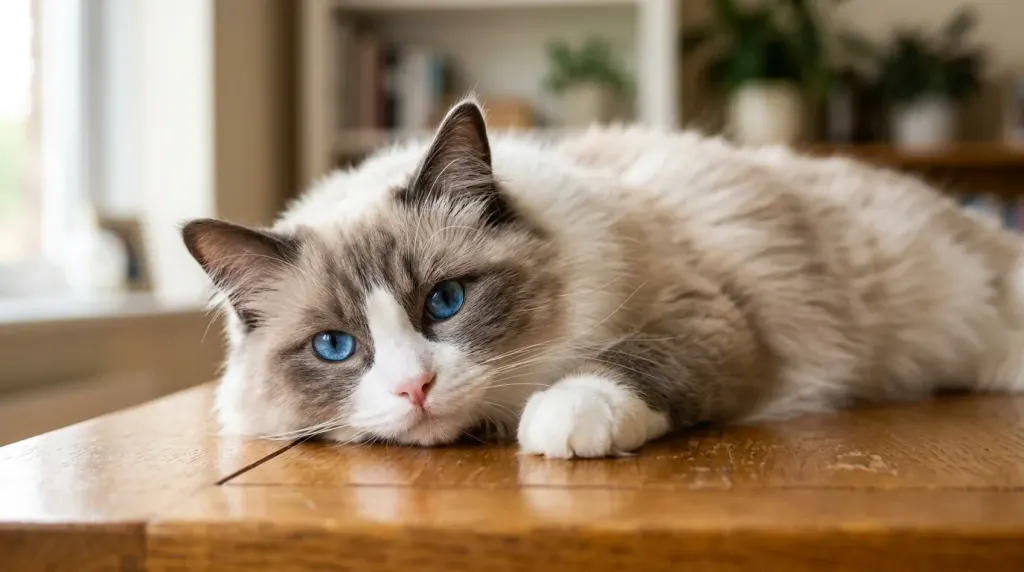
Eye color is one of the most critical identification markers for traditional Ragdolls. According to official breed guidelines, purebred Ragdolls in traditional colorations always possess blue eyes. The shade ranges from light sky blue to deep sapphire blue, with darker shades preferred in show standards. If you are researching whether all Ragdoll cats have blue eyes, non-blue eyes indicate either a mixed breed or a non-traditional mink variation.
Ragdoll coats fall into four primary pattern categories:
- Colorpoint: Classic point coloration where ears, mask, paws, and tail are distinctly darker than the body, with no white markings present.
- Mitted: Dark points on ears, mask, and tail, complemented by white “mittens” on front paws, white boots on hind legs, a white chin, and a white belly stripe.
- Bicolor: Marked by an inverted white “V” shape on the face, pink nose leather, white legs, white chest, and a lighter body coat with dark points on ears and tail.
- Van: Color points restricted primarily to the ears, tail, and top of the head, with the remainder of the body being solid white.
Beyond traditional point patterns, enthusiasts also encounter the mink Ragdoll coat variation, which features a richer body color, aquamarine eyes, and a softer coat texture.
Size and Body Shape
Ragdolls rank among the largest domesticated cat breeds. Their bodies are broad-chested, long, and heavy-boned, giving them a sturdy, rectangular appearance. The neck is short and muscular, leading to a broad head with broad cheekbones and a gently rounded muzzle.
On the lower body, adult Ragdolls often display a soft fat pad on the abdomen, which is a natural breed trait rather than a sign of overweight condition. Long fur on the hind legs forms characteristic “knickerbockers” or britches. Understanding full adult Ragdoll size benchmarks helps owners distinguish adolescent Ragdolls from smaller domestic short-hair or long-hair mixes. Physical appearance alone can be misleading in young cats. Because coat color deepens over several years and full body weight develops slowly, identification should evaluate body proportion and bone weight alongside coat pattern.
Personality Traits of a True Ragdoll
While physical traits form the foundation of breed recognition, behavior provides strong supporting evidence. Ragdolls are famous for their docile, affectionate temperament. They are often described as “puppy-like” because they follow family members from room to room, greet owners at the door, and enjoy interactive play.
Families evaluating whether Ragdoll cats are friendly will find that true Ragdolls rarely display aggressive tendencies. They prefer staying low to the ground rather than perching on high shelves, and they adapt easily to peaceful household routines. Owners considering taking care of a Ragdoll cat quickly learn that their gentle nature makes them indoor-only pets that require a safe, calm environment.
The “Floppy” Reflex Explained
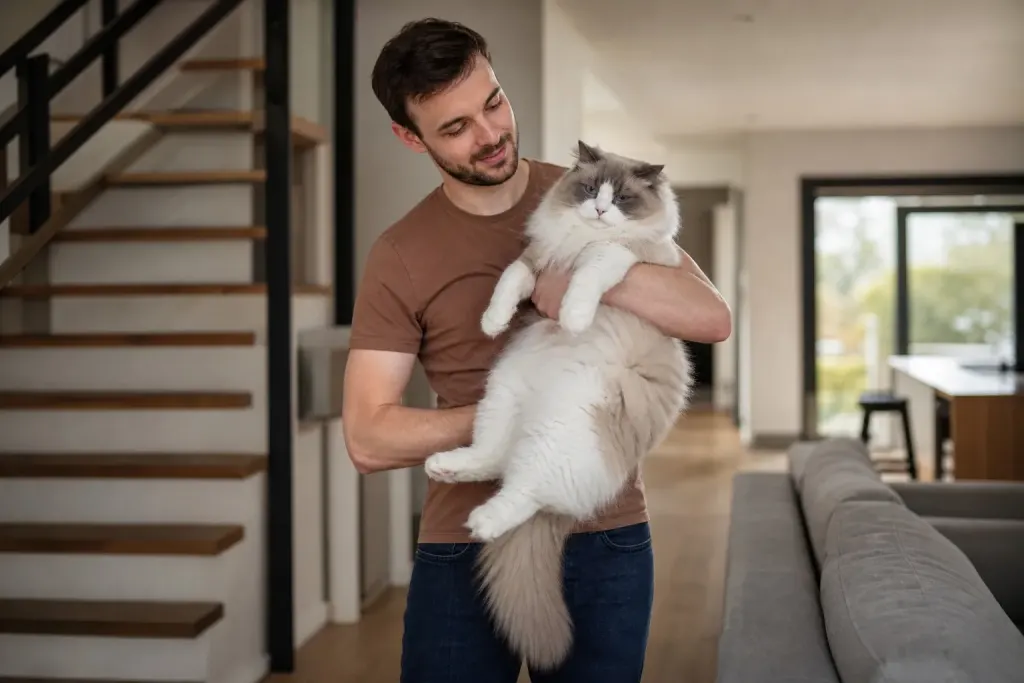
The breed earns its name from a characteristic behavior: many Ragdolls relax their muscles completely when picked up, cradled in a person’s arms like a rag doll. This reflex is a selective behavioral trait cultivated during early breeding programs.
Not every individual Ragdoll displays this reflex to the same degree, and being floppy does not mean the cat is immune to discomfort or injury. Handling a Ragdoll still requires proper support under the chest and hindquarters.
What Breeds Make a Ragdoll Cat (Ancestry)
Understanding what breeds make a Ragdoll cat requires tracing the history of the breed back to Riverside, California, in the early 1960s. Breeder Ann Baker created the foundation stock using a free-roaming white long-haired female named Josephine.
The founding cats involved in early matings included:
- Josephine: A white non-pedigreed female carrying Persian and Angora physical characteristics.
- Daddy Warbucks: A male cat with mitted point markings that sired early foundation litters.
- Buckwheat and Fugianna: Daughters of Josephine that established the dark-pointed and light-pointed bloodlines.
Readers exploring where Ragdoll cats originate from can trace every registered Ragdoll back to these original California litters.
Why the Exact Ancestry Is Still Debated
Because Josephine and the initial male foundation cats were non-pedigreed domestic cats, the precise genetic contribution of established purebreds remains debated. Historical notes indicate that foundation stock carried traits reminiscent of Persian, Birman, and Burmese breeds.
Modern genetic mapping confirms that Ragdolls share point-coloration gene mutations with Siamese and Persian lines, even though the historic origin relied on selective breeding rather than crossing established pedigreed lines directly.
What Officially Makes a Cat a Ragdoll (Breed Standard)
What makes a Ragdoll cat in an official capacity comes down to strict genetic and registration standards set by cat registries. According to feline registry guidelines, a cat is officially recognized as a Ragdoll only if it possesses documented pedigree ancestry tracing back through recognized registration books.
Genetically, traditional point-colored Ragdolls are homozygous for the recessive cs allele at the coat color locus. This temperature-sensitive gene mutation restricts pigment production to cooler areas of the body, creating dark points on the extremities.
Beyond color points, registry standards monitor breed health. Genetic testing for hypertrophic cardiomyopathy (MYBPC3 gene mutation) is widely used by reputable breeders. According to published veterinary research available via NCBI PMC, DNA screening helps maintain line health. Owners concerned about Ragdoll cat health problems should verify that breeding parents have undergone genetic health screening.
Note: A cat that physically resembles a Ragdoll but lacks pedigree documentation is officially classified as a domestic long-hair mix, regardless of visual similarity.
Ragdoll vs. Look-Alike Breeds
Several long-haired point-colored cat breeds look similar to Ragdolls. Distinguishing a Ragdoll from these look-alike breeds relies on key physical differences, particularly in adult size and coat coloration. Reviewing how big Ragdoll cats get shows their substantial frame compared to medium-sized look-alike breeds.
| Comparison Feature | Ragdoll | Sacred Birman | Himalayan (Persian Point) |
|---|---|---|---|
| Body Size | Large to extra-large (12-20+ lbs) | Medium (7-12 lbs) | Medium (7-12 lbs) |
| Facial Profile | Gently sloping profile, broad head | Roman nose profile, rounded head | Flat (brachycephalic) face |
| White Markings | Allowed in Mitted, Bicolor, Van | Mandatory white gloves on all 4 paws | No white markings allowed |
| Eye Shape | Large oval blue eyes | Round blue eyes | Round deep blue eyes |
When evaluating color variations, owners often ask can Ragdoll cats be black. Under traditional CFA standards, solid black coats are not permitted, as points must remain darker than the body coat.
How to Confirm a Purebred Ragdoll
When visual observations and temperament traits are not enough, confirming a purebred Ragdoll requires administrative and genetic proof:
- Pedigree Registration Papers: Authentic certificates from recognized registries such as the Cat Fanciers’ Association (CFA), The International Cat Association (TICA), or FIFe prove four generations of registered Ragdoll ancestry.
- Genetic DNA Testing: Commercial feline DNA tests can confirm the presence of the cs/cs point gene allele and screen for breed-specific genetic markers.
Understanding pedigree verification also helps buyers evaluate how much Ragdoll cats cost, as purebred cats with verified registration papers command higher prices than unregistered domestic long-hair mixes.
Frequently Asked Questions about How to Identify a Ragdoll Cat
Can a Ragdoll cat have green or yellow eyes?
No. Traditional purebred Ragdolls recognized by major registries like CFA always have blue eyes. Non-traditional mink or sepia Ragdolls may display aquamarine or greenish-blue eyes, but yellow or green eyes indicate a mixed-breed domestic cat.
Are all colorpoint cats Ragdolls?
No. Point coloration occurs in many breeds, including Siamese, Birman, Himalayan, and domestic short-hair or long-hair mixed cats. Color points alone do not make a cat a Ragdoll.
How big does a Ragdoll cat get compared to normal cats?
A typical domestic cat weighs 8 to 10 pounds. Male Ragdolls routinely reach 15 to 20 pounds or more, and females reach 10 to 15 pounds, making them noticeably larger and heavier-boned than average house cats.
At what age do Ragdoll cats get their full color and size?
Ragdolls develop slowly compared to other breeds. Their coat color darkens over 2 to 3 years, and their full muscular size and weight require 3 to 4 years to complete.
Leave a Reply