

Table of Contents
In 2026, how much is a White German Shepherd puppy ranges from $1,000 to $2,500 from a reputable breeder, while adoption fees through specialized breed rescues cost between $250 and $600. Beyond the initial purchase price, first-year setup expenses average $3,500 to $6,500 to cover veterinary care, training, durable supplies, and premium nutrition. Ongoing annual maintenance averages $1,800 to $3,500, bringing the total estimated lifetime cost of owning a White German Shepherd to between $22,000 and $42,000 over a 10 to 12-year lifespan.
- Puppy Price Range: Ethical breeders charge $1,000 to $2,500 for family companions, while pedigreed working lines can reach $3,500 or more.
- Adoption Affordability: Rescue adoption fees ($250 to $600) include spaying or neutering, core vaccinations, microchipping, and initial health exams.
- First-Year Budget: Expect total first-year expenses between $3,500 and $6,500 when factoring in gear, medical care, obedience classes, and high-protein food.
- Lifetime Commitment: Total lifetime expenditures range from $22,000 to $42,000 across a 10 to 12-year lifespan.
- AKC Standpoint: The American Kennel Club registers White German Shepherds as purebreds, but the white coat is a disqualification in conformation show rings.
- Health Testing Value: Sourcing puppies backed by OFA hip and elbow clearances prevents thousands of dollars in future corrective orthopedic surgeries.
How Much Is a White German Shepherd? 2026 Price Breakdown
In 2026, a White German Shepherd costs between $1,000 and $2,500 from a reputable breeder, compared to $250 to $600 from a specialized rescue organization.

The purchase price of a White German Shepherd reflects the breeder’s financial and professional investment in genetic screening, parental health clearances, early puppy socialization, and structured veterinary care. Puppies bred specifically for family companionship with limited registration fall into the $1,000 to $2,000 range. Top working bloodlines, show prospects with full registration, or puppies from imported European lineages often command between $2,500 and $4,000. Conversely, backyard breeders frequently advertise puppies for $500 to $900, but these lower upfront prices routinely mask a lack of parental health testing and increased long-term medical risks.
| Category Tier | Typical Price Range (USD) | What Is Included in the Price | Primary Risk / Consideration |
|---|---|---|---|
| Specialized Breed Rescue | $250 – $600 | Spay/neuter surgery, core vaccinations, microchip, heartworm check | Unknown genetic history; variable background |
| Unscreened Backyard Breeder | $500 – $900 | Basic deworming; sometimes first puppy shot | High risk of inherited hip dysplasia and genetic disorders |
| Ethical Breeder (Pet Quality) | $1,000 – $2,500 | OFA hip/elbow clearances, genetic health guarantee, microchip, early socialization | Limited registration (non-breeding contract) |
| Working / Foundation Line | $2,500 – $4,000+ | Full registration, titled working pedigree, complete health panels, breeding rights | Requires experienced handling and intensive daily activity |
Ethical breeders invest heavily in their litters before puppies go home at eight weeks of age. A legitimate breeder provides written proof of parental health clearances from the Orthopedic Foundation for Animals (OFA), initial core vaccinations, routine deworming records, microchip registration, and a binding genetic health guarantee covering at least two years. Prospective pet owners comparing canine acquisition budgets across popular purebreds often note that Pug puppy purchase prices and French Bulldog puppy pricing reflect distinct supply constraints and surgical breeding requirements, whereas German Shepherd pricing centers heavily on working lineage, physical size, and genetic orthopedic testing.
White German Shepherd Cost Breakdown: First-Year vs. Lifetime Expenses
The total cost to own a White German Shepherd ranges from $3,500 to $6,500 in the first year, leading into an estimated lifetime expenditure of $22,000 to $42,000 over a 10 to 12-year lifespan.
Bringing home a large-breed puppy involves significant upfront outlays for durable equipment, preventive healthcare, and developmental supplies. During the first twelve months, initial veterinary visits for booster vaccines, microchipping, rabies inoculation, and spay or neuter surgery represent a major financial commitment. In addition, large working dogs require heavy-duty gear that withstands rapid growth and strong chewing habits.
| First-Year Expense Category | Low-End Estimate | Average Budget | Premium Budget |
|---|---|---|---|
| Puppy Purchase or Adoption Fee | $250 (Rescue) | $1,500 (Ethical Breeder) | $2,800 (Champion Line) |
| Initial Vet Care & Vaccinations (DHPP, Rabies) | $250 | $400 | $650 |
| Spay or Neuter Procedure | $250 | $450 | $750 |
| Heavy-Duty Crate & Orthopedic Bedding | $120 | $220 | $350 |
| Puppy Food & Training Treats (12 Months) | $550 | $750 | $1,050 |
| Professional Puppy Obedience Classes | $150 | $300 | $600 |
| Essential Gear (Leashes, Harness, Bowls, Grooming Tools) | $100 | $180 | $300 |
| Microchip & Local County Pet Licensing | $40 | $70 | $120 |
| Pet Health Insurance Premiums (First Year) | $480 | $720 | $1,080 |
| Total First-Year Financial Investment | $2,190 | $4,590 | $7,700 |
Young large-breed puppies undergo rapid musculoskeletal growth and require up to 18 to 20 hours of rest per day. Understanding puppy daily sleep requirements helps owners structure crate rest schedules and invest in appropriately sized orthopedic bedding that supports joint development as the dog grows. Enrolling in structured puppy classes between 10 and 16 weeks of age is critical for large, energetic breeds; applying core methods from foundation puppy obedience training establishes solid leash manners, impulse control, and polite greeting habits before the dog reaches its full 65 to 90-pound adult size.
Over an average lifespan of 10 to 12 years, recurring expenditures stabilize after year one. Annual budgets average between $1,800 and $3,500, encompassing quality food, regular veterinary examinations, flea and tick preventatives, dental cleanings, and insurance premiums. According to cost modeling from Spot Pet Insurance, cumulative lifetime ownership expenses reach between $22,000 and $42,000.
Adoption Costs vs. Buying from a Breeder
Adopting an adult White German Shepherd or puppy through a breed rescue costs $250 to $600, offering substantial upfront savings over breeder purchases.
Adopting from a dedicated German Shepherd rescue or local animal shelter is a financially responsible path that provides a second chance to a dog in need. Adoption fees generally cover essential veterinary treatments that would otherwise cost $500 to $900 out of pocket. Rescue organizations routinely complete spay or neuter surgeries, administer core DHPP and rabies vaccinations, perform heartworm testing, initiate parasite prevention, and implant a microchip before placing the dog in a home.
| Ownership Factor | Adopting from a Breed Rescue | Purchasing from an Ethical Breeder |
|---|---|---|
| Upfront Financial Cost | $250 to $600 total adoption fee | $1,000 to $2,500+ purchase price |
| Included Medical Treatments | Spay/neuter, vaccinations, microchip, heartworm test included | First vaccinations, deworming, and microchip included |
| Pedigree & Lineage Records | Usually unknown or limited documentation | Documented multi-generation pedigree |
| Orthopedic Certifications | Rare; based on physical shelter exams | Official OFA/PennHIP parental hip and elbow scores |
| Age and Energy Level | Adult dogs, adolescents, and occasional puppies | 8-week-old puppies ready for early training |
| Behavioral Evaluation | Temperament evaluated in foster homes | Predictable working drive and temperament baseline |
When adopting an adult dog, prospective owners must evaluate the long-term healthcare horizon for larger breeds, which contrasts with smaller companion canines where reviewing the average French Bulldog lifespan and senior costs or Pug life expectancy trends reveals different chronic disease patterns and veterinary expense curves over a 10 to 14-year period. Potential adopters should prepare for an application process that often includes veterinary references, a phone interview, and a home check to ensure a safe, secure yard.
Breeder Price Factors: Pedigree, Registration, and the “Rare” Upcharge Myth
Breeder pricing is driven by parental bloodlines, health certifications, and registration status, though buyers should beware of inflated prices claiming the white coat is an ultra-rare trait.
The white coat in German Shepherds is produced by a simple recessive masking gene (the e allele at the MC1R locus). Both parents must carry this gene to produce white offspring. When both parents are white, 100 percent of the puppies will be white. Despite claims by some unverified sellers, the white color is not a genetic deformity, an albino condition, or a separate rare species.
Registration status and breed standards play a distinct role in pricing:
- American Kennel Club (AKC): White German Shepherds can be fully registered as purebred German Shepherd Dogs if both parents are registered. However, under the official American Kennel Club German Shepherd breed standard maintained by the German Shepherd Dog Club of America, the white coat color is classified as a disqualifying fault in conformation show rings. These dogs remain completely eligible to compete in AKC companion and performance events, including obedience, agility, tracking, and rally.
- United Kennel Club (UKC): The United Kennel Club White Shepherd standard has recognized the White Shepherd as a distinct standalone breed since 1999, allowing them to compete in all UKC conformation and performance rings.
- Fédération Cynologique Internationale (FCI): In Europe and internationally, the breed was developed into the Berger Blanc Suisse (White Swiss Shepherd Dog), recognized by the FCI as an independent breed.
Backyard breeders often market White German Shepherds as rare luxury dogs to justify asking $3,000 or more without conducting parental joint clearances. Authentic value rests in verifiable OFA health screenings and stable working temperaments, never in coat color alone.
While smaller brachycephalic companion dogs focus heavily on indoor lifestyle adaptation as seen in French Bulldog companion training and comprehensive French Bulldog care standards, German Shepherds are working animals whose drive, physical size, and intelligence require dedicated daily mental stimulation alongside structured obedience work. When evaluating a litter, buyers should look for transparent pricing that reflects health testing investments rather than speculative color markups. Legitimate breeders charge comparable rates for solid white coats as they do for standard black-and-tan, sable, or solid black puppies.
Ongoing Annual Maintenance Costs: Nutrition, Vet Care, and Insurance
According to breed budgeting benchmarks from Embrace Pet Insurance, maintaining an adult German Shepherd requires an annual budget of $1,800 to $3,500, with high-protein food and pet insurance forming the largest recurring expenses.
An adult White German Shepherd weighs between 50 and 90 pounds and possesses an active working metabolism. Sustaining this size and energy level demands a nutrient-dense diet rich in quality animal proteins and balanced fats. High-grade large-breed commercial kibble costs between $65 and $100 per 30-pound bag, with an active adult consuming roughly 40 to 55 pounds of food monthly. This equates to an annual feeding cost of $800 to $1,300.
| Expense Category | Budget-Conscious | Moderate Care | Comprehensive Care |
|---|---|---|---|
| Large-Breed Nutrition & Quality Treats | $750 | $1,050 | $1,400 |
| Routine Vet Exams & Annual Booster Vaccines | $200 | $350 | $550 |
| Flea, Tick & Heartworm Preventatives | $180 | $260 | $360 |
| Pet Health Insurance (Accident & Illness) | $540 | $780 | $1,140 |
| Grooming Equipment & Deshedding Tools | $60 | $120 | $220 |
| Toys, Chews, Bedding Replacement & Gear | $100 | $200 | $350 |
| Total Annual Maintenance Cost | $1,830 | $2,760 | $4,020 |
Feeding a 65 to 90-pound working shepherd requires substantial monthly food volumes, quite distinct from toy breeds where calculating calibrated Pug daily food portions focuses on preventing obesity on low caloric intakes. Routine preventative healthcare is critical for longevity. Annual veterinary wellness exams, fecal tests, blood panels, and heartworm screenings range from $200 to $450 annually. Year-round broad-spectrum parasitic preventatives add $180 to $360 each year.
The White German Shepherd has a dense, weather-resistant double coat that sheds year-round and experiences heavier shedding during seasonal coat transitions depending on climate and coat density. Grooming a double-coated White German Shepherd involves weekly line-brushing and seasonal deshedding rather than frequent baths. While single-coated breeds adhere to a routine French Bulldog bathing frequency every few weeks, washing a German Shepherd too often strips natural protective oils from the coat.
Original Analysis: The True Cost of Health Testing vs. “Bargain” Backyard Puppies
Buying an untested $600 puppy frequently results in $5,000 to $10,000 in orthopedic surgery costs, making an ethically bred $1,800 puppy far more economical over its lifetime.
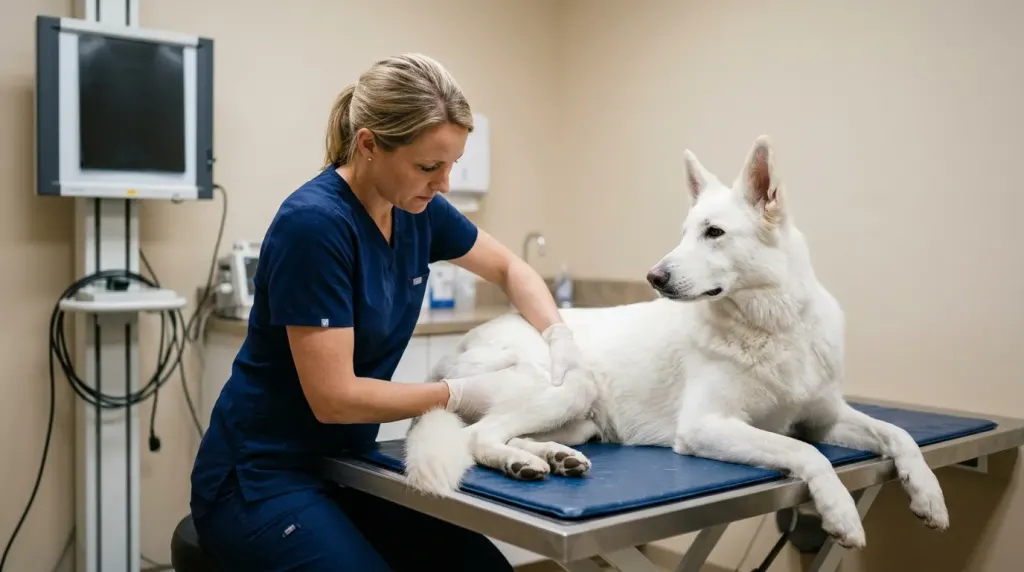
Large working breeds carry genetic predispositions to specific orthopedic and degenerative disorders. Ethical breeders eliminate these risks by screening prospective breeding stock through standardized radiographic evaluations and DNA testing. Backyard breeders, by contrast, routinely bypass these tests to maximize profit margins, passing the financial liability directly to the buyer.
| Condition Name | Diagnostic & Surgical Treatment Costs | Prevention Through Ethical Breeding |
|---|---|---|
| Canine Hip Dysplasia (CHD) | $3,500 to $7,000 per hip for Total Hip Replacement | Both parents OFA certified “Good” or “Excellent” |
| Elbow Dysplasia (ED) | $2,000 to $4,000 per joint for Arthroscopy | Both parents certified OFA “Normal” elbows |
| Degenerative Myelopathy (DM) | $1,500 to $3,500 for physical therapy and mobility equipment | DNA testing of parents; breeding only Clear pairs |
| Gastric Dilatation-Volvulus (Bloat) | $3,000 to $6,000 for emergency gastropexy and surgical repair | Selecting lines with moderate chest depth; preventive gastropexy |
Total hip replacement surgery for severe hip dysplasia costs between $5,000 and $7,000 per hip in veterinary surgical centers across the United States. If an unscreened puppy develops bilateral dysplasia, the surgical and rehabilitative costs can exceed $12,000 within the first three years of life.
| Lifetime Expense Model | Health-Tested Puppy ($1,800 Purchase) | Bargain Untested Puppy ($600 Purchase) |
|---|---|---|
| Initial Puppy Acquisition Cost | $1,800 | $600 |
| First-Year Routine Medical & Setup | $2,500 | $2,500 |
| Routine Care Across Years 2 to 10 | $18,000 ($2,000 per year) | $18,000 ($2,000 per year) |
| Orthopedic Surgery & Chronic Care | $0 (Genetic Screening Protection) | $8,500 (Hip Replacement & Therapy) |
| Total Estimated 10-Year Ownership Cost | $22,300 | $29,600 |
Note: Always ask breeders for the registered kennel names and OFA certificate numbers of both parent dogs. You can verify orthopedic health clearances directly on the public Orthopedic Foundation for Animals database at ofa.org.
To protect yourself financially, verify four essential clearances before transferring a deposit:
- OFA or PennHIP Hip Clearance: Confirmation that both sire and dam have certified hips graded Fair, Good, or Excellent (or an equivalent PennHIP distraction index).
- OFA Elbow Clearance: Documentation of normal elbow conformation free of dysplasia.
- Degenerative Myelopathy (DM) DNA Status: Proof that at least one parent is genetically Clear (N/N) so no puppy can inherit two mutant alleles.
- Cardiac Evaluation: Certification by a licensed veterinary cardiologist confirming normal heart function.
Because working dogs exert high physical energy during outdoor sessions, handlers must also master basic canine first aid, including recognizing canine heatstroke and overheating signs during summer agility trials. Combining sound genetics with diligent daily observation, similar to established preventive healthcare routines for Pug dogs, ensures acute health risks are caught and treated early before causing permanent damage.
Frequently Asked Questions About White German Shepherd Costs
How much is a White German Shepherd puppy?
A White German Shepherd puppy from a reputable breeder costs between $1,000 and $2,500, with prices depending on parentage, health clearances, and geographical location.
How much does a White German Shepherd cost per year?
The ongoing annual maintenance cost for a White German Shepherd averages $1,800 to $3,500 per year, covering high-quality food, annual veterinary check-ups, flea and heartworm prevention, grooming supplies, and pet insurance.
Are White German Shepherds more expensive than standard German Shepherds?
No, White German Shepherds are generally priced similarly to standard German Shepherds ($1,000 to $2,500), though some unverified breeders artificially inflate prices by falsely claiming the white coat is an exotic rarity.
Are White German Shepherds recognized by the AKC?
Yes, the American Kennel Club registers White German Shepherds as purebred German Shepherd Dogs if both parents are registered, but the white coat is a disqualifying fault in AKC conformation show rings.
Is a White German Shepherd rare?
White German Shepherds are less common than black-and-tan varieties because the white coat is inherited via a recessive gene, but they are not biologically rare or endangered.
What is the difference between a White German Shepherd and a White Swiss Shepherd?
While sharing ancestral roots, the White Swiss Shepherd (Berger Blanc Suisse) is recognized by the FCI as an independent breed developed in Switzerland, whereas the White German Shepherd in the US remains a color variation of the standard German Shepherd Dog or recognized separately by the UKC as the White Shepherd.



Leave a Reply