
Table of Contents
When asking are pugs smart dogs, canine behavioral research shows they possess solid adaptive and social intelligence, even though standardized obedience rankings place them in the fair working category. On Stanley Coren's widely cited canine intelligence scale, pugs rank 57th out of 79 rank groups. This means they learn routines and human emotional cues quickly, but they require patience and positive rewards for formal obedience commands.
- Pugs rank 57th out of 79 breed groups for working obedience, requiring 40 to 80 repetitions for new cues.
- Low obedience scores reflect independent companion breeding rather than a lack of mental capacity.
- Pugs excel at reading human facial expressions, navigating household routines, and solving food puzzles.
- Reward-based training in short five-minute sessions yields the most consistent behavioral results.
What does “smart” mean for dogs?
Evaluating canine intelligence requires looking beyond simple obedience drills or trick memorization. In animal behavior research, canine intelligence is multi-dimensional. It covers working intelligence, instinctive problem-solving, environmental adaptability, and social-communicative skills.
When researchers assess canine cognition, they distinguish between a dog’s innate drive to follow human orders and its ability to solve novel problems independently. Many companion breeds score lower on traditional obedience tests simply because they were never bred to perform repetitive tasks for human handlers. Understanding social traits of friendly pugs highlights how their intellectual energy focuses on human bonding rather than task compliance. Standardized canine intelligence tests measure trainability and compliance rather than general reasoning capacity. A dog that hesitates before following a command may be assessing incentives rather than failing to understand the instruction.
Measures of canine intelligence
Canine cognitive testing protocols evaluate multiple distinct areas of brain function:
- Instinctive Intelligence: Breed-specific abilities developed through historical selective breeding, such as retrieving game, herding livestock, or tracking scents.
- Adaptive Intelligence: Problem-solving ability, spatial awareness, and the capacity to learn from past experiences without direct human guidance.
- Working and Obedience Intelligence: The speed with which a dog learns human commands and the consistency with which it complies under varying distractions.
Studies documented in The Intelligence of Dogs by Stanley Coren, Ph.D., focus primarily on working and obedience metrics. These evaluations reflect human utility criteria rather than raw animal intellect. Pugs show notable cognitive shifts across life stages, particularly when pugs become senior dogs and experience changes in working memory and sensory processing.
What pugs excel at
Pugs demonstrate distinct strengths in social cognition and household problem-solving. In everyday home environments, pugs show exceptional memory for daily schedules, feeding times, and the spatial layout of living spaces. They track human movement patterns and quickly learn which behaviors secure food rewards, attention, or comfortable resting spots.
Are Pugs Intelligent? Breed-specific insights
Formal evaluations classify pugs as possessing fair working and obedience intelligence. In Stanley Coren’s research surveying nearly 200 obedience judges, pugs occupy the 57th position among 79 rank groups, which encompass 131 recognized breeds.
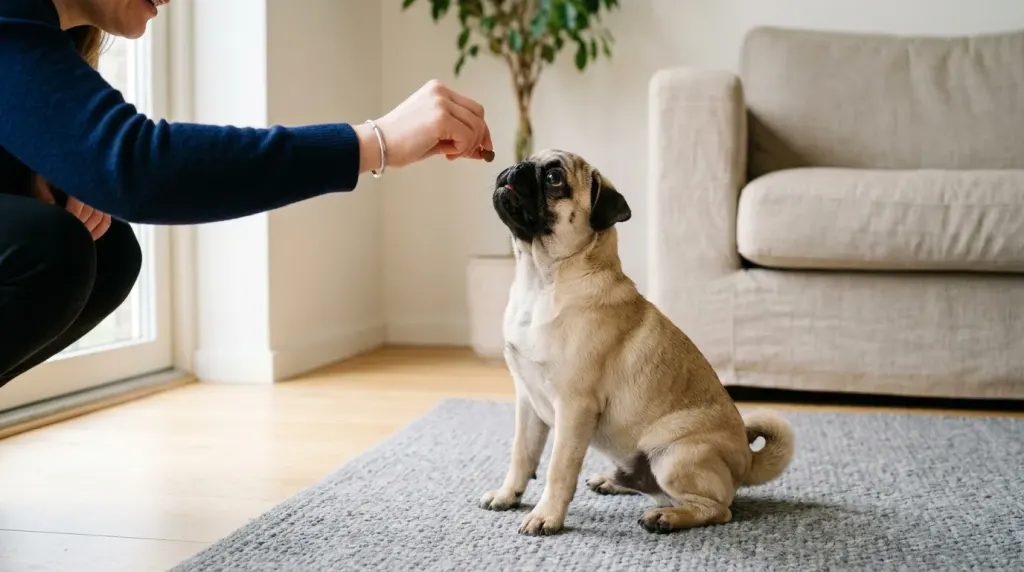
This ranking places the breed in Tier 5. Dogs in this group generally require 40 to 80 practice repetitions to grasp an unfamiliar command. Furthermore, they follow a known command on the first attempt approximately 30 percent of the time. While this performance lags behind high-drive working breeds, it aligns closely with other toy and companion dogs. For example, evaluating whether French Bulldogs are smart reveals a similar profile, as French Bulldogs sit at rank 58 right next to pugs.
| Breed | Rank Group | Intelligence Tier | Repetitions for New Cue | First-Command Compliance |
|---|---|---|---|---|
| Border Collie | 1 | Tier 1 (Brightest) | Under 5 | 95% or higher |
| Golden Retriever | 4 | Tier 1 (Brightest) | Under 5 | 95% or higher |
| Pug | 57 | Tier 5 (Fair Working) | 40 to 80 | ~30% |
| French Bulldog | 58 | Tier 5 (Fair Working) | 40 to 80 | ~30% |
| Chihuahua | 67 | Tier 5 (Fair Working) | 40 to 80 | ~30% |
| Afghan Hound | 79 | Tier 6 (Lowest Working) | 80 to 100+ | 25% or lower |
The primary reason for this ranking is rooted in breed history. According to the AKC Pug breed standard, pugs originated in ancient China as palace companions for royalty. Because their historical role focused on affection, calm presence, and lap companionship rather than herding sheep or retrieving waterfowl, they never developed an innate drive for repetitive work. Exploring quintessential pug lap dog history confirms that their breeding favored human connection over mechanical obedience.
As Dr. Stanley Coren noted regarding companion breeds, dogs with low working obedience often show high adaptive intelligence, choosing to act only when an activity offers clear value to them.
How pugs compare to other dogs
Comparing pugs with working breeds highlights differences in motivation rather than raw brain power. High-drive working dogs, like Border Collies and German Shepherds, possess an intrinsic desire to execute tasks. In contrast, pugs demonstrate cost-benefit decision-making. If a requested behavior does not provide an immediate reward, a pug often chooses to ignore the handler.
When evaluating how smart are pugs compared to other dogs, companion breeds frequently match working breeds in reading human gaze and gestures. However, companion dogs lag in multi-step mechanical problem-solving tasks, such as navigating complex obstacle courses or manipulating mechanical latches.
Why structure matters: training style and environment
Environmental setup and handler consistency directly shape how effectively a pug learns. Pugs thrive in predictable environments with clear daily routines. When training sessions are chaotic or inconsistent, pugs may appear confused or obstinate. Providing structured feeding, walking, and play schedules creates the mental stability pugs need to process new cues reliably.
Practical implications for pug ownership
Living with a pug means recognizing that their trainability depends heavily on motivation and positive reinforcement. Because pugs are deeply food-oriented and sensitive to human emotional tone, standard repetitive drill training often produces frustration rather than compliance. Integrating mental stimulation into routine daily pug care keeps their minds active while supporting general wellbeing.
Important Note: Pugs are a brachycephalic breed with shortened airways. Training sessions must never involve excessive physical exertion in warm weather, as heat stress limits oxygen delivery and impairs cognitive focus.
Training techniques that fit pugs
Training a pug successfully requires methods tailored to their specific learning style:
- High-Value Food Rewards: Use small, healthy treats like lean chicken or low-calorie training bites. Pugs respond best when compliance yields a direct, appetizing payoff.
- Micro-Sessions: Keep training blocks between three and five minutes. Short sessions prevent boredom and maintain high engagement.
- Positive Tone and Praise: Pugs are emotionally sensitive. Enthusiastic verbal affirmation reinforces confidence and prevents the dog from disengaging.
- Lure-and-Reward Shaping: Guide the pug into the desired posture using a treat close to the nose, marking the exact moment of success with a clicker or verbal marker.
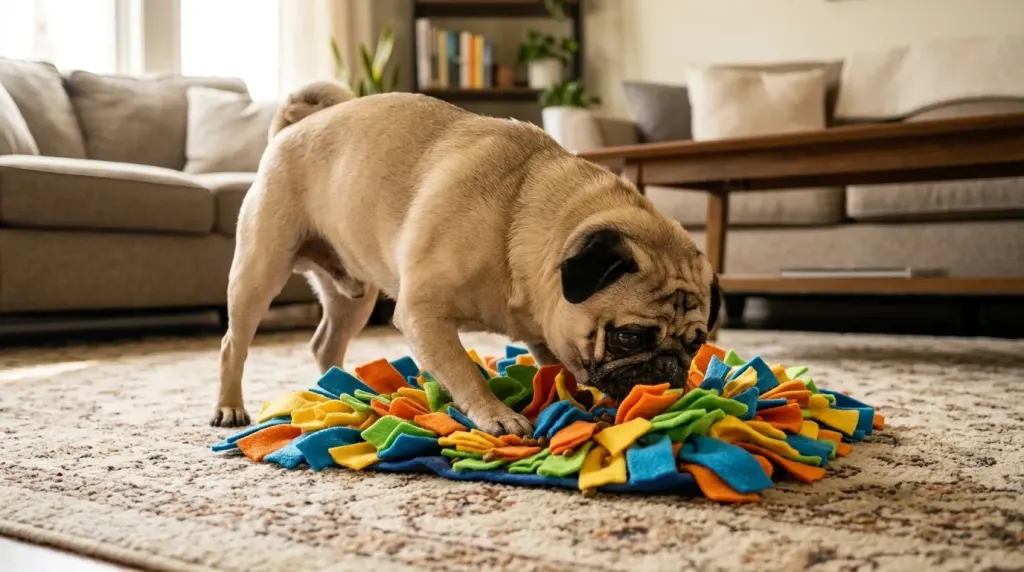
- Puzzle Toys for Mental Work: Provide interactive food puzzles and snuffle mats to satisfy their problem-solving instincts without causing physical strain.
Balancing mental enrichment with exercise management for active pugs helps prevent boredom-driven behaviors like excessive chewing or nuisance barking.
Common training pitfalls and fixes
- Repeating Commands Continuously: Saying “sit” five times teaches the dog that the first four cues can be ignored. Say the cue once, wait three seconds, and use a treat lure if the dog does not respond.
- Harsh Corrections: Raising your voice or using physical corrections causes a pug to shut down emotionally, halting the learning process. Keep interactions encouraging and calm.
- Long, Monotonous Repetitions: Practicing the same command ten times in a row leads to disinterest. Mix different cues, like alternating between sit, touch, and down, within the same two-minute window.
Myths vs. reality: Are Pugs Dumb or Clever?
A common stereotype portrays pugs as clumsy, comical, or dim-witted animals. This reputation arises from their goofy expressions, stubborn moments, and low working obedience scores. However, equating low compliance with low intelligence misinterprets how companion canines think.
In reality, pugs display clever manipulative abilities within the household. They frequently learn which vocalizations, head tilts, and facial gestures prompt family members to offer food, open doors, or grant lap space. Evaluating how pugs behave as family dogs illustrates how effectively they integrate into domestic routines and read social dynamics.
When considering broader questions about assessing if pugs make good dogs, their balanced temperament and practical social intelligence make them exceptionally well suited for home life, even if they never compete in advanced agility trials.
Social intelligence in Pugs
Canine cognitive researchers emphasize that social intelligence represents a major dimension of animal intellect. Pugs excel in this area through several observable behaviors:
- Facial Expression Sensitivity: Pugs actively monitor human facial changes and adjust their approach based on whether a person looks cheerful, stressed, or neutral.
- Gaze Following: Pugs readily follow human pointing gestures and eye direction to locate hidden treats or toys.
- Empathetic Responding: When owners show signs of distress, pugs often approach calmly, offering physical contact and quiet companionship.
When to seek professional training help
While most basic training can be completed at home, consulting a certified positive-reinforcement dog trainer is recommended if a pug displays intense stubbornness during house-training, develops separation anxiety, or guards resources like food bowls. Professional trainers can identify hidden stressors and adjust the learning environment to match the dog’s cognitive profile.
Frequently asked questions about pug intelligence
Are pugs considered smart dogs by professional trainers?
Professional trainers generally view pugs as moderately intelligent dogs with strong social awareness but lower working compliance. They recognize that pugs learn practical household rules easily when positive, reward-based methods are used, even if they require more repetitions than traditional working breeds.
How smart are pugs compared to other dogs like French Bulldogs?
Pugs and French Bulldogs have nearly identical working intelligence scores on Stanley Coren’s scale, ranking 57th and 58th respectively. Both companion breeds show similar learning speeds, strong food motivation, and an independent streak that requires patient, reward-driven handling.
Are pug dogs smart enough for advanced agility or obedience trials?
Pugs can participate in obedience and agility activities, but their physical conformation and lower intrinsic work drive make high-level competitive titles uncommon. Training them for basic agility courses serves primarily as fun mental and physical enrichment rather than serious competition.
Why do some people think pugs are dumb dogs?
People often mistake independent decision-making and a lack of interest in repetitive tasks for low intelligence. When a pug refuses to execute a command without a clear food incentive, it is exhibiting self-directed motivation rather than an inability to comprehend the instruction.
Leave a Reply