
Table of Contents
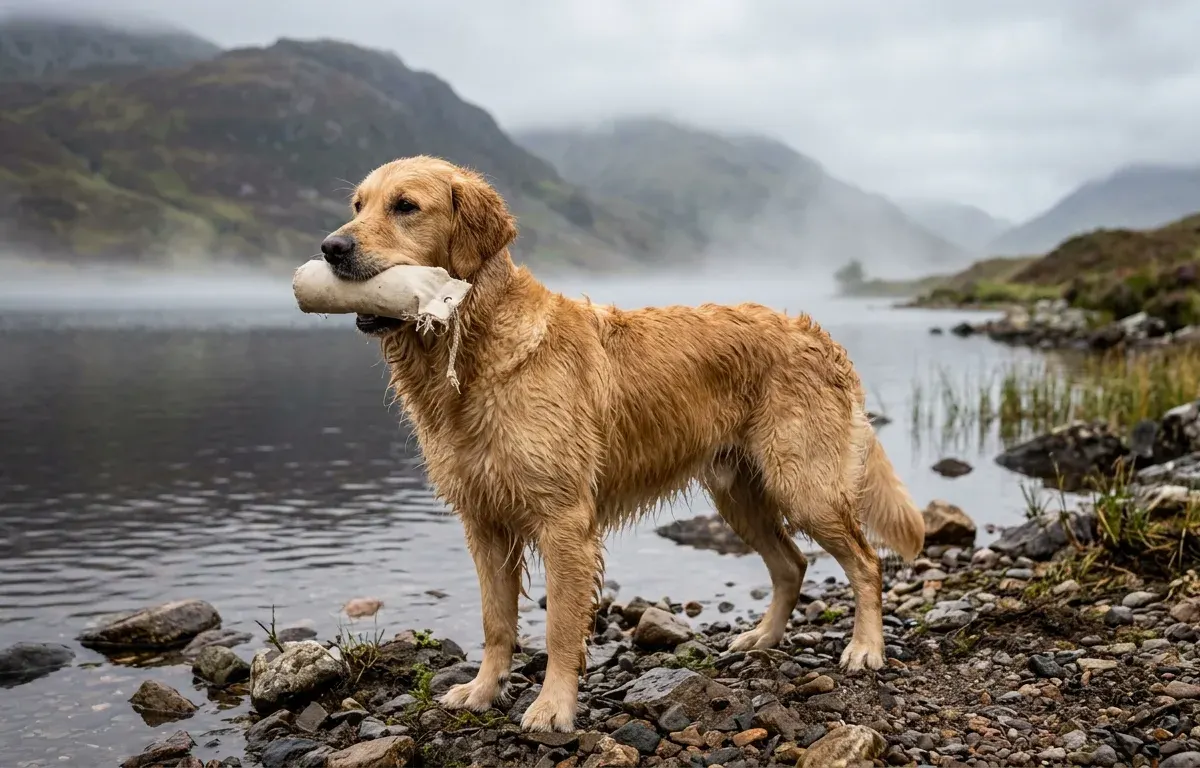
Golden Retrievers were originally bred in 19th-century Scotland as elite gundogs to retrieve shot waterfowl and upland game undamaged from both land and water. When examining what were Golden Retrievers bred for, Lord Tweedmouth developed the breed starting in 1868, selecting for a gentle "soft mouth," high trainability, dense water-repellent coats, and athletic endurance to navigate Scotland's rugged wetlands.
- Developed in 1868 at Guisachan, Scotland by Dudley Marjoribanks (Lord Tweedmouth) crossing a yellow retriever with a Tweed Water Spaniel.
- Engineered specifically to retrieve downed waterfowl and upland game across cold lochs, bogs, and rivers without damaging the quarry.
- Selectively bred with an instinctual "soft mouth" and docile temperament, explaining why the breed is universally famous for kindness.
- Modern Goldens retain these working attributes in search and rescue, service assistance, therapy work, and active family companionship.
The Golden Retriever is celebrated worldwide as a devoted family companion, yet its hallmark traits, from its buoyant swimming ability to its gentle jaw grip, stem directly from 19th-century field sports. Understanding what were golden retrievers bred for reveals how Scottish estate shooting shaped the breed’s physical anatomy, intellectual trainability, and remarkably biddable temperament.
What Were Golden Retrievers Bred for? Original Working Purpose
Golden Retrievers were engineered specifically as gundogs to locate, pick up, and return shot waterfowl (such as ducks and geese) and upland game birds (such as grouse and pheasants) across both land and deep water without causing physical damage to the quarry.
In 19th-century Britain, hunting evolved dramatically with advancements in firearms technology. The development of percussion caps and breech-loading shotguns allowed hunters to down game birds at significantly greater distances. However, existing hunting dogs struggled to locate and retrieve birds that fell across treacherous peat bogs, fast-moving rivers, or expansive Scottish lochs. Land dogs often refused cold water, while traditional water dogs lacked the athletic speed and distance marking required for upland terrain.
Sportsmen needed a versatile retriever capable of marking the flight and fall of shot birds across rugged country, swimming long distances in freezing currents, and delivering game intact to the handler. Per the American Kennel Club (AKC) breed standard, the Golden Retriever was established as a premier sporting gundog combining exceptional scenting power with an innate desire to retrieve.
Unlike companion breeds developed for indoor imperial life, such as what Pug dogs were bred for in ancient China, the Golden Retriever was engineered for rugged outdoor field trials. Similarly, while artisanal trades in 19th-century England and France influenced what French Bulldogs were bred for as small household companions, Scottish sporting estates required powerful, water-ready gundogs.
| Hunting Requirement | Working Challenge | Golden Retriever Adaptation |
|---|---|---|
| Marking Distant Falls | Birds downed 50 to 100+ yards away across broken terrain | Keen visual memory and high focus to track multiple falling birds |
| Cold Water Navigation | Freezing Scottish lochs, tidal marshes, and rocky streams | Dense, oily water-resistant double coat and webbed paws |
| Undamaged Game Delivery | Edible game birds required unpunctured meat and intact plumage | Innate “soft mouth” motor control and gentle jaw grip |
| Heavy Vegetation Cover | Thick heather, brambles, gorse, and dense reeds | Strong muscular frame, deep chest, and protective outer guard coat |
| Handler Synchronization | Long hunting days in blinds alongside multiple hunters and dogs | High biddability, quiet patience, and zero territorial aggression |
Why Were Golden Retrievers Bred in 19th-Century Scotland?
The breed was created in the mid-19th century because existing hunting dogs (setters and pointers) struggled to retrieve downed game from the cold, marshy waters and rugged terrain of the Scottish Highlands during driven bird shoots.
The Scottish Highlands presented one of the most demanding hunting environments in the world. Estate owners in Inverness-shire managed driven shoots across vast expanses of heather, peat bogs, and icy lochs. While pointers and setters were masterful at finding and indicating live game, they were not structurally equipped to retrieve heavy birds from deep water or push through dense gorse for hours.
During the Victorian era, selective breeding gained immense momentum across Great Britain. While toy companion lineages developed through crosses detailing what breeds make a French Bulldog, Scottish sporting estates needed larger, durable gundogs capable of enduring wet moorlands. Managing and housing these large sporting dogs also differed substantially from compact household pets, where selecting the right crate size for a French Bulldog focuses on small indoor spaces rather than outdoor estate kennels.
According to The Kennel Club breed history records, sporting gentlemen sought a specialised retriever that could withstand wet, cold climates while working harmoniously with other dogs. The breed development timeline highlights how systematically the Golden Retriever emerged:
- 1850s-1860s: Growing dissatisfaction among Scottish estate owners with the water endurance of standard Pointers and Setters during driven game shoots.
- 1868: Dudley Marjoribanks mates Nous (a yellow retriever) with Belle (a Tweed Water Spaniel) at Guisachan, producing the foundation litter.
- 1870s-1890s: Strategic outcrosses with Irish Setters, a Bloodhound, and additional water spaniels refine scenting ability and coat color.
- 1908: First public showing of Golden Retrievers at the Crystal Palace under the classification “Retriever (Golden or Yellow).”
- 1913: The Kennel Club (UK) officially registers the Golden Retriever as a distinct breed separate from Flat-Coated Retrievers.
How Golden Retrievers Were Bred: The 1868 Guisachan Crosses
Lord Tweedmouth (Dudley Marjoribanks) established the foundation of the breed at his Guisachan estate in Glen Affric, Scotland in 1868 by crossing a yellow Wavy-Coated Retriever named ‘Nous’ with a Tweed Water Spaniel named ‘Belle’.
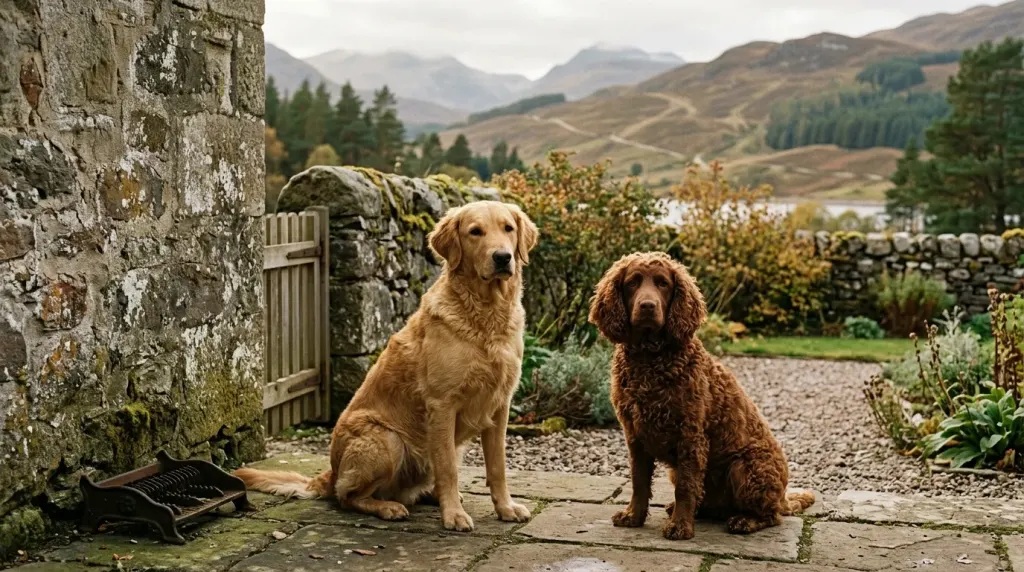
For decades, popular folklore claimed that Golden Retrievers originated from a troupe of Russian circus sheepdogs purchased by Lord Tweedmouth. This myth was disproved in 1952 when the 6th Earl of Ilchester, Tweedmouth’s great-nephew, published the meticulous breeding studbook maintained at Guisachan from 1835 to 1890.
The records confirmed that in 1865, Dudley Marjoribanks purchased “Nous,” the only yellow pup in a litter of black Wavy-Coated Retrievers, from a cobbler in Brighton. In 1868, Marjoribanks mated Nous with “Belle,” a Tweed Water Spaniel given to him by his cousin David Robertson. The Tweed Water Spaniel, now extinct, was a hardy, liver-colored working dog known along the River Tweed for exceptional swimming prowess, intelligent demeanor, and soft-mouthed water retrieval.
Tracing foundation stock through estate records reveals how deliberate crosses produced specialized working canines, much like historical records clarify what dogs make a Pug in Asian breed history. Tweedmouth specifically prioritized cold-hardy working traits similar to how natural northern adaptation shaped the dense weather-resistant coat of a Maine Coon cat in rugged environments.
The foundation litter produced four yellow female puppies: Crocus, Primrose, Cowslip, and Ada. Over the next two decades, Lord Tweedmouth refined the line through selective breeding:
- Nous (Yellow Wavy-Coated Retriever) x Belle (Tweed Water Spaniel): Formed the foundational 1868 cross, contributing water drive, yellow coat genetics, and retrieval instincts.
- Red Setter (Irish Setter) Crosses: Introduced in 1871 to enhance air-scenting drive, upland tracking speed, and rich golden pigment.
- Sandy-Colored Tweed Water Spaniels: Re-infused in 1872 to maintain aquatic stamina, tight foot structure, and water-repellent coat texture.
- Bloodhound Cross: Introduced in 1881 to deepen cold-scenting capability, bone density, and olfactory tracking in heavy marsh cover.
- Black Wavy-Coated and Flat-Coated Retrievers: Used sparingly to reinforce biddability, broad head structure, and jaw strength.
Physical Traits Bred for Hunting and Swimming in Scottish Lochs
Every hallmark physical trait of the Golden Retriever, from its water-resistant double coat to its webbed feet and muscular hindquarters, was engineered to withstand freezing Scottish lochs and heavy briars.
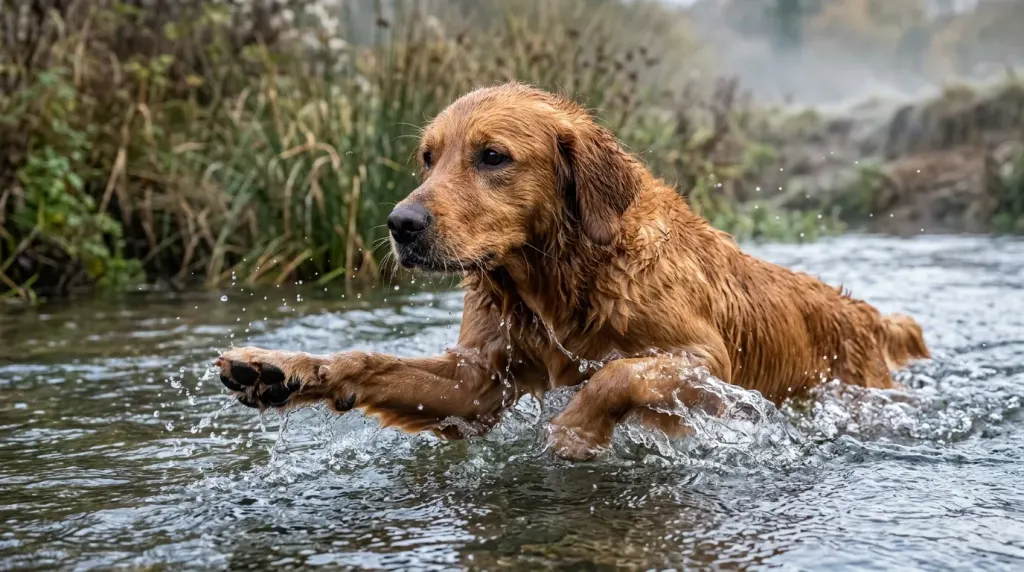
The anatomy of the Golden Retriever serves as a functional blueprint for cold-water work and rugged endurance. The athletic build and aerodynamic skull of the Golden Retriever stand in sharp contrast to brachycephalic companion breeds, where the distinctive physical appearance of a Pug dog reflects selection for indoor domestic aesthetics rather than aquatic endurance. Sustaining an energetic working gundog required dense caloric intake, differing significantly from the careful digestive management of what French Bulldogs can eat to prevent stomach upset and excessive weight gain.
According to the PDSA canine health and breed guide, the breed’s physical characteristics directly support its working heritage:
- Dense Double Coat: The coat consists of a resilient, flat or wavy outer guard coat that sheds water and brambles, over a dense, oily undercoat that traps warm air against the skin to prevent hypothermia in icy lochs.
- Webbed Paws and Thick Pads: Connective tissue webbing between the toes acts as natural flippers for efficient aquatic propulsion, while thick, durable footpads protect against sharp rocks, thorns, and frozen moorland crusts.
- Broad Cranium and Muscular Neck: A broad skull accommodates powerful yet controlled jaw musculature, while a robust, arched neck enables the dog to lift and carry heavy quarry (such as a 10-pound goose) over long distances without fatigue.
- Balanced Angulation and Otter-like Tail: Strong hindquarters with well-bent stifles provide explosive drive through deep mud and currents, while a thick tail with feathering serves as a rudder for steering during open-water swims.
Why Were Golden Retrievers Bred for Gentleness and a “Soft Mouth”?
Golden Retrievers were deliberately bred for gentle dispositions and a “soft mouth”, the neurological and muscular inhibition that allows them to carry birds gently in their jaws without puncturing skin, crushing bones, or bruising the meat.
In gundog terminology, a “hard mouth” describes a dog that chews, bites down, or damages retrieved quarry, rendering game birds unfit for the estate kitchen or dining table. Hunters systematically culled or excluded hard-mouthed dogs from breeding programs. Lord Tweedmouth selected dogs with exceptional sensory jaw control, capable of holding an egg or live bird in their mouth without breaking it.
Beyond jaw mechanics, working field conditions required a canine partner that was calm, steady, and eager to please (biddable). Retrievers had to sit motionless in shooting butts for hours, ignore gunshot blasts, and willingly relinquish shot game to their human handlers without possessiveness or growling.
This deliberate selection against biting pressure produced an unusually calm demeanor, mirroring the famously docile temperament of a Ragdoll cat in domestic settings. In hunting fields, handler communication relied on quiet canine attentiveness, contrasting with domestic appeasement cues such as why Pugs pull their ears back during family interactions. The Golden Retriever’s legendary gentleness with children and other animals is not an accident of domestic pet breeding; it is the direct evolutionary inheritance of working selective pressure where aggression, jaw-gripping, or stubbornness meant immediate elimination from Lord Tweedmouth’s breeding program.
What Are Golden Retrievers Bred for Today? Modern Working Roles
While many Golden Retrievers are beloved family pets, their high intelligence, biddability, and sensory acuity have made them the premier breed for service, detection, therapy, and search and rescue (SAR) work worldwide.
The precise working traits developed for 19th-century hunting translate directly into modern service and detection disciplines. While companion breeds maintain their roles within the toy dog breed classification of a Pug primarily as indoor companions, the Golden Retriever has expanded into complex modern working roles including guide work, medical alert, and disaster response.
Modern working roles include:
- Guide Dogs and Mobility Assistance: Exceptional problem-solving intelligence, gentle retrieval skills, and calm focus make Goldens the leading choice for guiding the visually impaired and assisting individuals with physical disabilities.
- Search and Rescue (SAR) and Disaster Response: Olfactory power inherited from Bloodhound and setter crosses, combined with athletic agility, allows Goldens to track lost hikers, avalanche victims, and urban disaster survivors.
- Medical Alert and Scent Detection: Scent sensitivity enables Goldens to detect subtle chemical shifts in human breath and sweat, alerting handlers to oncoming seizures, diabetic blood sugar crashes, or contraband at international borders.
- Animal-Assisted Therapy: Inherent patience, low reactivity, and affectionate nature allow Goldens to comfort patients in hospitals, hospices, and schools.
- Competitive Field Trials and Gundog Work: Dedicated working lines continue to excel in modern hunt tests, preserving the breed’s original retrieving heritage across land and water.
Distinctive Working Value: Why Tweedmouth’s Design Outperformed Other Retrievers
Unlike pure pointers that only freeze on game or heavy spaniels suited mainly for flushing brush, the Golden Retriever unified four distinct capabilities into one dog: long-distance marking, cold-water swimming, scent tracking, and an exceptionally docile temperament.
In the late 1800s, British sportsmen often had to maintain multiple specialized breeds: Pointers for finding birds, Setters for flushing, heavy Water Spaniels for reeds, and large Hounds for tracking. Lord Tweedmouth’s breeding vision created an all-in-one retriever that eliminated the logistical burden of coordinating disparate breeds in the field. Tweedmouth’s holistic vision produced a versatile canine partner that combined athletic hunting drive with the dependable, affectionate companion traits of a French Bulldog in home environments.
The Golden Retriever solved four fundamental field challenges that existing breeds could not simultaneously handle:
- Dual-Terrain Mastery: Unlike the Curly-Coated Retriever, which excelled in water but struggled with speed in upland heather, the Golden adapted effortlessly to both environments.
- Cooperative Intelligence vs. Hound Independence: While Bloodhounds provided superior tracking, their stubborn independence made them difficult to control on shoots. Infusing Bloodhound blood into retriever stock captured tracking power while retaining spaniel biddability.
- Weather Resistance Without Coarseness: The Golden’s dense double coat provided the thermal protection of Newfoundland-type dogs without the excessive bulk that slowed swimming speed.
- Reliable Soft Delivery: By anchoring the breed in Tweed Water Spaniel lineage, Tweedmouth ensured that retrieving was accompanied by gentle mouth pressure and willing release to handlers.
Frequently Asked Questions About Golden Retriever Breeding and Purpose
What were golden retrievers originally bred for?
Golden Retrievers were originally bred in 19th-century Scotland as sporting gundogs to locate and retrieve downed waterfowl and upland game birds from land and water without damaging the quarry.
What two breeds make a golden retriever?
The foundational cross of the Golden Retriever was established in 1868 between a yellow Wavy-Coated Retriever named Nous and a Tweed Water Spaniel named Belle at the Guisachan estate in Scotland.
Why do golden retrievers have a soft mouth?
Golden Retrievers were selectively bred for a soft mouth, a gentle jaw grip and muscular inhibition, so they could carry shot game birds back to hunters without puncturing meat, breaking bones, or damaging feathers.
Were golden retrievers bred to fight or guard?
No, Golden Retrievers were never bred for fighting or guarding. Any signs of guarding aggression or territorial possessiveness were strictly selected against to ensure dogs worked safely alongside hunters, gamekeepers, and other dogs.
Why are golden retrievers so friendly and gentle?
Their friendly and gentle nature is a direct result of gundog breeding that prioritized extreme biddability, quiet patience in hunting blinds, and complete willingness to surrender retrieved quarry to handlers.

Leave a Reply