
Table of Contents
Getting a Golden Retriever is an excellent decision if you can commit at least 60 to 90 minutes of active daily exercise, provide consistent companionship, and manage moderate to heavy year-round shedding. Known for their friendly, loyal, and highly trainable nature, Golden Retrievers thrive in active households, but they require substantial time, grooming upkeep, and a dedicated budget for lifelong health care.
- Golden Retrievers are energetic sporting dogs requiring 60 to 90 minutes of daily physical exercise and structured mental stimulation.
- Their water-repellent double coat sheds continuously year-round, requiring weekly brushing and daily care during seasonal coat blow cycles.
- Highly affectionate and human-oriented, they excel in family environments but are prone to separation anxiety if left alone for extended periods.
- Core hereditary health screenings include certified evaluations for hips, elbows, eyes, and cardiac health.
- First-year startup costs average $2,500 to $4,500, with ongoing annual maintenance ranging from $1,500 to $2,500.
Deciding whether to bring a dog into your home requires an honest assessment of your daily schedule, living space, and long-term budget. If you find yourself asking should I get a golden retriever, evaluating your household activity level and tolerance for regular grooming will help determine if this popular sporting companion matches your life.
The Golden Retriever Temperament: Personality, Intelligence, and Social Needs
Golden Retrievers have earned global recognition for their reliable, friendly, and outgoing disposition. Originally developed in nineteenth-century Scotland to retrieve waterfowl on land and in water, the breed retains a strong working drive paired with an eagerness to cooperate with humans. According to The Kennel Club breed standard, Golden Retrievers possess an intelligent, biddable nature accompanied by a kindly expression and a naturally gentle temperament.
Their friendly disposition makes them reliable companions in homes with multiple pets. While some companion breeds require careful socialization to determine if pugs get along with other dogs in shared spaces, Golden Retrievers instinctively display low dog-on-dog reactivity and welcome group play.
- Friendliness: Exceptionally high sociability toward family members, visiting guests, and unfamiliar dogs.
- Trainability: Highly receptive to positive reinforcement methods due to their intelligence and desire to please.
- Playfulness: Retain a puppy-like enthusiasm well into adulthood, often through three to four years of age.
- Sensitivity: Responsive to human tone and emotional climate; harsh corrections can damage their trust.
- Human Attachment: Form intense social bonds, frequently shadowing owners from room to room as classic velcro companions.
Because of this intense social attachment, Golden Retrievers do not tolerate chronic isolation well. Leaving an adult retriever alone for eight to ten hours every workday without human interaction or a midday dog walker frequently leads to distress. Separation anxiety manifests in persistent whining, pacing, door scratching, or destructive chewing on household items. Prospective owners must be prepared to integrate the dog into everyday routines.
Daily Exercise and Time Commitment: Meeting High Energy Demands
Physical activity is a non-negotiable component of responsible Golden Retriever care. These dogs are athletic sporting animals bred for endurance in demanding terrain. As detailed in the American Kennel Club breed suitability guide, daily exercise is essential to keep them physically sound and prevent boredom-induced behavioral problems. An adult Golden Retriever requires 60 to 90 minutes of dedicated activity each day.

Prospective owners accustomed to lower-energy companion breeds must recognize that sporting dogs require far greater stamina and space. For example, understanding how big French Bulldogs get and their modest 30-minute daily walking limits highlights the stark contrast with an athletic Golden Retriever needing up to 90 minutes of vigorous daily activity.
| Life Stage | Daily Physical Exercise | Recommended Activities | Mental Enrichment Focus |
|---|---|---|---|
| Puppy (3 to 6 Months) | 15 to 30 minutes (split into short sessions) | Gentle yard play, exploratory walks on soft surfaces | Basic lure-and-reward obedience, food puzzles |
| Junior (6 to 18 Months) | 45 to 60 minutes | Controlled leash walks, structured fetch, basic swimming | Intermediate obedience, impulse control games |
| Adult (1.5 to 7 Years) | 60 to 90 minutes | Brisk hiking, off-leash running, distance retrieving, agility | Scent work, advanced trick training, interactive puzzle feeders |
| Senior (8+ Years) | 30 to 45 minutes (low impact) | Slow-paced sensory walks, gentle swimming | Snuffle mats, gentle scent games, mobility-friendly drills |
When physical and mental outlets are insufficient, under-exercised retrievers channel excess energy into unwanted behaviors. Common issues include hyperactive jumping, digging in lawns, mouthing hands, and barking at outdoor stimuli.
Energy levels also vary according to lineage. Field-bred dogs from working hunting stock exhibit a leaner frame and higher drive compared to conformation show lines. Understanding what is a field golden retriever helps active runners and hunters choose an energetic partner, whereas families may prefer the moderate energy profile of standard companion lines.
Shedding, Grooming, and Housekeeping Realities
Prospective owners must realistically evaluate their tolerance for dog hair. Golden Retrievers feature a dense, water-repellent double coat designed to insulate them against freezing water. The soft undercoat provides thermal regulation, while the longer, resilient outer guard hairs shed moisture and protect the skin.
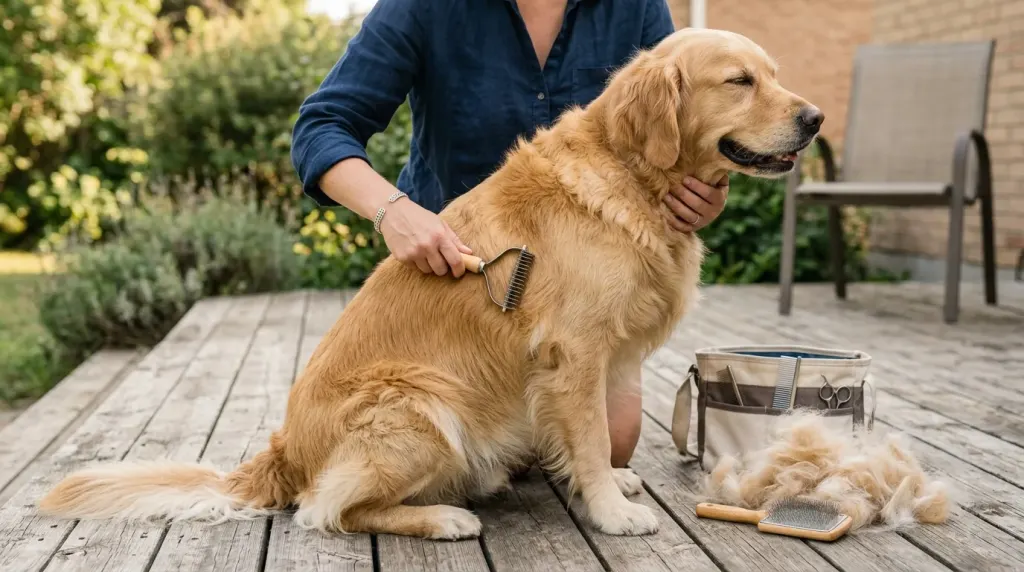
Managing pet fur in multi-pet households requires dedicated grooming routines. Owners who manage large longhaired pets and already know how big Maine Coon cats get will find daily brushing familiar, though a 70-pound retriever produces a significantly higher volume of shed undercoat.
| Grooming Task | Frequency | Recommended Tools | Purpose & Benefit |
|---|---|---|---|
| Routine Brushing | 2 to 3 times weekly | Slicker brush, steel greyhound comb | Removes surface debris, prevents painful mats |
| Undercoat De-shedding | Daily during seasonal coat blow | Undercoat rake, de-shedding blade | Extracts dead undercoat before it carpets furniture |
| Bathing | Every 6 to 8 weeks | Canine-formulated oatmeal shampoo | Cleans skin without stripping natural protective oils |
| Ear Inspection & Cleaning | Weekly & after every swim | Veterinary ear cleaner, cotton pads | Dries moisture to prevent fungal and bacterial ear infections |
| Nail Trimming | Every 3 to 4 weeks | Heavy-duty nail clippers, rotary grinder | Maintains proper paw alignment and joint health |
| Dental Hygiene | 3 to 5 times weekly | Dog enzymatic toothpaste, soft toothbrush | Prevents tartar buildup and periodontal disease |
Understanding the physical coat characteristics outlined in guides on what does a golden retriever look like clarifies why clipping or shaving their double coat is strongly discouraged. Shaving removes their thermal barrier, increases the risk of sunburn and heatstroke, and permanently damages the hair texture.
Households that maintain immaculate, fur-free environments must invest in a high-efficiency particulate air (HEPA) vacuum cleaner and accept that dog hair will inevitably adhere to clothing, carpets, and furniture.
Breed Health, Longevity, and Essential Screenings
Golden Retrievers have an average life expectancy of 10 to 12 years. Like many purebred sporting dogs, they are predisposed to specific inherited orthopedic, cardiovascular, and oncological health conditions. Navigating these health realities requires prospective owners to demand verifiable health clearances from parent dogs prior to acquiring a puppy.
Official breed preservation protocols established by the OFA Canine Health Information Center breed requirements require comprehensive testing across four primary body systems: hips, elbows, eyes, and heart.
| Health Condition | Body System Affected | Diagnostic Standard / Clearance | Clinical Significance |
|---|---|---|---|
| Hip Dysplasia | Skeletal / Orthopedic | OFA Radiographs or PennHIP Evaluation (at 24+ months) | Malformation of the hip joint causing degenerative arthritis and pain |
| Elbow Dysplasia | Skeletal / Orthopedic | OFA Elbow Radiographs (at 24+ months) | Developmental abnormalities leading to chronic forelimb lameness |
| Subaortic Stenosis (SAS) | Cardiovascular | Board-Certified Veterinary Cardiologist Echocardiogram | Narrowing below the aortic valve causing heart murmurs and exercise intolerance |
| Hereditary Cataracts & PRA | Ophthalmic | Annual CAER Exam by ACVO Ophthalmologist | Progressive vision impairment, juvenile cataracts, and pigmentary uveitis |
| Canine Cancer (Hemangiosarcoma/Lymphoma) | Oncological | Longitudinal Monitoring & Genetic Research | Elevated breed incidence being evaluated in multi-year veterinary studies |
Prospective owners should always verify OFA clearances for hips, elbows, eyes, and cardiac health directly in the public registry database rather than accepting verbal claims of vet checks.
Cancer remains a significant health concern within the breed. Longitudinal canine health research, such as the Golden Retriever Lifetime Study conducted by the Morris Animal Foundation tracking over 3,000 dogs, continues to evaluate environmental and genetic risk factors associated with hemangiosarcoma, lymphoma, and osteosarcoma. Choosing breeders who document longevity across three or more generations helps mitigate genetic risks.
Financial Commitment: Upfront Puppy Costs vs. Lifetime Annual Budget
The financial investment required to care for a Golden Retriever extends far beyond the initial purchase or adoption fee. As a large, active breed weighing between 55 and 75 pounds, ongoing costs for nutrition, veterinary care, and grooming supplies accumulate over their lifespan.
Researching upfront acquisition expenses through detailed overviews on how much a golden retriever costs provides realistic expectations before making a long-term commitment.
| Budget Category | Initial First-Year Cost | Recurring Annual Cost (Years 2-12) | Notes & Key Inclusions |
|---|---|---|---|
| Acquisition / Adoption Fee | $500 – $3,500 | $0 | Rescue adoption ($300-$600) vs Ethical preservation breeder ($2,000-$3,500) |
| Initial Setup & Gear | $400 – $800 | $100 – $200 | Heavy-duty crate, orthopedic beds, leashes, harnesses, durable toys |
| Premium Nutrition | $700 – $1,200 | $900 – $1,400 | High-quality large-breed formula (approx. 30-40 lbs of kibble per month) |
| Routine Veterinary Care | $450 – $800 | $350 – $600 | Puppy vaccines, annual wellness exams, core booster shots, fecal checks |
| Parasite Preventatives | $200 – $350 | $250 – $400 | Monthly heartworm, flea, and tick preventatives scaled to 60-75 lb body weight |
| Spay / Neuter Surgery | $300 – $700 | $0 | Timing determined in consultation with your veterinarian |
| Training & Socialization | $250 – $600 | $100 – $300 | Puppy kindergarten classes, basic obedience foundation courses |
| Pet Health Insurance | $600 – $1,200 | $700 – $1,500 | Comprehensive accident and illness coverage (recommended for large breeds) |
| Estimated Total | $3,400 – $9,150 | $2,400 – $4,400 | Lifetime expected cost ranges from $25,000 to $45,000 across 10-12 years |
Prospective owners must also maintain an emergency veterinary fund of at least $2,000 to $5,000 or maintain active pet health insurance to handle potential cruciate ligament tears, foreign body ingestions, or oncological treatments.
Living Compatibility: Family Dynamics, Apartment Living, and Other Pets
Golden Retrievers adapt well to diverse living arrangements when their physical exercise and companionship needs are met daily. Their gentle disposition makes them classic additions to family households with children.
Living with Children and Active Families
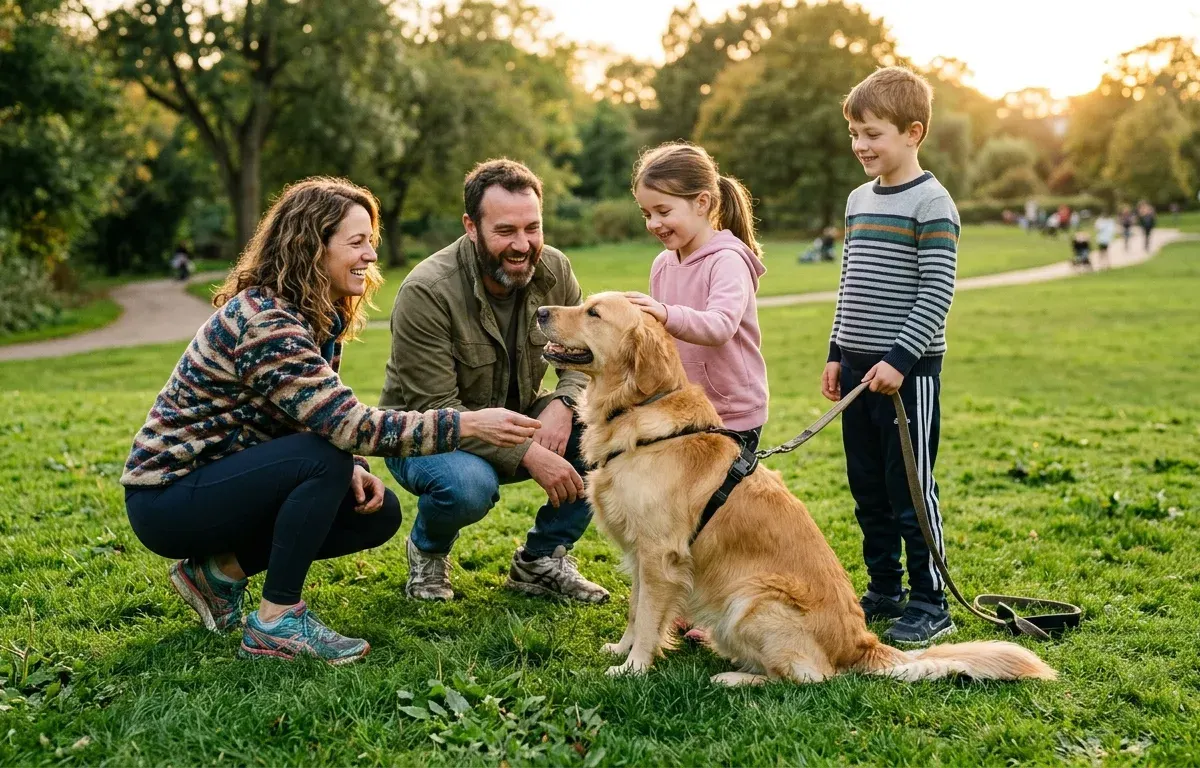
Golden Retrievers are typically patient and affectionate around children. However, during puppyhood and adolescence, which varies by individual dog before reaching full maturity, high energy levels present practical management challenges. Young retrievers can inadvertently knock over toddlers during enthusiastic greetings or mouth hands during play. Active adult supervision, consistent bite-inhibition training, and teaching children gentle handling are important for maintaining a safe household.
Apartment Living vs. Suburban Homes with Yards
A large suburban backyard provides convenient space for fetch, but a fenced yard does not automatically satisfy a sporting dog’s exercise needs. A Golden Retriever left alone in a yard often becomes bored and inactive.
Apartment living works well for a Golden Retriever if owners provide regular outdoor activity. Without a private yard, owners need to provide dedicated daily walks and park outings to meet the breed’s 60 to 90 minutes of daily exercise.
Compatibility with Cats and Other Pets
Golden Retrievers generally live peacefully alongside domestic felines when properly introduced. Their gentle nature pairs well with relaxed household pets, and knowing how big Ragdoll cats get helps owners understand why these calm, substantial cats often become confident companions to an easygoing retriever. Gentle introductions prevent excitement from overwhelming smaller animals. Observing whether do ragdoll cats get along with dogs confirms that docile, laid-back cat breeds thrive alongside patient sporting dogs.
Decision Matrix: Who Should (and Who Should NOT) Get a Golden Retriever
Evaluating a dog breed requires comparing your daily habits against the breed’s intrinsic genetic needs. A Golden Retriever is an exceptional dog for the right home, but a challenging mismatch for an incompatible lifestyle.
| Category | Golden Retriever is an Ideal Fit If You: | Consider a Different Breed If You: |
|---|---|---|
| Daily Schedule | Have an active lifestyle with 1.5 to 2 hours available daily for exercise, training, and play | Work 10+ hours away from home daily without access to dog walkers or doggy daycare |
| Housekeeping & Cleanliness | Accept dog hair on furniture, carpets, and clothing as a normal part of pet ownership | Demand a pristine, fur-free house and dislike frequent brushing and vacuuming |
| Social Environment | Enjoy an affectionate, highly social dog that seeks constant physical proximity | Prefer an independent, aloof pet that remains content resting alone for long stretches |
| Outdoor Lifestyle | Enjoy outdoor activities such as hiking, swimming, camping, jogging, and park outings | Lead a sedentary homebody lifestyle centered primarily around indoor relaxation |
| Property Protection | Seek a friendly companion that welcomes friends, delivery drivers, and neighbors | Want a guard dog or protective deterrent for home defense and security |
| Financial Preparedness | Have an established budget for high-quality food, insurance, and large-dog veterinary care | Have strict financial constraints that cannot absorb potential orthopedic or medical emergencies |
For households with restricted living space or minimal time for outdoor endurance exercise, smaller companion breeds may offer a more manageable match. Evaluating how big pug dogs get helps apartment dwellers choose a compact lap companion over a heavy, energetic retriever.
When comparing sporting options, families often weigh whether to select a Golden Retriever or evaluate alternative working breeds like the Labrador Retriever breed. While both share similar energy levels and trainability, Labradors feature a shorter coat that sheds differently and display a slightly more direct, assertive working style.
Ethical Sourcing: Adoption vs. Selecting a Reputable Breeder
Once you determine that a Golden Retriever fits your lifestyle, choosing an ethical, responsible source is critical to avoid supporting inhumane breeding operations and inheriting severe health problems. Helpful guidance on PDSA large dog commitment guidance emphasizes that prospective owners should be fully prepared for the long-term commitment before acquiring a pet.
Adoption Through Breed-Specific Rescues
Adopting a Golden Retriever provides a loving home to a dog in need. Dedicated rescue networks across the country evaluate adult dogs in foster homes, providing accurate assessments of temperament, energy level, and cat compatibility. Prospective owners can explore adoption pathways and vetting protocols by learning where you can adopt a golden retriever through established non-profit rescue networks.
Screening for Reputable Preservation Breeders
If purchasing a puppy from a breeder, you must verify that the breeder adheres to strict ethical standards. Preservation breeders breed specifically to improve health, temperament, and structure according to the official breed standard.
| Evaluation Metric | Green Flags (Reputable Ethical Breeder) | Red Flags (Backyard Breeder / Puppy Mill) |
|---|---|---|
| Health Clearances | Publicly verifiable OFA certificates for hips, elbows, eyes, and heart on both parents | Claims parents are vet checked without official OFA or PennHIP registry numbers |
| Facility & Environment | Welcomes in-person or live video visits to meet the mother and view the clean puppy nursery | Refuses facility visits, insists on meeting in parking lots, or ships puppies without screening |
| Puppy Placement | Screens buyers thoroughly with application questionnaires and phone interviews | Sells puppies on a first-come, first-served basis to anyone with cash or a credit card |
| Marketing & Novelty | Focuses on health, temperament, and standard colors (golden, light golden, dark golden) | Markets unsubstantiated designer mixes such as what is a mini golden retriever or rare colors at inflated prices |
| Contractual Guarantee | Provides a written health contract and requires the dog be returned if you can no longer keep it | Offers no written health warranty or refuses lifetime return support |
Note: Ethical preservation breeders prioritize sound genetics over profit, providing transparent lineage documentation and lifetime take-back contracts.
Frequently Asked Questions About Getting a Golden Retriever
Are Golden Retrievers good dogs for first-time owners?
Golden Retrievers are widely considered one of the best breeds for first-time dog owners due to their high biddability, forgiving nature, and gentle disposition. Their eager-to-please temperament helps novice handlers succeed in basic obedience training. However, first-time owners must still be prepared to meet their substantial daily exercise needs and consistent grooming requirements.
How many hours can a Golden Retriever be left alone?
An adult Golden Retriever should not be left alone for more than four to six hours on a regular basis. Because they thrive on human interaction, prolonged isolation increases the risk of separation anxiety, stress barking, and destructive chewing. If you work full-time outside the home, arranging a midday dog walker, pet sitter, or doggy daycare is strongly recommended.
Do Golden Retrievers bark a lot?
Golden Retrievers are moderate barkers who generally vocalize to alert owners to approaching visitors or express excitement during interactive play. They are not prone to chronic nuisance barking unless they are under-exercised, socially isolated, or bored. Providing daily physical exercise and interactive puzzle toys effectively prevents boredom-induced barking.
Are Golden Retrievers hypoallergenic?
Golden Retrievers are not hypoallergenic. They produce standard amounts of dander, shed a dense double coat throughout the year, and produce protein allergens in their saliva and urine. Individuals with dog allergies should spend time around adult Golden Retrievers before bringing one home to test their allergic sensitivity.


Leave a Reply