

Table of Contents
To understand what is a mini Golden Retriever, it is a designer crossbreed developed by combining a purebred Golden Retriever with smaller breeds such as the Miniature Poodle, Cocker Spaniel, or Cavalier King Charles Spaniel. Adult mini Goldens weigh 20 to 45 pounds and stand 14 to 20 inches tall, offering the affectionate personality of a standard retriever in a compact, apartment-friendly frame. They are not recognized as a purebred breed by the American Kennel Club (AKC).
- Mini Golden Retrievers are hybrid designer dogs, not purebred runts or dwarf Golden Retrievers.
- Adults reach 20 to 45 pounds (9 to 20 kg), roughly half the size of a standard 55 to 75 pound Golden Retriever.
- Primary foundation crosses include Golden Retriever mixed with Miniature Poodle, Cocker Spaniel, or Cavalier King Charles Spaniel.
- F1B generations (75% Golden Retriever, 25% Poodle/Spaniel) offer the most classic retriever look with lower shedding.
- Puppies cost between $3,000 and $5,500 from ethical breeders who perform OFA and PennHIP genetic health screenings.
The mini Golden Retriever has surged in popularity among pet owners who adore the friendly disposition of standard retrievers but lack the space for a 70-pound sporting dog. Understanding what a mini Golden Retriever is requires looking past marketing buzzwords to examine the genetics, physical growth patterns, daily care requirements, and breeding ethics behind this popular hybrid dog.
Are There Mini Golden Retrievers? Understanding the Genetic Reality
Prospective dog owners frequently ask whether mini Golden Retrievers exist as an authentic canine variety. The direct answer depends on whether you are looking for a recognized purebred dog or a purpose-bred designer hybrid.
The Short Answer: Yes, but They Aren’t Purebred
Mini Golden Retrievers exist as functional crossbreeds, but there is no such thing as a purebred miniature Golden Retriever. A standard Golden Retriever cannot naturally produce miniature offspring without crossbreeding or exploiting genetic abnormalities like dwarfism (achondroplasia). Examining what French Bulldogs were bred for originally demonstrates how purposeful size reduction historically relied on careful multi-generational breeding rather than spontaneous genetic mutation.
Reputable breeders produce mini Goldens by intentionally crossing standard Golden Retrievers with smaller companion and sporting breeds. This selective pairing achieves a smaller stature while preserving the friendly, biddable temperament characteristic of the retriever family.
The Pioneer Programs: Kathy Burgess and Taylormade
The structured breeding of miniature retrievers began in the late 20th century. Breeder Kathy Burgess of GoldenQuest established one of the first formal programs in 2003, developing what she trademarked as the “Comfort Retriever” by combining Golden Retrievers with Miniature Poodles.
Similarly, the Taylor family at Taylormade began developing miniature retriever lines in 1989, refining a three-way cross of Golden Retriever, Cocker Spaniel, and Miniature Poodle. While understanding what pug dogs were bred for historically highlights how centuries of single-breed refinement created distinct lap companions, modern designer programs took a deliberate multi-breed crossbreeding approach. Early pioneer breeders focused on multi-generational crosses to balance retriever aesthetics with manageable size. Responsible programs never breed runts or dwarf dogs, relying instead on healthy foundation stock from established smaller breeds.
Note: “Comfort Retriever” is a specific trademarked line from GoldenQuest, while “mini Golden Retriever” serves as the broad industry term for any retriever-spaniel-poodle hybrid.
Is There Such a Thing as a Miniature Golden Retriever in the AKC?
Conformation show rings and national kennel clubs operate under strict pedigree standards that distinguish established purebred dogs from modern designer crosses.
The Position of the American Kennel Club (AKC)
The American Kennel Club (AKC) does not recognize the mini Golden Retriever as a distinct breed or size variety. The official AKC breed standard recognizes only the standard Golden Retriever, classified within the Sporting Group, with accepted color variations of Dark Golden, Golden, and Light Golden.
According to AKC documentation on miniature breed histories, purebred recognition requires generations of documented pedigrees, predictable physical standards, and a dedicated parent club, none of which currently apply to crossbred mini Goldens. Just as historical records document what breeds make a French Bulldog from crossbreeding Toy Bulldogs with local Parisian ratters before achieving purebred status, the mini Golden remains in its formative hybrid phase.
Standard vs. Miniature: Visual and Temperament Differences
Comparing standard Golden Retrievers with mini Goldens reveals noticeable physical and behavioral distinctions:
- Size and Body Mass: Standard Goldens weigh 55 to 75 pounds and stand 21.5 to 24 inches tall. Mini Goldens weigh 20 to 45 pounds and stand 14 to 20 inches tall.
- Muzzle and Head Structure: Standard Goldens possess a broad skull with a defined stop. Mini Goldens often exhibit a slightly narrower muzzle and rounder eye shape inherited from Poodle or Spaniel ancestors. Evaluating what a French Bulldog looks like in official breed standards illustrates how specific skull contours define purebred profiles, whereas mini Golden facial features vary widely between litters.
- Coat Texture: Purebred Goldens have a dense, water-repellent double coat that sheds heavily year-round. Mini Goldens feature variable coat textures ranging from wavy fleeces to light curls that shed considerably less.
- Energy Distribution: While standard Goldens excel at sustained field retrieving, mini Goldens balance playful retrieving bursts with the adaptable lap-dog energy of companion breeds.
Conformation purebred registries evaluate strict physical uniformity, whereas designer hybrid registries prioritize companion suitability, hybrid vigor, and compact dimensions.
Note: Mini Goldens cannot compete in AKC conformation dog shows, but they can participate in AKC Canine Good Citizen (CGC) testing and companion events through AKC Canine Partners.
What Is a Miniature Golden Retriever’s Genetic Formula? (F1 vs. F1B)
Creating a miniature retriever requires strategic pairing across specific foundation breeds and filial generations to balance size reduction against classic retriever appearance.

The Three Common Crosses
Breeders use three primary crossbreeding combinations, each imparting distinct traits:
- Golden Retriever x Miniature Poodle (Goldendoodle / Comfort Retriever Base): Introduces high intelligence, low-shedding curly or fleece coats, and substantial size reduction.
- Golden Retriever x Cocker Spaniel (Golden Cocker Retriever): Retains the drop ears, expressive eyes, and lush golden coat of sporting dogs while reducing height. Studying what dogs make a pug shows how ancient Asian ancestral lines contributed to predictable physical standards, whereas mini Golden mixes still produce varied traits depending on whether Spaniel or Poodle genetics dominate.
- Golden Retriever x Cavalier King Charles Spaniel: Produces an exceptionally sweet, gentle companion with lower exercise demands, though careful cardiac screening is essential.
Understanding Breeding Generations
Generational designations (F1, F1B, F2) indicate the genetic ratio of Golden Retriever to foundation companion breeds:
| Generation | Genetic Composition | Coat Type & Shedding Level | Typical Adult Weight Range |
|---|---|---|---|
| F1 First Generation | 50% Golden Retriever / 50% Mini Poodle or Spaniel | Wavy to straight coat; moderate shedding | 30-45 lbs (14-20 kg) |
| F1B Backcross | 75% Golden Retriever / 25% Mini Poodle or Spaniel | Soft wavy fleece; low shedding; classic golden head | 25-40 lbs (11-18 kg) |
| F2 Second Generation | F1 Mini Golden x F1 Mini Golden | Highly variable coat; shedding varies by pup | 20-45 lbs (9-20 kg) |
| Multi-Gen | Multi-generation Mini Golden x Mini Golden | Consistent fleece coat; predictable adult size | 20-35 lbs (9-16 kg) |
Prospective pet parents researching what is a French Bulldog often compare its low-shedding short coat to the low-dander fleece coat of an F1B mini Golden when evaluating daily home maintenance. The F1B backcross (75% Golden Retriever, 25% Miniature Poodle/Spaniel) is widely regarded as the sweet spot for owners seeking true Golden Retriever aesthetics without the full-size bulk or heavy shedding.
Note: Coat genetics in F1 litters can vary widely among littermates; some puppies inherit straight retriever coats while others display loose Poodle curls.
How Big Do Mini Golden Retrievers Get? Size and Growth Chart
Understanding projected adult dimensions helps owners select appropriate crates, vehicles, and living arrangements for their new puppy.
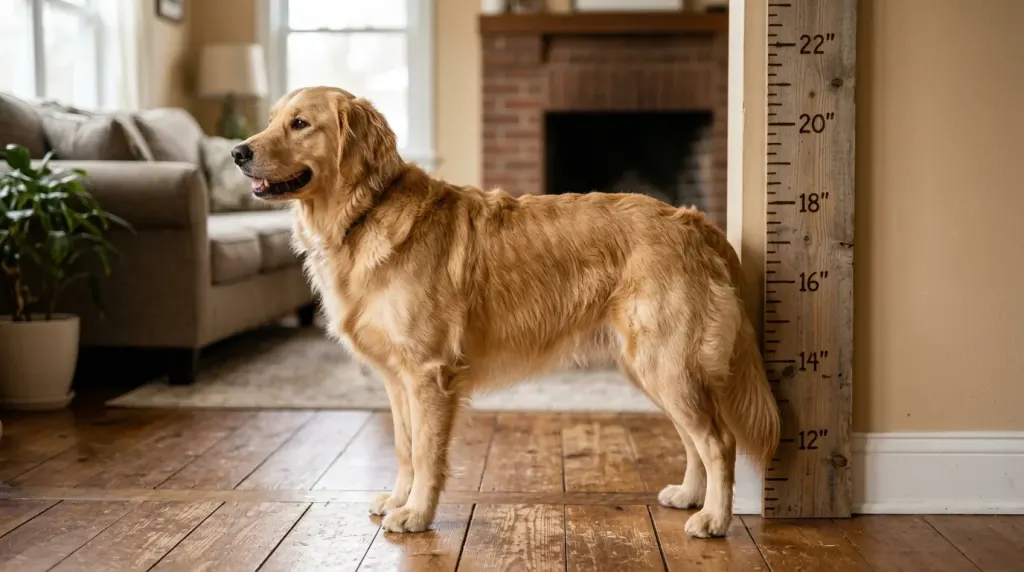
Weight and Height Standards
Mini Golden Retrievers generally reach full skeletal maturity around one year to eighteen months of age depending on each dog’s parental lineage, maturing faster than standard Goldens, which often continue filling out across their second year.
| Metric | Standard Golden Retriever | Mini Golden Retriever |
|---|---|---|
| Adult Weight | 55-75 lbs (25-34 kg) | 20-45 lbs (9-20 kg) |
| Height at Withers | 20-24 in (51-61 cm) | 14-20 in (35-50 cm) |
| Growth Duration | 12-24 months | 12-18 months |
| Coat Density | Dense double coat | Variable (wavy to curly) |
| Exercise Need | 60-90 min daily | 30-60 min daily |
Managing daily caloric intake according to established feeding protocols, similar to understanding what pug dogs eat to prevent canine obesity, keeps a mini Golden at its ideal body condition score.
Growth Milestones: Week by Week Growth Rate
Mini Golden puppies grow rapidly during their first six months before tapering into gradual muscle development:
| Puppy Age Milestone | Expected Weight Range | Percentage of Adult Size | Key Developmental Milestone |
|---|---|---|---|
| 8 Weeks | 4-7 lbs | ~15% | First vaccinations and weaning completed |
| 12 Weeks | 8-14 lbs | ~30% | Rapid bone growth, socialization window |
| 16 Weeks (4 Months) | 14-22 lbs | ~50% | Teething begins, steady 1-2 lbs weekly gain |
| 6 Months | 18-32 lbs | ~65-75% | Adolescent transition, adult height nearly reached |
| 9 Months | 20-40 lbs | ~85-90% | Growth plates begin closing |
| 12-18 Months | 20-45 lbs | 100% | Final chest broadening and adult muscle density |
During their juvenile growth phase through the third to sixth month, healthy puppies typically gain roughly one to two pounds each week. Comparing developmental scales to what a pug dog looks like at adult size helps owners visualize how compact sporting mixes differ structurally from toy and brachycephalic dogs throughout their adolescent growth curve.
Pros and Cons of Bringing a Miniature Golden Retriever Home
Evaluating the practical advantages and potential drawbacks ensures your household lifestyle matches the demands of this hybrid companion.
The Benefits of a Compact Retriever
- Apartment Compatibility: Their manageable 20 to 45 pound frame simplifies indoor living, potty training routines, and hygiene care, much like sizing charts that specify what size dog diaper for pug breeds during travel or recovery.
- Hybrid Vigor: Crossbreeding diverse genetic lines can reduce the incidence of hereditary conditions, broadening genetic diversity to help lower the risk of inherited disorders and breed-specific health issues common in purebred lines.
- Reduced Shedding: Poodle and Cocker Spaniel genetic influence reduces the sheer volume of undercoat blowing compared to purebred retrievers.
- High Trainability: Inheriting the biddable nature of retrievers alongside the keen problem-solving skills of Poodles makes mini Goldens exceptionally responsive to positive reinforcement training.
The Disadvantages You Must Know
- High Purchase Price: Purpose-bred puppies from health-tested parents command premium prices ranging from $3,000 to $5,500.
- Grooming Maintenance: Wavy fleece coats require scheduled professional clipping as the fur lengthens alongside regular line brushing to prevent painful matting.
- Separation Anxiety Risk: Mini Goldens form intense bonds with family members and may develop vocalization or destructive chewing habits if left isolated for extended periods. Understanding what type of dog is a pug when assessing companion fit highlights how high-attachment companion breeds share similar vulnerability to isolation stress when left alone for long working days.
| Consideration Factor | Key Advantage | Potential Drawback |
|---|---|---|
| Living Space | Fits comfortably in apartments and smaller homes | High energy requires dedicated daily exercise |
| Shedding Volume | Significantly less total hair shedding than standard Goldens | Coat requires periodic professional grooming as it grows |
| Health & Longevity | Hybrid vigor can reduce certain purebred cancer risks | Risk of inheriting orthopedic or cardiac issues from parent breeds |
| Temperament | Affectionate, eager to please, gentle with families | High attachment increases risk of separation anxiety |
| Purchase Cost | High demand drives strict health-tested breeding lines | Premium price range of $3,000 to $5,500 per puppy |
Health, Care and Grooming Standards
Maintaining a mini Golden Retriever requires proactive veterinary care, targeted coat maintenance, and regular physical exercise.
Common Hereditary Health Risks
While crossbreeding broadens the gene pool, mini Goldens can inherit health conditions common to their foundation parent breeds:
- Canine Hip and Elbow Dysplasia: Malformation of ball-and-socket joints that causes arthritis and mobility stiffness.
- Patellar Luxation: Slipping kneecaps frequently inherited from toy and miniature parent lines.
- Progressive Retinal Atrophy (PRA): Degenerative eye disorders leading to gradual vision loss.
- Subvalvular Aortic Stenosis (SAS): Congenital heart murmur condition requiring veterinary cardiac auscultation.
While chondrodystrophic breeds must monitor what is IVDD in French Bulldogs due to shortened limb genetics, mini Golden Retrievers require screening for canine hip dysplasia, patellar luxation, and progressive retinal atrophy.
Ethical breeders rely on the Orthopedic Foundation for Animals (OFA) and PennHIP registries to test parent dogs before breeding.
Daily Grooming and Exercise Routine
- Coat Brushing: Brush several times throughout the week using a slicker brush and metal greyhound comb to prevent tangles in friction zones (behind ears, armpits, and tail base), adjusting frequency during seasonal shedding.
- Bathing and Trimming: Routine professional grooming sessions as the coat grows out keep the fleece trimmed to a manageable length while protecting skin health.
- Exercise Requirements: Provide 30 to 60 minutes of daily physical exercise, including neighborhood walks, fetch games, and mental puzzle enrichment.
Maintaining a balanced diet that avoids common dietary allergens and toxic table scraps, alongside guidelines on what can French Bulldogs eat, supports optimal digestive health and joint comfort. Combining line brushing with professional trimming prevents the felt-like matting common to retriever-poodle cross coats. Neglected coats trap moisture and cause painful hot spots.
Note: Ear canals require weekly cleaning with a veterinary-approved drying solution, as dropped ears trap moisture and predispose dogs to yeast infections.
How to Find an Ethical Breeder & Avoid Red Flags
Because mini Goldens are not regulated by the AKC, buyers must exercise extra diligence to avoid puppy mills and irresponsible backyard breeders.
Warnings of Backyard Breeders and Puppy Mills
Unethical breeders often cut corners to maximize profit at the expense of canine welfare. Watch for these critical red flags:
- “Teacup” or “Micro” Marketing: Advertising 10-pound Golden Retrievers indicates dangerous breeding practices, such as pairing undersized runts or exploiting severe dwarfism mutations.
- No Verifiable Health Clearances: Refusing to provide official OFA or PennHIP certificate numbers for both sire and dam.
- Immediate Availability: Maintaining constant litters year-round with no buyer vetting or application process.
- Off-Site Hand-Offs: Insisting on meeting in parking lots rather than allowing buyers to view the whelping environment and mother dog.
Key Questions to Ask Your Breeder
- Can you provide the OFA registry links or certificate copies for the parents’ hips, elbows, eyes, and cardiac evaluations?
- What specific genetic percentage of Golden Retriever, Poodle, and Spaniel is in this litter?
- What early socialization protocols (such as Puppy Culture or Early Neurological Stimulation) do you implement?
- Do you offer a multi-year written health guarantee against genetic and congenital defects?
- Will you take the dog back at any point in its lifetime if our family can no longer care for it?
Frequently Asked Questions About Mini Golden Retrievers
Can mini Golden Retrievers be registered with the AKC?
No. Mini Golden Retrievers cannot be registered as purebred dogs with the American Kennel Club (AKC) because they are a hybrid designer mix. However, owners can enroll them in the AKC Canine Partners program to participate in agility, obedience, and tracking events.
Are mini Golden Retrievers 100% hypoallergenic?
No dog breed is 100% hypoallergenic. While F1B mini Goldens with higher Poodle genetics shed significantly less dander and hair than standard Goldens, individuals with severe dog allergies should spend time with an adult dog before purchasing.
What is the average lifespan of a mini Golden Retriever?
Mini Golden Retrievers generally live ten to fifteen years depending on genetic health, diet, and preventive care. Their smaller body size and hybrid genetic diversity often afford them a slightly longer lifespan than standard Golden Retrievers, which typically average ten to twelve years.
How much does a mini Golden Retriever puppy cost?
A mini Golden Retriever puppy from a reputable breeder who conducts full DNA and OFA health testing typically costs between $3,000 and $5,500. Prices vary based on generation (F1 vs. F1B), coat type, and breeder health guarantees.



Leave a Reply