
Table of Contents
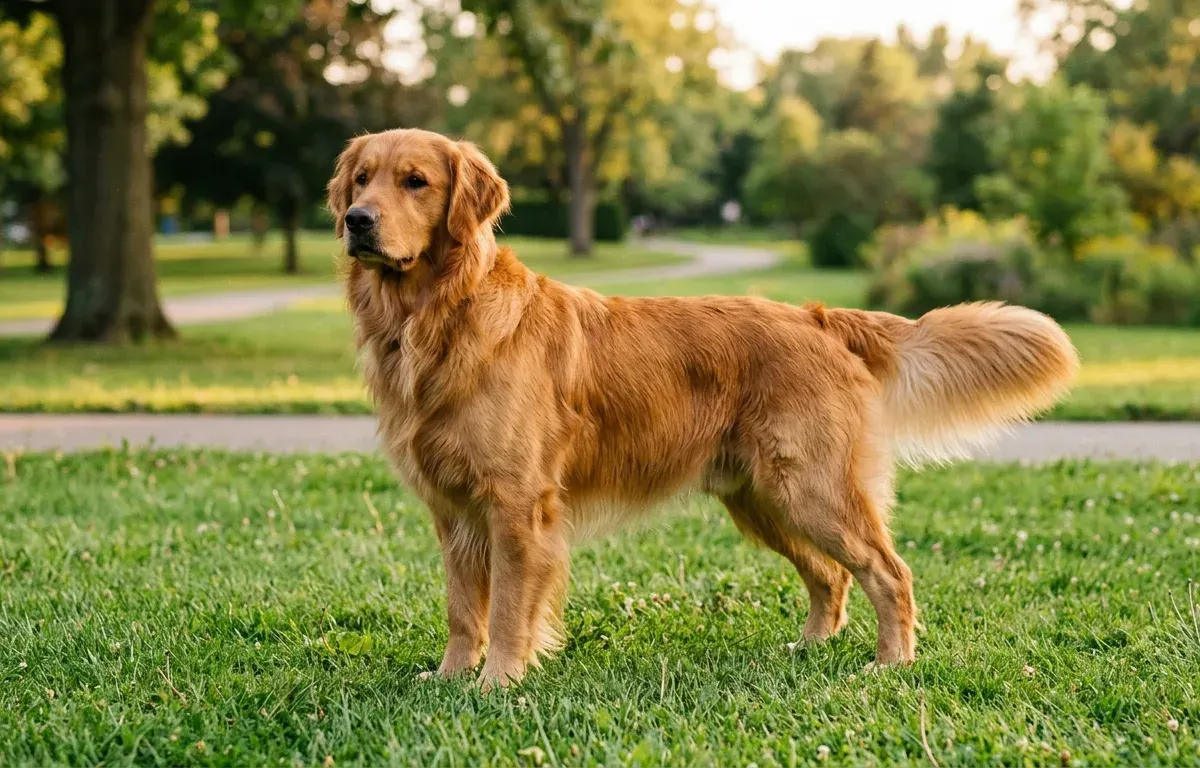
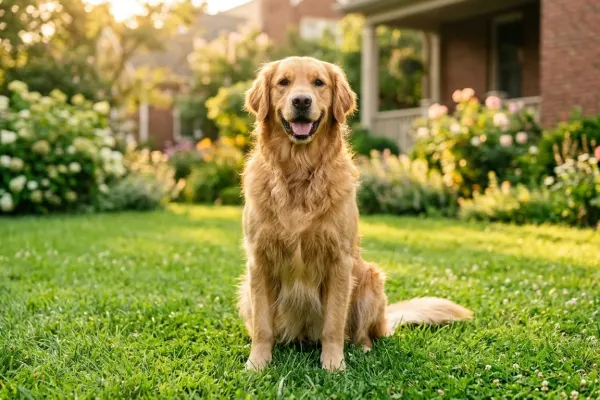
When evaluating what does a golden retriever look like, a purebred Golden Retriever is a sturdy, medium-to-large sporting dog characterized by a dense, water-repellent golden double coat with elegant feathering along the legs, chest, and tail. Adult males stand 23 to 24 inches tall at the shoulder weighing 65 to 75 pounds, while females measure 21.5 to 22.5 inches and weigh 55 to 65 pounds. They are instantly recognizable by their broad skull, warm dark brown eyes, folded drop ears, and a joyful, level tail carriage.
- Body Build: Symmetrical, muscular, and balanced athletic build with a deep chest and level topline.
- Coat & Colors: Water-resistant double coat with distinctive feathering; colors range from light golden to dark lustrous gold (pure black or snow white are not recognized).
- Head & Facial Traits: Broad skull, well-defined stop, kind dark eyes with black rims, and medium ears hanging flat against the cheeks.
- Look-Alikes: Often confused with Yellow Labradors (shorter smooth coat) and Flat-Coated Retrievers (black/liver coats with leaner skulls).
Identifying a purebred Golden Retriever requires looking beyond general golden fur to evaluate specific skeletal proportions, coat textures, and facial expressions. Developed in 19th-century Scotland as athletic waterfowl retrievers, these dogs combine functional muscular substance with gentle, symmetrical contours. Whether evaluating a family pet or verifying pedigree breed traits, understanding their standard anatomy provides an accurate blueprint of their physical identity.
Hallmark Physical Features and Anatomy of a Purebred Golden Retriever
The standard physical profile of a Golden Retriever balances athletic power with gentle symmetry, defined by precise height, weight, and proportion benchmarks set by official kennel clubs. According to the American Kennel Club breed standard, these dogs display a balanced, compact body where the length from breastbone to buttocks is slightly greater than the height at the withers, creating an approximate 12:11 ratio.
| Anatomical Metric | Adult Male Standard | Adult Female Standard | Evaluation Focus |
|---|---|---|---|
| Height at Withers | 23 to 24 inches (58 to 61 cm) | 21.5 to 22.5 inches (55 to 57 cm) | Measured vertically from ground to top of shoulder blades |
| Healthy Weight | 65 to 75 pounds (29.5 to 34 kg) | 55 to 65 pounds (25 to 29.5 kg) | Lean muscle mass over sturdy bone structure |
| Skull & Muzzle | Broad, slightly arched, well-defined stop | Slightly refined, balanced proportion | Straight bridge blending smoothly into skull |
| Eye Shape & Color | Medium-large, dark brown, black rims | Medium-large, dark brown, black rims | Friendly, alert expression with no loose haw |
| Tail Carriage | Level with backline or slight upward curve | Level with backline or slight upward curve | Never curled over back or clamped between hocks |
The head of a Golden Retriever is one of its most distinctive breed signatures. The skull is broad without appearing coarse, featuring a clearly defined stop where the forehead transitions into a wide, straight muzzle. The muzzle is nearly equal in length to the skull and accommodates a complete set of white teeth meeting in a precise scissors bite. The nose pigment is solid black or brownish-black in warmer months, occasionally lightening slightly in winter months.
Looking at the facial structure, the eyes sit comfortably wide apart, displaying dark brown irises set within tightly fitting, darkly pigmented rims that accentuate their gentle expression. The ears are moderate in size, attached slightly above eye level. When resting, they fall close to the cheeks with the tips reaching just past the inner eye corner. Unlike brachycephalic companion breeds where compact facial structures define what a French Bulldog looks like, the Golden Retriever retains an aerodynamic muzzle engineered for holding retrieved game without restricting respiration.
The neck is medium-long, muscular, and clean-throated, flowing gradually into well-laid-back shoulders and a strong, level backline. The chest is deep, extending down to the elbows to house expansive lung capacity. The tail is thick and muscular at the base, following the natural line of the croup. When the dog is in motion, the tail is carried level with the spine or with a slight upward sweep, constantly wagging, but it never curls over the back. While drop ears hang flat against the cheeks in neutral states, understanding what it means when dogs pull their ears back helps distinguish relaxed posture from appeasement signals during social interactions.
Visual Characteristics of a Golden Retriever: Coat, Colors, and Feathering
A Golden Retriever’s coat is a functional double coat featuring a dense, thermal undercoat beneath a resilient, water-repellent outer coat with prominent feathering. The The Kennel Club breed standard specifies that the outer coat can be flat or wavy, lying close to the body with a firm, resilient texture that repels water and protects against dense underbrush.
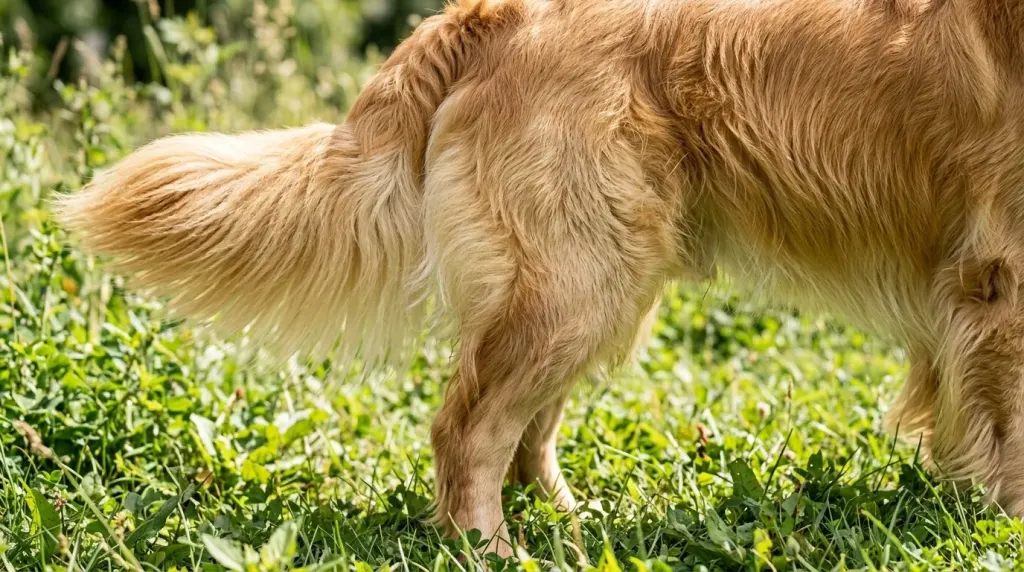
Distinctive feathering develops along specific areas of the body as the dog matures:
- Forelegs: Moderate, neat fringe along the back of the front legs from elbow to pastern.
- Underside & Chest: Plentiful ruff along the front of the neck and a dense fringe along the entire ribcage underline.
- Thighs & Breeches: Heavy, dense feathering forming distinct trousers on the back of the hind legs down to the hock joint.
- Tail Underside: A full, tapering plume of long hair resembling a triangular flag when extended.
The official color spectrum encompasses various shades of lustrous gold, categorized broadly into light golden, classic golden, and dark golden. The feathering is often a lighter shade than the main body coat, creating an attractive two-tone contrast across the chest and tail. While pet owners frequently use terms like “English Cream” or “Red Golden”, official standards from kennel authorities evaluate all legitimate purebreds within the spectrum of gold, rejecting extreme pigmentation lacks or foreign color mixtures.
Field lines bred for hunting often display darker golden or amber-copper coats with lighter feathering for field agility, whereas show lines tend to exhibit fuller, heavier coats in lighter cream to rich honey hues. In contrast to indoor companion dogs whose short single coats reflect what Pug dogs were bred for in sheltered royal courts, the Golden Retriever’s coat evolved for extended swimming in frigid Scottish lochs. Maintaining coat density and dermal moisture requires adequate dietary omega fatty acids, similar to establishing balanced nutritional boundaries for what French Bulldogs can eat to prevent dry, flaky skin. Pure white coats with pink skin pigments or pure black coats indicate outcrossing or separate breed lineages rather than standard purebred Golden Retrievers.
Puppy vs. Adult Appearance: How Golden Retrievers Change Over Time
Golden Retriever puppies look like fluffy, soft golden balls of wool with shorter coats and subtle ear coloring that hints at their future adult shade. A purebred puppy progresses through noticeable visual phases before reaching full physical and coat maturity, with adult feathering and skeletal frame settling gradually as the dog transitions out of adolescence depending on individual lineage and genetics.
| Development Stage | Typical Age Range | Visual & Physical Characteristics |
|---|---|---|
| Early Puppyhood | 8 to 16 Weeks | Soft plush fuzz, rounded body contours, ear tip shading indicating adult color |
| Adolescent Stage | 5 to 12 Months | Lanky growth spurt, adult guard hairs emerging along spine, temporary coat sparsity |
| Adult Maturity | 18 to 24 Months | Deep broad chest, full double coat density, extensive feathering on legs and tail |
Prospective owners often wonder how to predict the final coat color of a young puppy. The tips of the puppy’s ears carry the truest indicator of its future adult shade. Even if a puppy appears pale cream across its back at eight weeks old, darker honey or amber tones on its ear leather reveal the richer gold that will emerge across its backline during adolescence.
During the rapid growth phase between five and nine months, puppies often appear gangly and disproportionate as their long leg bones outpace chest expansion. Tail carriage also settles during this time, shifting from an energetic puppy curl to the level, feathering plume characteristic of adult retrievers. Observing structural growth shifts helps owners distinguish normal athletic leg lengthening from the compact square proportions seen in what a Pug dog looks like during early development. Because adolescent retrievers experience rapid skeletal expansion between four and eight months, their sleeping enclosures require progressive expansion compared to the compact crate sizing needed for a French Bulldog.
What Dog Looks Like a Golden Retriever? Distinguishing Look-Alikes
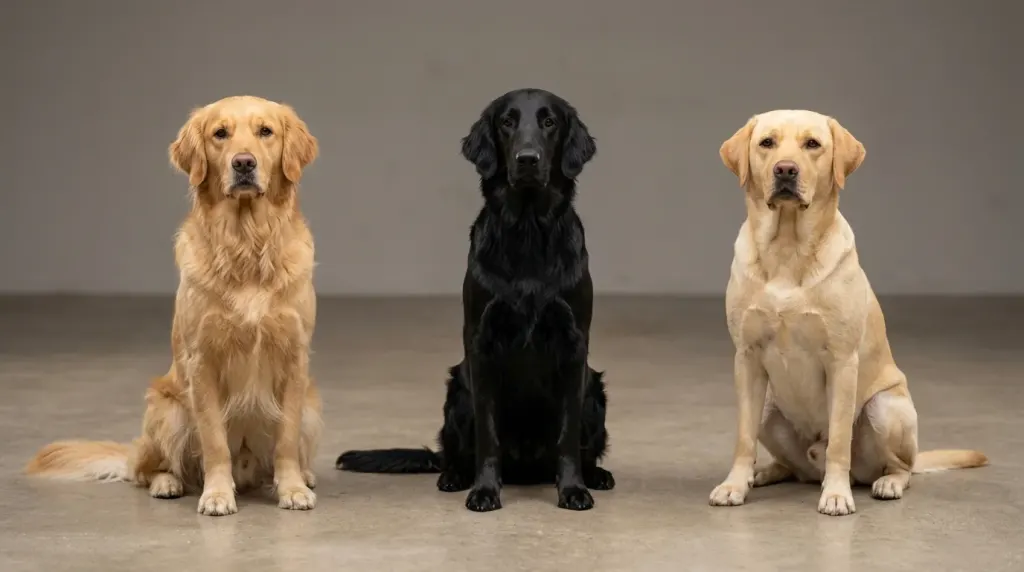
Several gundog and retriever breeds share physical silhouettes with Golden Retrievers, most notably the Flat-Coated Retriever, Yellow Labrador Retriever, and Nova Scotia Duck Tolling Retriever. Evaluating key skeletal and coat differences helps clarify potential breed confusion.
| Breed | Coat Structure & Length | Recognized Colors | Skull & Stop Profile | Average Weight |
|---|---|---|---|---|
| Golden Retriever | Medium-long double coat with heavy feathering | Light golden to dark rich gold | Broad skull with distinct, defined stop | 55 to 75 lbs |
| Flat-Coated Retriever | Medium-length fine coat with moderate feathering | Solid black or solid liver only | Flat, seamless skull with minimal stop | 60 to 70 lbs |
| Labrador Retriever | Short, dense, straight coat without feathering | Yellow, black, or chocolate | Broad head with distinctive otter tail | 55 to 80 lbs |
| Nova Scotia Duck Toller | Medium-length water-repellent coat with feathering | Red or orange with white markings | Wedge-shaped head, fox-like expression | 35 to 50 lbs |
| Great Pyrenees Mix | Thick, heavy double coat with massive ruff | Pure white, often with badger patches | Heavy, massive skull with loose jowls | 85 to 120+ lbs |
The Flat-Coated Retriever is the closest genetic and physical relative in terms of silhouette. Both breeds possess athletic sporting builds and flowing feathering along the legs and tail. However, the Flat-Coated Retriever features a unique one-piece head where the muzzle and skull run nearly parallel with barely any visible stop, and its coat is strictly black or dark liver. A solid black dog with the shape of a Golden Retriever is almost certainly a purebred Flat-Coated Retriever or a retriever mix, as the genetic alleles for black fur are dominant and do not exist in purebred Golden Retrievers.
Yellow Labrador Retrievers share an overlapping color palette and sturdy sporting build with Golden Retrievers. However, the Labrador has a short, sleek coat with no fringing, paired with a thick, rounded tail wrapped in short hair known as an otter tail. Meanwhile, the Nova Scotia Duck Tolling Retriever is noticeably smaller and lighter, displaying a crimson or copper coat frequently accented by crisp white markings on the chest, paws, or face. Comparing these flowing gundog contours against compact molosser builds illustrates how athletic field proportions diverge from the heavy-boned framework of a French Bulldog. Furthermore, pedigree records trace the modern Golden Retriever to Tweed Water Spaniels and Yellow Retrievers, presenting a documented ancestral lineage distinct from the ancient crossbreeding history of what dogs make a Pug.
Breed Type Differences: Field vs. Show Golden Retrievers
While all purebred Golden Retrievers adhere to the same underlying genetic lineage, selective breeding over generations has created distinct visual differences between dogs bred primarily for field trials and hunting versus those bred for the conformation show ring. Recognizing these subtype characteristics helps dog owners understand normal physical variations within the breed.
As detailed in the official United Kennel Club breed standard, a proper Golden Retriever must exhibit a harmonious balance of speed and stamina. Field-bred Golden Retrievers generally display a leaner, more agile build with a narrower head, a slightly longer muzzle, and a lighter bone structure designed for rapid retrieval across rugged terrain. Their coats are typically shorter, denser, and darker in shade, with minimal feathering to prevent burs and brush from catching during hunting expeditions.
In contrast, show-bred Golden Retrievers possess a heavier bone framework, a broader skull with a more pronounced stop, and a deeper chest. Their coats are noticeably longer and fuller, with profuse feathering along the chest, legs, and tail, appearing in lighter golden to rich cream shades. Contrasting these specialized working gundog classifications against companion toy groups illustrates how breeding objectives influence size and form, highlighting what type of dog is a Pug compared to an active sporting retriever. Understanding how purpose directs canine anatomy also clarifies what French Bulldogs were bred for in terms of structural compactness versus the athletic endurance required of retrievers.
Original Analysis: Visual Health and Conformation Indicators
A healthy, well-conditioned Golden Retriever displays clean muscle definition, a bright and alert gaze, clear skin under dense fur, and a natural, level gait without lumbering. According to veterinary guidelines published by the People’s Dispensary for Sick Animals (PDSA), maintaining proper body condition is essential for large breeds, as excess weight places unnecessary strain on joints and obscures functional conformation lines.
When evaluating a Golden Retriever from above, there should be a visible waistline tapering behind the ribcage. When viewed from the side, the abdomen should exhibit a clear upward tuck behind the deep chest. Running hands along the dog’s ribcage should allow the ribs to be felt easily under a light layer of muscle and skin without pressing deeply into fat deposits.
Key visual markers of optimal health and conformation include:
- Coat Texture & Sheen: A vibrant, glossy sheen across the guard hairs without greasy residue, flaking dander, or severe bald patches along the flanks.
- Eye Clarity & Lids: Bright dark eyes free from watery discharge, redness, or cloudy lenses, with tight eyelids that do not roll inward or sag downward.
- Ear Leather Health: Clean, pink interior ear canals free from dark waxy buildup, with supple leather hanging evenly on both sides.
- Gait & Movement: Smooth, ground-covering stride where the front legs reach forward effortlessly and the rear legs provide strong drive along a straight track.
Note: A sudden change in coat texture, symmetry, or posture warrants evaluation by a veterinary professional to rule out underlying endocrine or orthopedic conditions.
Persistent spinal stiffness or inability to settle comfortably into a resting posture can signal orthopedic joint pain, sharing behavioral similarities with what causes dogs to keep moving and not lay down during acute physical discomfort. While retrievers are primarily screened for hip laxity and elbow dysplasia, any sudden reluctance to jump or arched spinal posture requires veterinary evaluation just like managing spinal IVDD in French Bulldogs.
Frequently Asked Questions About Golden Retriever Appearance
What does a purebred Golden Retriever look like?
A purebred Golden Retriever has a balanced athletic build, a broad head with dark brown eyes and a black nose, drop ears, and a dense golden double coat featuring distinct feathering on the legs, belly, and tail. Adult males stand 23 to 24 inches at the shoulder weighing 65 to 75 pounds, while adult females measure 21.5 to 22.5 inches and weigh 55 to 65 pounds.
Can a purebred Golden Retriever be black?
No. Purebred Golden Retrievers carry recessive red/gold pigmentation genes and cannot produce black coats. A dog that appears to be a black Golden Retriever is almost always a purebred Flat-Coated Retriever or a mixed-breed dog resulting from a Golden Retriever crossed with a black Labrador or shepherd breed.
What is the visual difference between a Golden Retriever and a Labrador?
While both breeds share medium-to-large sporting builds and similar color tones, the Golden Retriever has a medium-to-long double coat with long feathering along the legs, chest, and tail. In contrast, the Labrador Retriever has a short, dense coat of uniform length with no feathering and a thick, rounded otter tail.
How do I know if my Golden Retriever puppy is purebred by its looks?
Purebred puppies feature a soft double-layer coat, broad skulls with moderate stops, dark brown eyes with dark rims, and ears hanging just below eye level. Looking at the tips of the puppy’s ears reveals the richer golden hue the dog will develop across its body as an adult.

Leave a Reply