

Table of Contents
French bulldog behavior is defined by an affectionate, human-oriented, and adaptable personality with moderate energy and low barking tendencies. Bred primarily for companionship, Frenchies thrive on close human contact and interactive indoor play, making them well-suited for household living. While mild clinginess, brief play bursts, and alert barking are standard breed traits, sudden lethargy, unexplained trembling, intense pacing, or avoidance of touch often signal underlying physical pain or respiratory strain rather than behavioral stubbornness.
- French Bulldogs are companion-focused dogs known for affectionate, clownish temperaments and adaptable indoor habits.
- Most adult Frenchies rest 12 to 14 hours daily and bark selectively to alert rather than persistently.
- High human attachment is typical, but structured independence routines prevent separation anxiety from developing.
- Sudden trembling, restlessness, or refusal to move often indicates spinal discomfort or airway distress.
- Positive reinforcement and predictable daily schedules produce the best obedience and house-training outcomes.
Overview of French Bulldog Temperament and Companion Traits
French Bulldogs display a distinct combination of companion loyalty, comical curiosity, and relaxed indoor habits. Understanding their core behavioral patterns helps owners distinguish between normal breed expressions and emerging behavioral or physical problems.

Companion Instincts, Affection, and Family Suitability
The American Kennel Club French Bulldog breed standard describes the French Bulldog as playful, alert, and highly adaptable. Similarly, The Kennel Club breed standard emphasizes their vivacious, deeply affectionate, and intelligent disposition. Frenchies form intense bonds with their human family members, frequently shadowing family members from room to room to maintain physical proximity.
This close attachment reflects generations of selective breeding as household companion lapdogs. In a large survey published in a PLOS ONE study on French Bulldog companion traits and owner recommendations, 93 percent of French Bulldog owners stated they would choose the breed again, citing their loving, clownish disposition as the primary reason. Understanding the broader French Bulldog breed profile clarifies why these traits make them so distinct from sporting or working dogs. For multi-person households, evaluating the suitability of French Bulldogs as family pets confirms that their patient, low-reactivity nature fits well around older children and gentle household dynamics. French Bulldogs form exceptionally strong social attachments due to generations of selective breeding as companion dogs. When owners mistake companion dependency for stubbornness, communication breaks down; establishing predictable daily micro-routines builds genuine emotional confidence.
Cognitive Drive and Problem-Solving Tendencies
French Bulldogs possess an active, observational intelligence. Rather than exhibiting the fast, repetitive drive of working sheepdogs, a Frenchie observes household patterns, learns the sounds of opening refrigerators or car keys, and problem-solves based on tangible rewards. They respond rapidly to consistent human cues when motivated by food or social praise, though they quickly disengage if training becomes repetitive or harsh.
Daily Activity Cycles, Sleep Habits, and Vocalization Patterns
Managing daily life with a French Bulldog requires balancing their low-impact physical needs with their unique communication styles and rest requirements.
Sleep Architecture and Resting Postures
French Bulldogs are low-to-moderate energy dogs that spend the majority of their day lounging or sleeping. Healthy adult Frenchies typically sleep 12 to 14 hours per day, while developing puppies require 18 to 20 hours to support rapid growth and tissue repair.
Because their compressed facial structure affects airflow during relaxation, Frenchies adopt specific sleeping positions. They frequently prop their chins on raised bed bolsters, sleep flat on their backs with all four paws in the air, or stretch out on cool tile floors to keep their upper airways open. Tracking daily sleep duration in French Bulldogs helps owners notice disruptions caused by airway obstruction, hot ambient temperatures, or musculoskeletal stiffness.
Vocal Communication and Alert Barking Triggers
French Bulldogs are generally quiet household companions compared to terrier or hound breeds. Their vocalizations fall primarily into the alert category, triggered by a knock at the door, an unusual delivery noise, or sudden excitement during play.
Continuous, repetitive nuisance barking is rare in balanced Frenchies. When vocalizing, they produce expressive sounds including soft grunts, comical chortles, throaty yodels, and gentle whines when asking for attention or a toy. Implementing proactive strategies for managing French Bulldog barking habits ensures that alert barking does not escalate into persistent window guarding or reactivity.
Play Dynamics, Energy Bursts, and Exercise Tolerance
French Bulldogs experience energy in short, enthusiastic bursts commonly referred to as zoomies. During these periods, a Frenchie may race across living room rugs, spin in tight circles, and toss soft toys before abruptly collapsing onto their bed for a long nap.
Two moderate 15 to 20 minute walks per day, paired with indoor puzzle toys, provide sufficient physical conditioning for most adults. Because their brachycephalic anatomy impairs efficient panting and heat dissipation, outdoor exercise must be scheduled during cooler morning or evening hours.
Recognizing Behavioral Red Flags and Health-Related Changes
Because French Bulldogs possess high pain tolerance and a strong desire to stay near their owners, discomfort often manifests as subtle behavioral shifts rather than vocal crying.
Unexplained Trembling, Postural Guarding, and Pain Signals
Bodily shivering or trembling can stem from benign environmental causes or serious medical conditions:
- Cold Sensitivity: Shivering in cool temperatures due to their single, short coat, which resolves with a sweater or warm bedding.
- Excitement or Anticipation: Brief trembling during meal preparation or greeting rituals that ceases once the activity begins.
- Acute Pain and Spinal Compression: Persistent trembling accompanied by a hunched back, low head carriage, panting, or reluctance to turn the neck.
Recognizing the root causes of French Bulldog trembling allows owners to distinguish harmless excitement from spinal compression. In particular, identifying IVDD in French Bulldogs at the first sign of behavioral hesitation prevents irreversible disc herniation and nerve damage.
Facial Discomfort, Eye Irritation, and Touch Sensitivity
Because Frenchies have shallow eye sockets and prominent globes, corneal scratches or dry eye produce noticeable behavior changes. An affected dog may frequently rub their face against carpets, paw at their muzzle, squint in bright indoor lighting, or shy away from petting near the top of the head.
Gastrointestinal Distress, Lip Licking, and Vomiting Behaviors
French Bulldogs often swallow excess air while eating, leading to gastrointestinal discomfort. Behavioral indicators of stomach pain or acid reflux include compulsive lip licking, frequent swallowing, eating grass frantically, and adopting the praying position with front paws flat on the floor and rear standing.
Respiratory Stress and Activity Hesitation
When an active Frenchie experiences respiratory fatigue, their behavior shifts abruptly from enthusiastic play to defensive posture. Critical indicators include a wide-stance stance with elbows turned outward, extended neck, loud rattling airway sounds (stridor), and sitting down to refuse another step during a walk.
Note: Because French Bulldogs are emotionally stoic and eager to please, subtle behavioral signs like hesitation before climbing steps or slight shivering are early warnings of spinal or joint distress.
Positive Reinforcement Training and Socialization Strategies
Training a French Bulldog requires positive reinforcement methods that build focus without triggering stubborn disengagement.
Reward-Based Learning Principles
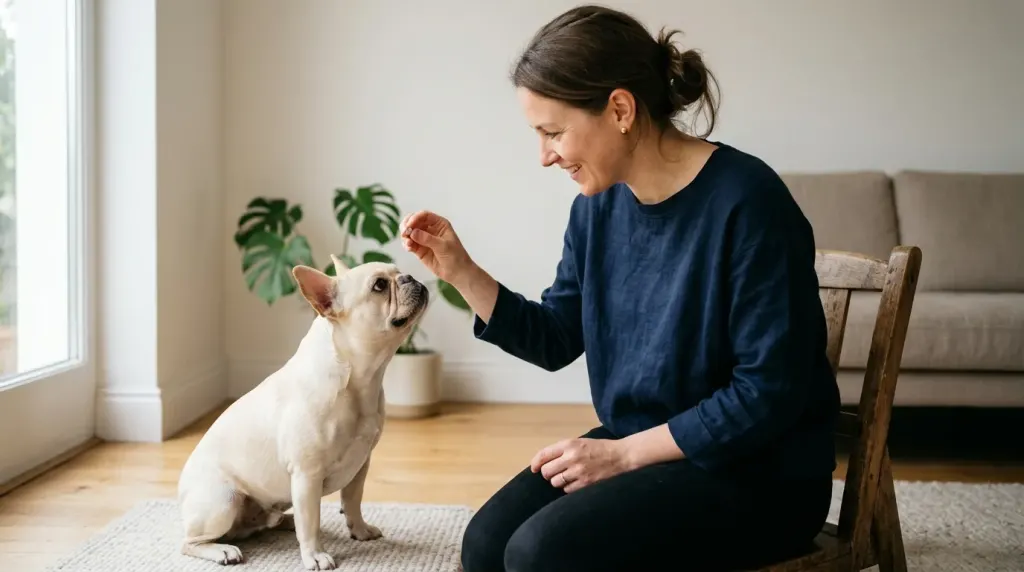
French Bulldogs possess sensitive emotional temperaments. Harsh physical corrections or loud verbal reprimands cause them to shut down, avoid eye contact, or refuse cooperation entirely. Utilizing effective French Bulldog training methods centered on high-value pea-sized treats, soft verbal markers, and enthusiastic play sessions keeps motivation high.
Structuring sessions into 3 to 5 minute intervals prevents mental fatigue and maintains enthusiastic participation throughout basic obedience and leash manners.
Assessing Learning Pace and Social Responsiveness
While French Bulldogs may take longer to execute repetitive obedience drills than herding breeds, assessing French Bulldog intelligence reveals strong contextual learning and social intuition. They quickly master house rules, crate routines, and polite greeting behaviors when expectations remain consistent across all family members.
Environmental Management and Daily Routine Structuring
Establishing a calm, structured home environment prevents boredom-related misbehaviors and promotes physical health.
Behavior-to-Action Decision Matrix
The table below outlines common behavioral scenarios, their underlying causes, and practical home solutions:
| Observed Behavior | Situational Context | Likely Root Cause | Recommended Home Action | Veterinary Threshold |
|---|---|---|---|---|
| Excessive Shadowing | Following family from room to room | Companion drive or mild insecurity | Place dedicated dog beds in main rooms; reward calm settled posture | Dog pants, cries, or claws doors frantically when separated by a baby gate |
| Sudden Shivering | Resting indoors in a warm room | Musculoskeletal pain, spinal strain, or nausea | Restrict movement to flat surfaces; avoid stairs and jumping | Shivering persists past 2 hours or is paired with an arched back and crying |
| Alert Barking at Windows | Seeing passersby or delivery vehicles | Visual arousal or territorial alert | Apply frosted window film to lower panes; redirect with a chew toy | Barking turns into frantic barrier aggression or redirected snapping |
| Restless Pacing | Evening or post-exercise hours | Overheating, respiratory strain, or bloating | Move to a cool air-conditioned space; check gum color and respiration | Dog cannot lie down comfortably, shows pale gums, or retches repeatedly |
| Furniture Chewing | Left unattended for 1 to 2 hours | Teething, boredom, or under-stimulation | Rotate durable rubber chew toys; increase structured sniffing walks | Chewing targets baseboards persistently alongside self-inflicted paw licking |
Environmental Enrichment and Daily Care Protocols
Structuring daily enrichment keeps indoor life engaging for low-endurance companion dogs. Integrating daily French Bulldog care routines such as daily facial wrinkle cleaning, ear checks, and orthopedic bed placement provides predictable structure. Pet ramps beside sofas eliminate spinal impact from jumping, while puzzle feeders slow down fast eaters and reduce aerophagia.
Furthermore, evaluating French Bulldog aggression risks underscores the value of early puppy socialization. Exposing young dogs to controlled sights, novel surfaces, and calm vaccinated dogs prevents fear-based reactivity and resource guarding from developing in adulthood.
Frequently Asked Questions About French Bulldog Behavior
Do French Bulldogs bark a lot?
French Bulldogs generally do not bark excessively. They typically vocalize to alert owners to visitors, door knocks, or unusual outdoor sounds, and during energetic play sessions. Persistent nuisance barking usually stems from boredom, insufficient mental stimulation, or distress when left isolated.
Why are French Bulldogs so clingy?
French Bulldogs were developed specifically as companion lapdogs, giving them a strong genetic drive for human proximity. They naturally prefer to remain in the same room as family members. Providing cozy resting stations and practicing brief independent quiet times helps balance affection with emotional confidence.
Why is my French Bulldog shaking?
A French Bulldog may shake due to short-term excitement, cold room temperatures, fear during thunderstorms, or acute physical pain. If shivering occurs in a warm indoor environment without an emotional trigger, check for signs of spinal discomfort, abdominal distress, or muscle stiffness.
How much exercise does a French Bulldog need daily?
Most adult French Bulldogs thrive on two 15 to 20 minute walks per day along with short indoor play sessions. Because their brachycephalic airway anatomy makes heat regulation inefficient, strenuous running and midday summer walks should be avoided to prevent overheating.



Leave a Reply