
Table of Contents
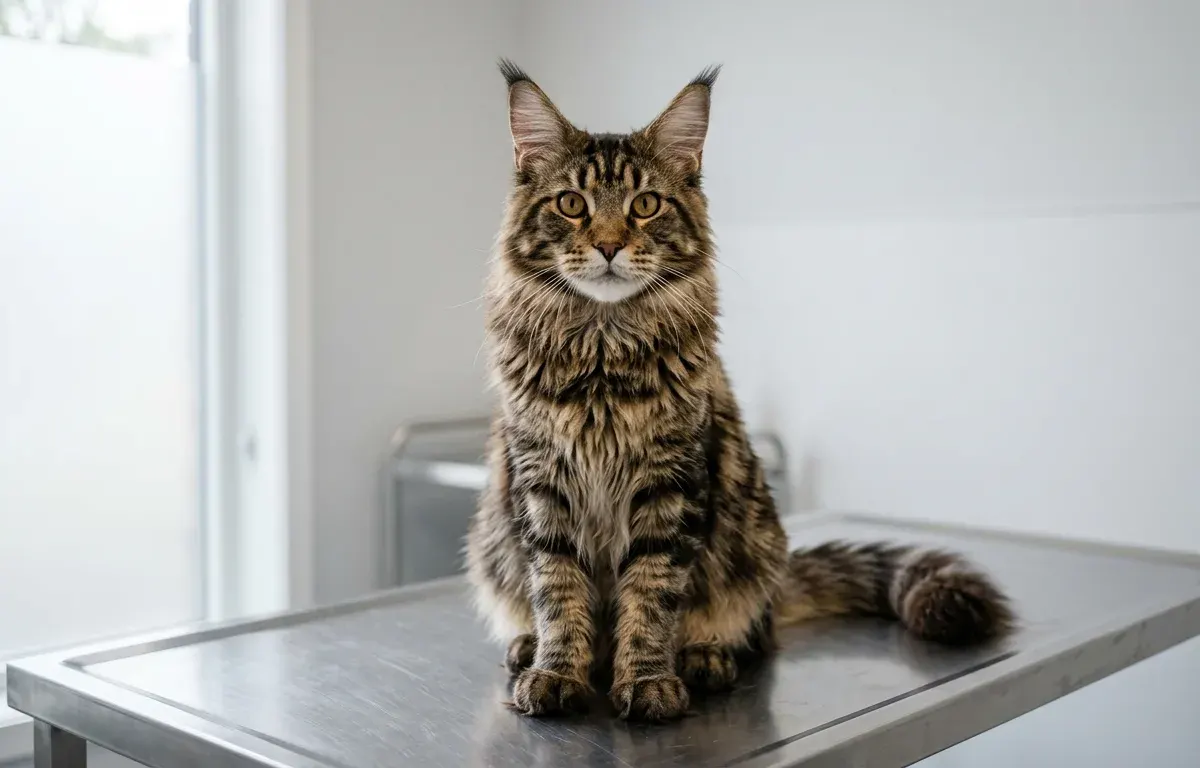
Learning how to identify a Maine Coon cat involves checking for a large rectangular body frame, a distinct square muzzle with a gentle concave profile dip, large lynx-tipped ears set high on the head, an uneven shaggy double coat with a frontal ruff, and a long plumed tail reaching the shoulders. Full physical maturity develops slowly over several years of growth. Because domestic longhair cats often share similar physical traits, official pedigree registration or genetic testing is required for definitive confirmation.
- Large rectangular frame: adult males weigh 12 to 18+ lbs (5.4 to 8.2 kg), while adult females average 8 to 12 lbs (3.6 to 5.4 kg).
- Distinctive head shape: a prominent square muzzle paired with high cheekbones and a gentle concave profile curve.
- Signature ears and tail: tall, wide-based ears with lynx tipping and a bushy plume tail as long as the cat's torso.
- Multi-layered all-weather coat: heavy water-repellent guard hairs, an uneven shaggy length, a frontal neck ruff, and britches on the hind legs.
- Slow physical maturity: Maine Coons experience prolonged development, continuing to grow and fill out their muscular frames over several years.
- Purebred verification: physical traits indicate breed type, but certified pedigree registration or DNA testing provides definitive confirmation.
Physical Characteristics to Identify a Maine Coon Cat
The Maine Coon is North America’s native longhaired cat, developed through natural selection to survive rugged northeastern winters. According to the Cat Fanciers’ Association (CFA) breed standard, the Maine Coon is a solid, muscular working cat with a well-balanced, rugged appearance.
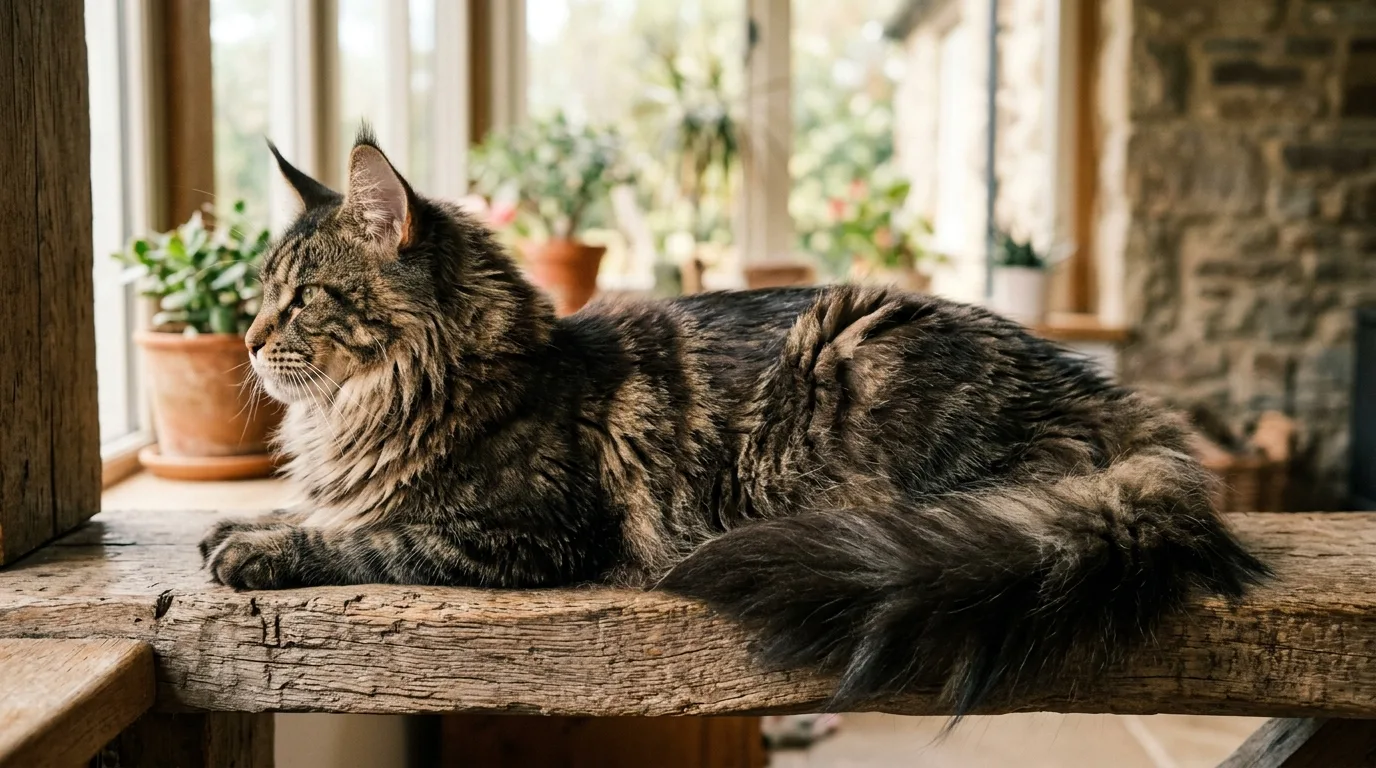
Evaluating physical traits begins with the cat’s overall frame, facial geometry, ear placement, coat distribution, and tail structure.
Rectangular Body Shape, Weight, and Skeletal Build
Maine Coons have a substantial, rectangular torso with a broad chest and heavy bone structure. Unlike compact, cobby, or tubular cat breeds, the body is long, solid, and medium to large in overall proportions.
- Adult Males: Typically weigh between 12 and 18+ lbs (5.4 to 8.2 kg), with some large individuals reaching 20 to 25 lbs (9 to 11.3 kg) without carrying excess adipose tissue.
- Adult Females: Generally weigh between 8 and 12 lbs (3.6 to 5.4 kg), occasionally reaching 14 lbs (6.3 kg).
- Length: Full-grown Maine Coons frequently measure 30 to 40 inches (76 to 101 cm) from the tip of the nose to the end of the tail, standing 10 to 16 inches (25 to 40 cm) tall at the shoulder.
This gradual skeletal development differs from other domestic breeds. Prospective owners tracking multi-year growth patterns often compare this trajectory with how big Ragdoll cats get to understand how long giant domestic feline breeds take to fill out their frames.
Head Geometry, Square Muzzle, and Profile Curve
The head shape is one of the most reliable visual markers separating a Maine Coon from other longhaired domestic cats:
- Muzzle: Visibly square and boxy. When viewed from the front or in profile, the muzzle forms a distinct blunt rectangle rather than a tapering wedge or a smooth triangle.
- Profile: Features a gentle concave curve (a slight dip) between the forehead and the nose. There should be no pronounced Roman nose hump or flat, unbroken slope.
- Cheekbones: High and prominent, giving the face a broad, sculpted look beneath large, expressive eyes.
- Chin: Firm and strong, aligned vertically with the upper lip and nose tip, forming a clean 90-degree angle with the jawline.
Large Lynx-Tipped Ears and Dense Furnishings
Maine Coon ears are large, broad at the base, and set high on the head, roughly one ear’s width apart:
- Lynx Tips: Tufts of hair extending vertically from the tips of the ear leather (often called lynx tipping). While desirable and common, tip length can vary between individual bloodlines.
- Ear Furnishings: Dense tufts of long fur growing from inside the ear canal outward past the ear edges, protecting the delicate canal from freezing drafts and debris.
- Ear Hygiene: Because heavy ear furnishings collect wax and environmental dust, pet owners maintain ear health by using gentle wiping routines, comparable to techniques used when learning how to clean French Bulldog ears to prevent otic inflammation.
Heavy Shaggy Coat Texture, Neck Ruff, and Britches
The coat is heavy, all-weather, and water-repellent, designed for outdoor resilience in severe sub-zero climates:
- Multi-Layered Texture: A soft, fine undercoat covered by substantial, water-resistant guard hairs. The texture is silky with body, falling smoothly along the flanks rather than standing out plushly like an exotic shorthair or Persian coat.
- Uneven Shaggy Length: Fur is shorter on the shoulders and neck nape, gradually lengthening along the back, flanks, and stomach.
- Frontal Neck Ruff: Long fur framing the chest and neck, resembling a lion’s mane, which becomes noticeably fuller during winter months.
- Britches: Long, thick, shaggy fur covering the upper hind legs down to the hocks, providing insulation when sitting on frozen ground.
Plumed Tail Length and Tufted Snowshoe Paws
- Tail: Long, wide at the base, and tapering toward the tip with flowing, plume-like fur. When pulled gently along the cat’s side, the tail should reach the shoulder blade or the base of the neck. In cold weather, the cat wraps this bushy tail around its face and paws for thermal insulation.
- Paws: Large, round, and heavily tufted with long fur sprouting between the toes (snowshoe paws), providing traction on snow and ice. Polydactyly (extra toes) occurs naturally in historical lineages, though modern show standards typically specify five toes in front and four behind.
How to Tell if Your Cat is a Maine Coon: Step-by-Step Checklist
Evaluating whether a cat matches the Maine Coon breed standard involves assessing multiple physical features simultaneously. A single trait, such as long fur or ear tufts, is common among non-purebred cats; a genuine Maine Coon displays a consistent combination of specific structural markers.
The comparison table below outlines key anatomical differences between a Maine Coon, a Domestic Longhair (DLH), a Ragdoll, and a Norwegian Forest Cat:
| Feature | Maine Coon | Domestic Longhair (DLH) | Ragdoll | Norwegian Forest Cat |
|---|---|---|---|---|
| Body Frame | Large, muscular, rectangular | Variable (medium, mixed bone) | Large, muscular, broad | Sturdy, muscular, high hind legs |
| Muzzle Shape | Distinct square, boxy muzzle | Rounded or tapered | Medium, gently rounded wedge | Triangular head, straight profile |
| Profile Line | Gentle concave dip | Variable (flat, curved, or stop) | Gentle curve with slight dip | Straight line from brow to nose tip |
| Ear Structure | Large, high-set, lynx-tipped | Small to medium, variable tufts | Medium, forward tilt, rounded tips | Large, wide base, follows face triangle |
| Coat Structure | Shaggy, multi-layered with ruff | Single or double, variable length | Semi-long, plush, non-matting | Dense double coat with woolly undercoat |
| Tail Length | Long, bushy plume (reaches neck) | Medium to long, variable plume | Long, bushy, proportionate | Long, flowing, bushy tail |
| Eye Shape | Large, slightly oval to round | Variable | Large, expressive, oval (always blue) | Large, almond-shaped, oblique |
| Growth Timeline | 3 to 5 years to full maturity | 1 to 2 years to full adult size | 3 to 4 years to full maturity | 3 to 5 years to full maturity |
When evaluating rescue cats or purebred lookalikes, comparing these physical markers helps clarify breed type, similar to identifying physical markers used to identify a Ragdoll cat through pointed coat patterns, color restrictions, and distinct eye geometry.
How to Tell if You Have a Maine Coon Cat by Head Shape and Coat Texture
To evaluate your cat at home, conduct a hands-on physical check focusing on head conformation, skeletal mass, and coat layering:
- Frontal Muzzle Check: Look directly at your cat at eye level. Place your fingers gently around the muzzle behind the whisker pads. A Maine Coon muzzle feels distinctly square and broad, like a small box, rather than tapering inward toward the nose leather.
- Side Profile Check: View your cat from the side. Trace the bridge of the nose up to the forehead. You should see a gentle, shallow curve dipping between the eyes. If the bridge is entirely straight with no dip, the cat shares more traits with a Norwegian Forest Cat; if the dip is sharp and deep (a break), it resembles a Persian or British Longhair lineage.
- Coat Shagginess Test: Run your hands along the coat from shoulder to hip. The fur should transition from shorter on the shoulder blades to noticeably longer, shaggier locks along the belly and thighs. A coat of uniform length throughout the body suggests a Domestic Longhair rather than a Maine Coon.
- Body Condition and Frame Evaluation: Feel along the ribcage and spine. A Maine Coon has a heavy bone structure with substantial muscular width. If a cat is heavy simply due to excess body fat rather than skeletal bone mass, owners implement nutritional adjustments and portion control, mirroring approaches on how to help a Pug lose weight to restore a healthy body condition score.
Do Maine Coon Cats Have an M on Their Forehead?
Yes, many Maine Coon cats have a visible “M” marking on their forehead, but this marking is not exclusive to Maine Coons.
The “M” shape is a genetic feature of the agouti gene, which produces the tabby coat pattern across all domestic felines. Any cat displaying a classic, mackerel, spotted, or ticked tabby pattern, including mixed-breed Domestic Shorthairs and Domestic Longhairs, will have an “M” on its brow.
Furthermore, Maine Coons come in solid colors (such as solid black, solid white, or solid blue), bi-colors, and smoke patterns that do not display a visible “M” at all. Relying on an “M” marking to identify a Maine Coon is inaccurate; head geometry, ear tipping, body proportions, and coat distribution provide far more reliable indicators.
How to Identify a Maine Coon Kitten
Identifying a Maine Coon kitten requires looking for early developmental indicators, as kittens do not yet possess the full neck ruff, mature body mass, or heavy shagginess of adult cats.
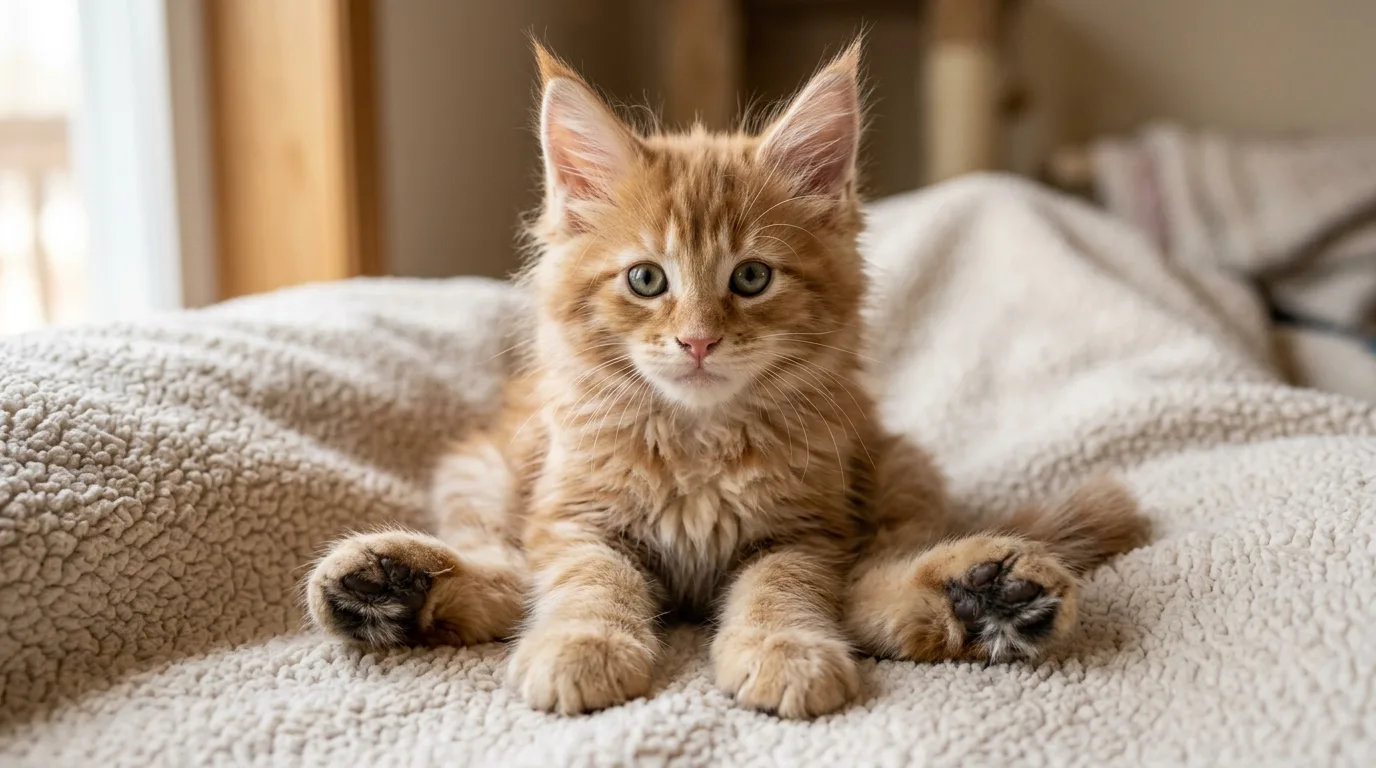
How to Tell if You Have a Maine Coon Kitten: Early Physical Clues
During early development (typically around two to four months of age), purebred Maine Coon kittens begin showing several distinctive physical markers, though individual growth rates vary by bloodline:
- Oversized Paws: Maine Coon kittens have noticeably large, heavy-boned paws with thick wrist joints relative to their body size. Tufts of fur between the toe pads are often visible within the first two to three months.
- Early Ear Tipping and Furnishings: The ears appear disproportionately large on a kitten’s head. Fine lynx tufts at the tips and dense wisps of fur inside the ears become prominent around three months of age.
- Muzzle Definition: While still growing, the muzzle should already show a blunt, squared-off contour rather than a fine, pointed face.
- Tail Thickness: The tail is broad at the base and covered in dense, soft fur that fluffs out noticeably before the main body coat develops its full length.
- Steady Growth Rate: Maine Coon kittens gain weight rapidly during growth spurts, frequently adding 1 to 2 lbs (0.45 to 0.9 kg) per month through early growth phases.
During these rapid skeletal growth windows, giant-breed kittens require significant downtime to support healthy bone and muscle formation, mirroring how much sleep puppies need during their early developmental stages.
Kitten Growth Velocity and Weight Tracking Milestones
Because full physical maturity develops gradually over three to five years, tracking developmental stages offers helpful growth context:
- Three Months: 3.5 to 5.5 lbs (1.6 to 2.5 kg).
- Six Months: 7.5 to 12 lbs (3.4 to 5.4 kg), with male kittens often matching the size of average adult domestic cats.
- Twelve Months (One Year): 11 to 16 lbs (5.0 to 7.3 kg) for males, 8 to 11 lbs (3.6 to 5.0 kg) for females.
- Two to Three Years: Skeletal frame reaches full length, followed by chest broadening and muscle filling.
Raising a high-energy, fast-growing young pet also involves establishing consistent household boundaries and routine socialization, using patience similar to guidance on how to train a puppy during early learning phases.
Is My Cat a Maine Coon or a Mix?
Many cat owners adopt a large, longhaired cat from a shelter and wonder if they have a purebred Maine Coon or a partial mix. Understanding feline genetics clarifies why so many domestic cats resemble Maine Coons without sharing purebred ancestry.
How to Tell if Your Cat is Part Maine Coon
A cat labeled as a “Maine Coon mix” by a rescue group is usually a Domestic Longhair (DLH). The domestic cat gene pool naturally carries the genes for long hair, large bone structure, tufted paws, and tabby patterns. When these independent genes combine naturally, the resulting cat can look strikingly like a Maine Coon.
There are only two methods to verify purebred or mixed Maine Coon status with scientific accuracy:
- Official Pedigree Registration Papers: A certified 3-to-5 generation pedigree issued by a recognized feline registry tracks verified purebred lineage from licensed catteries.
- Feline DNA Testing: Commercial feline genetic panels analyze genetic markers against reference breed databases to report breed similarity percentages.
Prospective owners budgeting for a registered kitten often review breed costs and adoption fees, comparable to researching how much Ragdoll cats cost when deciding between purebred breeders and rescue adoptions.
Certified Pedigree Documentation vs Commercial Feline DNA Testing
While physical appearance offers helpful clues, pedigree documentation remains the gold standard in feline breed identification. Official pedigree certificates provide authoritative verification that both parents are registered purebreds belonging to established bloodlines.
Commercial feline DNA testing panels (such as Wisdom Panel or Basepaws) compare your cat’s genetic markers to reference populations. If your cat is a first-generation or second-generation cross (50% or 25% Maine Coon), genetic panels can identify those ancestral markers. However, in cats with multi-generational mixed domestic ancestry, genetic tests often reflect general domestic feline heritage rather than pure breed percentages.
Hereditary Health Conditions and Genetic Screening
Verifying genetic background is also valuable for preventive healthcare. Purebred Maine Coons and their direct mixes carry elevated risks for specific hereditary conditions:
- Hypertrophic Cardiomyopathy (HCM): A thickening of the heart muscle. Responsible breeders test breeding stock for the known Maine Coon-specific cardiac mutation (MYBPC3 A31P gene).
- Spinal Muscular Atrophy (SMA): A genetic motor neuron disorder affecting spinal cord nerves.
- Pyruvate Kinase Deficiency (PKDef): An inherited hemolytic anemia affecting red blood cell metabolism.
Scheduling regular echocardiograms and genetic health panels helps owners manage long-term wellness and monitor life expectancy, similar to tracking longevity factors and learning how long Ragdoll cats live in large domestic breeds.
Personality and Behavioral Clues in Maine Coon Identification
While physical conformation remains the primary criteria for breed identification, Maine Coons are known for distinct behavioral characteristics often described as canine-like:
Distinct Vocalizations: Chirps, Trills, and Squeaks
Maine Coons rarely produce loud, harsh meows. Instead, they communicate using soft chirps, trills, squeaks, and purr-meows, especially when greeting family members, announcing their presence, or investigating new rooms.
Affectionate Temperament and Canine-Like Companionship
- Companionable Nature: They tend to be shadow cats that follow family members from room to room, preferring to stay nearby rather than demanding constant lap-sitting.
- Playfulness and Fetching: Many Maine Coons retain kitten-like playfulness into adulthood, frequently retrieving tossed toys or carrying items in their mouths. Training a retrieving cat uses positive reinforcement methods similar to how to train a French Bulldog through short, reward-focused play sessions.
- Multi-Pet Sociability: Their confident, easygoing temperament allows them to coexist well with companion dogs. Families who also understand how to care for a French Bulldog or other companion breeds find that a calm, well-socialized Maine Coon integrates smoothly into a multi-pet home.
Behavioral traits like chirping vocalizations and water fascination provide supporting clues, but they can appear in any curious domestic cat. Temperament should always be evaluated alongside physical conformation and pedigree evidence rather than used as standalone proof.
Coat Care, Summer Heat Management, and Thermal Regulation
Managing a Maine Coon’s dense, multi-layered coat requires regular grooming, especially during seasonal shedding cycles in spring and autumn:
Regular Brushing and Bathing Routines
The silky texture of a purebred Maine Coon coat is less prone to severe matting than a dense woolly Persian coat, but it still requires thorough combing two to three times weekly. A stainless-steel undercoat rake removes loose shed hair before it forms mats behind the ears or in the britches.
When bathing is necessary to remove built-up oil or dirt from the water-repellent guard hairs, owners follow consistent washing routines, comparable to recommendations on how often to bathe a French Bulldog to protect skin barriers and natural protective oils.
Summer Heat Management for Heavy-Coated Breeds
Because the Maine Coon coat was evolved for freezing northeastern winters, heavy-coated cats are sensitive to indoor heat and high humidity during summer months:
- Recognizing Thermal Discomfort: Cats with dense coats can experience thermal stress in poorly ventilated environments. Pet parents monitor breathing rates and lethargy, using observations similar to how to tell if a French Bulldog is overheating to spot early signs of thermal discomfort.
- Safe Cooling Strategies: Ensure constant access to air conditioning, fresh cold water, and shaded tile flooring. Ice mats and ceramic tiles provide cooling relief during heatwaves without the need for extreme measures like shaving the protective double coat.
Frequently Asked Questions About Identifying a Maine Coon
How big does a full-grown Maine Coon cat get?
Adult male Maine Coons typically weigh 12 to 18+ lbs (5.4 to 8.2 kg) and measure 30 to 40 inches in total length from nose to tail tip. Adult females weigh between 8 and 12 lbs (3.6 to 5.4 kg). They reach their full physical size and coat maturity gradually over three to five years of age, depending on individual sex and bloodline.
Can a short-haired cat be a purebred Maine Coon?
No. Purebred Maine Coons are naturally longhaired cats with heavy, multi-layered all-weather coats, shaggy textures, and prominent frontal neck ruffs. A short-haired cat cannot be a purebred Maine Coon.
What is the single most definitive way to prove a cat is a Maine Coon?
The only definitive proof of a purebred Maine Coon is official registration paperwork with a certified multi-generation pedigree from an accredited feline registry. Commercial feline DNA test panels can also detect breed-specific genetic markers to estimate ancestral heritage.
How do you distinguish a Maine Coon from a Norwegian Forest Cat?
The primary distinction is head shape and profile. A Maine Coon features a square muzzle, high cheekbones, large ears with lynx tips, and a gentle concave dip in profile. A Norwegian Forest Cat has a triangular head, ears following the outer jawline, and a straight, unbroken profile line from the brow to the tip of the nose.
Leave a Reply