
Table of Contents
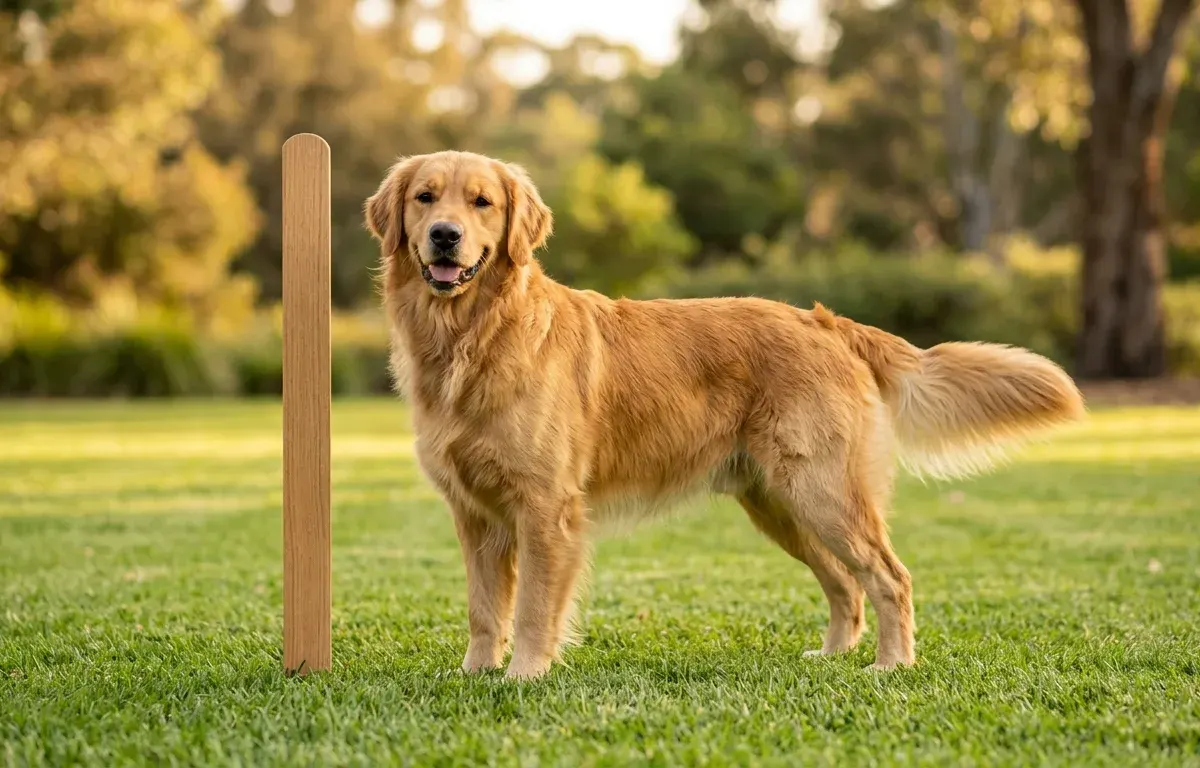
Adult Golden Retrievers are medium-to-large sporting dogs that stand 21.5 to 24 inches tall at the withers and weigh 55 to 75 pounds (25 to 34 kg) upon reaching physical maturity. Males are noticeably larger than females, averaging 65 to 75 pounds and 23 to 24 inches in height, whereas females average 55 to 65 pounds and 21.5 to 22.5 inches. Most individuals reach their full skeletal height around their first birthday, then continue developing lean muscle and chest breadth through their second year.
- Adult male Golden Retrievers weigh 65 to 75 lbs (29.5 to 34 kg) and stand 23 to 24 inches tall.
- Adult female Golden Retrievers weigh 55 to 65 lbs (24.9 to 29.5 kg) and stand 21.5 to 22.5 inches tall.
- Skeletal height is largely complete around one year of age, while muscle development and chest expansion continue through the second year.
- The 4-month weight rule offers a reliable estimate: puppy weight at 16 weeks is approximately 50% of adult body weight.
- Rapid weight gain from excess calories significantly increases the risk of developmental hip and elbow dysplasia.
When planning for a new puppy, a common question is: how big do Golden Retrievers get? Adult male Golden Retrievers typically stand 23 to 24 inches tall at the withers and weigh between 65 and 75 pounds (29.5 to 34 kg), while adult females stand 21.5 to 22.5 inches tall and weigh between 55 and 65 pounds (24.9 to 29.5 kg). Knowing their full adult dimensions helps families provide the right nutrition, crate sizing, and joint care across each stage of physical development.
Golden Retriever Size Overview: How Big Do Golden Retrievers Get as Adults?
The Golden Retriever is classified worldwide as a medium-to-large sporting dog, originally bred in the Scottish Highlands for retrieving waterfowl on land and in water. This heritage demands a powerful, symmetrical build capable of enduring long days in rugged terrain. According to official breed conformation standards from the American Kennel Club, an adult Golden Retriever combines physical strength with agile movement, presenting a compact, muscular torso supported by sturdy limbs.
Understanding expected adult dimensions is essential for planning home space, calculating feeding portions, and choosing appropriate travel equipment. While breed standards define strict numerical boundaries, individual dogs vary depending on genetic lineage, parental size, diet, and physical conditioning.
How Gender Influences How Big Golden Retrievers Get
Sexual dimorphism is distinct in Golden Retrievers. Male dogs consistently develop heavier bone structure, broader skulls, and wider chest spans than females. On average, a male Golden Retriever stands approximately 1.5 inches taller and carries 10 to 15 pounds more body mass than a female of comparable age and lineage.
Beyond basic measurements, male Golden Retrievers frequently take longer to finish maturing physically. While young males reach their adult height around one year of age, their characteristic “blocky” head shape and full muscular width across the shoulders often continue developing well into their second and third years. Females, by contrast, tend to settle into their mature silhouette earlier, typically completing their physical expansion well before their second birthday depending on individual bloodlines and activity levels.
Standard Weight Ranges: How Big Does a Golden Retriever Get?
Official kennel registries establish standard weight boundaries for purebred Golden Retrievers:
- Adult Males: 65 to 75 pounds (29.5 to 34.0 kg)
- Adult Females: 55 to 65 pounds (24.9 to 29.5 kg)
Clinical veterinary observations provide further context on weight distribution across mature dogs. Working and companion males at 18 months typically range from 30 to 36 kg (averaging 32 to 34 kg), with fully mature 3-to-4-year-old males stabilizing between 34 and 36 kg (averaging 35 kg). Mature females average between 24 and 28 kg (averaging 26 kg).
Maintaining a lean body condition is far more critical than aiming for the highest number on a weight chart. A dog carrying excess body fat faces higher risks of joint deterioration, cardiovascular strain, and shortened lifespan.
Visual Proportions: How Big Are Golden Retrievers in Everyday Life?
In person, a Golden Retriever presents an impression of harmonious symmetry, featuring a deep ribcage, level topline, and well-muscled hindquarters. However, their dense, water-repellent double coat can create an optical illusion, making them appear significantly broader and heavier than their true frame.
Because thick feathering on the chest, belly, legs, and tail can conceal underlying body contours, visual inspection alone is insufficient to evaluate body weight. Veterinarians recommend using a hands-on rib assessment (the “rib check”) alongside a Body Condition Score (BCS) system on a 1-to-9 scale. An ideal Golden Retriever maintains a BCS of 4 or 5 out of 9, where the ribs are easily felt under a light layer of fat without pressing hard, and a noticeable waistline is visible from above and in profile.
Maximum Size Boundaries: How Big Can a Golden Retriever Get?
While standard male weights cap at 75 pounds, some individual Golden Retrievers grow larger due to genetic variation or selective breeding for heavier bone mass. A healthy male Golden Retriever with an exceptionally large skeletal frame may weigh 80 to 85 pounds (36 to 38.5 kg) without being overweight. However, dogs exceeding 80 pounds require careful veterinary assessment to confirm that the extra mass represents lean skeletal structure rather than dangerous adipose tissue.
In rare cases, exceptional individuals exceed standard height limits. Registry records document rare Golden Retrievers reaching up to 30 inches (76.2 cm) at the withers. Such dogs are considered oversized for show conformation, but they can live active, healthy lives when their weight and exercise routines are managed responsibly.
Size Comparison: How Big Is a Golden Retriever Compared to a Wild Wolf?
Comparing a domestic breed to its wild ancestors provides a helpful sense of scale. A standard North American grey wolf (Canis lupus) typically weighs between 75 and 125 pounds (34 to 57 kg), with large northern males occasionally reaching 140 pounds.
An adult male Golden Retriever at 70 pounds sits near the lower boundary of an adult female wild wolf. This comparison highlights that, while Golden Retrievers are gentle and affectionate family companions, they remain substantial, powerful animals with physical mass far exceeding toy breeds like how big Pug dogs get in companion homes.
Official Height Standards: How Tall Is a Golden Retriever?
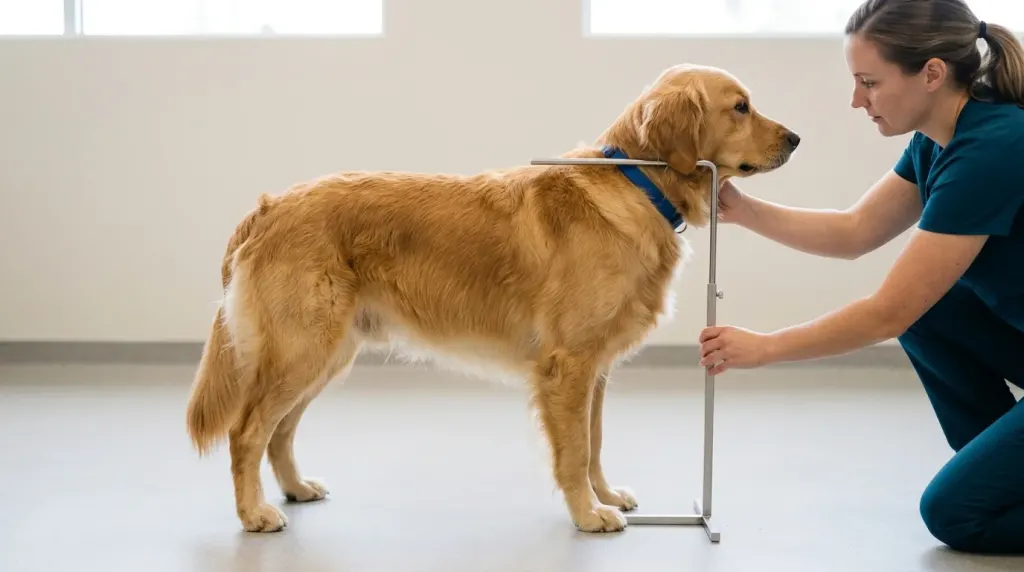
Canine height is measured from the level ground up to the withers, which is the highest point of the shoulder blades where the neck meets the back. Measuring to the top of the head is inaccurate because head carriage varies depending on posture and alertness.
Establishing standardized withers height ensures that dogs retain the functional proportions intended for their historical working roles. In show conformation, correct height is a primary judging criterion.
How to Measure Withers Height Accurately: How Tall Are Golden Retrievers?
Measuring your dog at home requires three simple steps:
- Have your dog stand squarely on a hard, flat surface with all four legs vertical and the head in a natural position.
- Locate the withers by feeling for the bony ridge where the neck connects to the shoulder blades.
- Use a rigid measuring stick or metal tape measure held perfectly vertical from the floor to the top of the withers, placing a level ruler across the shoulder blades to read the exact height.
Kennel Club Height Standards: How Tall Does a Golden Retriever Get?
Major international kennel organizations maintain tight specifications for height:
- American Kennel Club (AKC) Standards:
- Males: 23 to 24 inches (58.4 to 61.0 cm)
- Females: 21.5 to 22.5 inches (54.6 to 57.2 cm)
- Disqualification rule: Any dog deviating by more than 1 inch (2.54 cm) from these standard limits is penalized or disqualified in conformation events.
- Fédération Cynologique Internationale (FCI Standard No. 111):
- Males: 56 to 61 cm (22.0 to 24.0 inches)
- Females: 51 to 56 cm (20.0 to 22.0 inches)
These minor differences reflect regional preferences, but both standards describe a dog of athletic, medium-large proportions.
Height Progression by Month: How Tall Do Golden Retrievers Get?
A Golden Retriever puppy undergoes rapid skeletal lengthening during the first half-year of life:
- At 3 Months: Puppies stand roughly 12 to 14 inches (30 to 35 cm) tall.
- At 6 Months: Males reach approximately 19 to 22 inches (48 to 56 cm), while females reach 18 to 21 inches (45 to 53 cm), representing roughly 80% to 90% of their final height.
- At 9 to 12 Months: Skeletal vertical growth slows dramatically. Most Golden Retrievers reach 98% to 100% of their final withers height by their first birthday, gaining no more than half an inch thereafter as growth plates close.
Standing Height on Hind Legs: How Tall Golden Retrievers Reach
When an adult Golden Retriever stands on its hind legs to greet family members or reach for a surface, its paws and head can extend 32 to 36 inches (81 to 91 cm) above the floor.
Because Golden Retrievers can effortlessly rest their paws on countertops when standing upright, establishing early household boundaries is just as crucial as learning how to train a French Bulldog to prevent opportunistic scavenging or jumping behavior. Securing human foods, medications, and toxic substances like chocolate or raisins on high shelves prevents accidental ingestion.
Body Length and Physical Proportions: How Long Is a Golden Retriever?
Canine body length is measured from the prosternum (the front point of the breastbone) to the ischial tuberosity (the rearmost point of the buttocks).
According to conformation guidelines, a Golden Retriever’s ideal silhouette follows a 12:11 ratio of body length to withers height. This means that a dog standing 22 inches tall at the withers should measure approximately 24 inches in body length from breastbone to rump. This proportion produces a body that is slightly longer than it is tall, allowing for a free, ground-covering trot without appearing low-slung or excessively long in the loin.
When measured from the tip of the nose to the base of the tail, an adult Golden Retriever typically measures between 37 and 42 inches (94 to 107 cm) in total length. Maintaining these balanced 12:11 body proportions requires active weight management throughout adult life, especially since excess weight in compact companion breeds creates distinct challenges, as seen when comparing guidelines on how to care for a French Bulldog.
Comprehensive Size Chart by Age: What Is the Size of a Golden Retriever?
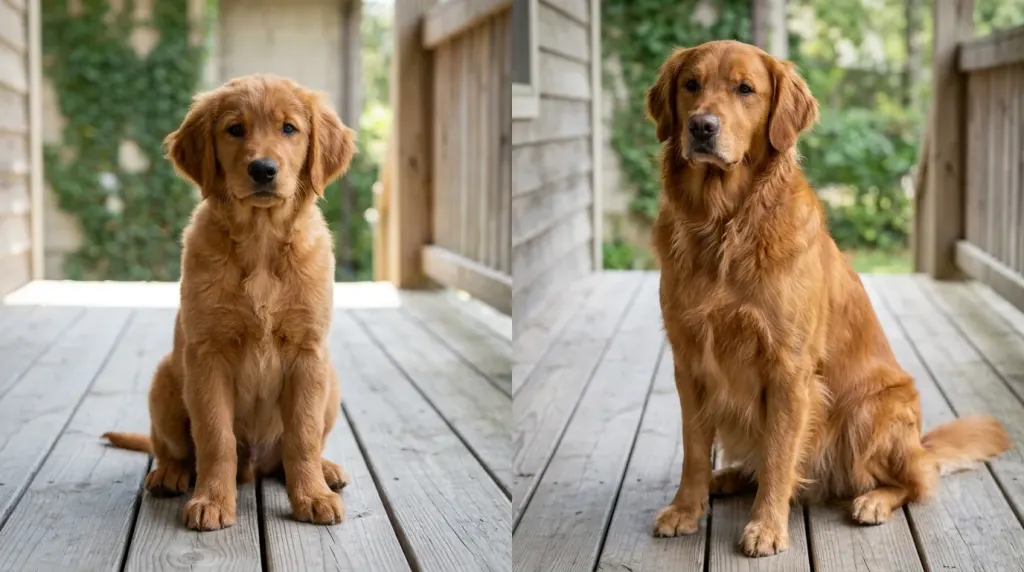
Canine growth follows a sigmoid curve, marked by rapid weight accumulation during puppyhood followed by a gradual tapering off during adolescence. A comprehensive study published in PLOS ONE on canine growth standards demonstrates that large-breed dogs experience their most intensive weight accumulation between 8 and 24 weeks of age.
Weight Chart by Age (lb and kg)
The following reference table outlines typical weight ranges for healthy Golden Retrievers from puppyhood to adulthood:
| Age | Male Weight Range | Female Weight Range | Estimated % of Adult Weight |
|---|---|---|---|
| 2 Months (8 Weeks) | 12 – 18 lb (5.4 – 8.2 kg) | 10 – 16 lb (4.5 – 7.3 kg) | ~22% |
| 3 Months (12 Weeks) | 20 – 28 lb (9.1 – 12.7 kg) | 18 – 25 lb (8.2 – 11.3 kg) | ~40% |
| 4 Months (16 Weeks) | 28 – 38 lb (12.7 – 17.2 kg) | 24 – 34 lb (10.9 – 15.4 kg) | ~50% |
| 5 Months (20 Weeks) | 35 – 48 lb (15.9 – 21.8 kg) | 30 – 42 lb (13.6 – 19.1 kg) | ~60% |
| 6 Months (24 Weeks) | 42 – 55 lb (19.1 – 24.9 kg) | 36 – 48 lb (16.3 – 21.8 kg) | ~70% |
| 8 Months (32 Weeks) | 52 – 65 lb (23.6 – 29.5 kg) | 45 – 57 lb (20.4 – 25.9 kg) | ~85% |
| 10 Months (40 Weeks) | 58 – 70 lb (26.3 – 31.8 kg) | 50 – 62 lb (22.7 – 28.1 kg) | ~92% |
| 12 Months (1 Year) | 62 – 75 lb (28.1 – 34.0 kg) | 53 – 65 lb (24.0 – 29.5 kg) | ~95% |
| 18 – 24 Months (2 Years) | 65 – 75 lb (29.5 – 34.0 kg) | 55 – 65 lb (24.9 – 29.5 kg) | 100% |
Individual puppies may experience minor growth spurts or plateaus. Tracking steady progress along a smooth curve is more important than matching an exact weekly number.
International Size Classification: What Size Are Golden Retrievers?
International canine nutritionists and breed clubs classify Golden Retrievers as a Large Breed because their adult body mass exceeds 25 kg (55 lbs).
Large-breed puppies have distinct developmental requirements compared to small or medium breeds. Because their skeletons must support substantial body mass, their bones grow over an extended 15-to-24-month timeframe. In multi-pet households, comparing canine developmental trajectories against companion breeds like how big French Bulldogs get helps owners plan appropriate feeding stations and separate resting zones.
Crate Size and Equipment: What Size Is a Golden Retriever Crate?
Selecting the correct crate size supports house training and joint comfort:
- Recommended Crate Length: 42 inches (107 cm) is the industry standard for adult Golden Retrievers. Exceptionally large males over 75 pounds may require a 48-inch (122 cm) crate.
- Selection Criteria: The crate must allow the dog to stand upright with its head in a natural position without touching the ceiling, turn around easily, and stretch out flat on its side with legs fully extended.
- Puppy Dividers: When purchasing a 42-inch crate for an 8-week-old puppy, use an adjustable divider panel to limit sleeping space during early potty training, expanding the interior as the puppy grows.
Selecting spacious 42-inch crates provides ample room for full body stretching, while smaller companion animals require distinctly different sleeping arrangements, as detailed in guides for how to take care of a Pug dog.
Growth Milestones: When Does a Golden Retriever Reach Full Size?
Canine growth progresses through distinct developmental stages, each with specific physical milestones.
Development Milestones from Puppyhood to Adulthood
-
Neonatal and Nursing Stage (Early Puppyhood): Puppies rely on maternal milk, gradually transitioning to solid food while developing sensory awareness, early motor coordination, and initial socialization with littermates.
-
Rapid Frame Growth (Early Adolescence): Puppies gain roughly 1.5 to 2 pounds per week as coordination improves, baby teeth emerge fully, and primary vaccinations begin. During this formative transition, structured house manners and crate routines mirror the fundamentals needed for how to train a Pug dog to establish positive lifetime habits.
-
The Lanky Adolescent Stage: Legs lengthen rapidly relative to torso depth, creating a temporary gangly appearance while adult teeth replace puppy teeth and exploratory curiosity peaks.
-
Height Stabilization and Coat Transition: Withers height nears completion as the soft puppy coat sheds out, replaced by a coarser, denser adult double coat.
-
Physical Filling Out: Withers height remains stable while the chest broadens, muscle mass thickens, and full adult feathering develops on the legs, tail, and underbelly.
Skeletal Maturity vs. Filling Out: When Do Golden Retrievers Reach Full Size?
Pet owners often confuse skeletal maturity with full physical maturity:
- Skeletal Growth Completion: The long bones of the legs stop growing as the cartilaginous growth plates (epiphyseal plates) at the ends of limb bones undergo calcification and close, typically around the dog’s first birthday.
- Muscular Filling Out: The dog builds adult muscle tone, expands its ribcage diameter, and develops full coat density through its second year. While height remains unchanged, body weight often increases by 5 to 10 pounds during this consolidation phase.
Female Golden Retrievers generally reach full physical maturity around two years of age, whereas males frequently continue building muscle until age 3. Owners managing multi-pet homes can compare this canine maturation window with large feline growth patterns by observing how big Maine Coon cats get across their prolonged multi-year skeletal development.
Field Lines vs. Show Lines: How Big Can Golden Retrievers Get?
Golden Retrievers have diverged into two distinct functional types, each with recognizable physical traits:
- Show Lines (Conformation): Bred to meet strict physical show standards, these dogs feature heavier bone structure, deeper chests, broader “blocky” heads, and dense, abundant coats. They tend to sit near the upper boundary of the standard weight range (65 to 75+ lbs).
- Field Lines (Working/Hunting): Bred for hunting agility, endurance, and field trials, these dogs feature lighter frames, narrower heads, longer legs, and shorter, less dense coats. Working lines often weigh 50 to 65 pounds, appearing leaner and more athletic while remaining completely healthy.
Developmental Delays: Why Is My Golden Retriever So Small?
It is common for owners to worry if their Golden Retriever appears smaller or leaner than other neighborhood dogs or online photos. In most instances, variation in size stems from natural genetics rather than health problems.
Natural Biological Factors Influencing Size
- Parental Genetics: Genetics is the single most influential determinant of adult body size. Puppies born to smaller field-bred parents will naturally mature into leaner, smaller adults.
- The “Runt” of the Litter: The smallest puppy in a litter, often resulting from late blastocyst implantation in the uterine horn, starts life with lower birth weight. With balanced nutrition and veterinary care, runts typically catch up to their genetically programmed adult size as they approach full maturity around two years of age.
Medical Causes of Growth Stunting in Puppies
When a puppy fails to gain weight steadily, a veterinary examination is necessary to rule out four common clinical conditions:
-
Intestinal Parasite Burdens: Heavy infestations of roundworms, hookworms, giardia, or coccidia deplete vital nutrients, causing poor muscle development and a bloated “potbellied” appearance. Regular parasite screening and proactive wellness checks protect long-term vitality across all pets, supporting healthy aging just as proactive veterinary monitoring influences how long French Bulldogs live.
-
Inadequate or Unbalanced Nutrition: Feeding poor-quality food or restricting calories during rapid growth phases deprives bones and muscles of essential amino acids, fatty acids, and minerals.
-
Early Pediatric Desexing: Spaying or neutering before growth plate closure removes sex hormones that signal growth plates to seal. This can cause limb bones to grow longer than normal, resulting in a taller, narrower, lighter-boned conformation with increased joint vulnerability.
-
Excessive Strenuous Exercise: Repetitive high-impact activities, such as long-distance jogging or jumping over obstacles before reaching one year of age, can cause microtrauma to open epiphyseal plates, leading to developmental bone deformities.
Risks of Rapid Growth and Developmental Skeletal Disorders
A widespread misconception among owners of large sporting breeds is that a heavier puppy is a healthier puppy. In reality, maximizing weight gain through excess calories or indiscriminate calcium supplementation places dangerous stress on developing joints.

Overfeeding does not increase a dog’s genetically determined adult height; it merely accelerates the rate of growth. This rapid weight gain forces immature cartilage and soft bone tissue to carry excessive loads, dramatically increasing the incidence of hereditary skeletal disorders.
Canine Hip Dysplasia (HD)
Hip dysplasia is a polygenic developmental condition where the femoral head (ball) and acetabulum (socket) of the pelvis fit together loosely. This laxity leads to abnormal joint friction, cartilage erosion, secondary osteoarthritis, and chronic lameness. Keeping joints lean and free from excessive mechanical pressure during bone formation directly impacts overall longevity, reflecting how weight management influences how long Pug dogs live over their lifespan.
While genetics establishes susceptibility, rapid weight gain and excess dietary energy accelerate joint degradation in predisposed puppies.
Canine Elbow Dysplasia (ED)
Elbow dysplasia encompasses developmental abnormalities of the elbow joint, including fragmented medial coronoid process (FCP), ununited anconeal process (UAP), and osteochondritis dissecans (OCD).
The canine elbow relies on the precise, millimeter-accurate alignment of three distinct bones: the humerus, radius, and ulna. When rapid growth causes uneven elongation rates between the radius and ulna, excessive mechanical pressure shears off vulnerable cartilage fragments. Managing growth rate through calorie-controlled large-breed puppy food formulated with an appropriate calcium-to-phosphorus ratio (1.1:1 to 1.3:1) is the most effective preventative measure against developmental skeletal disease. Keeping puppies lean (BCS 4/9) significantly reduces joint stress during bone formation.
Canine Brain Size: How Big Is a Golden Retriever’s Brain?
The Golden Retriever is renowned for exceptional intelligence, ranking 4th among all dog breeds in standardized working and obedience intelligence assessments. Golden Retrievers regularly master new commands in fewer than 5 repetitions and obey commands on the first attempt over 95% of the time.
Brain Anatomy and the “Shared Brain Cell” Meme
In medium-to-large domestic dogs, adult brain weight ranges between 50 and 130 grams (averaging approximately 72 to 80 grams), which is roughly the volume of a lemon or small tangerine.
Comparative neuroscientific assessments indicate that domestic dog brains contain approximately 530 million cortical neurons, compared to roughly 250 million in domestic cats. Canine cerebral mass features substantial neural density to support complex scent processing and rapid command retention, contrasting with domestic felines whose cognitive development is examined when studying how long Ragdoll cats live in home environments. Furthermore, a Golden Retriever’s brain possesses exceptionally well-developed olfactory bulbs, allowing them to process scent data with extraordinary precision.
In online pet culture, Golden Retrievers are affectionately teased as “all sharing a single brain cell.” This lighthearted meme celebrates the endearing contrast between their goofy, joyful, and sometimes clumsy everyday antics and their formidable working intellect in search-and-rescue, service work, and field trials.
Predicting Adult Size at Home: How Big Will My Golden Retriever Get?
Prospective and current owners often seek simple methods to estimate their puppy’s eventual adult size for dietary planning and gear selection.
The 4-Month Weight Rule for Large Breeds
A time-tested clinical rule of thumb for large sporting breeds states that a puppy’s weight at 4 months (16 weeks) represents approximately 50% of its final adult weight.
Estimated Adult Weight = Weight at 16 Weeks × 2
- Example 1 (Male Puppy): A male puppy weighing 33 lbs (15.0 kg) at 16 weeks projects to an adult weight of approximately 33 × 2 = 66 lbs (30.0 kg), placing him comfortably within standard male limits.
- Example 2 (Female Puppy): A female puppy weighing 28.5 lbs (12.9 kg) at 16 weeks projects to an adult weight of approximately 28.5 × 2 = 57 lbs (25.8 kg), aligning with typical female breed standards.
This 4-month doubling formula is tailored specifically for large canines, whereas feline weight milestones follow different trajectory curves when tracking how big Ragdoll cats get over their early development. Similarly, tracking kitten growth against adult benchmarks is essential when evaluating how much a Maine Coon cat weighs to distinguish healthy skeletal mass from excessive adipose tissue.
Note: Parental lineage and structured veterinary growth charting remain the most accurate predictive tools. Growth calculators provide helpful baseline projections rather than rigid guarantees.
Frequently Asked Questions About Golden Retriever Size
At what age is a Golden Retriever considered fully grown?
A Golden Retriever attains its full adult skeletal height around one year of age. However, dogs continue building lean muscle mass, expanding their chest width, and developing full adult coat feathering through their second year. Male dogs often take up to 3 years to reach peak muscular maturity.
How much should a 6-month-old Golden Retriever weigh?
At 6 months of age, a male Golden Retriever typically weighs between 42 and 55 pounds (19.1 to 24.9 kg), while a female weighs between 36 and 48 pounds (16.3 to 21.8 kg). This represents roughly 70% of their final adult body mass.
Can a healthy Golden Retriever weigh over 80 pounds?
Yes. Some purebred Golden Retrievers from show lines with broad bone structures or larger parental genetics can weigh 80 to 85 pounds while maintaining a healthy body condition score. However, any weight exceeding 80 pounds should be evaluated by a veterinarian using hands-on rib palpation to confirm that the dog is structurally large rather than overweight.
What is the difference in size between English Cream and American Golden Retrievers?
English Cream (British type) Golden Retrievers generally have a stockier build, slightly broader skull, deeper chest, and slightly shorter legs compared to American lines. However, both varieties fall within standard kennel club height limits of 21.5 to 24 inches at the withers.



Leave a Reply