
Table of Contents
So, are Maine Coons smart? Yes, Maine Coons rank among the most intelligent domestic cat breeds, characterized by sharp spatial problem-solving skills, strong social attunement, and high trainability. Often referred to as the dogs of the cat world, they readily learn household routines, interactive tricks, fetch, and harness walking through positive reinforcement.
- Maine Coons rank in the top tier of feline intelligence due to their keen spatial reasoning, observational learning, and quick adaptability.
- They display pronounced canine-like behaviors, including direct name recognition, interactive fetching, and close human attachment.
- Positive reinforcement clicker training enables Maine Coons to master cues, target touches, and leash walking effectively.
- High cognitive capacity requires structured daily mental stimulation and puzzle feeders to prevent boredom and exploratory mischief.
How Smart Are Maine Coons? (Cognitive & Social Intelligence Overview)
Maine Coons demonstrate an advanced degree of feline cognition characterized by quick observational learning, keen spatial problem-solving, and sophisticated social communication. Unlike many domestic cats that maintain solitary problem-solving habits, Maine Coons actively study their environment and use their physical size and dexterous paws to interact with household objects.
The Cat Fanciers’ Association (CFA) officially recognizes the Maine Coon for its outstanding intelligence, gentle disposition, and adaptability, noting that the breed adjusts smoothly to varied family environments. This native North American working breed developed its sharp intellect through generations of working on farms and ships, where independent thinking and agile hunting skills were essential for survival.
Feline cognitive studies evaluate intelligence across four primary dimensions: spatial reasoning, operant trainability, social attunement, and interspecies communication. While pet parents often assess companion learning rates when evaluating French Bulldog intelligence, feline intelligence manifests differently through environmental navigation, tool manipulation, and associative memory. Comparative animal behavior studies show that companion pets develop distinct cognitive strengths; just as assessing whether Pugs are smart dogs depends on their emotional attunement and eagerness to please, evaluating a Maine Coon centers on independent reasoning and tool manipulation.
| Cognitive Dimension | Maine Coon Characteristic | Practical Household Manifestation |
|---|---|---|
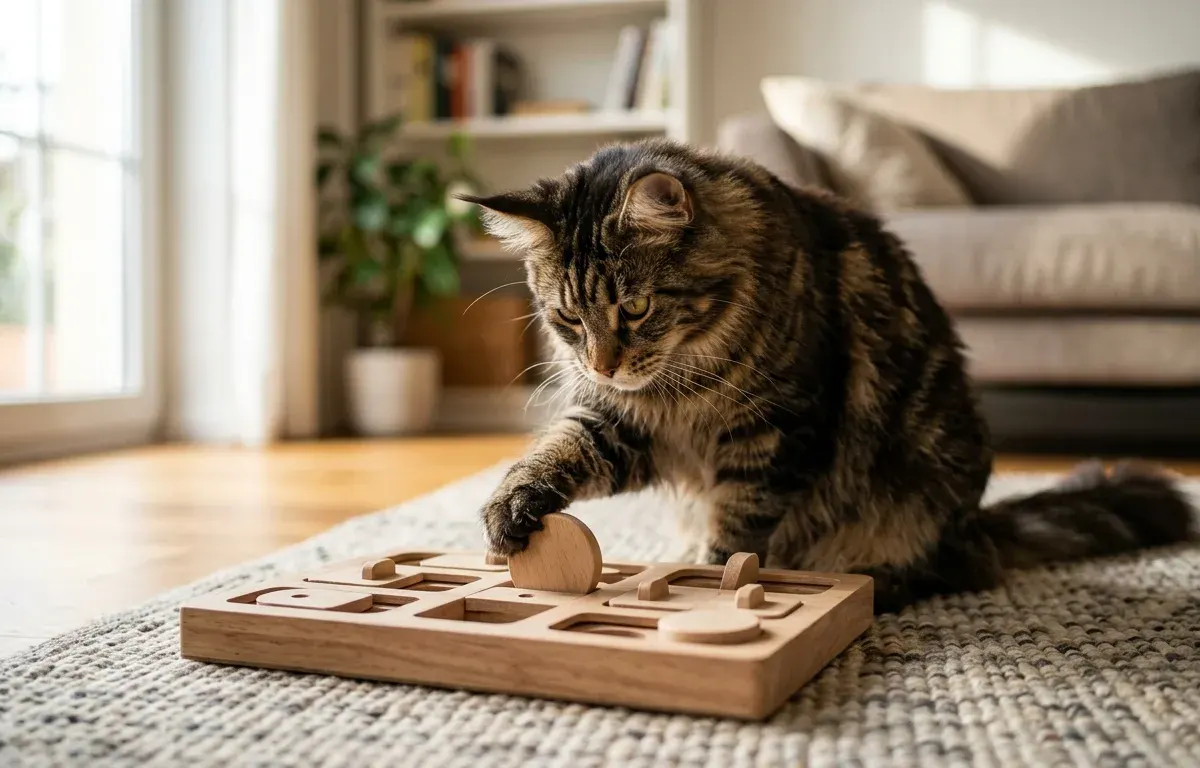
| Spatial Problem-Solving | High spatial awareness and tactile manipulation | Opening cabinet doors, turning lever handles, retrieving hidden toys |
| Operant Trainability | Rapid response to positive reinforcement | Learning clicker cues, recall, high-fives, and harness walking |
| Social Attunement | Close observation of human routines and emotion | Greeting owners at the door, following family members room to room |
| Interspecies Communication | Nuanced vocalizations and body language | Using chirps and trills rather than meows to signal specific needs |
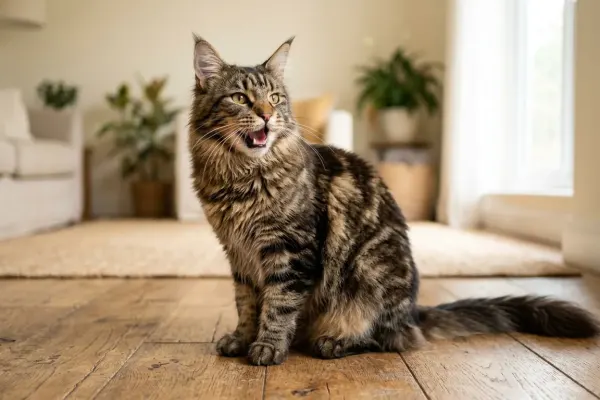
A defining element of Maine Coon intelligence is their vocal communication. Rather than relying on repetitive, loud meowing, Maine Coons produce a diverse range of chirps, trills, and soft chirrups. These distinct vocalizations allow them to express greeting, curiosity, playfulness, or hunger with clear contextual meaning.
5 Clear Signs of Maine Coon Intelligence in Everyday Life
Everyday life with a Maine Coon provides continuous evidence of their intellectual capabilities. Prospective and current owners regularly observe five distinct behaviors that demonstrate their problem-solving ability and memory retention.
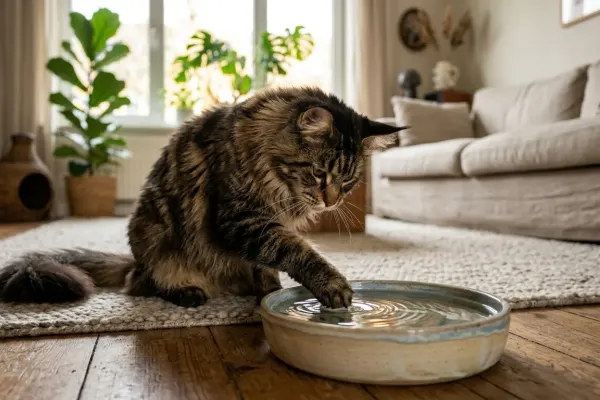
- Dexterous Paw Problem-Solving: Maine Coons possess large, tufted paws with remarkable dexterity. Many individuals have polydactyl heritage (extra toes), which enhances their grip. They frequently use their front paws like hands to grasp objects, scoop water into their mouths, turn doorknobs, and slide open closet doors.
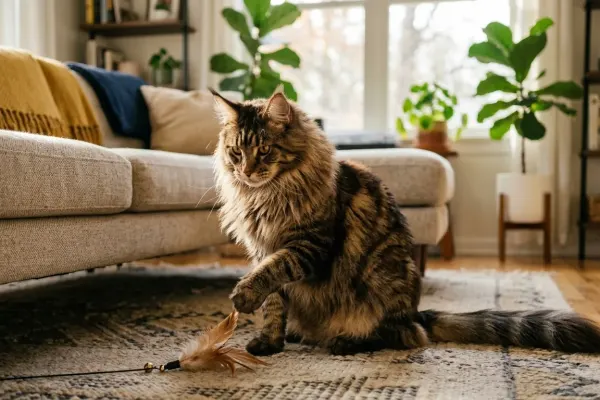
- Interactive Fetching and Toy Retrieval: While fetching is commonly associated with dogs, Maine Coons frequently initiate interactive retrieval games on their own. They will carry favorite toys in their mouths, drop them at their owner’s feet, wait for the throw, and reliably bring the item back for another round. Their willingness to initiate interactive retrieval games mirrors the enthusiastic companion nature seen in friendly Pug dogs, bridging the gap between typical cat independence and dog-like social play.
- Routine Awareness and Temporal Memory: Maine Coons maintain precise internal clocks. They quickly learn the sequence of household morning routines, recognizing the sound of an alarm, the specific drawer where their favorite treats reside, and the exact hour their owners return from work.
- Name and Verbal Cue Differentiation: Research in feline cognition confirms that cats can distinguish their given names from phonetically similar words. Maine Coons excel in this area, turning their heads, vocalizing with a chirp, or approaching directly when their name is spoken in a calm, clear tone.
- Empathetic Social Attunement: Maine Coons pay close attention to human emotional states. When a family member is unwell or distressed, they often provide quiet, comforting companionship. Unlike the intense physical dependency seen in why French Bulldogs are so clingy, a Maine Coon expresses its social devotion by staying near you in the same room without demanding constant lap holding.
How to Train a Maine Coon: Tricks, Harness Walking & Clicker Training
Because Maine Coons enjoy collaborative engagement, they respond exceptionally well to structured training. The key to successful feline education lies in positive reinforcement paired with clear acoustic marking.
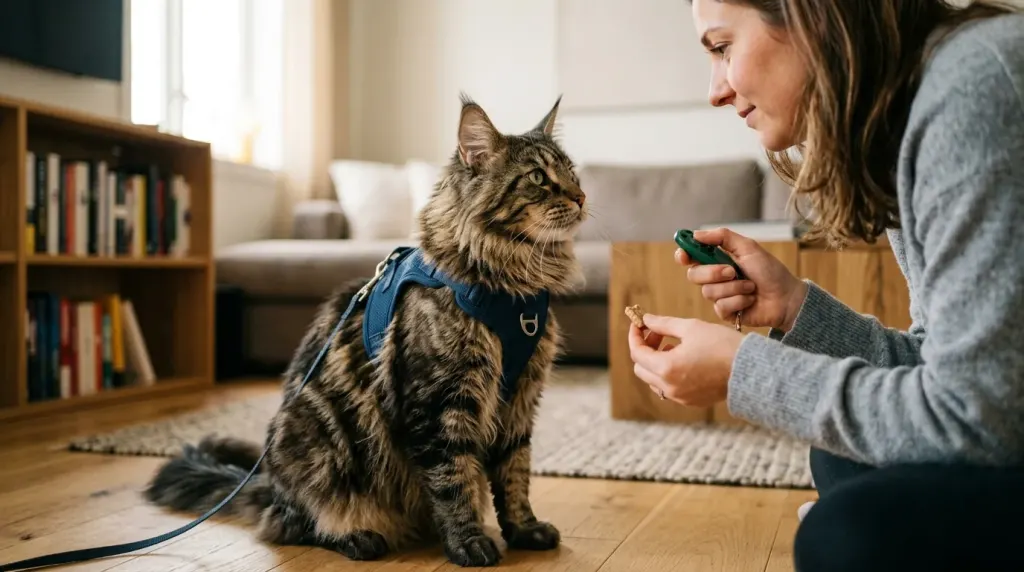
Step 1: Clicker Conditioning & Target Training
Step 2: Cue Shaping (Sit, High-Five, Recall)
Step 3: Harness Acclimation & Leash Walking
Stage 1: Clicker Conditioning and Target Touch
Clicker training establishes a precise communication bridge between pet and owner. Begin by clicking the device and immediately tossing a high-value treat (such as freeze-dried salmon or chicken) to build the association that a click always predicts a reward. Once conditioned, present a target stick or your finger near the cat’s nose. When the Maine Coon touches the target with its nose, click instantly and reward.
Stage 2: Cue Shaping and Trick Progression
Once your cat understands the target marker, guide them into basic behaviors:
- Sit Cue: Hold a treat slightly above the cat’s head and move it back toward their ears. As the head tilts up, the hindquarters naturally lower. Click the precise second the hips touch the floor and deliver the treat.
- High-Five / Fist Bump: Present your closed fist at chest level. When your cat reaches out with a paw to touch your hand, click and reward.
- Reliable Recall: Call your cat by name followed by a distinct cue word (such as “Come”) while shaking a treat container from across the room. Click and reward warmly upon arrival.
Much like the patient repetition needed when training Pugs as therapy dogs, successful feline clicker conditioning relies on short, calm sessions that reward small increments of progress. While early socialization helps in raising French Bulldogs as good family pets by setting clear household boundaries, Maine Coons learn household rules through gentle environmental cues and positive associations rather than verbal discipline.
Stage 3: Harness Desensitization and Leash Walking
Because Maine Coons are adventurous, many owners successfully train them for outdoor exploration. Use a secure, H-style or vest harness designed for large cats.
- Place the harness near your cat’s bedding for several days so it absorbs familiar household scents.
- Put the harness on for 2 to 3 minutes indoors while feeding high-value meals, then remove it.
- Gradually increase harness wear time over two weeks until the cat walks normally.
- Attach a lightweight leash indoors and follow the cat without pulling.
- Transition to a quiet, enclosed outdoor area once the cat exhibits calm confidence.
Positive reinforcement is essential for feline training. Harsh corrections or punishment induce fear, destroy trust, and halt learning progress. Keep training sessions between 5 and 10 minutes once or twice daily to match your cat’s natural focus span.
Preventing Boredom: Essential Mental Stimulation & Puzzle Feeders for Smart Cats
A sharp, inquisitive mind requires regular mental exercise. When an intelligent Maine Coon is left without appropriate environmental stimulation, boredom can lead to undesirable behaviors such as scratching furniture, opening kitchen cabinets, knocking items off counters, or excessive nighttime vocalization.
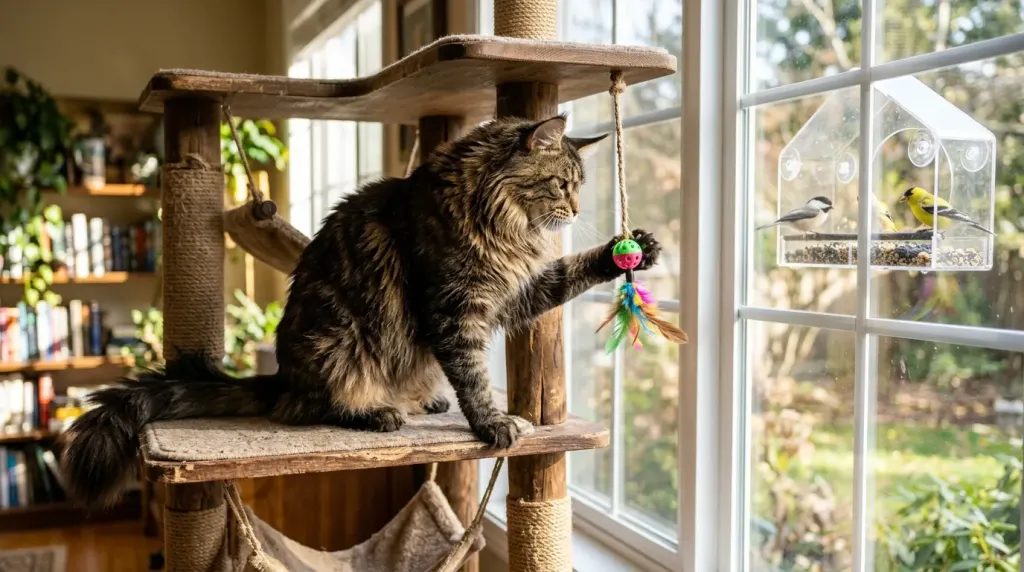
Just as indoor exercise routines and treat toys help channel energy in active Pug dogs, an intelligent Maine Coon requires structured daily puzzle challenges to keep its agile mind satisfied.
| Difficulty Level | Puzzle Type & Mechanism | Recommended Usage & Target Skill |
|---|---|---|
| Level 1: Beginner | Rolling treat balls and shallow maze bowls | Introduces paw-nudging and foraging concepts for kittens |
| Level 2: Intermediate | Sliding tile boards and treat-dispensing cups | Requires sequential paw swiping to unlock hidden food chambers |
| Level 3: Advanced | Multi-step puzzle boxes with pegs and lift-up lids | Challenges spatial memory and complex fine-motor paw manipulation |
In addition to interactive food puzzles, incorporate the following enrichment elements into your home:
- Sturdy Vertical Territory: Adult Maine Coons weigh between 15 and 25 pounds. Install heavy-duty, solid-wood cat trees with wide platforms and thick sisal scratching posts that can support their substantial weight.
- Visual Enrichment: Position high perches near windows overlooking bird feeders or garden activity (“cat TV”) to provide hours of engaging visual tracking.
- Toy Rotation: Keep toy selections fresh by rotating feather wands, kicking pillows, and crinkle balls every few days rather than leaving all toys on the floor continuously.
- Scent Games: Hide small portions of dry kibble or catnip-infused toys in paper bags, cardboard boxes, and puzzle mats around the house to encourage active exploratory hunting.
While compact indoor spaces work smoothly when Pugs thrive as apartment dogs with modest exercise, keeping an inquisitive 20-pound cat in an apartment demands deliberate vertical territory, such as multi-tier cat trees and window vantage points.
Maine Coon Intelligence vs. Other Cat Breeds (Comparative Breakdown)
When compared across domestic cat breeds, Maine Coons consistently rank in the top echelon for interactive and practical intelligence. However, their temperament distinguishes them from other high-IQ felines.
| Breed | Trainability Rating | Problem-Solving Drive | Energy & Activity Level | Social Temperament |
|---|---|---|---|---|
| Maine Coon | Very High | High (Tactile / Observational) | Moderate to High | Affectionate, patient, calm companion |
| Siamese | Very High | High (Vocal / Social) | Very High | Demanding, talkative, highly attached |
| Bengal | High | Very High (Physical / Agility) | Extremely High | High-energy, intense, athletic explorer |
| Ragdoll | Moderate | Moderate (Low-drive) | Low to Moderate | Placid, lap-oriented, gentle follower |
| Abyssinian | Very High | High (Curious / Inquisitive) | Very High | Constantly active, playful, independent |
While the Siamese and Bengal possess formidable intelligence, they often require continuous physical outlets and can become demanding or vocal if their exact schedules are disrupted. In contrast, Maine Coons offer a balanced combination of high trainability and a mellow, easygoing disposition.
When evaluating distinct feline personalities, friendly Ragdoll cats tend to be docile lap companions that prefer relaxed cuddling over complex puzzle solving. Prospective owners comparing companion cat breeds often weigh coat maintenance and dander levels when evaluating whether Ragdoll cats are hypoallergenic, but from a behavioral standpoint, Maine Coons require significantly more daily intellectual stimulation than placid longhaired breeds.
Unique Value: The Cognitive Enrichment Framework for Maine Coon Owners
Because Maine Coons develop slowly over an extended growth period before reaching full physical and behavioral maturity, their cognitive needs shift across distinct developmental stages. Implementing an age-tailored cognitive framework ensures your cat remains stimulated and well-adjusted throughout its life.
| Life Stage | Cognitive Development Focus | Key Enrichment Strategy |
|---|---|---|
| Kittenhood (2-12 Months) | Sensorimotor exploration, bite inhibition, socialization | Target touch conditioning, varied texture toys, gentle handling desensitization |
| Junior & Young Adult (1-3 Years) | High curiosity, spatial testing, physical agility | Multi-tier puzzle boards, leash training, obstacle agility courses |
| Mature Adult (3-8 Years) | Routine mastery, associative problem-solving | Scent foraging trails, trick maintenance, rotating interactive feeders |
| Senior Years (8+ Years) | Cognitive preservation, gentle mental stimulation | Low-impact sniffing mats, warm window perches, soft puzzle treat mats |
Senior cognitive care requires subtle adjustments; similar to the care shifts when identifying when Pugs are considered senior dogs, mature Maine Coons transitioning into their senior life stage benefit from low-impact scent games and accessible puzzle mats that keep neural pathways active without straining older joints.
Childproofing for a Large, Clever Feline
Living with a 20-pound cat that understands mechanical levers requires proactive home safety measures:
- Cabinet Safety: Install magnetic child locks on lower kitchen and bathroom cabinets where cleaning supplies or dry food bags are stored.
- Waste Bin Security: Use step-cans with locking lids to prevent dexterous paws from tipping over trash cans.
- Door Lever Awareness: If your home features horizontal door handles, consider replacing them with round knobs on rooms that must remain off-limits, as Maine Coons can easily jump up and pull down lever handles.
Frequently Asked Questions About Maine Coon Intelligence
Are Maine Coons easy to train?
Yes, Maine Coons are among the easiest cat breeds to train due to their natural curiosity, biddable temperament, and food motivation. Using a clicker paired with small, high-value treats allows owners to teach commands such as sit, stay, come, high-five, and leash walking within short, consistent daily training sessions.
Are Maine Coons smarter than dogs?
Feline and canine intelligence operate through different evolutionary frameworks. While dogs are bred for pack cooperation and direct human obedience, Maine Coons display comparable learning speed, associative memory, and problem-solving skills. Many Maine Coons match popular dog breeds in their ability to retrieve toys, learn verbal cues, and adapt to household routines.
Do Maine Coons get bored easily?
Yes, highly intelligent breeds experience boredom if their environment lacks stimulation. Without access to puzzle toys, climbing structures, and interactive play, a bored Maine Coon may develop unwanted habits such as opening cupboards, knocking items off tables, or scratching unapproved surfaces to create their own entertainment.
Can a Maine Coon learn its name?
Yes, Maine Coons readily learn their given names. Scientific studies on feline cognition demonstrate that cats recognize the specific phonetic structure of their names compared to other words. With regular verbal reinforcement and positive interaction, a Maine Coon will consistently respond to its name by looking, vocalizing with a chirp, or walking toward you.
Leave a Reply