
Table of Contents
Yes, most Maine Coon cats genuinely like water due to a 2-layer, water-repellent double coat and a maritime working heritage developed in 19th-century New England. Their dense undercoat and oily guard hairs insulate their skin from moisture, driving common behaviors like dipping paws into 1 to 2 inches of water, batting at dripping sink faucets, and investigating showers.
- Maine Coons have an innate fascination with water driven by a water-repellent double coat, maritime heritage, and high intelligence.
- Common water behaviors include dipping paws into bowls, batting at dripping faucets, submerging toys, and lounging in damp shower stalls.
- Enjoying voluntary water play does not mean Maine Coons want forced baths, which remain unnecessary for healthy cats that self-groom.
- Because their coat is water-resistant rather than waterproof, cats that get thoroughly wet require gentle drying and comb-outs to prevent matting.
Why Do Maine Coon Cats Like Water? 4 Key Reasons
Maine Coon cats are drawn to water through a combination of physical adaptations and behavioral traits. While most domestic felines avoid moisture because a soaked coat feels heavy and cold, the Maine Coon possesses biological features and evolutionary history that make water an inviting source of sensory enrichment.
According to the Cat Fanciers’ Association (CFA), the breed developed in the rugged climate of New England, where harsh winters demanded a heavy, all-weather coat. As documented across the foundational Maine Coon cat breed standards, these physical adaptations make moisture far less uncomfortable for them than for short-haired breeds.
| Factor | Maine Coon Adaptation | Impact on Water Tolerance |
|---|---|---|
| Coat Structure | Dense undercoat covered by longer, silky guard hairs | Repels surface moisture, keeping skin dry |
| Historical Background | Ship cats and barn mousers in maritime environments | Familiarity with damp docks and coastal weather |
| Mental Drive | High problem-solving intelligence and tactile curiosity | Treats moving streams and ripples as interactive prey |
| Temperament | Confident, dog-like personality with low neophobia | Approaches splashing water with curiosity instead of fear |
A Semi-Water-Resistant Double Coat
The Maine Coon features a heavy, 2-layer coat adapted to sub-zero New England winters. Long guard hairs reaching 2 to 4 inches in length are coated in natural sebum oils, allowing water droplets to bead up and run off before soaking the dense undercoat beneath. This natural oil barrier keeps skin dry when a cat steps into shallow puddles or plays under dripping water.
Maritime and Cold-Climate Heritage
Originating in Maine during the 19th century, these large working cats served as mousers on sailing ships and coastal farms. Surviving coastal winter temperatures down to -20 °F established a hardy gene pool comfortable around maritime dampness, sea spray, and wet wooden decks.
Tactile Curiosity and Visual Stimulation
Maine Coons rank among the most intelligent domestic cat breeds, requiring 20 to 30 minutes of daily sensory enrichment. Flowing water ripples at variable speeds, triggering hunting instincts refined over 150 years of breed development. Moving water bends light and produces distinct trickling sounds, turning every water basin into a dynamic puzzle.
Confident and Adventurous Temperament
Weighing 11 to 25 pounds at adult maturity, Maine Coons carry a bold, dog-like temperament with low neophobia. While smaller domestic breeds retreat from running water, a Maine Coon frequently approaches sinks within 1 to 2 seconds of hearing the tap. Similar curiosity can also be observed in other large companion breeds, such as Ragdoll cats and water interactions around household sinks and basins.
Common Water Behaviors: How Maine Coons Interact with Water
Water-loving Maine Coons display distinct behavioral patterns when interacting with household moisture. Rather than jumping directly into deep water, they engage in controlled, tactile games that allow them to explore fluid dynamics on their own terms.
| Behavioral Profile | Typical Action | Underlying Motivation | Management Tip |
|---|---|---|---|
| The Paw Dipper | Scoops water with curved paw to drink or splash | Testing depth, surface cleanliness, or texture | Use heavy ceramic bowls with wide bases |
| The Faucet Inspector | Bats at dripping taps or drinks from running streams | Attracted to fluid motion, sound, and fresh aeration | Install a multi-tier pet water fountain |
| The Toy Dunker | Drops plush mice or balls into the water dish | Simulating prey capture or washing cached items | Keep felt toys away from feeding stations |
| The Shower Sitter | Sits on wet tiles or steps into the shower stall | Enjoying warm humidity and exploring damp surfaces | Rinse soap residue thoroughly before allowing entry |
The Paw Dipper
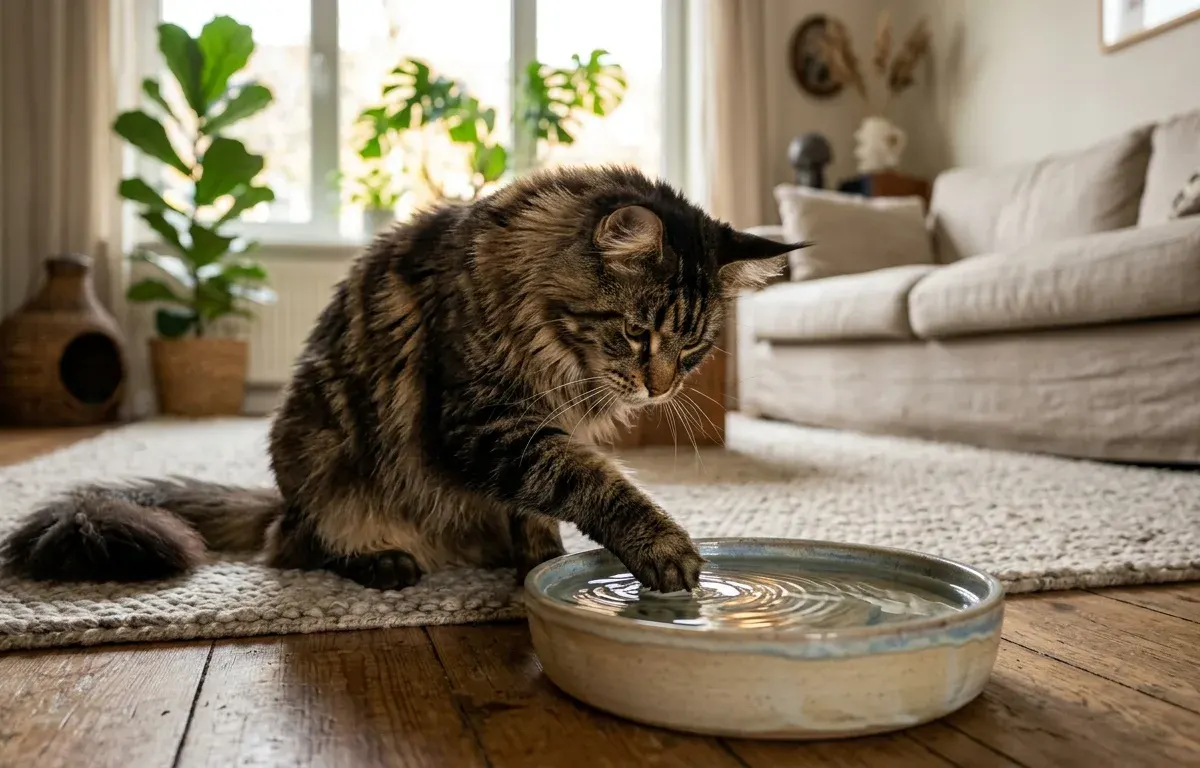
Maine Coons often dip their large, tufted paws into water dishes 2 to 3 times before drinking. This tactile habit tests surface tension and water depth (often 1 to 2 inches) or clears perceived surface film, a natural behavior observed in cats whose wild ancestors drank from forest streams.
The Faucet Inspector
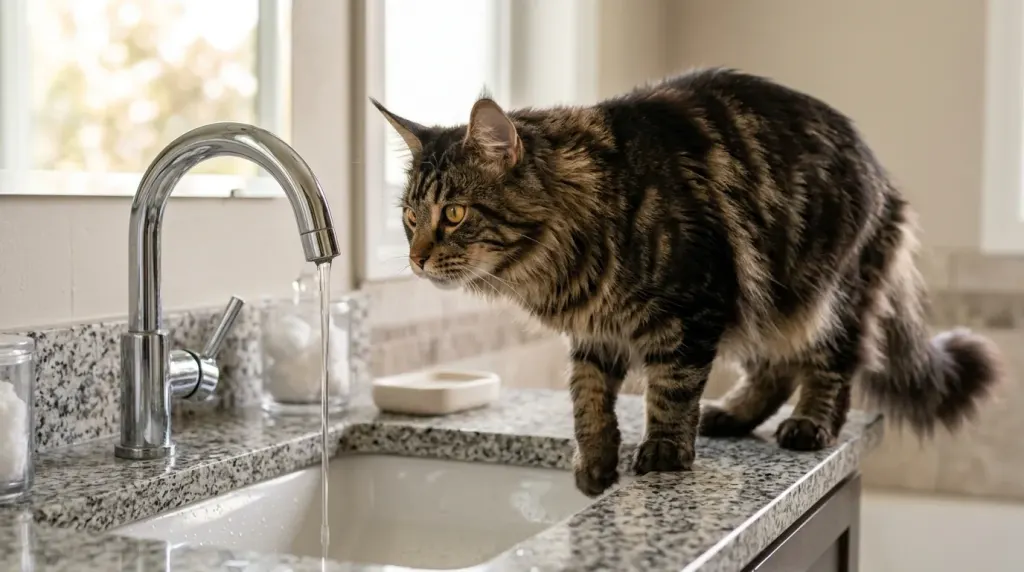
A dripping kitchen or bathroom tap provides both auditory and visual stimulation, with running water flowing at 1 to 2 gallons per minute or dripping at 30 to 60 drops per minute. Maine Coons frequently sit on countertops for 5 to 10 minutes at a time, tracking droplet movement and lapping aerated water directly from the faucet spout.
The Toy Dunker
Feline behavior studies attribute toy-dunking to ancestral prey-caching instincts, where cats dropped food items into water sources to mask scent trails from predators. In a home, owners often find 1 to 3 submerged felt mice, sponge balls, or plastic bottle caps at the bottom of water bowls each week.
The Shower Sitter
Bathrooms after a warm shower reach 75 to 80 °F with 70% to 80% relative humidity, creating a warm microclimate that Maine Coons enjoy. Many cats wait outside the glass stall for 10 to 15 minutes, stepping onto wet bathroom tiles immediately after the water stops to investigate warm puddles.
Analysis: Voluntary Play vs. Forced Bathing
Enjoying voluntary water play does not mean a Maine Coon wants to be submerged in 4 to 6 inches of bathtub water. Forcing a cat into standing or deep water removes their sense of footing and control, turning an enjoyable sensory game into a frightening experience.
A clear distinction exists between autonomous water play and a mandatory full bath. In autonomous play, a cat chooses contact depth (rarely exceeding 1 to 2 inches) and keeps all 4 paws planted firmly on non-slip surfaces. During a bath, slick porcelain surfaces, loud rushing water, and physical restraint provoke panic responses in even the most water-tolerant cat.
According to veterinary grooming standards, healthy domestic felines spend 30% to 50% of their waking hours self-grooming, meaning full-immersion baths are only necessary 1 to 2 times per year or when soiled with grease or sticky substances. Regular brushing combined with natural grooming keeps their coat clean and healthy without water immersion.
For localized dirt on the britches or paws, spot-cleaning with a warm damp cloth (around 98 to 100 °F) cleans soiled fur in 2 to 3 minutes without stripping natural skin oils or causing distress. Unscented feline grooming wipes provide another gentle option for spot maintenance.
How to Safely Provide Water Enrichment for Your Maine Coon
Providing structured water activities satisfies a Maine Coon’s curiosity while protecting household floors from excessive splashing. The following practices keep water play safe, hygienic, and engaging.
| Enrichment Tool | Benefit | Setup Recommendation |
|---|---|---|
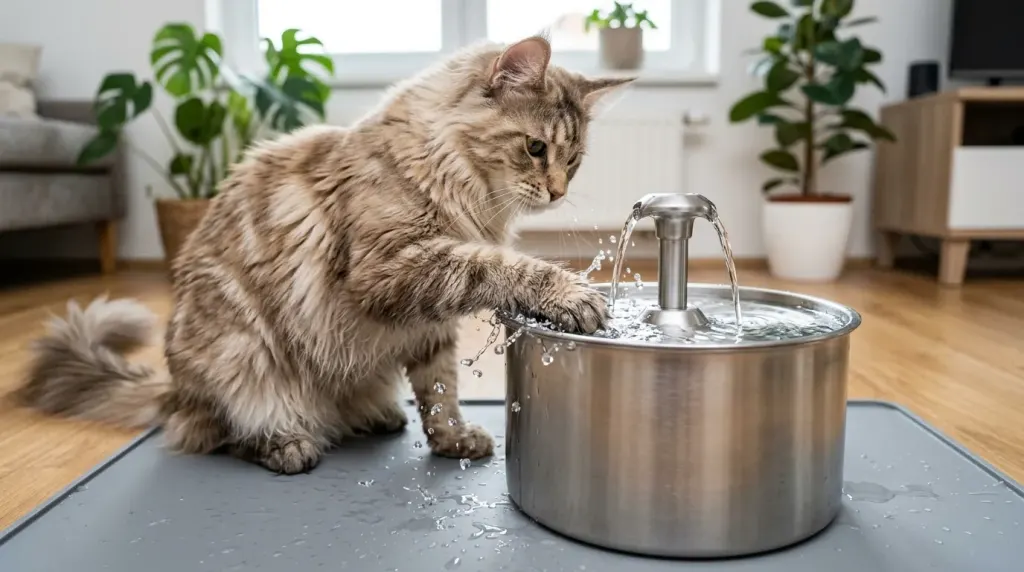
| Circulating Pet Fountain | Constant aeration and filtered running stream | Stainless steel or ceramic unit cleaned weekly |
| Shallow Sensory Splash Tray | Safe tactile splashing with floating items | Wide baking tray with 1 inch of lukewarm water |
| Heavy Stoneware Water Bowl | Prevents tipping and floor flooding | Wide-base bowl placed over a silicone lip mat |
| Ice Cube Enrichment | Slow-melting moving target for paw batting | Large round ice cubes placed in a shallow basin |
Install a Circulating Pet Water Fountain
Electric pet fountains with 2-liter to 3-liter capacities provide continuous water aeration, encouraging cats to meet their daily hydration target of 3.5 to 4.5 ounces of water per 5 pounds of body weight. Choose stainless steel or ceramic units with multi-stage carbon filters, cleaning the reservoir every 7 to 10 days to prevent bacterial biofilm.
Create a Shallow Sensory Splash Pan
Set up a dedicated splash basin using a shallow baking dish or sensory mat filled with 1 to 2 inches of lukewarm water (around 75 to 80 °F). Dropping 2 to 3 lightweight ping-pong balls or floating robotic fish into the tray allows 10 to 15 minutes of safe tactile exercise without soaking the cat’s undercoat.
Use Heavy-Bottom Bowls with Silicone Trays
Paw-hooking cats easily tip lightweight dishes under 1 pound. Upgrading to a wide stoneware or ceramic bowl weighing 2 to 4 pounds prevents tipping, while a food-grade silicone mat with a 0.5-inch raised perimeter lip contains any water splashes within a 12-by-18-inch area.
Maintain Household Water Safety
Curiosity around water requires 3 practical household safety measures:
- Keep toilet lids closed at all times to prevent accidental falls into 3 to 5 gallons of standing water containing chemical sanitizers.
- Never leave bathtubs filled with more than 2 inches of standing water unattended when curious cats have access.
- Cover outdoor rain barrels, garden water features, and 5-gallon mop buckets with tight-fitting secure lids.
Post-Water Care: Drying and Grooming Their Dense Coat
Although a Maine Coon’s outer coat repels light splashes, prolonged water play or heavy soaking penetrates down to the undercoat. If dense fur stays damp, the fine undercoat fibers tangle and felt together, forming painful mats near the skin. Following a simple post-water drying routine keeps their coat healthy and tangle-free.
Regular comb-outs prevent trapped moisture from turning into stubborn pelts, making this routine a core part of long-term Maine Coon care.
| Step | Action | Best Tool | Purpose |
|---|---|---|---|
| 1. Gentle Towel Blotting | Press microfiber towels against wet areas | High-absorbency microfiber cloth | Removes surface water without friction tangling |
| 2. Draft-Free Air Drying | Keep cat in a warm, enclosed room | Warm ambient air (no loud blow dryers) | Allows natural moisture evaporation safely |
| 3. Line Combing | Part fur and comb from skin outward | Wide-tooth steel buttercomb | Separates damp undercoat hairs to stop matting |
Step 1: Gentle Towel Blotting
When your cat finishes playing in water, wrap them in a warm, dry microfiber towel. Press the towel gently against their paws, chest, and belly for 2 to 3 minutes to absorb up to 70% of surface moisture. Avoid vigorous back-and-forth rubbing, as friction knots the long guard hairs around the delicate undercoat.
Step 2: Warm Ambient Drying
Allow your Maine Coon to dry in a draft-free room kept between 70 and 75 °F. Household blow dryers emitting 80 to 90 decibels of high-pitched noise cause intense sensory stress for felines. Unless your cat was trained from kittenhood to accept a low-noise pet dryer, let them air-dry naturally in a secure indoor space.
Step 3: Wide-Tooth Line Combing
Once the coat is 80% dry, use a wide-tooth stainless steel buttercomb with 1-inch metal tines. Comb in 1-inch horizontal layers from the skin outward, focusing on friction areas behind the ears, armpits, and britches.
Frequently Asked Questions About Maine Coons and Water
Why does my Maine Coon like water so much?
Your Maine Coon loves water due to its 19th-century New England working heritage, an insulating 2-layer coat that repels moisture, and high feline intelligence that finds moving streams stimulating.
Can Maine Coon cats swim?
Yes, Maine Coons possess muscular bodies weighing 11 to 25 pounds, broad paws, and buoyant double coats that allow them to swim across calm water. However, swimming should always be voluntary in water under 6 to 12 inches deep.
Do all Maine Coon cats like water?
No, feline personalities vary. While approximately 60% to 70% of Maine Coons enjoy playing with running water or dipping paws, some individuals avoid damp surfaces entirely.
Why do Maine Coons dip their paws in water?
Maine Coons dip their paws into bowls 2 to 3 times to measure water depth, break surface tension, or clear floating particles before drinking.
Do Maine Coons need baths?
Healthy Maine Coons rarely need baths because they self-groom for 3 to 5 hours daily. Full-immersion baths are only required 1 to 2 times a year if the coat gets greasy or matted.
Leave a Reply