
Table of Contents
When tracing where do pug dogs originate from, canine historical archives point directly to ancient China, where royal kennels cultivated them as cherished lapdogs for emperors during the Han Dynasty (206 BC to 220 AD). Descended from the ancient short-coated Lo-sze, these dogs lived in imperial palaces before European maritime traders introduced them to the West during the 16th century.
- Ancient China is the documented country of origin for the Pug breed, with recorded royal lineage dating back over 2,000 years.
- The direct ancestor of the modern Pug is the Lo-sze, an ancient Asian short-coated companion dog bred exclusively for ruling nobility.
- European maritime traders introduced the breed to the continent during the 16th century, where it became the official mascot of the royal House of Orange.
- Pugs are an authentic ancient purebred toy breed, not a modern designer crossbreed.
- Modern Pugs reside worldwide, ranking consistently among the most popular companion dogs in North America, Europe, and Asia.
Geographic and historical origins
When asking where do pug dogs originate from, canine historians and genetic researchers trace the breed directly to ancient East Asia. Long before flat-faced toy dogs became popular family pets in Western households, Chinese royal courts developed compact, short-muzzled companions to live inside imperial palaces. Emperors valued these dogs for their affectionate disposition, calm indoor behavior, and distinctive appearance. Royal Asian kennels prioritized gentle human companionship over hunting, herding, or guard duties, shaping what Pugs were originally bred for from their earliest beginnings.
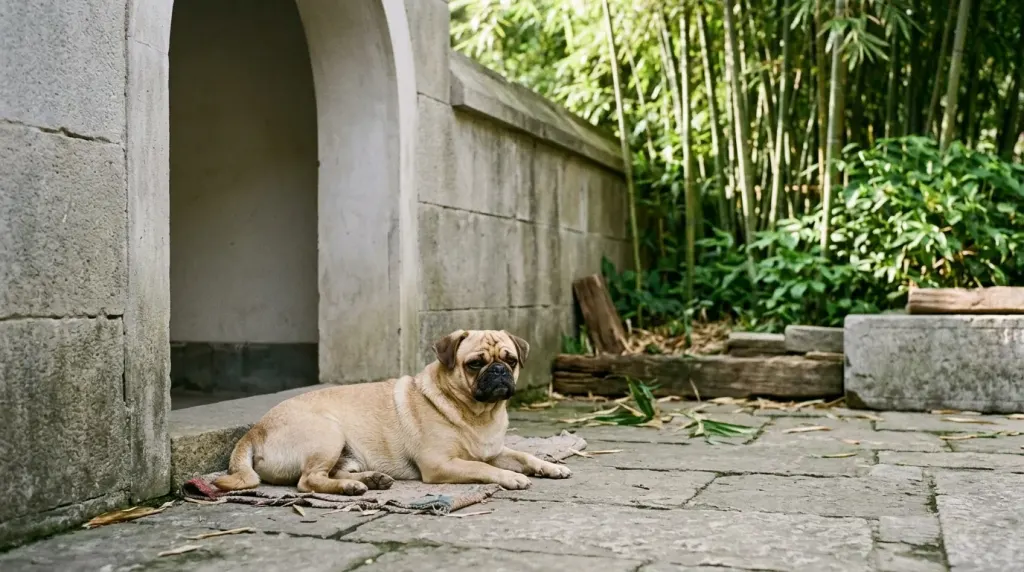
Early Chinese historical references to small, short-muzzled dogs date back to Confucius (circa 551 BC to 479 BC), who described short-legged dogs referred to as pai or baigou. Official imperial records indicate that the earliest true ancestors of the Pug flourished during the Han Dynasty (206 BC to 220 AD). Imperial archives document small, flat-faced dwarf dogs living alongside ruling families and high-ranking nobility. Emperor Ling of Han (reigned 168 AD to 189 AD) elevated his favored palace dogs to high noble ranks, granting them personal servants, dedicated silk cushions, and protective military bodyguards. Commoners were strictly forbidden from owning these palace pets, and stealing an imperial lapdog resulted in severe corporal or capital punishment.
Imperial breeding programs continued expanding through subsequent Chinese ruling eras. During the Tang Dynasty (618 AD to 907 AD) and the Song Dynasty (960 AD to 1279 AD), palace kennels maintained detailed physical records and selective bloodlines for flat-faced toy dogs. By the Qing Dynasty (1644 AD to 1912 AD), court handlers categorized Chinese companion dogs into three distinct types: the long-coated Pekingese, the Lion Dog (ancestral to the modern Shih Tzu), and the smooth-coated Lo-sze.
Canine ancestry research confirms that Pugs descend directly from the Lo-sze lineage. Examining the lineage of ancient Asian companion dogs reveals how the Lo-sze provided the core anatomical foundation of the modern Pug, passing down its smooth coat, square frame, compact head structure, and tightly curled tail carried over the hip.
Etymology and naming
Exploring where did the name pug dog come from reveals a linguistic journey across several European languages. In ancient China, handlers referred to the breed by descriptive native names like Lo-sze and Pai. When international trade routes brought the dogs to Europe, each nation created a distinct name based on physical appearance and cultural references.
The English word “Pug” became common during the early 18th century. Pet owners at the time kept small marmoset monkeys, which were affectionately known as “Pug-monkeys” or “Pugs” due to their expressive facial features and dark eyes. Because the small Chinese lapdog shared a similar flat facial profile and large, expressive eyes, English dog lovers adopted the same nickname for the canine breed. A related linguistic root links the name to the Latin noun pugnus, meaning clenched fist, because the compact profile of a Pug’s skull resembles the shape of a closed human fist. Folklore traditions also note a possible connection to Puck, the mischievous sprite featured in Shakespeare’s A Midsummer Night’s Dream.
In Chinese palaces, court handlers paid special attention to the distinctive wrinkled head and facial folds. Breeders particularly prized forehead wrinkles that formed three horizontal lines intersected by a vertical mark, resembling the Chinese character for king (Wang, 王). Palace breeders regarded dogs bearing this natural pattern as living symbols of royal legitimacy and fortune.
Continental European countries adopted different descriptive names:
- The Netherlands: Known as the Mopshond, derived from the Dutch verb mopperen (to grumble or frown), describing the dog’s wrinkled muzzle and audible brachycephalic respiratory snorts produced by Pugs due to their shortened airways.
- France: Called the Carlin, named after the 18th-century Italian actor Carlo Antonio Bertinazzi (stage name Carlin), who wore a dark Harlequin half-mask resembling the Pug’s black facial mask.
- Germany and Central Europe: Referred to as the Mops, retaining the Dutch linguistic root referencing facial folds.
- Italy and Spain: Known historically as the Carlino in Italy and the Doguillo in Spain.
| Country | Historical Breed Name | Linguistic Meaning | Cultural Context |
|---|---|---|---|
| China | Lo-sze / Pai | Ancient short-coated Asian lapdog | Imperial palace companion bred for emperors |
| Great Britain | Pug | Derived from marmoset monkeys and Latin pugnus (fist) | 18th-century pet naming referencing facial structure |
| Netherlands | Mopshond | Derived from Dutch mopperen (to grumble or frown) | Describes facial wrinkles and snorting respiration |
| France | Carlin | Named after 18th-century Harlequin actor Carlo Bertinazzi | References the black facial mask against fawn coat |
| Germany | Mops | Dutch root referencing expressive facial wrinkles | Standard continental European naming convention |
| Spain | Doguillo | Diminutive form of dogo (small mastiff-type companion) | References compact, muscular molosser-like build |
Cross-cultural diffusion to Europe
The international migration of the Pug began during the 16th century when early European maritime merchants returned from Asian trading voyages with Chinese lapdogs. Following the founding of the Dutch East India Company (Vereenigde Oostindische Compagnie) in 1602, commercial exchanges with China expanded significantly, and Dutch traders regularly brought Lo-sze dogs back to the Netherlands. The compact, affectionate dogs quickly gained admiration among European aristocrats and merchant families.
The breed earned a prominent place in European history in 1572 during the Eighty Years’ War. According to historical accounts documented by the American Kennel Club, a Pug named Pompey saved the life of Prince William the Silent (William I of Orange) at the military encampment of Hermigny. When Spanish assassins attempted a surprise night raid on the prince’s tent, Pompey barked and scratched at the canvas, leaping onto the prince’s face to wake him in time to escape. Following this event, the Pug became the official mascot of the royal House of Orange. When William the Silent died, an effigy of Pompey was carved at his feet on his monumental tomb in the Nieuwe Kerk in Delft.
When William III and Mary II ascended the British throne in 1689 during the Glorious Revolution, they brought their favored royal Pugs adorned with orange ribbons to London, establishing them as cherished royal lap dogs across European courts at Hampton Court Palace and Kensington Palace.
The breed’s high standing in British culture was further documented by English artist William Hogarth (1697 to 1764). In his celebrated 1745 self-portrait The Painter and his Pug, Hogarth depicted his beloved Pug Trump as an emblem of tenacity and loyalty. The original painting remains preserved in the permanent collection of the Tate Britain museum in London.
In France, Empress Josephine Bonaparte owned a Pug named Fortune. During her imprisonment in Les Carmes prison in 1794 during the Reign of Terror, Fortune carried hidden letters beneath his collar to her children, playing a documented role in historical correspondence. Fortune also famously defended Josephine by biting Napoleon Bonaparte on their wedding night in 1796.
In the 19th century, Queen Victoria became an active royal patron of the breed, maintaining up to 36 Pugs (including favorites named Fatima, Olga, Pedro, Venus, and Mino) in her private kennels at Windsor Castle. Queen Victoria supported standard kennel registries and actively opposed cosmetic ear cropping, laying the foundation for modern breed standards and major dog show championships earned by Pugs throughout the 20th century.
In 1860, following the Second Opium War, British officers brought pure Chinese Pugs named Lamb and Moss from Beijing back to England. When bred together, Lamb and Moss produced an influential sire named Click. Victorian breeders crossed Click with dogs from the preexisting Willoughby line (established in the 1840s by Lord Willoughby d’Eresby) and Morrison line (developed by Charles Morrison), merging and refining the two independent strains into the modern breed standard. The Kennel Club (UK) was founded in 1873 and recognized the Pug in its initial stud books, followed by the introduction of solid black Pugs to Western show rings in 1886 by Lady Brassey.
Modern breed identity and myths
Examining what countries do pugs come from throughout their development shows that while China is their true birthplace, Great Britain and the Netherlands served as key secondary hubs for standardizing the modern breed.
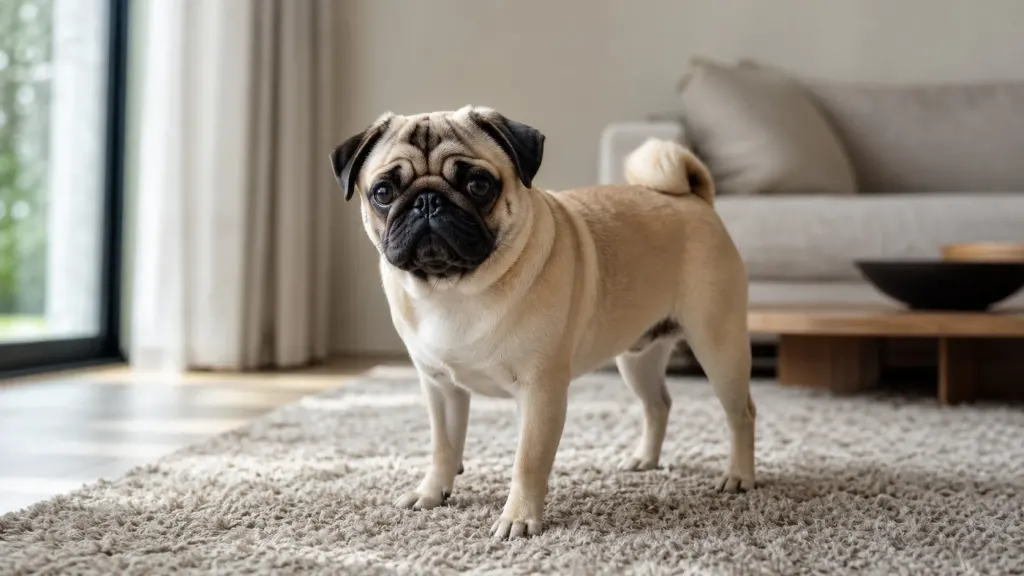
During the 18th century, English paintings depicted Pugs with longer legs, leaner bodies, and slightly longer muzzles than modern show dogs. The selective breeding efforts of 19th-century Victorian fanciers refined the standard height and weight range for adult Pugs to 14 to 18 pounds (6.3 to 8.2 kg) and a shoulder height of 10 to 13 inches (25 to 33 cm), establishing the compact silhouette known today.
A common myth suggests that Pugs are modern designer crossbreeds. Genetic sequencing confirms that Pugs represent an ancient, naturally developed purebred line. Their distinctive physical traits resulted from centuries of selective breeding within isolated royal kennels rather than recent hybridization. The transition of the Pug from an imperial Chinese status symbol to a global companion reflects continuous human selection for low-aggression, companion-oriented behavior. This selective history explains why modern Pugs show remarkable social adaptability across different family settings.
Note: Because Pugs are a brachycephalic breed with shortened facial bones, owners must protect them from extreme heat and humidity. When outdoor temperatures exceed 80 degrees Fahrenheit (26.7 degrees Celsius) combined with humidity above 60 percent, their compromised panting efficiency can cause heat exhaustion within 15 to 20 minutes of strenuous activity.
Today, Pugs live worldwide, adapting smoothly to apartment living due to their moderate exercise needs, predictable 12 to 15 year lifespan, and calm indoor disposition.
Evolving evidence and authoritative sources
Modern kennel clubs and international canine registries maintain strict preservation standards for the Pug. Official breed standards preserve the historical Latin motto multum in parvo (a lot of dog in a small space), emphasizing a compact, cobby build with sound physical structure.
When screening reputable Pug breeders and rescue organizations, buyers should verify that parent dogs undergo standardized health testing for Brachycephalic Obstructive Airway Syndrome (BOAS), patellar luxation, eye clearance, and DNA screening for Pug Dog Encephalitis (PDE). Prospective owners investigating the realistic cost of buying and owning a Pug should balance initial purchase expenses with long-term veterinary care, routine facial fold hygiene, and specialized wellness needs.
Frequently asked questions about pug origins
Are pug dogs Irish?
Pug dogs are not Irish in origin, and they share no genetic or historical roots with native Irish breeds. Ireland developed distinct hunting, sporting, and herding dogs, including the Irish Setter, Irish Water Spaniel, Irish Wolfhound, and Kerry Blue Terrier. Pugs originated exclusively in ancient China before migrating to Western Europe through maritime trade centers. Confusion occasionally occurs when casual observers mistake small terrier mixes for purebred Pugs, but pedigree records confirm purely Asian and European purebred ancestry.
Are there Chinese pug dogs today?
Chinese pug dogs continue to be bred and kept across modern China. Following historical periods in the 20th century when companion pet ownership declined due to economic and political shifts, purebred dog ownership experienced a strong revival in East Asia during the late 1990s and 2000s. Today, the China Kennel Union (CKU), affiliated with the Federation Cynologique Internationale (FCI), maintains official breed registration standards for purebred Pugs in China.


Leave a Reply