
Table of Contents
You can adopt a Maine Coon cat through dedicated 501(c)(3) breed-specific rescue organizations (such as Maine Coon Rescue and East Coast Maine Coon Rescue), aggregate pet databases like Petfinder and Adopt-a-Pet, local animal shelters, or retired breeding programs from registered catteries. Adoption donation fees typically range from $100 to $450, covering spay/neuter surgery, vaccinations, microchipping, and veterinary screening.
- Breed-specific rescues provide the highest likelihood of finding purebred and documented mix Maine Coons.
- Aggregate platforms like Petfinder connect prospective adopters with thousands of shelters and rescues across North America.
- Rescues enforce thorough screening protocols, including veterinary reference checks, landlord approval, and non-negotiable indoor-only and no-declaw policies.
- Purebred kittens in shelters are exceptionally rare; the vast majority of adoptable rescue cats are adults, seniors, or domestic longhair mixes.
- Adoption donation fees ($100 to $450) offset veterinary care costs, unlike commercial breeders that charge $1,500 to $4,000.
- Beware of online adoption scams demanding wire transfers, gift cards, or non-refundable cash app deposits for cheap kittens.
Top Breed-Specific Maine Coon Rescues in the United States
Breed-specific rescues are dedicated non-profit foster networks specializing in the rescue, rehabilitation, and rehoming of purebred Maine Coons and Maine Coon mixes. Unlike traditional brick-and-mortar municipal animal shelters, these organizations operate through networks of volunteer foster homes across multiple states. Cats in foster care receive individualized veterinary rehabilitation, behavioral evaluation, and social conditioning in home environments prior to placement.
When prospective adopters search for where can i adopt a maine coon cat, specialized non-profit networks represent the most reliable pathway for ethical adoption. Because foster parents live with the cats daily, they can provide accurate assessments of each animal’s personality, activity level, and compatibility with children or other household pets.
| Organization Name | Operational Scope | Website / Platform | Typical Fee Range | Key Highlights |
|---|---|---|---|---|
| Maine Coon Rescue (MCR) | Nationwide (Continental US) | mainecoonrescue.net | $150 – $450 | 501(c)(3) national volunteer foster network, thorough vetting, and transport coordination |
| East Coast Maine Coon Rescue (ECMCR) | East Coast / Mid-Atlantic | eastcoastmainecoonrescue.org | $195 – $420 | Comprehensive medical rehabilitation and dedicated foster-to-adopt support |
| Only Maine Coons Rescue (OMC!) | Mid-Atlantic & Northeast | omcrescue.org | $175 – $375 | Specializes in rescuing at-risk Maine Coons and mixes from municipal shelters |
| Specialty Purebred Cat Rescue (SPCR) | Midwest Region | purebredcatrescue.org | $150 – $350 | Dedicated purebred feline rescue placing surrendered pedigreed cats |
Maine Coon Rescue (MCR) is a nationwide 501(c)(3) non-profit organization that coordinates foster placements across the continental United States. Volunteers work directly with public animal shelters to pull at-risk longhaired felines, provide needed medical treatments, and manage comprehensive matching processes for approved applicants.
Regional groups like East Coast Maine Coon Rescue (ECMCR) and Only Maine Coons Rescue (OMC!) focus on specific geographic corridors. These organizations maintain dedicated medical funds to treat common feline health issues, dental disease, and senior care needs before making cats available for adoption. When arranging out-of-state foster adoptions, transport logistics require careful planning; understanding carrier safety protocols and whether companion pets like French Bulldogs can fly on planes in passenger cabins helps adopters prepare compliant travel kennels for long-distance transport.
Finding Maine Coons on Aggregate Pet Platforms and Local Shelters
Online adoption aggregators allow searchers to scan thousands of municipal shelters, humane societies, and private rescues simultaneously using custom breed and location filters. These platforms centralize available pet listings across North America, giving adopters real-time visibility into shelter intakes within their local driving radius.
When reviewing listings on aggregate databases, prospective adopters must understand how shelters classify incoming animals. Municipal animal control facilities rarely receive certified pedigree paperwork. Consequently, staff members evaluate incoming cats visually and assign the “Maine Coon mix” label based on physical traits such as long fur, tufted ears, or large body frames. Evaluating shelter coat colors requires realistic expectations; just as adopters often ask whether Ragdoll cats can be black when encountering solid dark coats in rescue databases, shelter staff frequently categorize solid black or tuxedo longhairs as Maine Coon mixes purely due to physical size and coat density.
| Platform / Resource | Search Strategy | Best For | Application Dynamics |
|---|---|---|---|
| Petfinder (petfinder.com) | Set breed filter to “Maine Coon”, expand radius to 100+ miles, enable daily email alerts | Nationwide rescue and shelter listings | Direct routing to individual rescue application forms |
| Adopt-a-Pet (adopt-a-pet.com) | Use “Search by Breed” feature with custom notification triggers | Municipal shelters and private humane societies | Shelter-specific intake and application procedures |
| Local Humane Societies | Visit shelter portals weekly; check intake gallery updates | Local community surrenders and strays | First-come, first-served or in-person adoption walk-ins |
| Municipal Animal Controls | Monitor municipal lost-and-found stray intake listings | Urgent rescue pulls and community adoptions | Immediate in-person processing with minimal screening wait times |
To maximize your chances on Petfinder or Adopt-a-Pet, set up automated email notifications for “Maine Coon” within a 100 to 250 mile radius. High-demand longhaired cats often receive dozens of inquiries within 24 hours of being listed. Having a completed universal adoption resume ready enables immediate submission when a matching cat appears.
Adopting a Retired Breeding Cat from a Reputable Cattery
Reputable cat registries place retired adult show and breeding cats into permanent pet homes at modest adoption fees. When professional preservation breeders conclude a cat’s show career or breeding program, they neuter or spay the feline and look for quiet, permanent indoor homes where the cat can enjoy life as a pampered family companion.
Retired breeding cats are typically between 2 and 5 years old. These adult felines offer distinct advantages for adopters: they possess documented pedigree lineages, verified genetic health screenings, and well-established, stable adult temperaments. Because these cats have spent years in structured home catteries, they are thoroughly accustomed to regular handling, grooming routines, and family life.
Official pedigree standards defined by The Cat Fanciers’ Association require registered catteries to maintain detailed lineage records, while The International Cat Association maintains strict registration rules that ensure breeding cats undergo comprehensive health evaluations. Retired adult show cats often display extraordinarily calm, patient temperaments suited for quiet households or emotional support roles, comparable to how families evaluate whether Pugs can be service dogs or therapy companions based on predictable adult demeanor.
| Evaluation Factor | Retired Breeding Adult | Rescue Organization Cat | Kitten from Commercial Breeder |
|---|---|---|---|
| Pedigree Documentation | Fully documented CFA or TICA pedigree | Typically unknown or mix lineage | Fully documented CFA or TICA pedigree |
| Age Range | 2 to 5 years old | Varied (kittens to seniors) | 12 to 16 weeks old |
| Typical Cost / Fee | $300 – $800 | $100 – $450 (donation) | $1,500 – $4,000 |
| Medical Status | Spayed/neutered, genetic DNA tests completed | Spayed/neutered, fully vaccinated, microchipped | Initial kitten vaccinations, microchip, altered |
| Personality Stability | Fully established adult temperament | Observed in foster care setting | Developing kitten temperament |
To inquire about retired program cats, use official CFA and TICA breeder directories. Contact established catteries with a polite, detailed introductory email describing your home environment, experience with large longhaired cats, and veterinary references. Many ethical preservation breeders maintain quiet waiting lists for their retired champions. Adopting a retired adult from a registered cattery bridges the gap between rescue adoption and purebred provenance, offering a socialized pedigreed cat while circumventing commercial kitten trade.
The Maine Coon Adoption Process and Screening Requirements
Legitimate rescue organizations follow a rigorous vetting procedure to ensure prospective homes match the physical, emotional, and financial needs of the cat. Because rescued Maine Coons often come from neglected backgrounds or traumatic surrender situations, volunteer foster coordinators prioritize long-term stability and responsible animal stewardship.
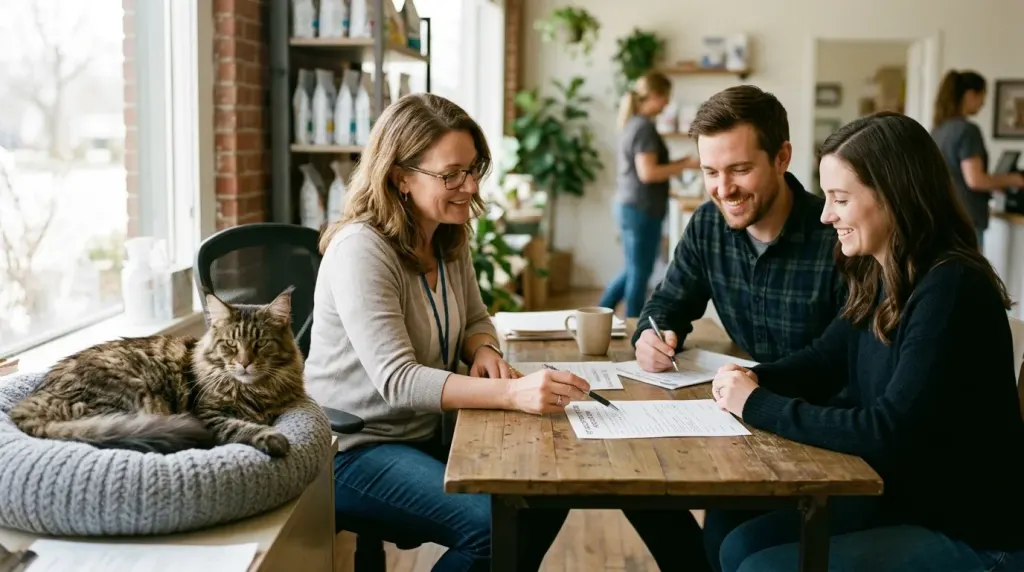
During the application review, rescue volunteers evaluate the overall safety of the living environment. Multi-pet households must demonstrate thoughtful management routines, including establishing designated feeding stations and understanding what French Bulldogs and other resident pets can eat so high-protein cat food is kept safely away from resident dogs.
| Screening Stage | Focus Area | Required Documentation | Processing Timeframe |
|---|---|---|---|
| 1. Online Application | Household profile, lifestyle, experience | Completed digital application questionnaire | 1 to 3 days |
| 2. Veterinary Check | Verification of past and current pet care | Clinic name, phone number, pet medical history | 2 to 4 days |
| 3. Landlord & Housing | Verification of pet permissions and lease rules | Copy of lease, pet deposit proof, landlord contact | 1 to 2 days |
| 4. Personal References | Character and pet handling confirmation | 2 non-family personal references | 2 to 3 days |
| 5. Home Safety Review | Environmental safety, catio or window checks | Virtual video walkthrough or volunteer home visit | 2 to 4 days |
| 6. Final Placement | Formal agreement and adoption donation | Signed adoption contract, fee transfer | 1 to 2 days |
The veterinary reference check represents the most critical hurdle in the screening process. Rescues will contact your current or previous veterinary clinic to confirm that all resident pets are spayed or neutered, up to date on core vaccinations (rabies and FVRCP), receive annual wellness exams, and stay on monthly parasite prevention. Pet owners who routinely use high-value rewards such as xylitol-free peanut butter for dogs to administer monthly heartworm and flea preventatives can easily demonstrate a documented history of consistent wellness care to rescue case managers.
Furthermore, legitimate feline rescues enforce strict non-negotiable contract clauses:
- Strict Indoor-Only Policy: Cats must remain exclusively indoors or in escape-proof outdoor catios to prevent motor vehicle trauma, infectious disease exposure, and predator attacks.
- Prohibition Against Declawing: Adoption contracts explicitly ban surgical declawing (onychectomy). Declawing is an amputation of the last toe bone that frequently causes chronic neuropathic pain, litter box aversion, and defensive biting behaviors.
- Lifetime Return Guarantee: If an adopter can no longer care for the cat at any point in its lifespan, the cat must be returned directly to the rescue organization rather than surrendered to a municipal shelter or rehomed online.
How Much Does It Cost to Adopt a Maine Coon Cat?
Adopting a Maine Coon cat typically costs between $100 and $450 in non-profit adoption donation fees, compared to $1,500 to $4,000 when purchasing a kitten from a commercial breeder. Non-profit adoption fees directly offset the cost of comprehensive veterinary care, surgical sterilization, and rehabilitation provided while the cat lives in foster care.
In addition to initial adoption fees, long-term budgeting should account for species-appropriate nutrition. Large-breed cats benefit from diets rich in quality animal proteins and healthy fats; incorporating cooked fish or feeding plain cooked salmon safely provides natural omega-3 fatty acids that support coat health without added sodium. Similarly, lean proteins like plain boiled chicken for household pets serve as gentle, digestible options during the initial post-adoption transition period.
| Category / Age Bracket | Rescue Adoption Donation | Commercial Breeder Purchase | Inclusions & Medical Services |
|---|---|---|---|
| Purebred Kitten (under 1 year) | $400 – $450 | $1,500 – $4,000 | Spay/neuter, microchip, FVRCP & rabies vaccines, FeLV/FIV test |
| Purebred Adult (1 to 9 years) | $275 – $375 | $800 – $1,500 (retired) | Full veterinary wellness exam, core vaccines, dental if needed |
| Maine Coon Mix (all ages) | $175 – $275 | N/A | Sterilization, parasite preventative, microchip registration |
| Senior (10+ years) / Special Needs | $100 – $200 | N/A | Senior blood panel, chronic condition stabilization, vaccinations |
When you adopt from a registered non-profit rescue, the adoption donation covers medical services that would cost $400 to $700 if paid out of pocket at a private veterinary hospital:
- Surgical spay or neuter procedure: $150 – $300
- Core vaccinations (FVRCP series and Rabies): $60 – $120
- Microchip implantation with lifetime registration: $45 – $65
- FeLV (Feline Leukemia) and FIV (Feline Immunodeficiency Virus) viral blood testing: $50 – $80
- Broad-spectrum deworming and topical flea/tick preventative: $35 – $60
- Pre-adoption veterinary health certificate: $50 – $85
Some rescue organizations charge a nominal non-refundable application processing fee ($5 to $25) to offset volunteer administrative costs. If the cat requires volunteer ground transport coordination across state lines, a standard transport contribution of $50 to $100 may apply.
Purebred Maine Coon vs. Maine Coon Mix: Managing Expectations
While most cats in general municipal shelters are domestic longhair mixes rather than pedigreed Maine Coons, they share many of the breed’s signature personality traits and make exceptional family companions. Understanding the genetic difference between a purebred cat and a domestic longhair mix prevents unrealistic expectations during the shelter adoption search.
A pedigreed Maine Coon possesses certified lineage documentation tracing back multiple generations through registered cat registries. In contrast, random-bred domestic longhairs (DLH) naturally develop plush double coats, ear furnishings, and bushy tails through natural selection in temperate climates, without carrying Maine Coon DNA.
| Physical & Genetic Trait | Documented Purebred Maine Coon | Shelter Domestic Longhair Mix |
|---|---|---|
| Pedigree Documentation | Certified CFA or TICA registration papers | No certified pedigree; visual classification |
| Adult Body Structure | Heavy-boned, rectangular torso, broad muscular chest | Variable; medium to large domestic feline frame |
| Facial Characteristics | Square muzzle, high cheekbones, gentle concave profile | Rounder head or modified domestic wedge profile |
| Ear & Paw Features | Large lynx-tipped ears, heavy tufting between toes | Moderate ear tufts; varied paw hair density |
| Temperament Profile | Outgoing, dog-like, vocal chirps and trills | Affectionate, adaptable, varied personality |
Activity levels and physical stamina also vary between individuals. While young Maine Coons and vigorous mixes love interactive feather-wand chasing, assessing overall physical endurance is as practical as knowing how far French Bulldogs can run when tailoring daily playtime to match a pet’s natural energy level without causing physical fatigue.
When adopting from a municipal shelter or foster rescue, focus on the cat’s individual temperament, health history, and compatibility with your home rather than genetic purity. A rescued longhaired mix will provide the same devoted companionship, playful interactions, and loving presence as a papered purebred.
How to Identify and Avoid Maine Coon Adoption Scams
Fraudulent websites and social media pages exploit the popularity of Maine Coons by advertising fictitious low-cost kittens to steal deposits via non-refundable payment apps. Criminal scammers copy photographs from legitimate breeders’ websites, create convincing fake rescue portals, and target emotional buyers searching for affordable purebred kittens.
Legitimate non-profit rescue adoption counselors take time to walk applicants through real-world pet care, sharing practical household safety guidance like whether pets can safely eat apples without cores or offering crunchy raw carrots for pets as safe, low-calorie kitchen treats. In contrast, scammers avoid discussions about pet care entirely and focus solely on collecting quick upfront deposits.
| Evaluation Factor | High-Risk Scam Red Flags | Legitimate Non-Profit Rescue |
|---|---|---|
| Price & Payment Method | “Purebred kittens” for $300-$500 via Zelle, CashApp, Venmo, or wire | Transparent $100-$450 donation via official non-profit portal or check |
| Communication | Text-only, pressure for immediate deposit, refuses video calls | Multi-step application, volunteer phone interview, virtual home check |
| Domain & Registry | Misspelled clone websites, generic free email addresses | Official 501(c)(3) IRS registration, verified web domain |
| Delivery Claims | Promises direct air shipment to your doorstep within 24 hours | Foster-to-adopter pickup or verified ground transport network |
To protect yourself from fraudulent pet schemes, apply standard safety verification protocols:
- Verify 501(c)(3) Non-Profit Status: Search the organization’s legal name on the official IRS Tax Exempt Organization Search database or GuideStar to confirm active federal non-profit status.
- Demand a Live Video Call: Insist on a live video interaction (FaceTime, Zoom, or Google Meet) to view the cat interacting with its foster parent in real time. Scammers cannot produce a live animal they do not possess.
- Perform Reverse Image Searches: Right-click listing photos and run them through Google Lens. If the identical cat photo appears on multiple unrelated websites or foreign cattery pages, the listing is fraudulent.
- Never Use Unprotected Payment Channels: Legitimate rescues process donations through registered non-profit merchant portals, official organization checks, or in-person credit card processing. Never send money via Western Union, Zelle, CashApp, or retail gift cards.
Caution: Legitimate non-profit rescue organizations will never demand immediate wire transfers or gift cards before reviewing your application. Always verify 501(c)(3) credentials on official registry portals before transferring funds.
Preparing Your Home for an Adopted Maine Coon
Bringing home a rescued Maine Coon requires oversized feline accessories and an intentional decompression routine to help the cat transition smoothly. Because of their physical stature and long coats, standard commercial cat furniture and standard litter pans are frequently inadequate for their body dimensions.
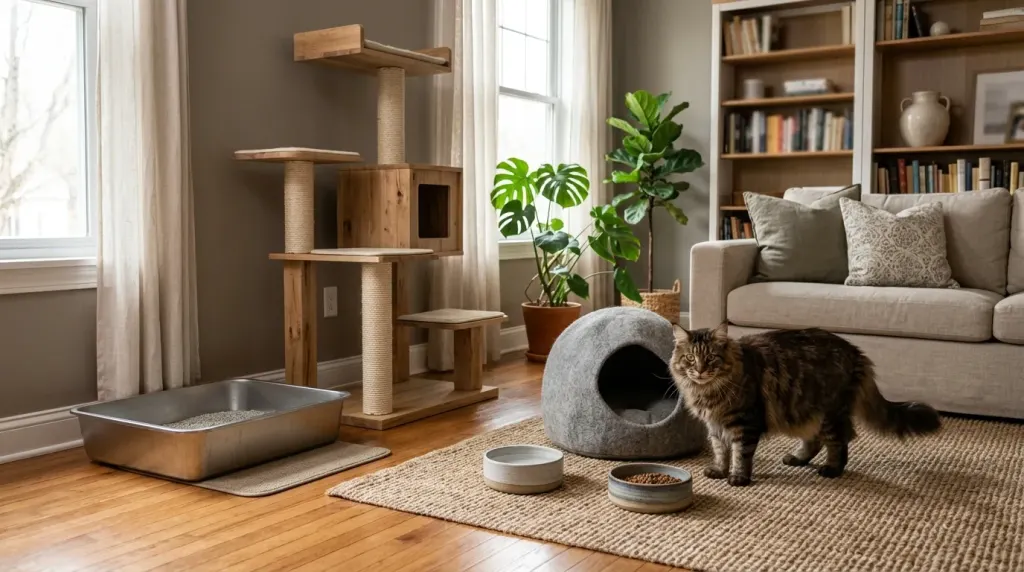
Pet-proofing your living space is vital before bringing home a curious, water-loving cat. Maine Coons frequently play in open water sources, making it essential to secure full bathtubs and swimming pools, particularly in homes where companion breeds like Pugs cannot swim safely without life jackets. Additionally, during calm introductory bonding sessions, offering simple healthy rewards like fresh blueberries for household pets helps create positive, low-stress interactions between new and resident animals.
| Essential Equipment | Specific Feature Required | Why It Matters for Maine Coons |
|---|---|---|
| Scratching Tree / Tower | Solid wood posts, wide base, 18-20 inch perches | Prevents tipping under the weight of a 15 to 25 pound cat |
| Litter Box | Jumbo open pan or 30-gallon storage tote conversion | Allows large-framed cats to turn around without stepping in waste |
| Grooming Tools | Stainless steel undercoat rake, wide-toothed comb | Removes loose undercoat fur and prevents painful matting |
| Food & Water Dishes | Heavy ceramic or stainless steel wide bowls | Prevents whisker fatigue and stops active cats from tipping water |
When introducing a rescued cat to your home, follow the established 3-3-3 Decompression Protocol:
- First 3 Days (Decompression): Confine the newly adopted cat to a dedicated quiet sanctuary room equipped with food, water, a litter box, and a hiding spot. Allow the cat to decompress without forced handling or overwhelming household traffic.
- First 3 Weeks (Acclimation): Gradually open access to the rest of the home. Establish consistent feeding, play, and grooming routines. Begin scent swapping with resident dogs and cats before allowing supervised visual contact.
- First 3 Months (Integration): The cat establishes complete confidence, bonds deeply with household members, and displays its authentic personality as a secure family companion.
Frequently Asked Questions About Adopting a Maine Coon
Where is the best place to adopt a Maine Coon cat?
The best places are dedicated 501(c)(3) breed-specific rescue organizations such as Maine Coon Rescue (MCR) and Only Maine Coons Rescue (OMC!), aggregate shelter databases like Petfinder, and CFA or TICA registered catteries placing retired adult breeding cats.
Can you find purebred Maine Coons in animal shelters?
Finding a documented purebred Maine Coon in a municipal shelter is rare; most long-haired shelter cats are domestic longhair mixes. However, breed-specific rescues occasionally receive surrendered purebred adults whose owners can no longer care for them.
How much is the adoption fee for a Maine Coon?
Adoption donation fees at reputable rescue organizations typically range from $100 to $450, depending on the cat’s age, pedigree documentation, and medical needs. This fee covers complete veterinary workups, vaccinations, and spay/neuter procedures.
Are Maine Coon rescues indoor-only?
Yes. Nearly all reputable Maine Coon rescue organizations require that adopted cats remain strictly indoors or have access only to fully secure outdoor enclosures (catios) to prevent trauma, loss, and theft.
How long does the Maine Coon adoption screening process take?
The screening process typically takes between 7 and 14 days, allowing volunteer case managers to review your application, verify veterinary records for existing pets, contact personal references, and perform a virtual or in-person home visit.
Leave a Reply