

Table of Contents
In answering what are Golden Retrievers known for, the breed stands out for its gentle and affectionate temperament, exceptional working intelligence, lush water-repellent golden coat, and natural retrieving instincts. Originally bred in Scotland as waterfowl hunting companions, they have evolved into world-class service dogs, therapy animals, and beloved family pets celebrated for their eagerness to please.
- Renowned for a friendly, trustworthy, and eager-to-please temperament suited for households with children and other pets.
- Ranked among the most versatile working breeds, excelling as guide dogs, search-and-rescue partners, and therapy dogs.
- Possess a water-repellent double coat that requires regular grooming and sheds moderately year-round with seasonal peaks.
- Demand at least two hours of daily exercise and mental enrichment to channel their sporting stamina.
- Retain a "soft mouth" instinct, naturally enjoying carrying items without chewing or damaging them.
Golden Retrievers consistently rank among the most popular and recognizable dog breeds in the world, admired by families, sportsmen, and service organizations alike. Developed in the nineteenth century as rugged upland hunting companions, these athletic canines blend remarkable working competence with an unusually gentle and social disposition. Understanding what Golden Retrievers are known for helps prospective owners, trainers, and canine enthusiasts appreciate how their historic instincts translate into modern household companionship and specialized working roles.
What Are Golden Retrievers Known For? The 6 Defining Hallmark Traits
Golden Retrievers are widely recognized for six core traits: an eager-to-please personality, high working intelligence, boundless sporting energy, a gentle “soft mouth”, a distinctive golden double coat, and profound sociability with humans and other animals.
Originally developed in nineteenth-century Scotland by Dudley Marjoribanks (Lord Tweedmouth) at Guisachan, the breed was carefully crafted to retrieve downed waterfowl across rugged moorland and cold wetlands without damaging the game. Today, according to the American Kennel Club (AKC) breed profile, the Golden Retriever ranks as the third most popular dog breed in the United States, maintaining its sporting capabilities while serving as a premier household pet.
| Defining Hallmark Trait | Historical Purpose (19th-Century Gundog) | Modern Expression (Domestic & Working Life) |
|---|---|---|
| Eager-to-Please Disposition | Biddability during long shooting days | Rapid responsiveness in obedience training and family living |
| High Working Intelligence | Complex terrain navigation and hand-signal memory | Mastery of service tasks, search-and-rescue, and canine sports |
| Natural “Soft Mouth” Grip | Retrieving delicate game birds undamaged | Carrying toys gently and greeting family members with items |
| Water-Repellent Double Coat | Thermal insulation in freezing Scottish lochs | Protection against elements, requiring steady seasonal grooming |
| Enduring Sporting Stamina | Full-day endurance tracking across wetlands | Need for at least two hours of daily exercise and interactive play |
| Unconditional Sociability | Peaceful cooperation with other hunting hounds | Warm affection toward children, guests, and other household pets |
While compact companion breeds have surged in urban settings (why French Bulldogs are so popular), Golden Retrievers remain the benchmark standard for medium-to-large active dogs, offering a unique blend of athleticism and gentle devotion.
Hallmark Temperament: Gentle, Eager to Please, and Highly Social
Golden Retrievers possess an inherently friendly, calm, and loyal disposition, making them trustworthy companions that rarely show unprovoked aggression or aloofness.
According to The Kennel Club UK breed standard, the official breed standard requires a kindly, friendly, and confident nature, with any tendency toward unprovoked hostility or nervous timidness considered completely untypical of the breed.
- Affection with Children: Golden Retrievers are celebrated for their patience and resilience around kids. Their sturdy physical build and tolerant mindset allow them to navigate the boisterous energy of active family homes comfortably.
- Compatibility with Other Animals: Having been bred to work harmoniously in packs alongside other gundogs, Goldens typically lack intense territorial rivalry. They integrate smoothly into multi-pet homes with cats and other canines.
- Guarding Limitations: Because their default instinct is to welcome strangers warmly, Golden Retrievers make ineffective guard dogs. While an alert Golden may bark to announce a visitor at the gate, they will almost always greet newcomers with a wagging tail rather than protective suspicion.
Prospective pet owners evaluating whether pugs make good family dogs or assessing guard dog instincts in pugs often notice that while smaller breeds can be vocal sentinels, the Golden Retriever prioritizes peaceful social connection above territorial vigilance.
High Intelligence and Trainability
Golden Retrievers rank among the smartest canine breeds, capable of rapid command comprehension, complex task execution, and intuitive problem-solving.
In canine psychology and working intelligence assessments, Golden Retrievers consistently place in the top tier of all breeds, demonstrating the ability to master new commands in fewer than five repetitions and obeying known cues with over ninety-five percent consistency.
- Responsiveness to Positive Reinforcement: Goldens thrive on praise, food rewards, and structured playtime. Their sensitivity means harsh corrections can cause them to become inhibited, whereas rewarding desired behaviors produces rapid learning.
- Handler Collaboration: Unlike independent working breeds that make autonomous decisions, Golden Retrievers possess a high degree of biddability, constantly checking in with handlers for direction and approval.
| Training Level | Typical Age & Stage | Core Capabilities & Milestones | Primary Handler Focus |
|---|---|---|---|
| Foundation Obedience | 8-16 Weeks | Name recognition, housebreaking, loose-leash walking, basic cues (sit, stay, come) | Positive reinforcement, socialization, impulse control |
| Intermediate Working Skills | 4-12 Months | Reliable recall under distraction, off-leash heeling, object retrieval to hand | Channeling energy, preventing jumping, focus exercises |
| Advanced & Specialized Tasks | 12+ Months | Multi-step problem solving, directional hand signals, public access manners | Scent work, agility, service task mastery, canine therapy |
While pet parents studying canine cognition often examine how smart pugs are or explore French Bulldog training intelligence, the Golden Retriever’s intense desire to cooperate with humans allows handlers to teach intricate multi-step routines with notable speed.
Exceptional Versatility: Service Dogs, Search & Rescue, and Working Roles
Due to their high problem-solving capacity, biddable nature, and stable temperament, Golden Retrievers are among the top choices globally for service work, including guide work for the blind, medical alert tasks, and disaster search-and-rescue.

- Guide and Mobility Assistance: Golden Retrievers represent a large proportion of working guide dogs worldwide. Their physical height (21.5 to 24 inches at the withers) pairs naturally with walking harnesses, and their balanced pace provides stable guidance through complex urban environments.
- Medical Alert and Psychiatric Support: With heightened sensory awareness and emotional attunement, Goldens can be trained to detect subtle chemical scent changes preceding diabetic hypoglycemia or seizures, as well as providing deep pressure therapy during anxiety episodes.
- Search and Rescue (SAR) and Detection: The breed’s powerful olfactory capabilities and athletic endurance make them indispensable in disaster zones, avalanche recoveries, and airport customs detection for contraband or agricultural items.
- Therapy Dog Work: Their gentle physical contact and composed demeanor allow them to provide comfort in pediatric hospitals, nursing care facilities, and disaster relief settings without becoming overstimulated.
Although smaller companion animals frequently excel as therapy dog companions like pugs, Golden Retrievers offer the physical height and endurance needed to reach hospital beds comfortably while navigating crowded medical facilities.
Natural Sporting Heritage: Retrieving Instincts and Love for Water
Bred specifically to retrieve game undamaged from both land and water, Golden Retrievers are famous for their strong swimming ability, love for water, and signature “soft mouth” grip.

- The Soft Mouth Adaptation: Gundogs must carry downed game birds without piercing delicate meat or crushing bones. Golden Retrievers inherit a specialized sensory feedback loop in their jaws that allows them to hold items with feather-light pressure. In domestic settings, this instinct manifests as carrying socks, slippers, or favorite plush toys around the house to welcome arriving family members.
- Aquatic Prowess: The breed possesses physical traits tailored for swimming, including webbed paws, powerful hindquarters, a broad rudder-like tail, and a dense water-repellent coat that provides buoyancy and thermal protection.
While their retrieving instinct is endearing, prospective owners should anticipate constant carrying behaviors. Channeling this drive into interactive games of fetch and structured obedience prevents unwanted object gathering or mouthiness during puppyhood.
Understanding how historical working ancestry shapes modern behavioral drives helps owners appreciate their pets, whether exploring how German Shepherds relate to ancestral working wolves or observing a retriever’s instinctual love for open water.
Distinctive Golden Double Coat and Shedding Reality
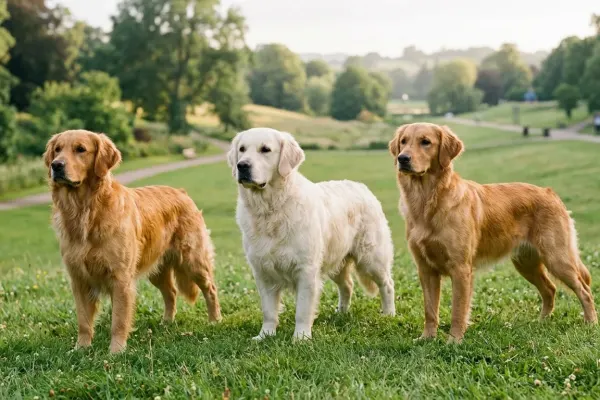
The breed is named for its radiant coat, which ranges in shades from light cream to dark gold, featuring a dense water-resistant undercoat and a feathering outer coat that requires routine grooming and sheds throughout the year.
- Double Coat Anatomy: The coat consists of two distinct layers. The dense, woolly undercoat traps warm air close to the skin in cold conditions and insulates against heat in summer. The outer guard coat is flat or wavy, shedding water and repelling burs or outdoor debris.
- Shedding Cycles: Golden Retrievers shed moderately year-round, with substantial increases during spring and autumn when they “blow their coat” to transition between seasonal temperatures.
- Grooming Regimen: Regular maintenance requires brushing two to three times weekly with an undercoat rake and slicker brush to remove dead fur before it mats. Because their drop ears trap moisture after swimming, regular ear inspections and drying are essential to prevent bacterial and yeast overgrowth.
Exercise Requirements: High Energy and Working Stamina
Golden Retrievers are active sporting dogs requiring a minimum of two hours of quality exercise every day, combining physical exertion with mental stimulation to prevent boredom and destructive behaviors.
According to PDSA canine exercise and health guidance, adult Golden Retrievers need at least two hours of daily exercise to maintain healthy cardiovascular function, support joint integrity, and prevent obesity.
| Activity Session | Activity Format | Recommended Duration | Key Physical & Mental Benefits |
|---|---|---|---|
| Morning Routine | Brisk Leash Walk & Sniffari | 45-60 Minutes | Cardiovascular warm-up, sensory exploration, elimination routine |
| Afternoon Play | Distance Fetch & Swimming | 30-45 Minutes | High-intensity sprint conditioning, satisfies retrieving drive |
| Evening Session | Structured Training & Scent Puzzles | 20-30 Minutes | Cognitive fatigue, reinforces impulse control and handler bond |
In contrast to companion breeds that thrive on brief neighborhood strolls, such as managing active pug daily routines or accommodating pugs in apartment settings, an under-exercised Golden Retriever may channel unspent energy into digging, chewing, or excessive barking.
Reality Check: Who the Golden Retriever Is and Isn’t For
Golden Retrievers thrive in active households that can dedicate substantial time to daily exercise, grooming, and companionship, but they are poorly suited for sedentary owners or families away from home for extended hours.
- Best Suited For:
- Active families and individuals who spend considerable time outdoors hiking, running, or swimming.
- Owners committed to daily brushing, seasonal shedding management, and regular obedience training.
- Households seeking an affectionate, socially confident canine that integrates seamlessly with children and visitors.
- Not Suited For:
- Individuals seeking a low-maintenance, minimal-shedding pet.
- Homes where the dog will remain isolated for eight to ten hours daily, which can trigger separation distress.
- Handlers looking for a protective guard dog to deter intruders.
- Owners seeking a sedate companion; Goldens maintain exuberant puppy energy until approximately two to three years of age.
Owners who prefer low-exercise lap companions may find pug lap dog traits a better match for quiet indoor living, whereas the Golden Retriever requires an engaged, active lifestyle.
Frequently Asked Questions About What Golden Retrievers Are Known For
What are Golden Retrievers best known for?
Golden Retrievers are best known for their gentle, loyal temperament, radiant golden double coat, high intelligence, and innate ability to retrieve objects gently on land and in water.
Why are Golden Retrievers so popular?
Golden Retrievers are widely popular because they combine high trainability and working versatility with an exceptionally friendly, trustworthy demeanor that makes them ideal family companions and service animals.
What are the unique characteristics of a Golden Retriever?
Unique characteristics include their water-repellent double coat, webbed paws designed for swimming, a specialized “soft mouth” capable of holding delicate objects without crushing them, and an enduring eagerness to please humans.
Are Golden Retrievers good guard dogs?
No, Golden Retrievers are generally poor guard dogs because their natural instinct is to be friendly and welcoming toward strangers rather than defensive or suspicious, though they may bark to announce an arrival.
At what age do Golden Retrievers calm down?
Golden Retrievers typically mature later than smaller breeds, maintaining energetic puppy-like exuberance until roughly two to three years of age when they transition into a more settled adult demeanor.


Leave a Reply