

Table of Contents
Yes, Golden Retrievers are widely recognized as one of the best dog breeds for households with cats due to their naturally gentle temperament, low aggressive prey drive, and eagerness to please. While their friendly disposition makes coexistence highly successful, achieving lasting harmony requires gradual, phased introductions, consistent impulse control training, and dedicated vertical safe spaces for the cat.
- Golden Retrievers rank among the top cat-friendly dog breeds due to their patient, sociable nature and historic breeding for a gentle soft mouth.
- Differences in energy levels matter: energetic field-bred Goldens and boisterous puppies require structured impulse training compared to calm adult show lines.
- A structured 4-step introduction protocol using scent swapping, visual barriers, leashed meetings, and supervised free-roaming prevents fear-based chasing behaviors.
- Multi-pet homes must establish vertical feline safe zones, separate feeding areas, and dog-proof litter box locations.
Bringing a new dog into a home with a resident feline requires thoughtful planning, but Golden Retrievers make this transition remarkably smooth. Renowned for their balanced demeanor, high intelligence, and cooperative spirit, Goldens typically view cats as companionable family members rather than prey. By understanding the breed’s natural instincts and following a structured introduction protocol, pet parents can establish a peaceful, affectionate multi-pet household.
Are Golden Retrievers Good With Cats? Breed Temperament & Natural Compatibility
Golden Retrievers are exceptionally well-suited for living with cats because they are bred for emotional stability, high sociability, and cooperative companionship rather than hunting or territorial aggression. According to the American Kennel Club (AKC), the sporting group heritage of the Golden Retriever emphasizes biddability, patience, and non-aggressive social interaction, making them ideal multi-pet companions.
Historical breeding plays a pivotal role in this compatibility. Unlike terriers bred to eradicate vermin or sighthounds wired to sprint after fleeing animals, Golden Retrievers were developed in nineteenth-century Scotland as waterfowl retrievers. This required an instinctual “soft mouth”, meaning the dog carried game gently without biting down or damaging it. In a domestic setting, this translates into a low propensity for predatory grip and bite behaviors toward smaller household animals. As noted by canine behavior specialist Stephanie Gibeault, MSc, CPDT, writing for the American Kennel Club (AKC), sporting breeds like the Golden Retriever thrive in multi-pet homes because their historical selection favored social cooperation, emotional stability, and high responsiveness to human cues rather than solitary predatory pursuit.
| Temperament Trait | Expression Around Cats | Multi-Pet Household Impact |
|---|---|---|
| Soft Mouth Instinct | Low biting or clamping reflex when curious | Minimizes risk of accidental physical harm during exploratory sniffing |
| High Biddability | Readily responds to basic obedience cues like “leave it” | Allows handlers to redirect canine attention away from cats instantly |
| Pack Sociability | Views other domestic pets as household members | Reduces territorial aggression and resource guarding around shared living areas |
| High Play Drive | May attempt to initiate play bows or bouncy approaches | Requires impulse control to avoid startling shy or timid felines |
Golden Retrievers naturally view family pets as pack members rather than foreign intruders. While high-drive hunting breeds may fixate on a cat with predatory intent, a typical Golden approaches with curious sniffing or a friendly play bow. Docile and affectionate feline breeds, such as friendly Ragdoll cats, pair exceptionally well with Golden Retrievers because their relaxed nature prevents erratic movements that might trigger excitement. Similarly, large and confident domestic cats, including cuddly Maine Coon cats, often enjoy lounging alongside a gentle retriever without feeling threatened.
Do Golden Retrievers Get Along With Cats? 4 Key Behavioral Factors
While the breed’s general disposition is feline-friendly, individual compatibility is governed by four primary behavioral factors: prey drive expression, lineage energy levels, early socialization history, and the resident cat’s personality.
Play Drive vs. Predatory Drive
Understanding the difference between play drive and predatory drive is crucial for feline safety. Play drive in Golden Retrievers manifests as loose body language, open-mouthed panting, playful barking, and exaggerated play bows. In contrast, predatory drive involves silent stalking, a stiffened spine, a lowered head, and unblinking eye fixation. Most Goldens exhibit high social play drive rather than true predatory aggression, which can be managed effectively through basic impulse training.
Field Lines vs. Show Lines
Energy levels and arousal thresholds vary significantly between working field lines and conformation show lines:
- Field-Bred Goldens: Bred for hunting stamina and high retrieve motivation, field lines have higher physical energy and faster reaction times. They require 60 to 90 minutes of vigorous daily exercise and structured mental enrichment to prevent over-arousal around cats.
- Show/Bench-Bred Goldens: Generally possess lower energy, heavier bone structure, and calmer domestic temperaments, making their baseline reactivity around indoor cats lower and easier to manage.
Early Socialization History
The canine socialization window between 3 and 16 weeks of age heavily influences adult pet tolerance. Puppies raised alongside cats learn to interpret feline body language, such as tail flicking and ear flattening, as clear signals to back away. Adult Golden Retrievers without prior cat exposure still adapt well due to their high biddability, though they require a more measured, step-by-step introduction process.
The Resident Cat’s Temperament
A successful multi-pet household is a two-way street. A confident cat that stands its ground or calmly walks away helps teach a dog healthy boundaries. Conversely, an anxious cat that bolts in terror can trigger a dog’s natural chasing reflex, even in gentle breeds. Cat owners evaluating multi-pet dynamics often ask if Maine Coon cats are aggressive when meeting new dogs, but self-assured cats usually hold their ground calmly, which signals the dog to respect personal space. Naturally outgoing felines, including friendly Maine Coons, tend to adapt quickly to a retriever’s curious sniffing, turning potential tension into playful coexistence.
Age Dynamics: Golden Puppies vs. Adult & Senior Dogs
The life stage of both the Golden Retriever and the cat dictates the pace of integration and the level of supervision required.
| Golden Life Stage | Canine Behavioral Profile | Cat Compatibility Level | Management Strategy |
|---|---|---|---|
| Puppy (2-12 Months) | High energy, sharp needle teeth, lack of impulse control | Moderate (Risk of accidental overwhelm) | Strict crate rotation, baby gates, structured bite inhibition training |
| Adult (1-7 Years) | Established obedience, stable energy, reliable impulse control | High (Optimal pairing) | Controlled leash meetings, consistent reinforcement of “leave it” cues |
| Senior (8+ Years) | Low physical energy, placid demeanor, predictable habits | Very High (Calm cohabitation) | Joint management, quiet sleeping quarters, orthopedic resting zones |
Golden Retriever puppies learn feline boundaries quickly, but their boundless exuberance, sudden zoomies, and puppy mouthing can easily stress a resident cat. A 6-month-old Golden weighing 45 pounds can unintentionally injure a kitten or terrify an older cat simply by pouncing to initiate play.
Adult Goldens with basic obedience skills (“sit”, “stay”, “leave it”, “place”) offer immediate predictability. Shelter adoptions often allow cat-testing prior to bringing the dog home, ensuring peace of mind. Senior Goldens share the tranquil demeanor characteristic of senior pugs, making them peaceful roommates for mature cats that prefer quiet naps over energetic play. Owners who appreciate gentle house pets like lap-oriented pugs will find that older retrievers provide similar calm companionship without disturbing a cat’s daily routine. While many pet owners assume bringing home a puppy guarantees easy cat integration, an energetic 6-month-old Golden Retriever (40-55 lbs) can unintentionally injure or traumatize a cat through rambunctious play. Adult dogs with confirmed cat-testing offer immediate safety predictability.
Step-by-Step Guide: How to Introduce a Golden Retriever to a Cat
Successfully introducing a Golden Retriever to a resident cat requires a controlled 4-phase protocol over 1 to 3 weeks to establish mutual trust without triggering stress or chase reflexes.
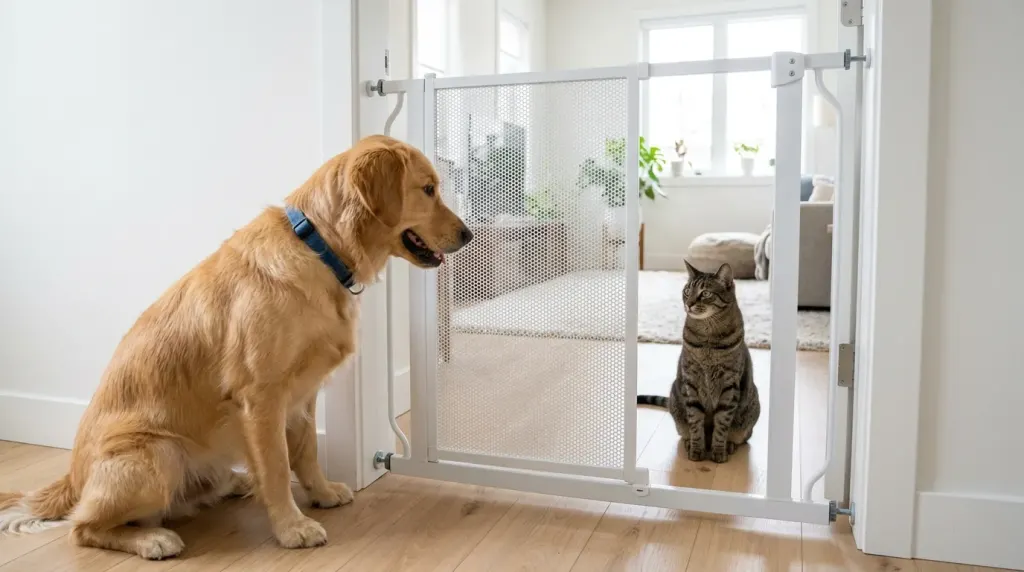
Phase 1: Scent Swapping & Room Separation (Days 1 to 4)
Keep the dog and cat in separate rooms with a solid closed door between them. Exchange their bedding, towels, and sleeping blankets daily so each animal becomes accustomed to the other’s scent in a low-stress environment. Feed both pets on opposite sides of the closed door, placing bowls a few feet away and gradually moving them closer. This builds a positive association between the scent of the other pet and delicious food.
Phase 2: Visual Separation via Physical Barriers (Days 5 to 9)
Replace the solid door with a tall baby gate or secure mesh screen. Allow the pets to see each other while enjoying meals or high-value treats. If the Golden stares intensely or whines, increase the distance from the gate. Reward the dog with treats every time it looks at the cat and then voluntarily looks back at you (the “look-at-that” counter-conditioning technique).
Phase 3: Controlled Leashed Meetings (Days 10 to 14)
Bring the Golden Retriever into the shared living room on a short, 4-foot leash while the cat explores freely. Keep the dog in a calm “sit” or “down-stay” position, dispensing high-value treats (such as cooked chicken or freeze-dried liver) for maintaining loose, relaxed posture. Practicing structured calm routines, much like the methods used to raise good family pets like French Bulldogs, helps a Golden Retriever understand that self-control around small animals brings positive rewards. Never allow the dog to lunge or pull toward the cat.
Phase 4: Supervised Off-Leash Cohabitation (Day 15 Onward)
Allow the dog off-leash in the common area while letting a lightweight 6-foot training drag line trail behind it for quick management if needed. Ensure the cat has multiple unobstructed vertical escape routes. Just as handlers rely on the quick learning capacity of smart French Bulldogs during household training, a Golden’s eagerness to please accelerates off-leash obedience around felines. Maintain close human supervision during all shared interactions until peaceful cohabitation is consistently demonstrated over several consecutive weeks.
Setting Up Your Home: Essential Feline Safe Zones & Environmental Management
Environmental management prevents territorial friction and ensures the cat feels secure throughout the home.
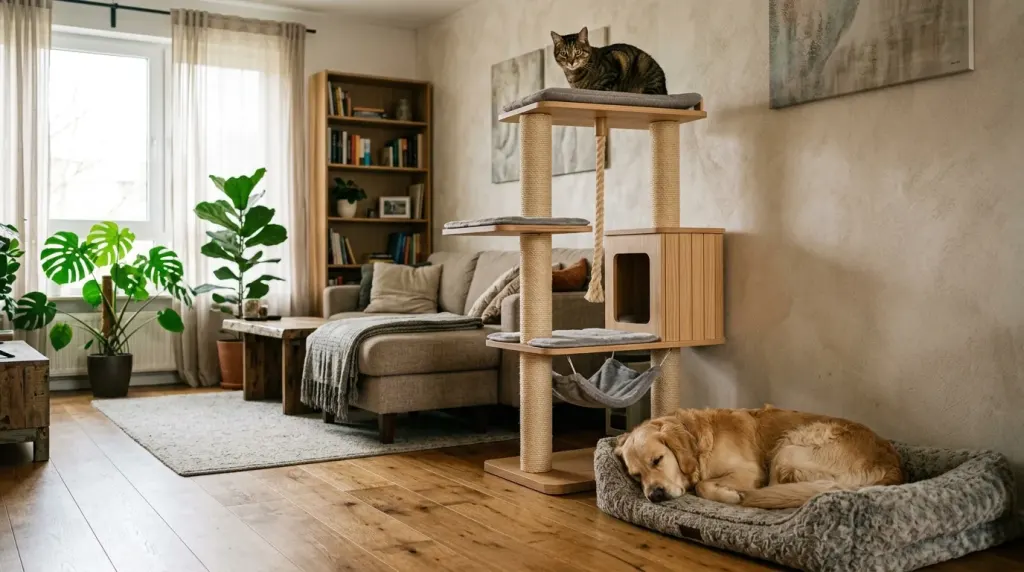
| Zone Setup Element | Recommended Equipment | Multi-Pet Function |
|---|---|---|
| Vertical Escape Routes | Multi-tier cat trees (5+ feet tall), wall shelves | Provides elevated navigation without touching floor |
| Barrier Hardware | Extra-tall baby gates with micro pet doors | Grants exclusive feline access to private retreats |
| Protected Nutrition | Wall-mounted feeding perches, high countertops | Prevents canine food theft and resource guarding |
| Litter Box Security | Door Buddy latch straps, gated utility rooms | Eliminates canine coprophagia and feline litter stress |
Vertical territory is essential for feline psychological well-being. Cats are semi-arboreal creatures that monitor their environment from elevated vantage points. Equipping living areas with cat trees, wall-mounted perches, and accessible bookshelf tops allows the cat to traverse rooms without stepping on the floor. Designing dedicated vertical spaces allows cats to navigate shared rooms comfortably, even in compact living areas suitable for apartment-friendly pugs where floor space is limited.
Access control must be maintained in high-stakes zones. Dog-proofing the cat’s litter box is critical; dogs frequently seek out feline feces (coprophagia), which not only transmits intestinal parasites but also creates severe stress for the cat, leading to litter box avoidance. Installing baby gates or Door Buddy straps allows the cat easy entry into private rooms while keeping the larger Golden Retriever out. In households managing fur and dander alongside hypoallergenic Ragdoll cats, setting up elevated feeding perches also prevents dogs from raiding specialized feline diets.
Warning Signs & Red Flags: When to Intervene
Pet owners must accurately differentiate between benign, playful curiosity and potentially dangerous predatory fixation to de-escalate situations before conflict occurs.
| Behavior Category | Playful Curiosity (Normal / Manageable) | Predatory Fixation (Red Flag / Unsafe) |
|---|---|---|
| Body Posture | Loose, curvy body; bouncing; front-end play bows | Stiff, rigid spine; lowered head; frozen stance |
| Eye Contact | Blinks regularly; easily breaks eye contact when called | Unblinking hard stare; dilated pupils; hyper-fixated |
| Vocalization | High-pitched play barks; happy panting | Low throaty growling; intense whining; silent stalking |
| Response to Redirection | Responds immediately to name or “leave it” cue | Completely deaf to verbal cues; refuses high-value treats |
| Action Required | Praise calm disengagement; reward with a chew toy | Step between pets; calmly lead dog away; return to Phase 2 |
Distinguishing between playful posturing and genuine predatory tension is vital. Just as dog guardians learn to determine whether French Bulldogs show aggressive posturing or simple vocal frustration, Golden owners must treat rigid body posture and intense staring as immediate cues to intervene. If a Golden exhibits stiff stalking or lunging, calmly insert an opaque physical barrier (such as a large piece of cardboard or blanket) between them, lead the dog away on leash, and step back to visual barrier management. Never use physical punishment, as this associates the cat’s presence with negative experiences.
Original Value Analysis: The Golden Retriever & Cat Cohabitation Verdict
The Golden Retriever stands out as one of the most reliable canine companions for cat owners due to its uniquely balanced temperament and high working biddability.
- Biddability Advantage: Unlike independent sighthounds or stubborn terriers, a Golden Retriever’s intense desire to work cooperatively with its handler makes counter-conditioning fast and durable. Teaching a reliable “leave it” command takes days rather than months.
- Ideal Household Profile: Families or individuals committed to providing 60+ minutes of daily physical exercise, structured impulse control training, and dedicated vertical feline spaces.
- When to Exercise Caution: Multi-pet homes with extremely frail, traumatized senior cats, or owners unable to physically manage a strong, adolescent 60-pound dog during its bouncy developmental phase.
When raised with patience, consistency, and early socialization, Golden Retrievers join the ranks of friendly pug dogs as some of the most reliable and harmonious additions to multi-pet families.
Frequently Asked Questions About Golden Retrievers and Cats
Can a Golden Retriever hurt or kill a cat?
While fatal aggression from a well-bred Golden Retriever toward a household cat is extremely rare due to the breed’s gentle nature, an untrained adolescent or high-drive field Golden can cause accidental crush injuries or severe stress if allowed to chase or corner a cat without supervision.
How long does it take for a Golden Retriever to get used to a cat?
Most Golden Retrievers and cats achieve peaceful cohabitation within 2 to 4 weeks of structured, phased introductions, although developing close companionship, play, or mutual grooming can take several months.
Are male or female Golden Retrievers better with cats?
There is no significant behavioral difference between male and female Golden Retrievers regarding cat compatibility; individual temperament, early socialization, and consistent obedience training are far more important factors than sex.
What should I do if my Golden Retriever chases my cat?
Immediately interrupt the chase using a neutral noise or verbal cue, redirect the dog’s attention to an alternative task or chew toy, and keep the dog on an indoor leash until reliable “leave it” and recall commands are re-established.



Leave a Reply