
Table of Contents
Why are German Shepherds called German Shepherds? The name translates directly from the German Deutscher Schäferhund, combining their country of origin (Germany) with their original working purpose (herding sheep). Developed in 1899 by Captain Max von Stephanitz, the breed was officially named Deutscher Schäferhund (literally "German Shepherd Dog"). The word "Dog" was formally included in the name to distinguish the canine breed from a human livestock herder. During World War I and II, anti-German sentiment led kennel clubs in Britain and the Commonwealth to rename the breed "Alsatian" (and "Alsatian Wolf Dog") before officially restoring "German Shepherd Dog" in 1977.
- The name translates directly from the German Deutscher Schäferhund (Schäfer = shepherd, Hund = dog).
- Captain Max von Stephanitz established the breed in 1899 to standardize regional German herding dogs into an ideal working breed.
- Official kennel clubs (AKC, UK Kennel Club) retain the word "Dog" in "German Shepherd Dog" (GSD) to distinguish the animal from a human shepherd.
- In the UK and parts of Europe, the breed was officially renamed "Alsatian" from 1919 to 1977 to distance it from anti-German wartime sentiment.
Why Are German Shepherds Called German Shepherds? The Literal Meaning
German Shepherds are named literally after their geographic origin in Germany and their primary historical job as sheep herders. The English name is a direct translation of the German Deutscher Schäferhund.
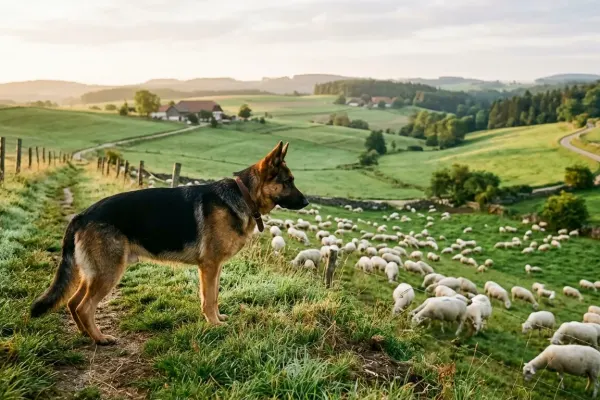
During the late nineteenth century, rural Germany relied on various native pastoral dogs to manage and protect sheep flocks across diverse terrain. These dogs were selected entirely for working capability rather than uniform physical appearance. When breeders standardized these regional dogs into a formal pedigree in 1899, they chose a name that described exactly what the animal was: a German dog bred to shepherd livestock.
| German Term | English Translation | Historical Function |
|---|---|---|
| Deutsch / Deutscher | German | Denotes the country and cultural region of origin |
| Schäfer | Shepherd / Sheep Herder | Describes the working occupation of managing sheep flocks |
| Hund | Dog / Canine | Identifies the animal species assisting the livestock handler |
| Deutscher Schäferhund | German Shepherd Dog | Formal compound name established as the breed standard in 1899 |
The two components of the name reflect clear functional priorities. “German” established national identity, uniting distinct regional strains from Thuringia, Swabia, and Württemberg under one standard. “Shepherd” defined the dog’s daily duty. While modern companion households often prefer gentle home companions and study how well Pugs fit as family dogs, the German Shepherd was engineered from its inception as a high-drive pastoral worker built to traverse vast grazing acreage and maintain strict livestock boundaries.
Unlike smaller breeds specifically developed to rest indoors as docile Pug lap dogs, the shepherd dog of late 19th-century Germany had to withstand harsh continental winters and protect flocks against rural predators. The name reflected this uncompromising working expectation.
Captain Max von Stephanitz and the Breed’s Creation in 1899
On April 22, 1899, former German cavalry captain Max von Stephanitz attended a dog show in Karlsruhe, Germany. There, he observed a four-year-old working herding dog named Hektor Linksrhein. Von Stephanitz was so impressed by the dog’s physical stamina, high intelligence, and disciplined temperament that he purchased him immediately.
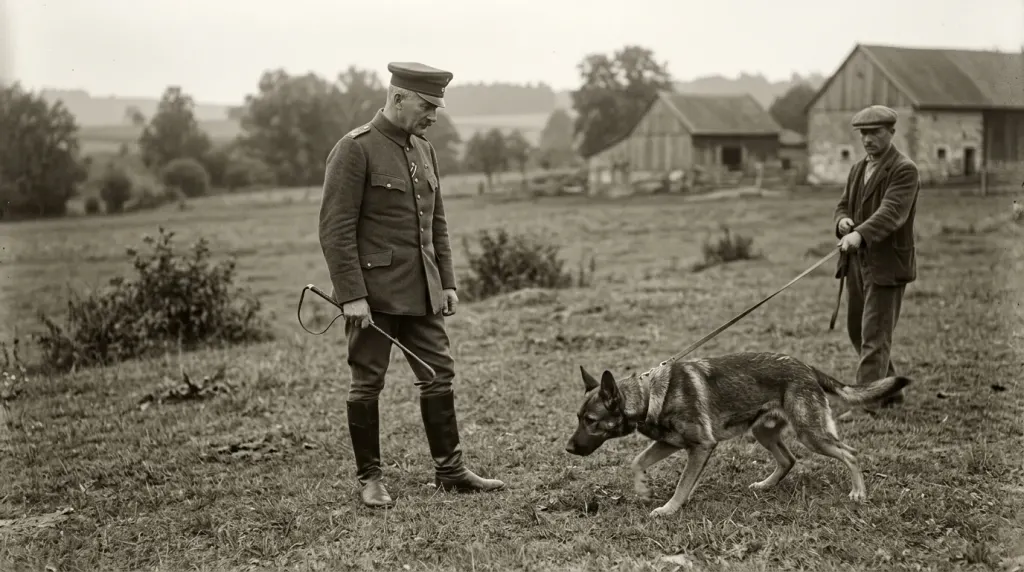
Von Stephanitz renamed the dog Horand von Grafrath and founded the Verein für Deutsche Schäferhunde (SV), the Society for the German Shepherd Dog. Horand was registered as SZ 1 (Schäferhund Zuchtbuch number 1), making him the first officially registered German Shepherd Dog in history.
1899 Breed Standardization Timeline:
- April 1899: Max von Stephanitz purchases Hektor Linksrhein (Horand von Grafrath).
- April 22, 1899: Verein für Deutsche Schäferhunde (SV) is founded in Karlsruhe.
- September 1899: First official breed standard is drafted at the SV General Meeting in Frankfurt.
- 1901 to 1910: Systematic registration and working trials expand across Germany and export worldwide.
According to historical records from the American Kennel Club, von Stephanitz established a strict breeding philosophy centered on utility: “Take this motto to heart: A Shepherd dog is a working dog; who fails to appreciate this does not understand the breed.” Rather than selecting dogs for coat color or decorative show traits, von Stephanitz prioritized mental stability, trainability, physical soundness, and obedience.
While contemporary pet owners frequently compare household canine problem-solving by assessing French Bulldog intelligence, von Stephanitz demanded an extreme tier of biddability suitable for complex tactical commands. In contrast to companion metrics used when evaluating Pug intelligence in domestic environments, the German Shepherd standard required rapid situational judgment, acute handler focus, and disciplined drive. By assigning the name Deutscher Schäferhund, von Stephanitz deliberately established a unified national identity that superseded local German dialect names, positioning the dog as Germany’s premier working breed.
Why Is the Word “Dog” Officially Part of the Breed Name?
The official registry name recognized by major kennel organizations worldwide is “German Shepherd Dog” (abbreviated as GSD). The word “Dog” is an integral part of the formal breed standard, rather than a casual descriptive suffix.
In the English language, the word “shepherd” primarily designates a human being who tends sheep. To prevent linguistic ambiguity between the human livestock handler and the canine assistant, English-speaking kennel registries translated Deutscher Schäferhund literally into “German Shepherd Dog.”
- American Kennel Club (AKC): Registers the breed formally under the name “German Shepherd Dog” within the Herding Group.
- The Kennel Club (UK): Uses “German Shepherd Dog” as the official breed title.
- Fédération Cynologique Internationale (FCI): Lists the breed under Standard No. 166 as Deutscher Schäferhund (German Shepherd Dog).
- Canadian Kennel Club (CKC): Maintains “German Shepherd Dog” as the official studbook designation.
While everyday dog owners routinely drop the word “Dog” in casual conversation, retaining it in formal registries preserves the literal German syntax (Deutscher Schäferhund) and maintains international breed standard uniformity across kennel federations.
Today, while calm temperament and gentle sociability allow many Pugs to work as therapy dogs in hospital settings without occupational confusion, the German Shepherd Dog designation remains formally fixed across global studbooks to honor its specific pastoral title. This naming convention is shared with only a handful of breeds, such as the Canaan Dog, where omitting the species noun could cause occupational confusion.
The Alsatian Era: Why the Name Changed During World War I and II
The German Shepherd did not always carry its original name in English-speaking nations. Following the outbreak of World War I in 1914, intense anti-German sentiment swept across the United Kingdom, the British Commonwealth, and the United States. Anything associated with Germany faced public boycotts and suspicion.
To protect the popular breed from wartime prejudice and prevent owners from abandoning their pets, the British Kennel Club officially renamed the breed the “Alsatian Wolf Dog” in 1919. The name referenced the French-German border region of Alsace-Lorraine, an area associated with Allied sympathies.
Registry Name Evolution Across Major Kennel Clubs:
- United Kingdom (The Kennel Club):
- Pre-1919: German Shepherd Dog
- 1919 to 1928: Alsatian Wolf Dog
- 1928 to 1977: Alsatian
- 1977 to 2010: German Shepherd Dog (Alsatian)
- 2010 to Present: German Shepherd Dog
- United States (American Kennel Club):
- 1908 to 1917: German Shepherd Dog
- 1917 to 1930: Shepherd Dog
- 1930 to Present: German Shepherd Dog
The addition of “Wolf Dog” quickly created unintended consequences. Public fear grew that the dogs were unpredictable, aggressive wolf-hybrids. Recognizing that the breed was entirely domestic, the UK Kennel Club dropped the words “Wolf Dog” in 1928, leaving the official title as simply “Alsatian.”
During the same era, the American Kennel Club voted in 1917 to drop “German” from the title, officially designating the breed as the “Shepherd Dog.” The AKC restored the full name “German Shepherd Dog” in 1930 after anti-German sentiment subsided.
Wartime anxieties prompted many civilian households to turn away from larger working lines and explore whether Pugs could serve as watchful guard dogs or dependable home sentries without drawing public scrutiny. Similarly, urban families increasingly sought out compact European breeds to determine how well French Bulldogs perform as household pets during periods of social uncertainty.
However, the German Shepherd’s unmatched bravery as a messenger, sentry, and ambulance dog on European battlefields ultimately proved its exceptional loyalty. In 1977, following decades of campaigning by breed enthusiasts, the British Kennel Club officially restored “German Shepherd Dog” as the primary breed name, finally ending the Alsatian-only era.
The Evolution of the German Shepherd’s Role: From Sheepfold to Working Icon
Although the name “Shepherd” remains permanently fixed in the breed’s title, agricultural sheep herding represents only a small fraction of the dog’s modern responsibilities. As industrialization accelerated across Germany in the early twentieth century, pasture land decreased, and traditional flock management declined.
Max von Stephanitz foresaw this economic shift and recognized that if the breed remained tied solely to agricultural livestock, its population would dwindle. He actively collaborated with the German military, municipal police departments, and railway security services to test the dog’s aptitude for public service.
| Working Discipline | Historical Herding Skill Utilized | Modern Operational Application |
|---|---|---|
| Police / Law Enforcement | Territorial vigilance and pursuit drive | Suspect apprehension, building searches, crowd control |
| Military K-9 | High endurance, courage, and keen olfactory tracking | Patrol, perimeter security, explosive detection |
| Search and Rescue (SAR) | Independent problem-solving and stamina over rough ground | Wilderness tracking, disaster rubble searches, avalanche recovery |
| Service and Guide Work | High biddability, focus, and environmental stability | Visual assistance, mobility support, post-traumatic assistance |
| Family Protection | Flocking bond, loyalty, and natural discernment | Household guardianship, personal protection, companionship |
| Companion / LAP & Therapy | Adaptability to domestic structure and task loyalty | Emotional support, family companion, structured household guardian |
The German Shepherd transitioned smoothly into these demanding occupations because the core genetic traits required for herding sheep (intelligence, biddability, stamina, and protective loyalty) are identical to the traits needed for tactical service.
Whereas companion owners often examine how active Pugs are to manage moderate daily indoor routines, the German Shepherd requires extensive daily physical conditioning and structured mental tasks. For urban residents wondering how Pugs adapt to apartment living, small companion animals present a manageable footprint, whereas the German Shepherd requires dedicated space, rigorous obedience work, and purposeful activity. The name “Shepherd” endures as an authentic historical tribute to the working pastoral roots that forged the dog’s versatile capabilities.
Original Historical Perspective: Why the Name “German Shepherd” Endured
The preservation and global restoration of the name “German Shepherd Dog” provides a remarkable historical case study in breed identity. Despite nearly six decades of official geopolitical rebranding as “Alsatians” across Britain and the Commonwealth, the original name survived in the public consciousness and eventually reclaimed its official status.
This endurance stems directly from the integrity of the foundational breed standard established in 1899. Max von Stephanitz did not create a cosmetic show dog; he codified an exacting working system based on performance trials (Schutzhund, now IGP) that tested courage, tracking ability, and handler compliance.
In modern times, even as global ownership trends explain why French Bulldogs have become so popular in urban centers, the German Shepherd Dog remains a fixture among the top working and guardian breeds worldwide. Whether serving in elite military units or living as loyal household protectors, these dogs carry a name that honors over 125 years of German working canine heritage.
Frequently Asked Questions About the German Shepherd Name
What was the German Shepherd called before it got its name?
Before formal standardization in 1899, the regional ancestors of the breed were called Altdeutsche Schäferhunde (Old German Herding Dogs) or identified by their local regions, such as Thuringian Sheepdogs, Swabian Herders, and Württemberg Cattle Dogs.
Is an Alsatian the exact same breed as a German Shepherd?
Yes, Alsatians and German Shepherds are genetically and physically identical. “Alsatian” was an alternate name adopted in the United Kingdom and parts of the Commonwealth between 1919 and 1977 to distance the breed from anti-German sentiment during and after the World Wars.
Why do some people call them GSD?
GSD is the standard acronym for “German Shepherd Dog,” which is the full, official breed title recognized by major international kennel registries, including the American Kennel Club, the UK Kennel Club, and the German SV (Verein für Deutsche Schäferhunde).
Are German Shepherds part wolf because of the name “Alsatian Wolf Dog”?
No, German Shepherds are fully domesticated dogs (Canis lupus familiaris) and are not direct wolf hybrids. The British Kennel Club added the suffix “Wolf Dog” in 1919 due to the breed’s erect ears and wolf-like silhouette, but removed the words in 1928 because they caused unfounded public fear regarding the dog’s temperament.
Leave a Reply