

Table of Contents
Most French Bulldog puppies begin seeing their ears lift between 4 and 8 weeks of age, with fully erect bat posture usually establishing between 12 and 16 weeks. However, cartilage development varies naturally across individual dogs, and teething between 3 and 6 months can cause them to temporarily flop again before setting permanently by 6 to 8 months.
- Most Frenchie puppies start lifting their ears between 4 and 8 weeks, with permanent erect posture settling by 12 to 16 weeks.
- Teething between 3 and 6 months frequently causes previously standing flaps to drop or fold temporarily as the body prioritizes jaw development.
- The American Kennel Club standard requires erect bat posture with broad bases and rounded tips facing forward.
- Asymmetrical posture—with one side up and the other down—is a normal intermediate phase during puppy development.
- Non-erect cartilage after 8 months is purely a cosmetic variation that does not affect a French Bulldog's health, hearing, or companionship.
What Age Do French Bulldog Ears Typically Stand Up?
French Bulldog puppies are born with soft, folded cartilage resting flat against their heads. As puppies mature and their pinna tissue thickens, structural support at the base gradually increases, causing the leather to lift upright. For the majority of purebred Frenchies, this process begins around 4 to 8 weeks of age, with many puppies showcasing fully erect ears by the time they reach 12 to 16 weeks.
Understanding adult frame development can help owners evaluate puppy growth in relation to overall physical milestones, such as those detailed in the adult French Bulldog size chart. Lightweight leather on a compact head often stands earlier than heavy, broad cartilage on a heavy-boned puppy.
Why the Standing-Up Window Is So Wide (4 to 16+ Weeks)
Cartilage firming relies on multiple individual factors, which explains why puppies within the same litter may experience different timelines. Key influences include:
- Leather Thickness: Puppies inheriting thinner, lighter cartilage require less structural density to hold themselves erect, often standing as early as 4 to 6 weeks. Those with thick, broad bases require more time for the foundation to strengthen sufficiently.
- Genetic Inheritance: Parental genetics dictate the width, height, and natural structural strength of a puppy’s bat shape.
- Overall Growth Rate: Rapid skeletal growth spurts can temporarily divert nutritional resources, leading to intermittent periods of drooping before full stabilization.
Why Are My French Bulldog’s Ears Still Down?
If a Frenchie puppy reaches 12 to 14 weeks with flaps that remain flat or semi-folded, owners often wonder if structural development is running behind schedule. In most healthy puppies, delayed carriage is a natural developmental phase rather than a permanent condition.
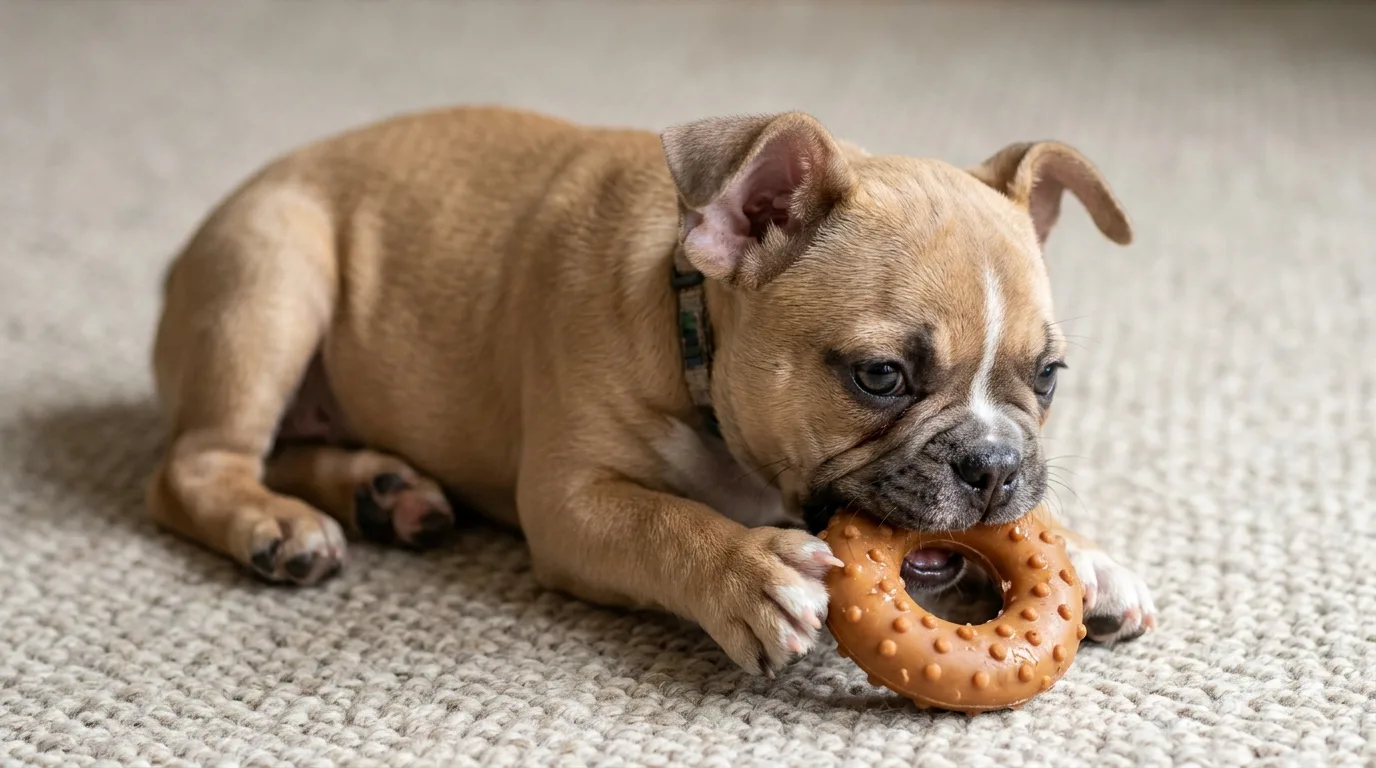
During puppyhood, offering gentle, digestible rewards like low-fat cheese options can keep training positive without disrupting balanced nutrition.
Does Teething Really “Steal” Calcium From the Ears?
Between 3 and 6 months of age, French Bulldog puppies shed their deciduous baby teeth as permanent adult teeth emerge. During this intensive teething window, previously erect pinnae frequently soften and flop over again.
A common explanation among dog owners is that the body “steals” calcium from cartilage to build adult teeth. According to veterinary anatomical research, ear cartilage consists of an elastic matrix composed of collagen and proteoglycans, rather than calcified bone tissue. While calcium is not directly extracted from these structures, the body’s overall metabolic energy and systemic nutrient distribution are heavily focused on jawbone remodeling and tooth eruption. This intense physiological demand can temporarily reduce structural firmness. Once permanent teeth are fully established around 6 months of age, the tissue typically firms up permanently.
Can Ears Go Up and Down Repeatedly During Teething?
Yes. It is entirely typical for a French Bulldog puppy’s ear posture to fluctuate daily or weekly during peak teething months. An owner may observe both sides standing straight in the morning, only for one tip to fold sideways by evening after an active day of chewing.
During this stage, puppies also experience natural shifts in energy and behavior. Reviewing data on French Bulldog aggressiveness reassures owners that teething-related restlessness or chewing is typical puppy behavior rather than behavioral aggression. As teething concludes around 6 to 7 months, structural posture stabilizes into its permanent form.
What Is the AKC Bat-Ear Standard for French Bulldogs?
The signature head outline of the French Bulldog is one of the breed’s most defining physical features. According to the official American Kennel Club (AKC) breed standard, the French Bulldog’s ears are designated as “bat ears.”

The AKC standard specifies that bat ears must be broad at the base, elongated with a rounded top, set high on the skull, and carried erect with the orifice facing forward. The leather should be fine and soft to the touch. Under AKC conformation show rules, any variation other than erect bat posture constitutes a disqualification.
Owners interested in how structural traits fit into broader breed characteristics can explore the full French Bulldog breed profile for detailed information on temperament, structural standards, and origin history. Conformation standards set strict requirements for show dogs, but physical carriage is purely cosmetic for companion pets. A French Bulldog with floppy cartilage possesses the exact same affectionate temperament, intelligence, and health outlook as one with perfectly erect bat ears.
Note: Owners should never administer over-the-counter calcium supplements or mineral powders without explicit veterinary guidance. Excessive dietary calcium can cause severe skeletal malformations in growing puppies.
When Should You Be Concerned or See a Vet?
While delayed lift is almost always a harmless developmental variance, certain clinical signs require professional veterinary assessment:
- Age Beyond 7 to 8 Months: If a puppy’s flaps remain completely flat or folded past 8 months, the basal cartilage may lack the rigidity to support natural erection.
- Sudden Dropping Accompanied by Pain: If a previously erect side suddenly flops while the dog shakes its head, paws at its head, or cries out, an underlying medical issue may be present.
- Redness, Odor, or Discharge: Swelling, inflammation, dark wax build-up, or unpleasant odor inside the auditory canal indicates an infection or parasite infestation requiring immediate veterinary treatment.
- Physical Trauma: Injury during rough play with littermates can damage delicate cartilage fibers or cause an aural hematoma, requiring veterinary care to prevent permanent tissue deformity.
Because Frenchies have unique cranial structures, monitoring overall physical health includes watching for airway issues like BOAS in French Bulldogs, ensuring that routine vet visits cover both structural development and respiratory health.
Should You Help a French Bulldog’s Ears Stand Up?
Taping, also referred to as posting, is a traditional technique used by some breeders when a puppy’s cartilage requires structural support to remain upright. The procedure involves applying supportive medical tape around the base or inserting light foam backing to hold the leather erect while the tissue matures.
If taping is considered after 5 months of age, it must be performed using breathable, skin-safe medical tape and proper technique. Incorrect wrapping can trap moisture inside the auditory canal, restrict blood circulation, or cause painful skin necrosis. Providing a safe, comfortable resting environment, such as selecting an appropriate crate size for French Bulldogs, ensures the puppy remains calm and avoids rubbing taped pinnae against crate wire. Always consult an experienced veterinarian or reputable breeder before attempting any physical intervention.
Is one ear up and one ear down normal for a Frenchie puppy?
Yes. Asymmetrical posture is a very common developmental stage in French Bulldog puppies. Cartilage hardens independently on each side, so one flap frequently stands upright days or weeks before the other. This uneven appearance usually resolves naturally as both sides complete their growth phase.
Do all French Bulldogs eventually get erect ears?
Across different individuals, most purebred French Bulldogs develop fully erect bat ears by 6 to 8 months of age. However, a small percentage of purebred Frenchies retain soft or semi-floppy posture due to heavy leather or genetic variations. Floppy cartilage is considered a cosmetic fault under kennel club show standards but does not impair a dog’s health or hearing.
Can diet or supplements help a French Bulldog’s ears stand up?
Feeding a complete, balanced puppy food formulated for healthy growth provides all necessary nutrients for cartilage maturation. Some breeders recommend adding a small spoon of plain Greek yogurt or unflavored gelatin to meals for dietary collagen support. However, calcium tablets and synthetic mineral supplements should be strictly avoided unless prescribed by a veterinarian, as excess calcium can harm developing bones.



Leave a Reply