
Table of Contents
Are Maine Coons part Angoras? No, feline genetics confirms they are not. The Maine Coon is an independent natural landrace breed that developed in Maine over centuries of adaptation to cold New England winters. While popular folklore suggested longhaired Angoras brought by sailors or French royalty crossbred with local cats, modern genetic studies confirm that similarities between the two breeds stem from convergent environmental adaptation rather than shared hybrid ancestry.
- Independent Genetic Heritage: DNA evidence places Maine Coons within Western European domestic cat lineages, distinct from Near Eastern Turkish Angora stock.
- Myth vs. Fact: Tales involving Marie Antoinette and Captain Charles Coon are regional folklore rather than documented pedigree history.
- Distinct Body Anatomy: Maine Coons have heavy-boned rectangular bodies (12 to 22 pounds) with rugged double coats, while Turkish Angoras are fine-boned (5 to 10 pounds) with single silky coats.
- Official US Homeland: The breed developed naturally in Maine, which designated the Maine Coon as its official state cat in 1985.
Are Maine Coons Part Angoras? The Genetic and Scientific Reality
Feline genetic research confirms that Maine Coons are not part Turkish Angora. The Maine Coon developed as an indigenous North American landrace: a population of domestic cats that evolved distinct physical traits through natural selection in a specific geographic environment, without intentional crossbreeding by human breeders.
During the 18th and 19th centuries, merchant ships docked regularly along the rugged New England coast. These vessels carried working ship cats to control rodents in cargo holds. The felines that stepped ashore in Maine bred with resident domestic shorthairs brought over by early European colonists. Over successive generations, harsh climate pressures favored cats with dense water-repellent coats, substantial underfur, heavy bone structure, and broad paws.
The visual resemblance between Maine Coons and Turkish Angoras is an example of convergent evolution. When unrelated animal populations face comparable environmental pressures, they often evolve similar physical adaptations independently. Turkish Angoras adapted to the mountainous plateau climate of central Anatolia, while Maine Coons adapted to freezing, damp coastal New England winters.
Feline genetic mapping shows that modern Maine Coons cluster closely with North American and Western European domestic populations rather than Mediterranean or Near Eastern gene pools. While dense double coats protect working cats in sub-zero weather, they also trap shedding dander and saliva proteins, demonstrating why hypoallergenic traits in Ragdoll cats and longhaired breeds remain frequent misconceptions among prospective pet owners.
The Marie Antoinette and Captain Coon Legends
The belief that Maine Coons carry Turkish Angora ancestry originated from two popular 18th-century maritime legends passed down through New England folklore.
The first legend involves Marie Antoinette, the Queen of France. During the French Revolution, Captain Samuel Clough allegedly arranged a plan to transport the Queen to safety in Wiscasset, Maine, aboard his merchant ship, the Sally. The cargo supposedly included several of the Queen’s prized longhaired Turkish Angora cats. Although Marie Antoinette was captured before departure, Captain Clough sailed to Maine, where her royal cats supposedly escaped into the countryside and bred with native farm felines.
The second legend credits a British sea captain named Charles Coon. Captain Coon kept longhaired Angora and Persian cats aboard his vessel as pest controllers. Whenever his ship anchored in New England harbors, his cats wandered ashore. When longhaired kittens began appearing in coastal barn litters, residents referred to them as “Coon’s cats.”
Historical and genetic documentation demonstrates that both stories are charming regional folklore rather than factual pedigree records. Aristocratic folklore often elevates public fascination with domestic animals, establishing romantic origin stories comparable to the cultural prestige explaining why French Bulldogs became so popular across Victorian society and modern pet households. In early America, settlers used the word “Angora” as a generic descriptive term for any cat with long fur, which created lasting confusion between authentic Turkish Angoras and local New England longhairs.
Where Did Maine Coon Cats Come From? Historical Origins in New England
Maine Coon cats came from the rural farmsteads, coastal harbors, and island communities of Maine and surrounding New England territories. They represent America’s first indigenous longhaired show breed, recognized by international feline associations as a natural working cat.
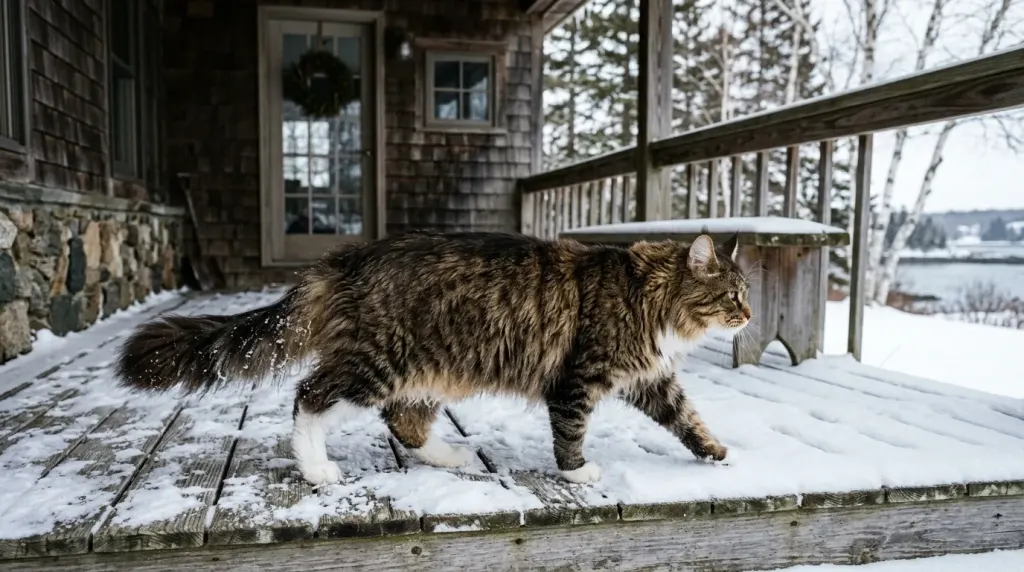
Early American settlers valued these felines for their hunting skills and rugged constitution. Barns, grain mills, and trading vessels required continuous protection from rodent infestations. The Maine Coon’s substantial body weight, keen intelligence, and thick insulated coat made it an outstanding working mouser in unforgiving environments. Early northeastern farmers relied on these working felines for self-directed rodent patrol, contrasting with domestic companion breeds such as active Pug dogs that require structured daily interaction and exercise.
During the late 19th century, New England farmers presented their working cats at local agricultural fairs. According to university feline historical archives, Maine Coons were featured at community exhibitions as early as the 1860s, including the Skowhegan Fair. The breed achieved national prominence at the 1895 National Cat Show at Madison Square Garden in New York City, where a brown tabby female named Cosey won Best in Show.
Biological science has disproved persistent myths claiming Maine Coons originated from crosses between domestic felines and wild raccoons or bobcats. Interspecies breeding between domestic cats (Felis catus) and raccoons (Procyon lotor) is genetically impossible because the two animals belong to distinct taxonomic families. Likewise, domestic hybridization with wild North American bobcats has never been verified in scientific genetic testing. The breed’s physical power, tufted ears, and bushy tail developed entirely through selective environmental adaptation within domestic cat populations.
Where Is the Breed’s Homeland Located in the USA?
The Maine Coon’s homeland is located in the State of Maine, situated in the New England region of the northeastern United States.
Maine’s geographical environment, marked by severe winter blizzards, deep snow accumulation, and icy ocean winds, shaped every facet of the cat’s physical structure. The breed developed broad, round paws with heavy interdigital hair tufts that act as natural snowshoes to prevent sinking in drifts. Its long, heavily furred tail wraps tightly around the head and paws during sleep to conserve body heat in freezing temperatures. The breed evolved for expansive outdoor homesteads and cold coastal barns, unlike modern companion animals that thrive as apartment-friendly Pugs in compact city spaces.
In recognition of the breed’s cultural heritage and historical status as an American original, the Maine State Legislature formally honored the cat. Under Maine Revised Statutes Title 1, § 217, the State of Maine officially designated the Maine Coon cat as its state cat in 1985.
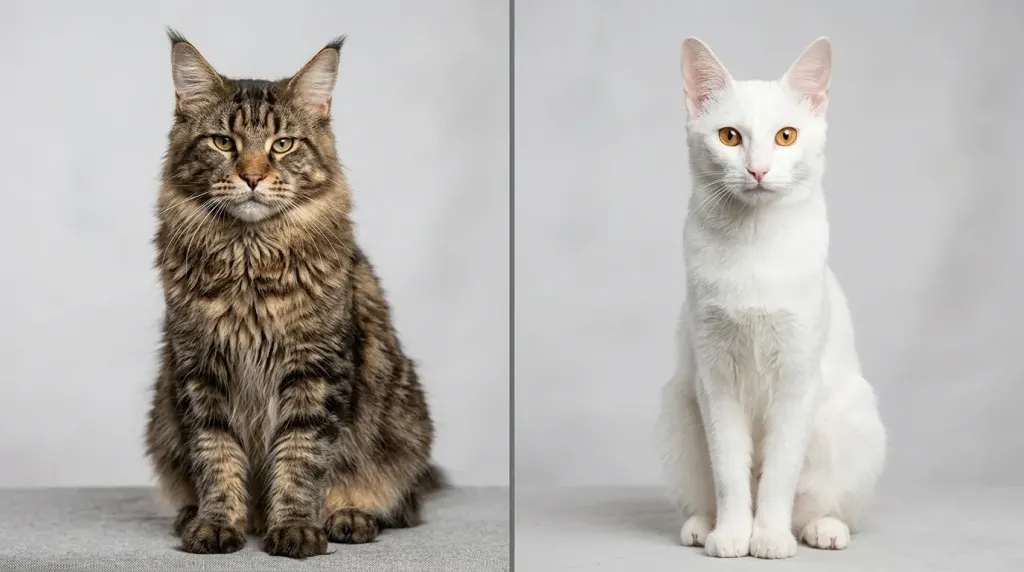
Maine Coon vs. Turkish Angora: Key Physical Differences
While 19th-century cat enthusiasts sometimes applied the term “Angora” loosely to any feline with long fur, modern breed standards and pedigree registries define clear physical profiles for each breed.
| Physical Feature | Maine Coon Cat | Turkish Angora Cat |
|---|---|---|
| Native Region | Maine, United States (New England) | Ankara (Angora), Turkey (Central Anatolia) |
| Adult Weight | Males: 15 to 22+ lbs; Females: 10 to 15 lbs | Males: 7 to 10 lbs; Females: 5 to 8 lbs |
| Bone Structure | Heavy-boned, substantial, broad, muscular frame | Fine-boned, delicate, graceful, svelte frame |
| Body Shape | Long, rectangular torso with broad chest | Slender, graceful torso with fine boning |
| Head Profile | Medium width, square muzzle, gentle concave curve | Small to medium wedge, smooth straight profile |
| Ear Anatomy | Large, wide at base, heavily tufted with lynx tips | Medium-large, pointed, set high on head, lightly tufted |
| Coat Structure | Rugged double coat: dense woolly undercoat and glossy guard hairs | Single coat: silky fine fur with no insulating undercoat |
| Tail Appearance | Long, bushy plume, wide at base and heavily furred | Tapering, feather-light plume flowing like silk |
| Paw Structure | Large, round snowshoe paws with heavy toe tufts | Small, delicate, oval-shaped paws |
The physical contrast between the two breeds reflects their distinct evolutionary roles. The Maine Coon is built for power, cold tolerance, and stability on icy surfaces, possessing heavy bone density and an all-weather double coat. In contrast, the Turkish Angora is built for lightness, acrobatic agility, and speed, featuring a fine skeleton and a single-layer silky coat with no undercoat.
Prospective pet owners evaluating longhaired pedigree companions often discover that cattery pricing reflects health testing and registration standards, similar to the financial considerations involved when researching how much Ragdoll cats cost through reputable breeders. Despite notable contrasts in skeleton weight and muscle mass, both breeds display remarkably calm personalities, sharing the affectionate, people-oriented temperament found in friendly Ragdoll cats. Early cat show records from the 1880s frequently grouped all longhaired felines under the general label of “Angora.” Modern pedigree genetics and breed registry standards now firmly separate the muscular North American working cat from the fine-boned Mediterranean Turkish Angora.
Where Do Maine Coon Cats Live Today? From Working Farm Cats to Global Homes
Maine Coon cats live in family homes across the world as one of the most beloved domestic cat breeds. While originally restricted to maritime ports, coastal farms, and rural townships in Maine, the breed consistently ranks among the most registered pedigree felines across North America, the United Kingdom, Europe, Japan, and Australia.
Their successful transition from outdoor barn mousers to indoor household companions is a direct result of their steady, amiable temperament. Maine Coons are widely celebrated as the gentle giants of the cat world. They adapt exceptionally well to indoor living environments when provided with sturdy scratching posts, heavy-duty cat trees capable of supporting their substantial body weight, and regular interactive play sessions that satisfy their hunting instincts.
Their patient and confident nature also makes them ideal pets for busy multi-pet households, allowing them to coexist peacefully alongside calm canine companions like family-friendly Pugs. Their sociable, adaptable temperament allows them to share domestic spaces comfortably, mirroring the loyal companion qualities that make French Bulldogs good pets in modern family homes.
Because a dense double coat is an essential breed requirement, prospective owners often wonder if shorthaired variants exist. Purebred Maine Coons always possess semi-long to long fur. While domestic shorthair cats may share similar tabby markings or large facial features, every certified breed registry requires the full longhaired double coat for purebred registration.
Frequently Asked Questions About Maine Coon Origins
Are Maine Coons related to Angora cats?
Maine Coons are not direct descendants of Turkish Angoras. Although 19th-century New Englanders informally referred to many longhaired cats as “Angoras,” genetic research confirms that Maine Coons developed independently from Western European domestic cats that adapted naturally to the northeastern United States.
Why are they called Maine Coons if they are not related to raccoons?
They are called Maine Coons because they originated in the State of Maine and possessed long, bushy tails with dark rings that reminded early settlers of raccoons. Biological crossbreeding between domestic felines and raccoons is impossible due to fundamental species and family barriers.
Where did the long hair of the Maine Coon come from?
The long hair of the Maine Coon originated from recessive genetic mutations present in domestic cats brought to North America by early European settlers and trading ships. Dense fur provided a distinct survival advantage during freezing New England winters, allowing longhaired cats to thrive and reproduce.
How does the Turkish Angora differ from the Maine Coon in personality?
Both breeds are affectionate and loyal, but Maine Coons tend to display a relaxed, dog-like personality, preferring to stay close to family members on the floor or sofa. Turkish Angoras are typically more acrobatic, spirited, and determined to perch in high, elevated locations.
Leave a Reply